A giant green fireball lit up the skies across five western states on Wednesday night. It outshone the city lights for a few dazzling seconds before exploding over northeastern Wyoming.
The American Meteor Society (AMS) has received over 30 eyewitness accounts of the fireball from Wyoming, Colorado, Montana, Nebraska, and South Dakota. It was seen as far north as Billings, as far south as Denver, and as far east as North Platte.
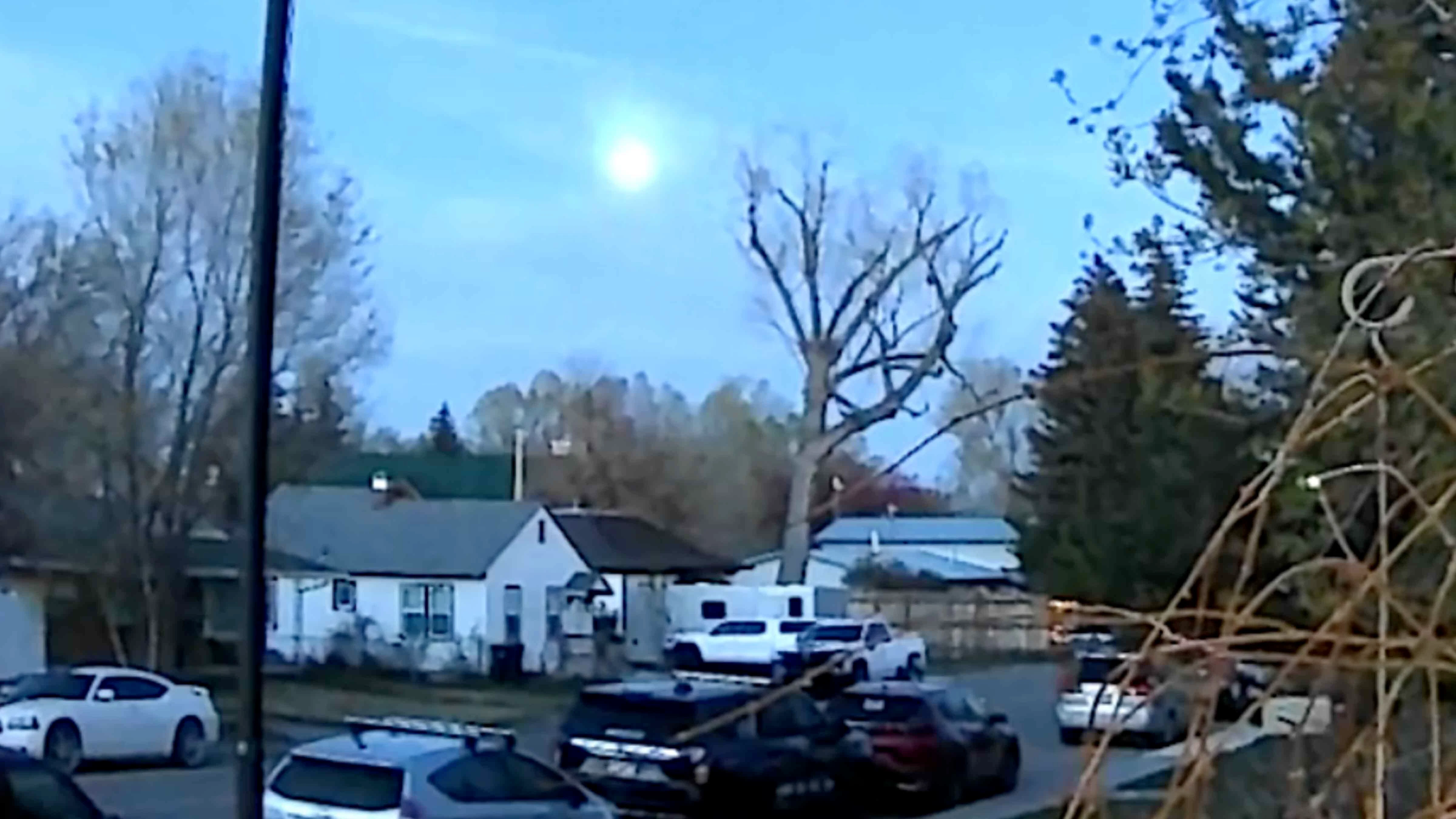
A few of those witnesses captured the celestial event on their doorbell cameras. Casper resident Steven Smathers didn’t see the fireball with his own eyes but realized he’d captured it after checking his cameras.
“My camera recorded it at 8:24 p.m. last night,” he said. “I didn’t see it myself, but it definitely lit up the sky and overpowered the streetlights.”
Lander resident Dan McOmie got a similar video from his home at 8:20 p.m. The fireball can be seen descending at a sharp angle before disappearing in a blaze of light.
Sarah K, another Lander resident, said she lives 10 miles from town in the report she submitted to the AMS. She was lying on a picnic table watching the skies when she saw “nothing like I've gotten to see before.”
“It was an enormous ‘ball’, not linear,” she wrote. “There was no time to holler for my husband. It quietly, brilliantly, fell below our eastern ridge. My smile muscles are aching.”
Fireball Facts
The AMS defines a fireball as “a very bright meteor, generally brighter than magnitude -4,” making it brighter than anything else in the night sky except a full moon. Hundreds of fireballs fall to Earth every day, but most are too small to be seen or cannot be seen during daylight hours.
Even though this fireball was seen in five states, the AMS plotted its trajectory entirely over Wyoming. It appeared right at the northern edge of Converse County before soaring into and disintegrating over Campbell County, northeast of Wright.
“Everything indicates that it actually exploded before it terminated,” said retired Wyoming State Climatologist Jan Curtis. “There was an increase in brightness, where it kept getting brighter and brighter, until there was a final burst. It’s very common for meteors to do that.”
Curtis said the “instantaneous brightness” of fireballs comes from their short-lived interaction with Earth’s atmosphere. They’re moving at such high speeds, around 60 miles per second, that the resistance of the atmosphere quickly and spectacularly tears them apart.
“That makes them almost as bright as the moon,” he said. “The meteor gets hotter and hotter because there are more air molecules rubbing against it as it’s going through the atmosphere, until it either burns out or explodes.”
The multi-state sighting is easy enough to explain. Even though it entered and exploded in the skies over Wyoming, the meteor was high enough in the atmosphere to be clearly seen across hundreds of miles.
At least two eyewitnesses reported hearing a sound associated with the fireball. That supports Curtis’s assertion that this fireball exploded before it reached the surface.
Some fireballs can soar for over a hundred miles in a few seconds before disappearing. Curtis said this one seems to have flown for less than 60 miles before going boom.
“It was probably 30 miles above the surface when it exploded,” he said. “I don’t think you’d find any pieces if people were to go searching for them.”
Glorious Green
Fireballs are like fireworks in that they can have a wide range of colors as the elements inside them burn off. Most people who saw Wednesday night’s fireball reported it was bright green, the most common color of fireballs.
“Fireballs don’t have the same brilliance in color,” Curtis said. “Some are just iron, while others are more like stone with different minerals, elements, and other compounds that are outgassed as it burns up. Each one is different, but some are rarer than others.”
Most meteors are primarily composed of iron and magnesium, which burn green at high temperatures. A meteor with a more diverse elemental composition, like the one that exploded over Yellowstone in May 2025, can include a spectrum of blues, yellows, purples, pinks, whites, and reds.
“Those colors indicate that there were strong concentrations of elements,” said Max Gilbraith, planetarium coordinator at the University of Wyoming. “Red, orange, and white are expected from the black body radiation of a really hot object. Green is usually iron, but other colors can come from magnesium, manganese, nickel, and copper.”
A Parent Object?
Gilbraith was intrigued by the number of fireballs seen on Wednesday night. The Wyoming event was one of four reports across the U.S. that night, within a few hours of each other.
“Another fireball reported over Maine, New Jersey, New York, Pennsylvania, and Rhode Island at around midnight their time,” he said. “About 30 minutes later, another fireball was reported over Iowa, Kansas, and Nebraska, and then another fireball was reported over Canada and northern New England four hours later.”
Gilbraith was confident these weren’t coincidences, as the fireballs were too close in both time and general location. That suggests that all the fireballs were connected to “a parent object” that scattered across the skies of North America.
“There might have been one object that broke apart,” he said. “They're too spatially and time-related to have not been close to each other, at least gravitationally, at some point. Earth’s gravity or the moon might have accelerated the pieces at slightly different rates.”
The idea of a large meteor breaking into several smaller meteors that scattered across a continent is a little unsettling, but it needn’t be. Gilbraith said that if the object was concerningly large, it would have been spotted a while ago.
“There's almost always going to be stuff out there that we don’t see,” he said. “Fireballs are really noticeable, but their actual size is quite small. (The parent object) was probably at the very limit of what we'd be able to detect, unless we got super lucky.”
There’s no indication that there are any “city killer” comets, meteors, or asteroids in Earth’s trajectory, according to Gilbraith. There are extensive systems in place to detect celestial objects large enough to cause that level of destruction.
Still, the bigger they are, the more damage they can potentially cause. Just ask the dinosaurs.
“Fortunately, the bigger they are, the rarer they are that occur,” Curtis said. “Extinction-level objects are really rare, and this fireball wasn’t even big enough to reach the ground.”
Rogue Elements
Many people are lucky to see a fireball once in their lives, but the chances have been pretty good recently.
According to the AMS, the first quarter of 2026 “produced what appears to be a significant surge in large fireball events” with 2,046 total events worldwide. One of those events occurred over Flaming Gorge in February.
“Whether this reflects a genuine change in the near-Earth meteoroid environment, an amplification of reporting through AI and social media, or some combination of both, we cannot yet say definitively,” the agency said in a statement. “What we can say is that the question deserves both public awareness and scientific attention.”
A fireball can correspond to a well-known meteor shower, but it doesn’t always.
The biggest meteor shower in April is the Lyrids, when Earth passes through the dust trail left by Comet C/1861 G1. The long-period comet was last seen by humans in the summer of 1861 and won’t be seen again until the year 2283.
Curtis said it’s possible but unlikely that Wednesday night’s fireball was associated with the Lyrids, mainly because they haven’t started yet.
“The Lyrids start next week, and this fireball is far enough from then that it probably wasn’t part of it,” he said. “Fireballs are usually just space debris that’s naturally out there, and at least one of these passes between Earth and the moon every month.”
There have been over 30 reported fireball events so far in April. The AMS doesn’t know what’s led to the surge of fireballs, but they believe it’s more than a fluke.
“An enhancement in this population is unusual and warrants further study,” they said.
Any Wyomingite who wants to increase their chance of seeing a fireball just needs to get outside when it's dark and keep looking. There are no guarantees, but Earth might be in the middle of a fireball bonanza.
“It takes a lot of consistent stargazing to see a fireball, but maybe there's some weird resonance or a fireball storm going on,” Gilbraith said. “Does that mean if you stay out any given night, you're going to see one? Probably not, but seeing four fireballs all over North America in the span of one night is pretty exciting.”
Andrew Rossi can be reached at arossi@cowboystatedaily.com.