ASPER — Construction is still years out for a proposed $3 billion to $4 billion, 970-megawatt pumped storage facility at Seminoe Reservoir that has to clear a number of regulatory hurdles. But that hasn’t alleviated ongoing concerns about the downstream fishery and bighorn sheep in the construction area.
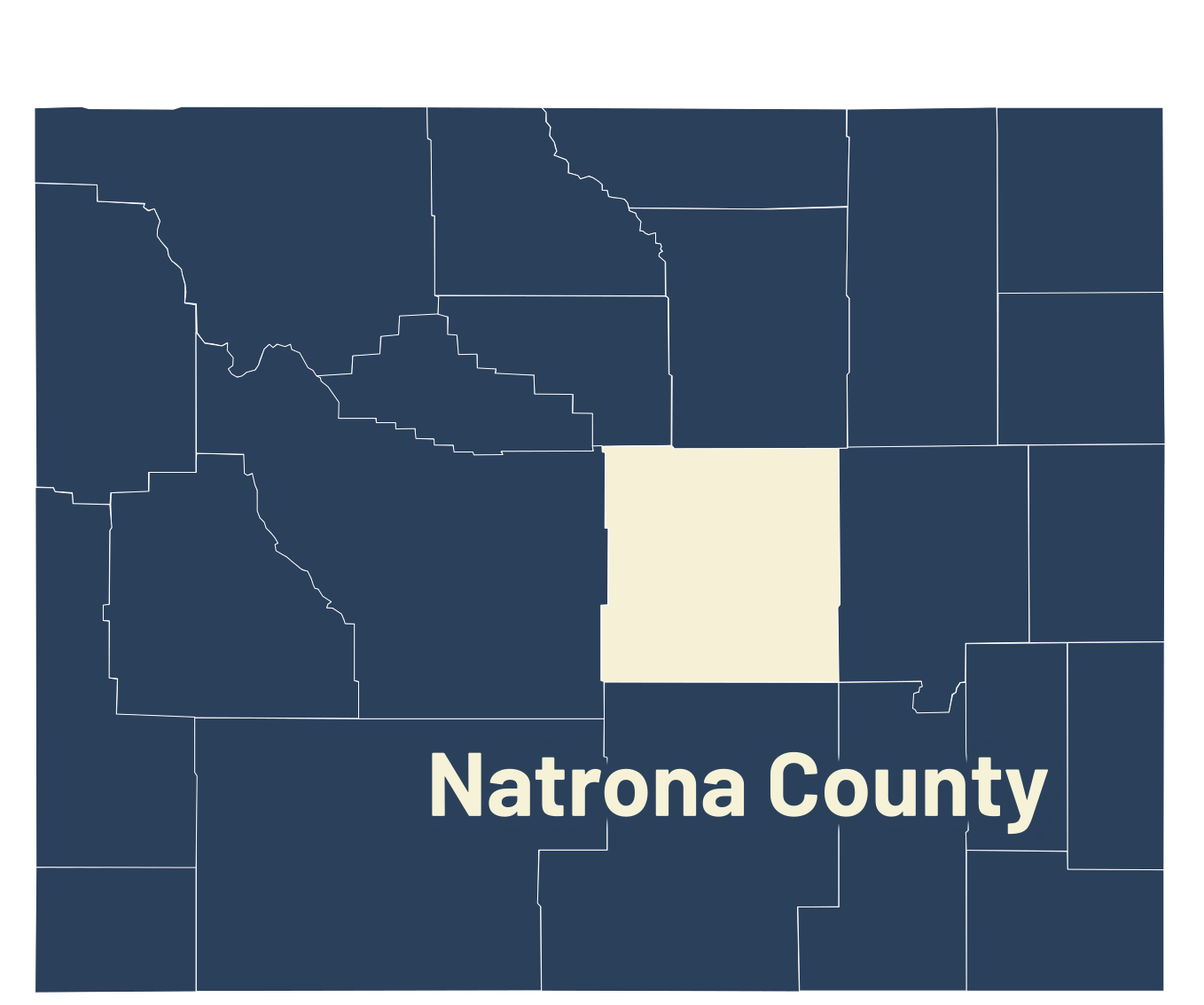
That was the takeaway from a Tuesday evening update on the project with Natrona County commissioners from Utah-based rPlus Hydro Managing Director Matthew Shapiro and General Counsel Kevin Baker.
They outlined company efforts to advance project in Carbon County, which was given a water certification last month by the Wyoming Department of Environmental Quality.
The Federal Energy Regulatory Commission (FERC), the lead permitting agency, as well as the U.S. Bureau of Reclamation, Bureau of Land Management (BLM) and state agencies covering water, fish and wildlife all get a say on whether the energy pump storage system proposed to help provide “stability” to the nation’s electric grid moves forward.
“The earliest that project construction could begin is 2029 and then there would be a five-year construction period,” Shapiro said. “Even with all of that, there’s no guarantee the project would even begin construction, because we still need a power purchase agreement, and without that the project can’t be built.”
After six years in development and spending millions of dollars, Shapiro told commissioners the company wants to ensure that there is “light at the end of the tunnel.”
Under the current timeline, a final environmental impact statement is expected to be released in June, then the record of decision from FERC and a license for the project to follow in September.
Then the firm needs to pursue a BLM right of way for part of the construction and accomplish two more years of FERC dam safety review engineering.
Pumped storage facility technology, which involves pumping water between lower and upper reservoirs of water during low usage times for the electrical grid and pumping from the top to the bottom to create power during high-demand times has been in use for decades, Shapiro said.
Because of the granite geology and the geography of the mountains around the reservoir, the site was identified by the U.S. Bureau of Reclamation for a potential pumped storage facility decades ago.
The Plan
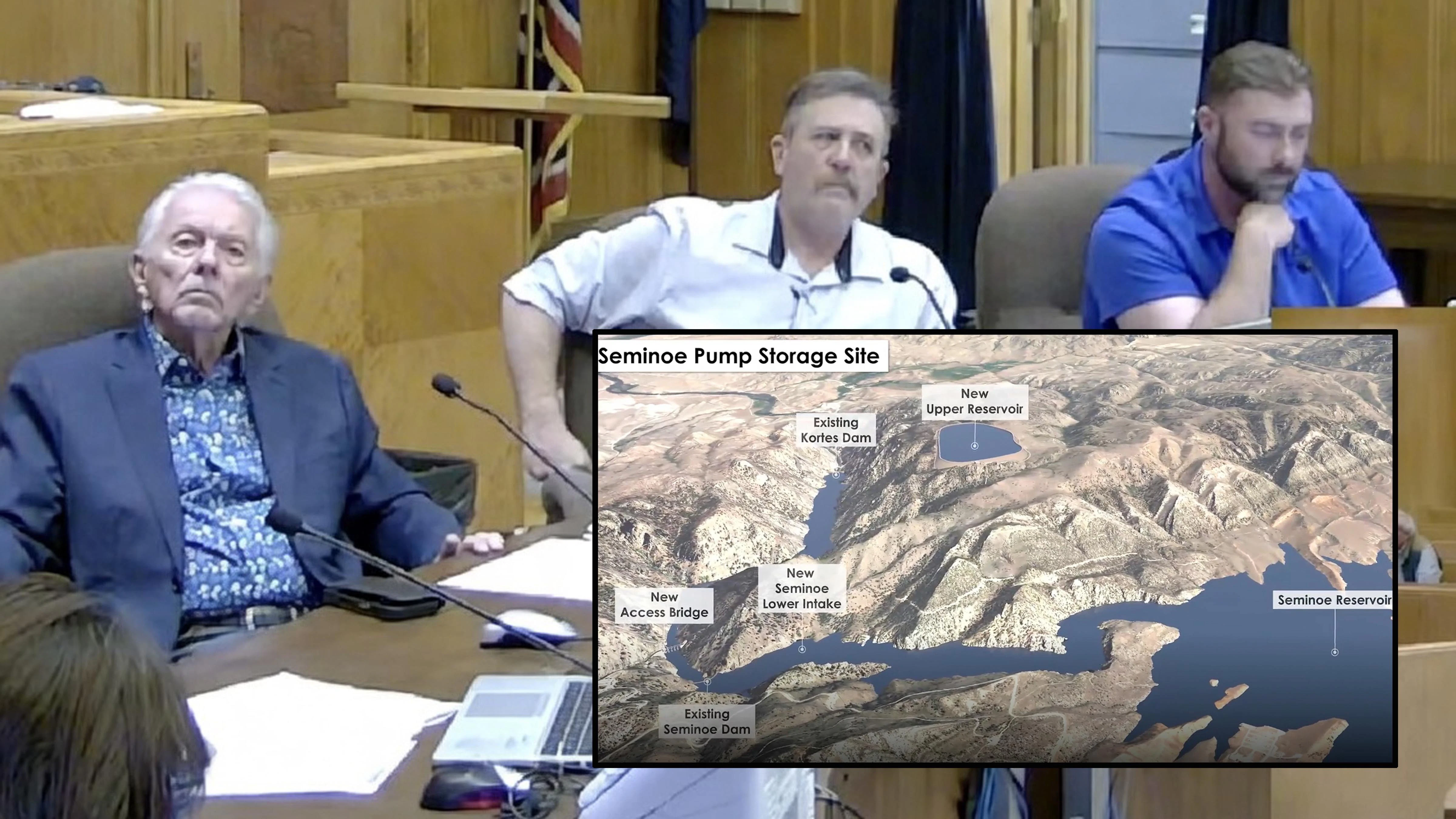
To create the storage capability, rPlus Hydro proposes to build a new upper reservoir on 120 acres of U.S. Bureau of Reclamation land and fill it with 13,000 acre feet of water.
About 10,000 acre feet would be pumped back and forth between the upper and lower reservoirs to create the electricity, Shapiro said.
The project involves construction of tunnels to move water and and house a power station in the mountain as well as construction intake structures on the reservoir shorelines.
A 29-mile transmission line would take the power from the pump storage facility to a PacifiCorp substation near Medicine Bow.
To overcome concerns from the Wyoming Game and Fish Department, as well as conservation groups about impacting the bighorn sheep habitat in the area during construction, the company revised its plan for heavy truck traffic.
Instead of a 3-mile route to haul rock mined for tunnel construction out and cement back in, the company now is proposing a 1.6-mile route. The proposed construction site for the lower project area was moved away from the state park campground.
“We developed an extensive set of minimization mitigation in terms of training of crew, reducing noise, vibration and light,” Shapiro said. “At the upper site there’s a natural slowdown, a lot of the activity there is related to laying concrete for that reservoir structure and it can’t really be laid when the temperature is below freezing, which is several months of the year.”
He said they continue to work with the BLM, U.S. Bureau of Reclamation and Game and Fish for additional strategies to avoid impacting the sheep herd.
Fishery Concerns
To deal with concerns about the world-famous trout fishery below the reservoir at the Miracle Mile and beyond, the company has worked for more than two years with the Wyoming DEQ to address water turbidity, temperature, and sediment, Shapiro said.
“DEQ is very appreciative,” he said. “They said it was one of the best studies they’d ever seen, and the way we worked together with them to build on that science and ensure that were would be no impacts to the (North Platte River’s) Miracle Mile, Seminoe and Kortes reservoirs, because they cannot be allowed to happen.”
Commissioner Dave North questioned how on a day when 10,000 acre feet of water are pumped from the top reservoir into Seminoe that the temperature in the thermocline, that separates warmer water above and colder water below in deeper bodies of water isn’t impacted — which would impact the fishery.
Baker told North that the firm created a “robust regulatory model” with the DEQ to ensure that the temperature threshold is “not exceeded.”
“If the temperature starts to uptick as a result of stratification, they we have to reduce significantly the operations itself,” he said. “The standards that we put in place … were all designed and signed off by the state to make sure that’s not going to have an impact there.”
Board Chairman Jim Milne asked if the company studied evaporation loss at the upper reservoir.
Shapiro said that the issue has been studied and the company would be liable for 470-acre-feet of water lost through its operations annually, even though that amount probably would not be impacted.
Baker said the company worked closely with the Casper Alcova Irrigation District to ensure the company has the water rights for the initial fill of the upper reservoir as well as “make-up water.”
He said the company is negotiating a contract with the U.S. Bureau of Reclamation on all of the water rights.
“We’re using the water, but we are not consuming it,” he said. “We’re bringing it up and then we’re bringing it back down outside of whatever water losses or evaporative losses come.”
The firm worked with the state engineer to ensure all requirements under the interstate compact for deployment of water from the Seminoe and Kortes reservoirs, through the Miracle Mile and all the way to Nebraska were followed, he said.
In addition to providing a potential 100-year source of energy for the electrical grid, the project would provide about $9 million in property tax revenue, primarily in Carbon County but will create 300 to 500 jobs during the five-year construction period.
There would be 30-to-35 full-time jobs once the plant becomes operational, Shapiro said.
“Natrona County would see significant local construction spend through that construction period,” he said.
Dale Killingbeck can be reached at dale@cowboystatedaily.com.