Whether he's still around or not, no one knows.
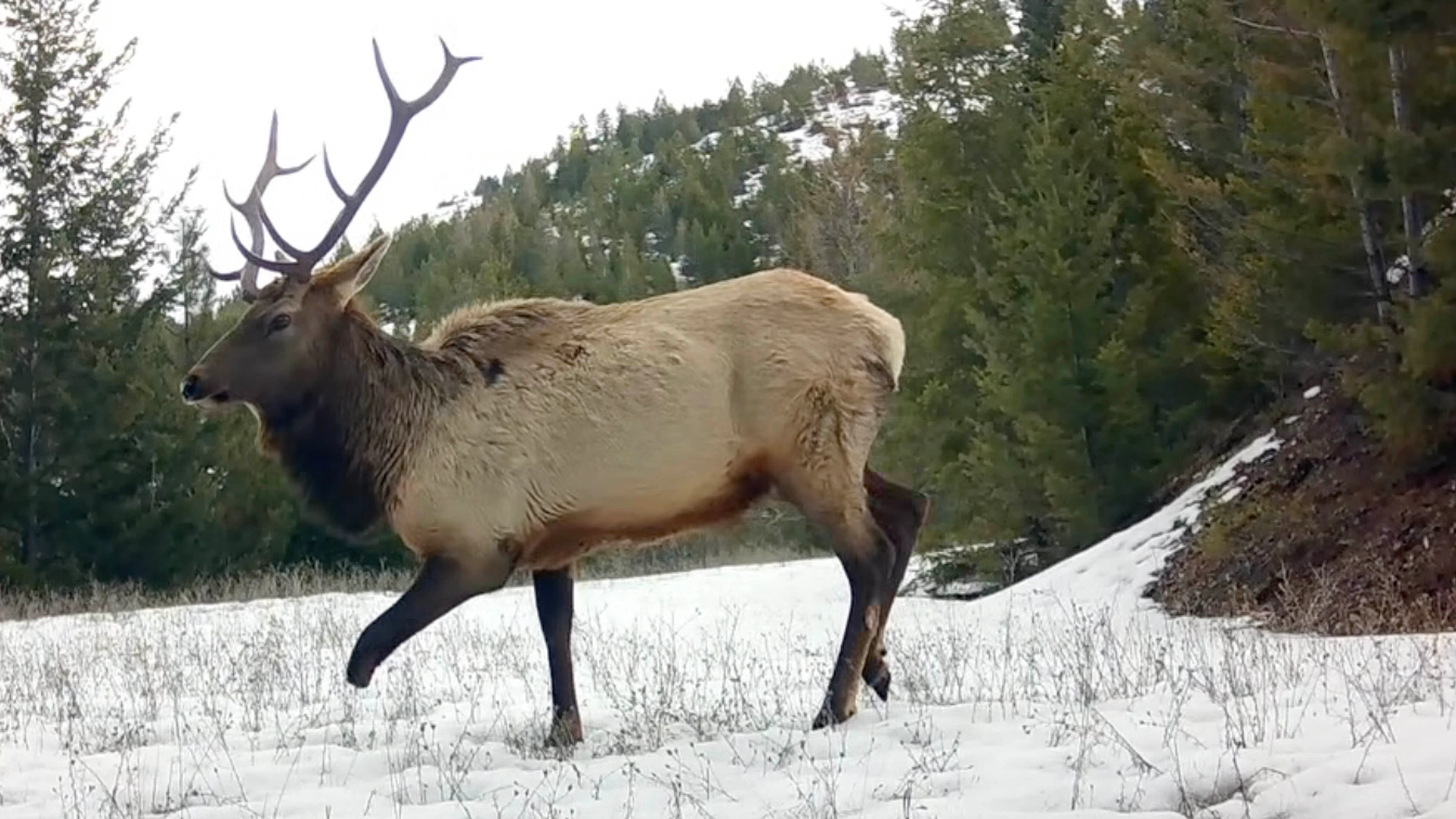
But biologists are quite impressed with the shape of a three and a half legged elk when it was captured on a video trailcam.
The MPG Ranch near Missoula, Montana, decided to share the video of the elk this past week.
"The cinematic quality of the scene, the hearty appearance of the bull, and the cleanliness of the complete sever just below this bull's front left knee leaves us totally gobsmacked and wondrously puzzled," they wrote.
The elk, which appeared to be at least five years old, was missing the lower half of its left front leg, right below the femur. It was hobbling and very keen to avoid putting any weight on its stump, but otherwise seemed surprisingly healthy despite its obvious handicap.
"We see a lot of strange stuff on our trailcams, but this clip stopped us in our tracks," they added.
Craig Jourdonnais, a large game biologist working with the MPG Ranch, said the elk hadn’t been seen before or since.
Considering how merciless the wild can be, most biologists wouldn’t expect that particular elk to survive for long with that kind of injury.
But how did it survive at all?
How To Lose A Leg
John Winnie Jr., an associate teaching professor in the Department of Ecology at Montana State University, reviewed the MPG Ranch video and has his own speculations about the 3.5-legged elk.
What was immediately obvious to him was that the elk hadn’t been a tripod for very long.
“When elk forage in deep snow, they paw snow out of their way with their front hooves to find grass,” he said. “Doing that when you're missing a good chunk of a leg would be incredibly difficult. I can't see him getting through a normal winter on three legs.”
That would rule out the missing leg as a birth defect. It’s unlikely that an elk calf born with such a disadvantage would last long before being targeted by any number of predators.
So, what caused the elk to lose its leg? Jourdonnais suggested the elk might have broken and lost the lower half of its leg running through a downfall of rock and other debris, something Winnie also speculated as a possible cause.
“He might have gotten his leg stuck and sheared off in some talus,” he said.
Another possible explanation is that the elk might have been shot in the leg, which eventually caused enough decay for it to fall off. Winnie, after reviewing the video, though he saw some similarities to injured animals he’s seen elsewhere in the world.
“It looks similar to African wildlife that I've seen that have been caught in snares,” he said. “(The injury) isn’t from a leg trap, because no trap would get that high up a leg, but a snare could grab fairly high. It’s pure speculation on my part, but it may have gotten caught in a snare, struggled to get out of it, and eventually the snare cut deep enough that the elk managed to rip itself out of it.”
One explanation that Winnie ruled out was that the elk lost its leg in an altercation with a predator.
“I haven't found any evidence of predators going for the lower legs,” he said. “Wolves and mountain lions go for the haunches and shoulders to bring their prey down, then go for the throat and crush the windpipe. Elk are really strong and can use their legs to toss or stomp on a wolf. The legs are too dangerous.”
Survival Of The Luckiest
What Winnie found remarkable wasn’t only that this bull elk survived such an incident, but that it appeared to be very healthy.
“He was in really good condition coming out of the winter. If you just look at him, you can't see a single rib, and his hips are barely starting to show. He came through in very good shape.”
Winnie recalled a necropsy he’d done on the carcass of a bull elk that had survived for a prolonged period with a serious fracture to its left hind leg. The emaciated body showed how much of a toll the injury had taken.
“His fat reserves were virtually completely depleted, and the bone marrow was a clear, red soup,” he said. “Marrow is the last reserve they’ll tap into, after subcutaneous and internal fat. If that's depleted, an elk's in pretty bad shape.”
It was obvious that the elk had survived for a long time after the injury. Winnie said the hooves on the left hind leg had grown out to the point where they were “starting to cross.”
“He'd not been bearing weight on that leg and abrading that hoof down for quite a long time,” he said. “It was obvious that he’d starved to death.”
Winnie believes breaking or losing a front leg could be even more detrimental than a back leg. That’s more evidence that the elk spotted on the MPG Ranch had lost its leg not long before it was spotted.
Surviving in the short term would be difficult, but not impossible. Winnie chalks that up to luck and circumstance rather than the resilience of that particular bull.
“He probably hadn’t survived multiple winters like that, and that was probably a mild winter,” he said. “If you imagine that elk going through snow up to its belly, trying to do that on three legs would be really hard going. I don’t think he would have made it five years like that.”
Borrowed Time
Nobody at the MPG Ranch has seen the 3.5-legged elk since March 2024. Everyone, including Winnie, assumed the inevitable.
“Most of the mountainous and forested areas in Montana have wolves and mountain lions, but even a bear could take a hobbled bull elk,” he said.
Winnie believes the tripod elk lucked its way through a mild winter and found strength in numbers by hanging around with other bulls, as seen on the trailcam. He not only survived a traumatic injury but also came out of the winter in remarkably good shape.
How this bull wasn’t killed during the winter is anybody’s guess, but a hobbling elk would be an obvious target for any predator. Winnie’s best guess is that this elk was living on borrowed time and was eventually killed because of its injury.
“I think he's really lucked out,” he said. “He might have survived the winter, with difficulty, but his days were numbered with an injury like that.”
Andrew Rossi can be reached at arossi@cowboystatedaily.com.