
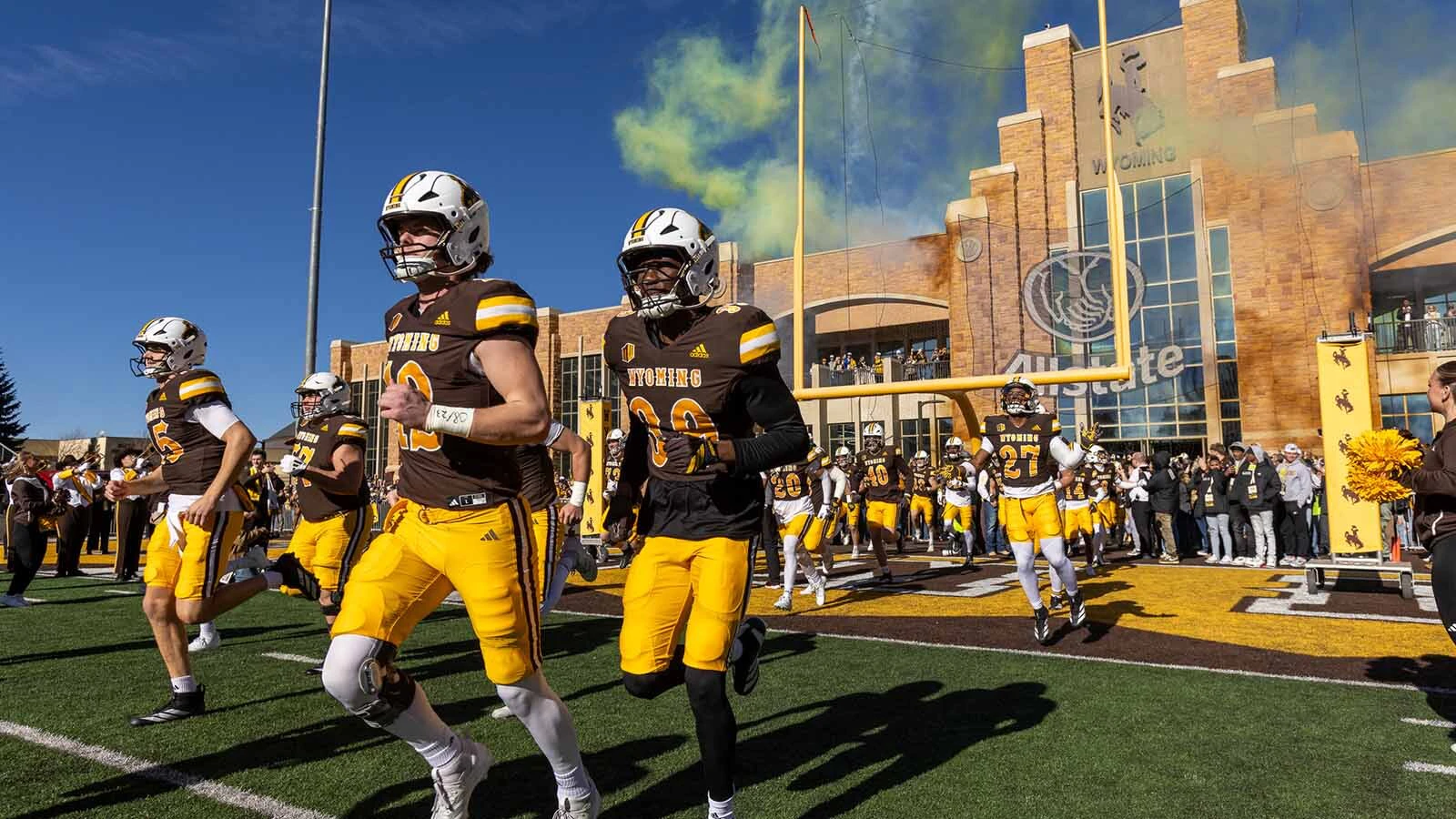
The University of Wyoming Athletics announced Monday the largest corporate investment in program history — a five-year, multimillion-dollar jersey patch partnership with Tallgrass, a Colorado-based energy infrastructure company that operates thousands of miles of pipelines across Wyoming.
The deal, facilitated by Learfield's Wyoming Sports Properties, places the Tallgrass logo on football, men's basketball and women's basketball jerseys and makes the company the presenting sponsor of the Wyoming Kids Club, according to a UW statement.
"This is the largest corporate investment in Wyoming athletics history," Rob DeSoto, general manager of Wyoming Sports Properties, told Cowboy State Daily. "Over the five-year window, it's over $4 million invested to Wyoming athletics."
DeSoto said the partnership reflects a shift in how corporate sponsors approach college sports in the revenue-sharing era.
"This partnership is really geared around Tallgrass kind of coming to the table and saying, 'Hey, we already do a ton of business in Wyoming. We want to tell our story, but we want to support the student athletes,'" DeSoto said, who described the deal as "forward facing" about the revenue-sharing era.
Director of Athletics Tom Burman said in a statement the commitment "will have an immediate impact on our ability to recruit and retain our best and brightest."
Executive Order
The UW-Tallgrass announcement arrives three days after President Trump signed a sweeping executive order titled "Urgent National Action to Save College Sports," using the federal government's contracting and grant authority to pressure universities into compliance with NCAA rules that federal courts have already struck down.
The order, signed Friday hours before the NCAA women's basketball Final Four tipped off in Phoenix, directs federal agencies that contract with or provide grants to universities to evaluate violations of NCAA rules on eligibility, transfers, revenue sharing and financial activities to determine whether those violations render a school unfit for federal funding.
At its center is a financial crisis driven by football and basketball spending.
The order cites one major athletics program that closed fiscal year 2025 with $535 million in athletics-related debt and another carrying $437 million.
The University of Louisville wrote in a statement last month that "the math no longer works" across college sports, CBS Sports reported.
Among the order's most significant provisions is a call to reinstate a version of the one-time transfer rule, under which athletes would be allowed one transfer with immediate eligibility during a five-year window, with a second transfer permitted only after earning a four-year degree.
The order also directs the NCAA to cap eligibility at five years and to bar professional athletes from returning to college competition.
The order also takes aim at booster-funded collectives — the donor groups that have sprung up at universities nationwide to funnel money to athletes through endorsement deals that critics say often bear little resemblance to legitimate advertising.
What’s Fair, And What’s Fraud
Under the order, any payment to a student-athlete that exceeds what the athlete's name, image and likeness (NIL) would command on the open market would be classified as a "fraudulent NIL scheme."
A local car dealership paying a quarterback a fair rate to appear in a commercial would remain legal. A booster collective paying a recruit six figures for a social media post that nobody sees would not.
Revenue-sharing payments approved by the NCAA under the House settlement framework are also exempted.
Separately, the order draws a hard line on public money: no federal funds may be used for NIL payments, revenue-sharing payments or coaching and recruiting compensation.
The order includes protections for women's and Olympic sports, requiring that any revenue-sharing arrangement preserve or expand scholarships and roster spots in those programs.
The provision is designed to prevent football and men's basketball — the two sports driving the spending arms race — from cannibalizing funding for the other sports that Title IX requires universities to support.
The Department of Education is directed to consider requiring universities to publicly report total roster spots and total athletically related spending broken out by gender, creating a data trail that would make it harder for schools to quietly cut women's programs while pouring money into revenue sports.
The goal is for some of these suggested changes to be in place just before the start of the college football season.
Still Digesting
Asked about the executive order Monday, Nick Seeman, UW's associate athletic director for communications, told Cowboy State Daily that, "At this point in time we have no comment."
DeSoto said his team is still digesting the order's details.
"We've got a call tomorrow actually with our legal team who's gone through the entire executive order, kind of reviewing everything to help us understand what's coming down the pipeline," DeSoto said.
At the Women's Final Four in Phoenix, NCAA President Charlie Baker told reporters he hadn't read the full order, but said that based on what he had seen, “There's a bunch of things in there that are pretty consistent with the things we've been talking to them and to Congress about."
Following a White House roundtable in March attended by Baker, SEC Commissioner Greg Sankey, NBA Commissioner Adam Silver, and U.S. Olympic and Paralympic Committee CEO Sarah Hirshland, the administration formed five committees on college sports covering legislation, rules, NCAA reform, media, and player issues, CBS Sports reported.
Those committees held their initial meetings last week.
The order calls on Congress to pass legislation addressing the issues but frames further delay as unacceptable, citing the 500,000 annual scholarship opportunities and nearly $4 billion in athletic scholarships at stake. Bipartisan legislative negotiations have stalled for more than a year.
Rules Chaos
For coaches and administrators trying to build programs under constantly shifting rules, the executive order is at a minimum a signal that someone in authority is trying to impose order on the chaos.
Dennis Patchin, the voice of University of Idaho men's basketball and football, and a retired sportscaster who has covered the Big Sky Conference for 45 years, said the lack of consistent national rules has made it nearly impossible for coaches to plan from one year to the next.
"Whatever rule you're gonna make, make it. But stick by it," Patchin told Cowboy State Daily. "Because the rules keep changing, and when you're trying to put a program together, that's a really hard way to do it."
Patchin pointed to the patchwork of state laws as a driving force behind the order.
Mississippi recently eliminated state income tax on NIL earnings, giving its schools a recruiting advantage that programs in other states cannot match.
"Something had to happen," Patchin said. "All the different states have different rules. Everybody needs to be operating under the same restraints."
The order's five-year eligibility cap and transfer restrictions address a situation in which athletes can play at four schools in four years with little regard for academic progress, Patchin said.
He questioned whether the NCAA's academic progress rate — the metric that once barred underperforming programs from postseason play — still carries any weight.
"How is a kid who's played at four schools in four years possibly eligible?" Patchin said. "Anybody who's transferred between colleges knows that credits don't count."
Patchin said the transfer limits would not stop player movement but could slow it meaningfully. Instead of a player leaving after his freshman year, he said, "maybe he leaves after his sophomore year."
He also raised a question few in the industry have answered: if universities are paying athletes directly through revenue sharing rather than through third-party NIL deals, how does that square with Title IX requirements for equal funding between men's and women's programs?
"If I'm going to pay 25 male athletes an average of half a million dollars a year, do I have to pay 25 female athletes an average of half a million dollars a year?" Patchin said. "I have yet to have anybody explain that to me."
Also, Patchin pointed out the order is susceptible to legal challenges.
Courts have repeatedly struck down NCAA restrictions on antitrust grounds, and the executive order is asking the association to reimpose versions of rules that judges have already invalidated.
"I heard a lot of, 'Well, this is going to be overturned in a court of law,'" Patchin said.
What is not in question, he said, is that the problems the order attempts to address are real — and that the people closest to the sport have been asking for help.
"A lot of the things in this executive order are what university people have been saying, college commissioners have been saying, and the NCAA has been saying," Patchin said.
Trustee Briefing
Those same conversations have already been playing out in Laramie.
At a March 26 Board of Trustees meeting, Burman, football coach Jay Sawvel, and senior associate AD Peter Prigge walked the board through the mechanics of the House settlement, the consolidated NCAA lawsuit that created the revenue-sharing framework now in use across Division I.
Sawvel told the board UW's football program funded its roster last fall on roughly $700,000 and has since grown that to about $2 million, but said it is not enough to compete for conference titles.
"When you're looking at where we will need to be to be a championship program in the new Mountain West, truthfully, it's going to be at $5 million," Sawvel said. "And that's where our top-of-the-line competitors will be.
"That is also where the teams exiting our old Mountain West and going into their new conference, including our biggest rival close to the South, are all operating in a 5-plus-million-dollar range."
When Trustee John McKinley asked Burman for a total across all five revenue-sharing sports — football, men's basketball, women's basketball, volleyball, and wrestling — Burman put the number at $8 million.
"I think you have to be at $5 million in football quickly. I think you have to be at $2 million in men's basketball quickly. And the rest — you wouldn't add up to a million bucks. So $8 million quickly," Burman said.
Burman told the trustees UW self-generates $35 million of its $55 million athletics budget and has kept revenue-sharing payments separate from state appropriations.
"We are not using state dollars," Burman said. “We have a system in place that there will be no issue if someone called us on the table and said, 'We want to make sure that none of the state monies went to student athletes.'"
Prigge offered national context, noting the lowest basketball NIL budget among that week's Sweet 16 teams was $6.25 million, which was the University of Iowa, for basketball alone.
"So as we continue to have these conversations, we're trying to do it with a football team and stay below that number," Prigge said. “It’s a continuing conversation about what’s next, how do we do more?”
Wild West
DeSoto said the executive order, whatever its legal fate, addresses a problem the industry recognizes.
"Right now, we live in the Wild West, and we say that regularly — not just because we live in Wyoming, but because that is what college athletics is," DeSoto said. "It is the Wild West when it comes to rev share and NIL."
He said the order's transfer restrictions and eligibility caps, if implemented, would help conferences like the Mountain West reach competitive balance.
"It should make each of these conferences — the Mountain West, the SEC, everybody — become a little more balanced in their conferences and kind of bring all of the realignment we've seen over the last few years to hopefully a more balanced approach," DeSoto said.
For a program operating at $2 million in football revenue sharing against competitors spending $5 million or more, the practical question is whether the new rules can help Wyoming keep its best players.
DeSoto said the effect is already visible on the basketball side, pointing to the decisions by UW players Naz Meyer and Gavin Gores to return to Wyoming rather than enter the transfer portal.
"Investments like this from businesses allow our coaching staff and athletics department to go and say, 'Hey, here's how we can go help you retain these student athletes,'" DeSoto said. "You're no longer having to chase them over here because we're getting people to come in and say, 'Hey, we want to support this.’
"And they're helping us add dollars to that bucket of revshare that allows us to go, 'Hey, we can compete with bigger schools.'"
"As we've seen in other programs, prior to the NIL space, when you can develop athletes and they stay in the same program for multiple years, they usually compete and produce better teams overall in the long run," he said.
David Madison can be reached at david@cowboystatedaily.com.


