
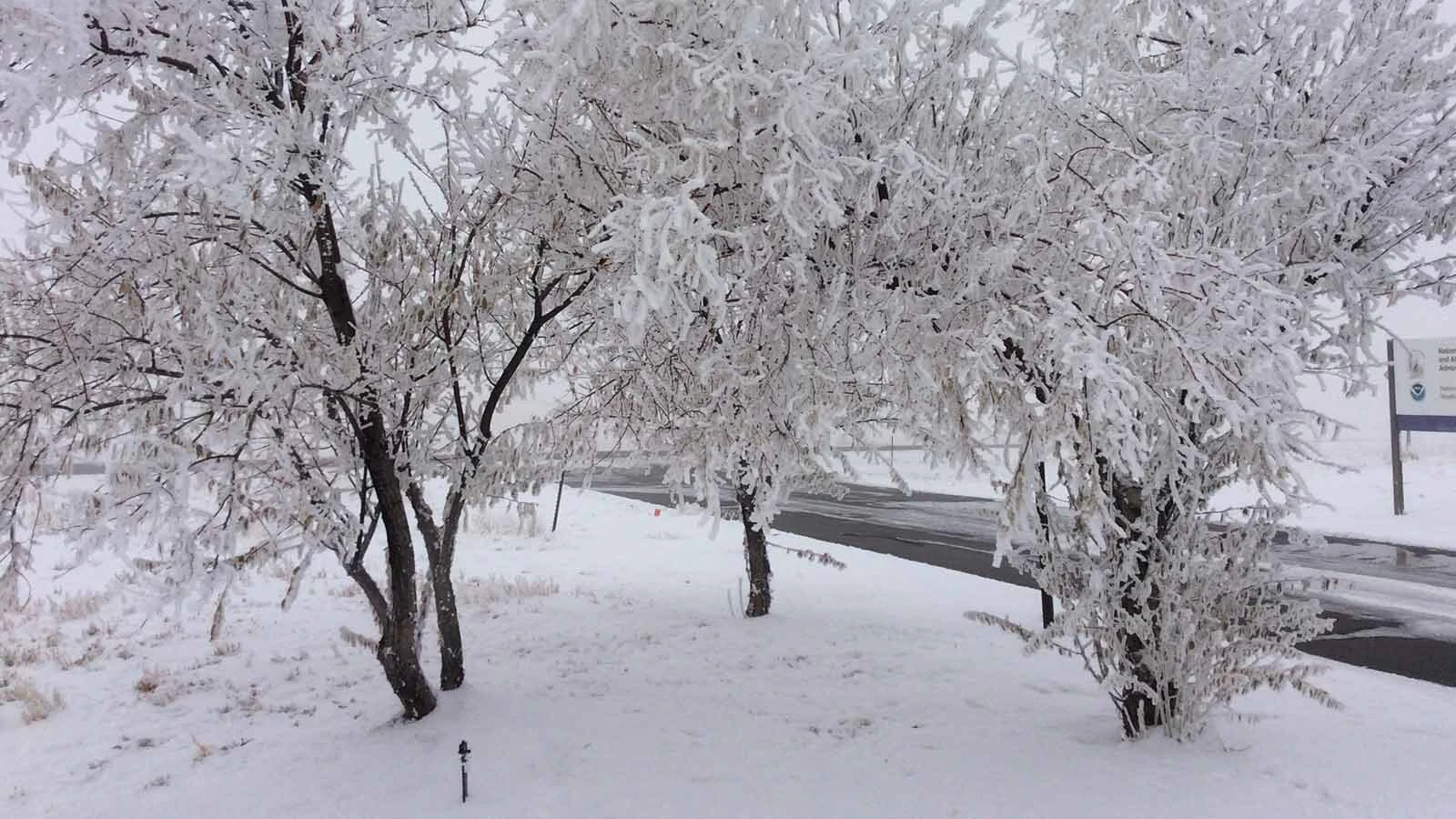
Wyoming has seen a decent amount of snow in the first week of April, but meteorologists says it's officially too little, too late to save the state’s historically low snowpack, which has been melting for weeks.
The spring storm brought much-needed moisture to several dry spots across the Cowboy State. After a miserable March, the first week of April has been what meteorologists says they’ve have been hoping for since November: a normal week.
“All of the mountains, from the Snowies to the Bighorns, got the equivalent of 1 to 2 inches of water,” said Cowboy State Daily meteorologist Don Day. “There was nearly three-quarters of an inch in the Red Desert. Laramie got over half an inch of moisture. There were some good precipitation totals.”
That improved Wyoming’s snow water equivalent map slightly, but anyone looking for comfort there won’t find it.
Tony Bergantino, the director of the Water Resources Data System and the Wyoming State Climate Office, finally said the word that describes this past winter’s miserable snowpack.
“I guess you could say that it’s ‘unprecedented,'” he said. “We have not seen snowpack this low, across the state, in the 30-plus years that I've been here, and it’s historically low even further than that.”
Last Week’s Weather
A surge of cold air and precipitation caused chaos on Wyoming’s highways with this latest blast of snow, a true spring storm that was desperately needed across the state.
The mountains did best, as usual, but even they needed the boost.
“Most of the snowfall amounts were between 10 and 15 inches in the Bighorns, and right around 12 inches for the Tetons and the Wind River Range,” said meteorologist Jason Straub with the National Weather Service (NWS) office in Riverton. “That’s roughly the equivalent of 1 inch of water.”
Millions of people across the Western U.S. would have liked a lot more, but beggars can’t be choosers, he said.
Straub said Wyoming’s mountain ranges are in fairly good shape. It’s the lower elevations that are struggling the most.
“Most of the mountainous areas are sitting pretty close to normal for this time of year, and have been most of the winter,” he said. “The lower elevations are well below average, and we have a significant to severe drought starting to develop across most of the state.”
That wouldn’t be the worst-case scenario going into the wettest months of the year, but March came and went with well-above-average temperatures and well-below-average precipitation, which has had a dramatic impact on Wyoming’s snowpack.
Serious Snowpack Slump
In December, the snowpack wasn’t at its best, but many basins were well above their seasonal averages. Those circumstances changed dramatically in the last three months, meteorologists say.
Most of Wyoming’s snowpacks reach their peaks in early April. The cutoff tends to be April 1, when the snow water equivalent starts to decline as temperatures rise and snow becomes less frequent.
Bergantino said Wyoming is well past its peak.
“We hit peaks anywhere between 12 and 45 days early this season,” he said. “None of those basins, except the Yellowstone Basin in northwest Wyoming, even reached their median snowpack before they peaked."
According to 50 manual snow measurements submitted to the Wyoming State Climate Office, Bergantino said 28 indicate that 2025-2026 was the lowest snowpack in Wyoming’s recorded history.
An additional seven of those 50 were tied for the lowest snowpack on record, and those records go back a long way.
“We're talking, 90-plus years of records for some of these places,” Bergantino said. “A lot of areas are either tied to the bottom or have gone below it.”
Prolonging The Agony
Wyoming could cope with a below-average snowpack, assuming temperatures were cold enough to keep it intact for as long as possible, but Bergantino said that the temperature threshold was crossed weeks ago.
“That’s the double-whammy,” he said. “We didn't get the volume of snow for the peak, and it started melting early.”
The chances of a dramatic rebound in snowpack were slim even before the record-breaking March temperatures. Now in early April, Bergantino is looking and hoping for the bare minimum.
“It'd be nice to get the basins above the historical minimum,” he said. “I don’t see any basin reaching its seasonal peak, but we might get enough to shoot above the minimum line. Even that isn’t a guarantee.”
Even more precipitation could be a double-edged sword for the current state of the snowpack. As it gets warmer, the chance of snow decreases, even at the highest elevations.
“Extended forecasts are showing above-average precipitation for the next eight to 14 days, but temperatures are also above the median,” he said. “If we get more precipitation, you run the risk of what form that precipitation takes.
"Does it come down as snow, or does it come down as rain and chew up even some more of that lower elevation snowpack?”
Bergantino wasn’t complaining about last week’s weather. Something’s always better than nothing, but that something wasn’t enough to change anything.
“I would say it prolonged the agony a little bit,” he said. “It helped. It moved things forward a little bit, but it definitely did not cure anything.”
Will It Get Better?
After reviewing all the current and historical data, even the best-case scenario isn’t looking great. Bergantino cautions Wyomingites to prepare for what’s ahead.
“If things don't turn around this spring, you're going to be looking at water supply issues this summer,” he said. “Most of Wyoming’s basins are running below their minimum snowpack, and most of the others are bouncing off the top of their all-time lows.”
Bergantino added that Wyoming could already be primed for a disastrous fire season. Many plants have started to leaf out and flower, either in confusion or desperation.
If those plants don’t get enough moisture, they’ll desiccate. That’ll leave lots of dry branches and dead leaves to feed any fire.
“That’s one of the really concerning things right now,” he said. “If everything greens up and dries out, you’re adding a lot of fuel for fires.”
Straub said the NWS’s short-range outlook is favoring above-average moisture. At this point, any wetness is welcome.
“April and May are when Wyoming gets 25% to 50% of its moisture,” he said. “Right now, the outlooks are looking pretty close to normal. Any of that precipitation will be very beneficial to bring some moisture, keep the reservoirs full, and things like that.”
There’s another storm system anticipated this week. Straub said it’ll arrive late Tuesday, but won’t have the same potency as the systems that stretched across Wyoming last week.
“It's mainly going to bring around 2 to 4 inches of snowfall to the mountains of northwest Wyoming,” he said. “Most of the lower elevations will see a sprinkle, at best. Accumulation will be minimal, but it’s something.”
Cold Comfort?
Bergantino couldn’t find a modern precedent for what Wyoming’s experiencing in terms of below-average, earlier-melting snowpack. The only comparable year happened long before his tenure at the Wyoming State Climate Office.
“A lot of records still have 1977 as the lowest snowpack,” he said.
That’s somewhat vindicating for Day.
He’s classified the 2025-2026 winter season as a “once-in-a-generation” winter that hasn’t been experienced since the 1970s, with the 1977-1978 season as the lowest point on record.
Day isn’t ready to throw in the towel yet. He’s not anticipating a meteorological Hail Mary that’ll revitalize the state’s snowpack, but there have been some dramatic turnarounds.
“I've seen some big comebacks in snowpack before,” he said, adding that, "2011 was one of the years where there was a tremendous amount of mountain snow in April, and last week was great. We have broken the streak.”
Day always finds hope in history. April has done a lot to change Wyoming’s fortunes going into a season of severe drought, and it might do the same this year.
“If you go back and look at some of the bigger snowstorms in Wyoming’s history, a lot of them happened in the last 10 days of April,” he said. “You get these bigger, slower-moving storms that tend to cover more real estate, and that's what we really need.”
As usual, Day has an analogy for what’s happened and how everything’s shaping up.
“It's like we haven't been on the interstate since November,” he said. “We've been on side roads, dirt roads, and secondary highways trying to get on track. “
In that analogy, Day said last week’s weather was a possible “exit ramp.”
He’s not promising anything, but that weather was more of what meteorologists would expect in Wyoming for the first week of April, one of Wyoming’s wettest months.
“I don't think we're on the interstate yet, but maybe we're getting on to the entrance ramp, and hopefully we can merge into traffic,” he said.
Andrew Rossi can be reached at arossi@cowboystatedaily.com.


