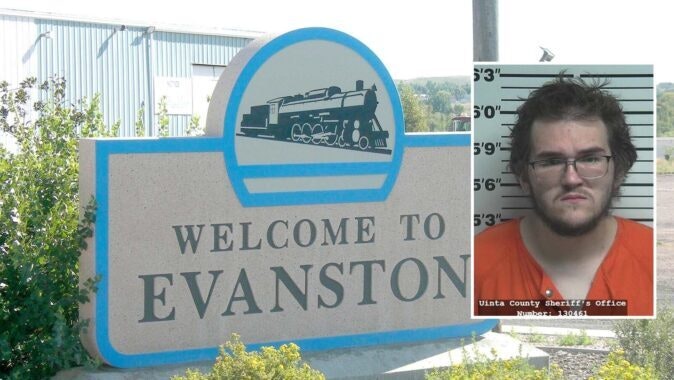
In the case of an Evanston man who claimed he acted in self-defense when allegedly killing his father last November, the prosecutor is asking the court to allow extra evidence of murder threats and violence into the May 12 trial — including a claim that the man threw a dog down the stairs.
Ethan Grasse, who was born in 2002, was charged with second-degree murder in November on claims that he shot his father, Michael Grasse, around the morning of Nov. 22 in their shared home in Evanston.
Through his public defense attorney Tammy Fields, Ethan Grasse argued in a January motion and a March hearing that his father had been violent, drunk and threatening the day and night prior, and that he acted in self-defense.
Ethan Grasse’s motion says he took his dad’s phone, wallet and keys Nov. 21 due to concerns over Michael’s drunkenness.
It says Ethan tried to get out of the house and away from his dad that day; he added a lock to his own bedroom door before going to bed; and his dad, met with the locked door in the night, threatened to “kick (Ethan’s) ass” and break down the door.
His motion says Michael broke through the door later that night, waking Ethan Grasse — and that Ethan Grasse shot into the dark, heard his father “moan,” then called 911.
The judge denied Ethan Grasse’s motion to end his case early on self-defense grounds, though the defendant can still argue that before the jury.
His trial is slated for four days starting May 12, his court file says.
‘To Murder Every Member Of His Family’
Meanwhile, the case prosecutor, Uinta County Attorney Loretta Howieson Kallas, is asking the Uinta County District Court to let her bring extra evidence to trial.
Trials as a hard-and-fast rule revolve around evidence of the crime charged, but parties can bring evidence of other bad conduct if appropriate under the Wyoming Rules of Evidence.
The prosecutor isn’t allowed to present such evidence just to paint the defendant as a bad person. But she may bring it to show proof of motive, opportunity, intent, preparation, plan, knowledge, identity or that the crime wasn’t an accident.
She can only offer outside bad-acts evidence for a proper purpose, if it’s relevant, and if its capacity to prove the truth outweighs its capacity to prejudice the defendant unfairly.
“In 2017, Defendant Grasse expressed a threat to murder every member of his family by using a firearm while they slept,” asserted Kallas as one segment in the evidence list, of a motion she filed March 19 in Uinta County District Court Judge James Kaste’s court.
“Defendant Grasse had been previously warned of the danger of maintaining a loaded firearm in his room,” Kallas continued.
She wrote that Ethan Grasse had argued with his brother because Grasse had “thrown (his brother’s) dog down the stairs.”
Their argument, she added, led to Grasse punching a large hole in the wall, “which is readily visible in the photographs and video associated with this case.”
Ethan Grasse had “historically” had fights with his dad Michael and had given his dad a black eye, wrote the prosecutor.
By taking his dad’s phone, keys and wallet on Nov. 21, Ethan Grasse “may” have committed theft, wrote Kallas.
She added that by restraining his dad’s movement that same day, Ethan Grasse “may” have committed false imprisonment.
And in their fight that day, Ethan Grasse “may” have committed battery, domestic battery, or fighting in public, the prosecutor wrote, citing the statute numbers rather than the names of crimes as listed here.
Michael Grasse suffered a swollen left ear with scrapes on his ears, head, neck, arm, wrist, shin and left knee, plus contusions on his scalp, and another on his right hand “that may have been associated with self-injury or inflicted injury” during the fight, the document says.
Why This?
Kallas noted that at his March 13 self-defense hearing, Ethan Grasse pointed to an example of his dad harming his brother’s dog, as a sign of his father’s aggressive behavior.
His own conduct is relevant for fact-checking him on such statements, she wrote.
Kallas argued that she wants to send all this evidence to trial to show motive, intent, course of conduct and absence of mistake in the relevant case, and that “the evidence should be admitted.”
Grasse’s attorney had not filed a response, nor the judge ruled, in the public-facing file as of midday Friday.
This case is ongoing.
Clair McFarland can be reached at clair@cowboystatedaily.com.