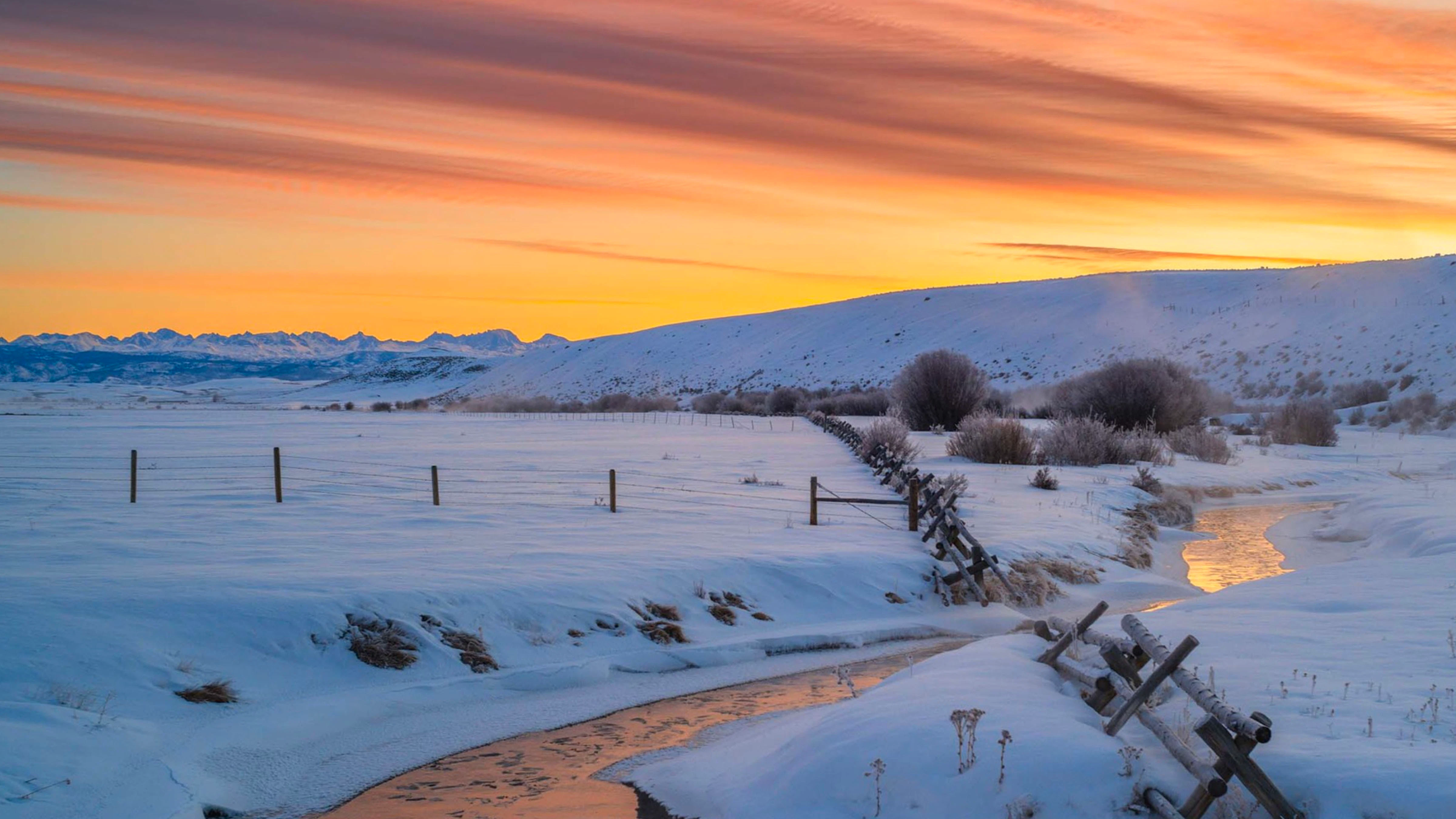
This week in Wyoming’s weather: a mix of rain and snow and temperatures more in line with spring.
That's seasonal weather. This week, everything will be as it should be in late March and early April.
A wave of seasonal weather will ripple across Wyoming this week, bringing colder temperatures and desperately needed precipitation. It’s nowhere near enough to make up for the lack of winter weather this year, but it’s better than nothing.
Wyoming’s mountains will get a foot or two of snow. Precipitation below 9,000 feet will vary based on location, but it seems every corner of the state will get a little wet before the week’s over.
“Any snowflake, any raindrop that we can get is good,” said Cowboy State Daily meteorologist Don Day. “It's better than zero, but it'll be really critical to keep the momentum going.”
Feet To Inches
The first wave of seasonal weather reached Wyoming on Tuesday and will persist into Wednesday. A second wave will follow between Thursday afternoon and Friday evening.
These systems will be carrying a large amount of moisture and cold air. Like most winter storms since November, the mountains will get the most from these weather systems.
“Wyoming's major mountain ranges are going to get the liquid equivalent of about one to two inches of water,” Day said. “That’s one to two feet of snow. It's going to be a very productive mountain event.”
Day said the areas most likely to receive the most moisture will be the northern, central, and western mountains. These storms should be strong enough to send some of their precipitation into the lower elevations, which have been disturbingly dry for months.
The southeast corner, Wyoming's driest spot, will see the least impact from these storms. Still, anything is better than nothing.
“It'll be nice to see something falling from the sky, for sure,” said Michael Natoli with the National Weather Service (NWS) office in Cheyenne. “Snow levels are going to be high with this storm, so lower elevations can expect mostly rain, with some snow mixing in at times, but not accumulating.”
The seasonal precipitation will be accompanied by seasonal temperatures, including freezing temperatures in the mountains.
According to Natoli, colder temperatures are their own reward. At the very least, it’ll slow the rate of the increasingly melting snowpack.
“The North Platte Basin has lost nearly half of its snowpack in the last two weeks,” he said. It was already at a record low when it started declining, so we are considerably below the record low.”
This week’s weather won’t turn the tide on the alarmingly low snowpack. Natoli said the anticipated snow won’t even be enough to get the snowpack back to the previous record-low, but he’s not complaining.
“Anything will be welcome and helpful," he said.
An Absolute Killer
March, April, May, and June are the most critical months of the year for Wyoming. It’s the period when, historically, Wyoming gets most of the moisture that will sustain its rivers, streams, and irrigation canals for the rest of the year.
After the warmest winter in Wyoming’s recorded history, March was off to a great start. Unfortunately, that didn’t last.
“We’ve dug such a hole,” Day said. “There was some really good moisture the first week of March, across the state. Then we went into the 70s and 80s for two weeks, which was an absolute killer.”
Natoli said his office was compiling the temperature and precipitation records for March 2026. He was expecting “some pretty absurd numbers.”
“Most of Wyoming had average March temperatures that would still be warmer than average for the month of April,” he said. “That demonstrates how absurdly warm it has been over the last two to three weeks.”
Those unseasonably warm temperatures were catastrophic for Wyoming’s snowpack. As of March 31, none of Wyoming’s basins are at 100% of their seasonal snowpack, and the majority are below 50%.
Even basins in western Wyoming, which had been doing well, have seen a precipitous drop in the last month. Snowpacks went from over 140% at the end of December to under 70% at the end of March.
Most basins in eastern Wyoming, from Sundance to Cheyenne, are sitting at 0% of their seasonal snowpack. At this point, that’s extremely concerning.
“Snowpack typically peaks around the middle of April,” Natoli said. “We usually are still building through March and into early April. The melt we've seen in the last couple of weeks was at a rate that we usually won't see until May or early June.”
Riding The Wave
Meteorologists aren’t expecting one week of seasonable weather to offset months of below-average snow and above-average temperatures. Still, they’re thrilled to see this change.
“We’re finally in a typical spring situation,” Day said. “It may rain. It may snow a little bit. The plains will probably be between a quarter and three-quarters of an inch. That’s a decent spring storm.”
The real question is whether this weather will continue into April, May, and June. That’s looking too far ahead for most, but the next week is showing some promise.
“There's another opportunity for the state to pick up moisture mid to late next week,” Day said. “With what's coming this week and mid to late next week, it's certainly encouraging. It doesn't mean drought is over, but we've got some opportunities to get wet.”
Temperatures are expected to warm up again, but not as high as 80 degrees. The first half of April might be cooler than the second half of March.
“We’ll have highs in the 60s and 70s instead of the 80s,” Natoli said. “That’s still warmer-than-average for this time of year, but only by 10 to 15 degrees instead of 20 degrees.”
Long-range outlooks based on computer modeling favor slightly above-average moisture and temperatures over the next two months. However, everyone’s wary of models after the winter season they’ve experienced.
“Once you get past five days, weather forecasts drop off a cliff in terms of accuracy,” Day said. “I always like to say, ‘Trend is your friend,’ but the trend since November has been a block for two weeks, a week of weather, and back to another block.”
Blocking patterns have been the bane of Wyoming’s winter. Several long-lasting ridges of high pressure set up in the Arctic Circle, funneling winter weather away from the western U.S., which led to a record-breaking winter of snow and cold in the eastern U.S.
Day doesn’t see another blocking pattern forming in April, which is promising. Then again, nobody watching the models in early March saw the blocking pattern that formed in mid-March.
“I'm reluctant to say that we're over the hump, and that we’re finally going to get back to where we need to be,” he said. “This week is more like what we would expect in late March and into early April, but it’s too early to say if this is going to continue for the rest of spring.”
Back To Your Regularly Scheduled Spring
After months of extremely abnormal weather, Wyoming’s meteorologists are enjoying a normal stretch of seasonal weather. It’s not enough, but it’s something.
“We are in a very deep hole right now,” Natoli said. “It would take something very unusual to get us to an average or above-average year at this point, but not impossible to do that.”
Natoli is already cautioning Wyomingites to prepare for “record-low runoff” this spring, particularly in southern Wyoming. However, a few more weeks of this kind of weather could improve that outlook.
“A really strong April and May could bring us back to a slightly bad year, but there’s probably less than a 10% chance we even get close to an average runoff at this point,” he said.
For Day, he gets a week to relax, at least a little.
“I joked this morning in my podcast that when old TV shows would interrupt programming to go to like a news alert or whatever, they would say, ‘We now return you to our regularly scheduled programming.’ That’s kind of like what's happening now. We're just going to have to slog our way through the next few weeks and see if we can keep this up,” he said.
Andrew Rossi can be reached at arossi@cowboystatedaily.com.