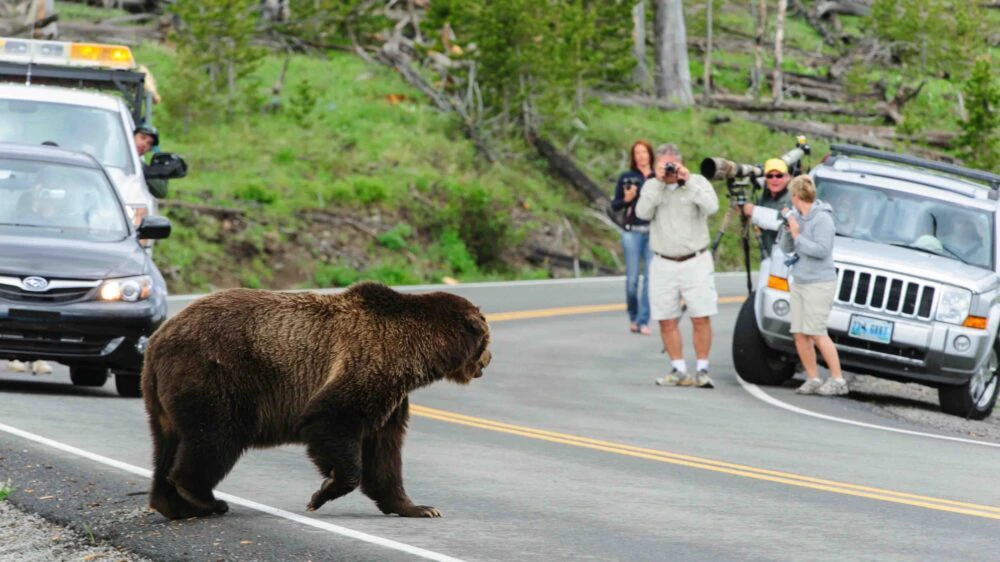
Grizzlies have been the top troublemakers in Wyoming with 6,089 human-bear conflicts documented between 1982 and 2025, according to the Wyoming Game and Fish Department.
That included 220 conflicts in 2025, the vast majority of which were reported attacks on cattle, according to the department’s large carnivore section report to the Wyoming Game and Fish Commission Tuesday.
There were two reported grizzly attacks on humans in 2025, both of which involved non-life threatening injures to people. No human deaths were reported, Brian DeBolt, Game and Fish large carnivore conflict coordinator, told the commission.
The Large Carnivore section is selective in what it classifies as “conflicts” verses only sightings of predators, DeBolt said.
Conflicts are defined as incidents involving human injury or death, the illegal killing of predators, agricultural damage/loss of livestock and property damage, he said.
The vast majority of conflicts happen on private property, he said.
Conflicts Vary By Species
Other 2025 human-carnivore conflicts included 192 involving black bears, 36 with mountain lions and 35 involving wolves.
The 1982 to 2025 totals for those species were 4,485 with black bears, 1,120 for mountain lions and 1,021 with wolves, according to the Game and Fish Department.
Conflicts tend to peak in the summer or early fall, when grizzlies are most active.
The busiest days in 2025 were Sept. 26 to Sept. 28, with 41 conflicts involving all four large carnivore species reported over that three-day period, DeBolt said.
The types of conflicts tend to break down by species, DeBolt said.
In general terms, grizzlies get into trouble for attacking cattle and black bears for tearing up trash bins. Whereas mountain lions most frequently attack sheep and wolves attack livestock “year-round,” DeBolt said.
The number of conflicts rose steadily from 1982 until about 2016, according to Game and Fish.
But the numbers have held steady for the past several years, DeBolt said. He credited the efforts of both the department and the public for keeping conflicts down.
“I think that’s due to the hard, hard-working folks on the ground, doing a ton of work to prevent those conflicts, and the cooperative public,” he said.
Conflict prevention includes public education programs, as well as efforts to secure garbage and other things that might attract bears and other large carnivores, he said.
Electric Fence Saves Corn Maze
Electric fencing has proven successful in deterring grizzlies and other carnivores.
“A lot of what we do is reactionary,” such as putting electric fencing around a chicken coop after a bear attacks it, DeBolt said.
Electric fence proved highly effective against grizzlies in one location, Game and Fish Bear Wise coordinator Mark Aughton told the commission.
Gallagher’s Corn Maze & Pumpkin Patch near Clark was notorious for grizzly conflicts, because the bears were drawn in by the corn.
A five-strand, 9,600-foot-long electric fence surrounding the corn maze and the adjacent attractions was installed shortly before the maze and pumpkin patch opened on Sept. 27, 2024.
There were “no interruptions” because of grizzlies in 2025, when roughly 10,000 visitors came to the maze and pumpkin patch over a 5-week period, Aughton said.
The owners also reported that they didn’t find any grizzly sign in or around the site in 2025, he said.
Along with Game and Fish, that fencing project was backed by the Greater Yellowstone Coalition, U.S. Fish & Wildlife Service, USDA Wildlife Services and Defenders of Wildlife.
Mark Heinz can be reached at mark@cowboystatedaily.com.