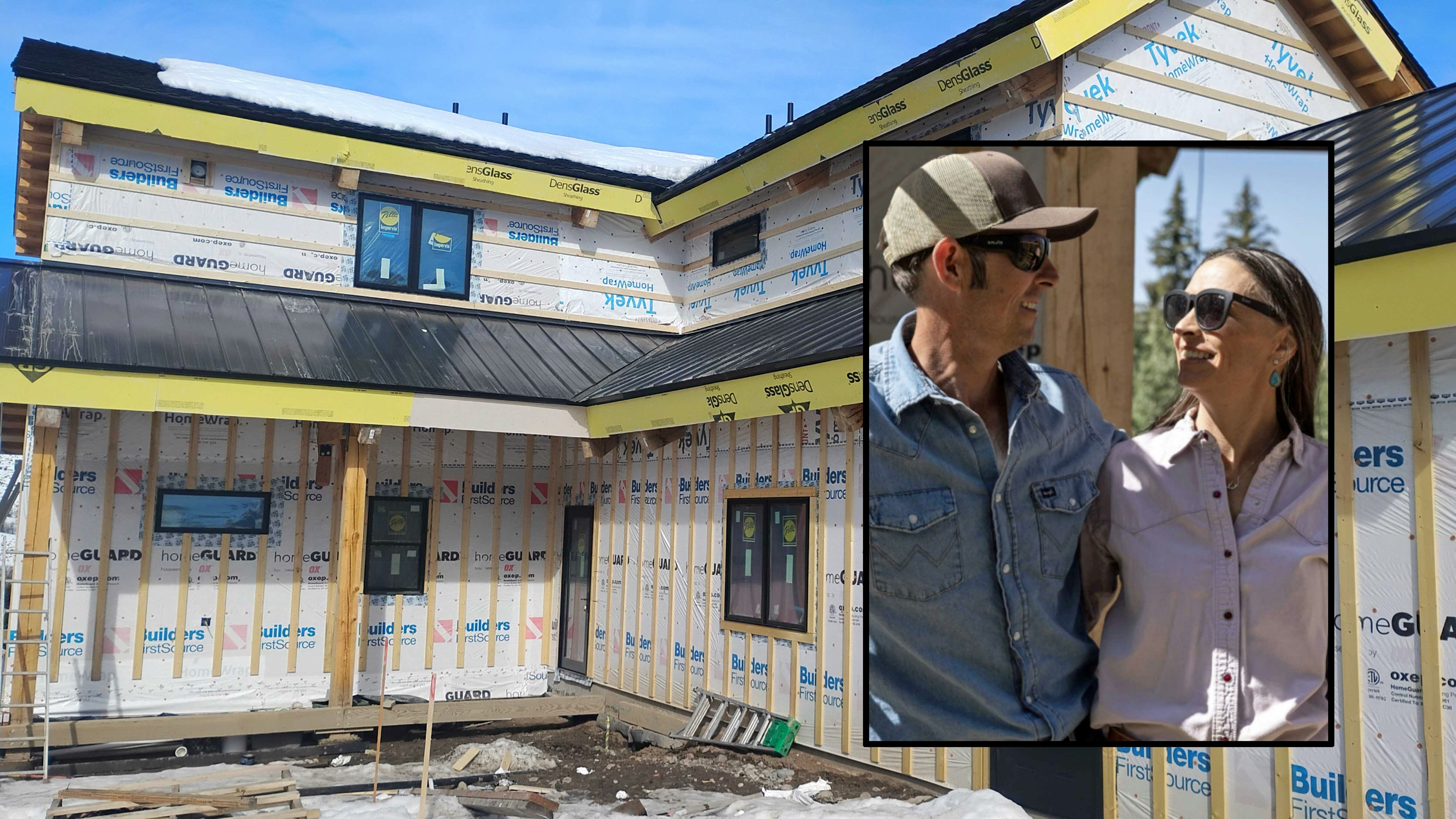
The husband and wife who tried getting a court to strike down Teton County’s elaborate house-building fees as a violation of property rights regret that their lawsuit isn’t the right engine to do so, they told Cowboy State Daily on Monday.
Trey and Shelby Scharp sued Teton County in May 2025 over the $24,325 fee they were required to pay to build a home on property they already owned.
Filing in the U.S. District Court for Wyoming, the Scharps challenged the county’s elaborate, often costly system of fees requiring home builders to help pay for price-controlled homes within the county. They alleged the system violates of the Fifth Amendment to the U.S. Constitution, which says private property shall not be taken for public use without just compensation.
The Wyoming Legislature tried and failed this year to ban such housing mitigation fees statewide.
In Teton County, advocates of the practice say it helps build affordable homes for the working class as ultra-wealthy transplants spike the housing market.
Opponents of the practice say Teton County’s version of it is unconstitutional, and bottlenecks the market even further while driving a chasm between the upper and lower economic classes.
Trey and Shelby Scharp are slated to receive their $24,325 fee back plus interest for a total of $29,909 — and the county is paying another $25,000 to their legal counsel at Pacific Legal Foundation, according to the firm.
That’s after the county announced that it had miscalculated the original fee and owed the pair a refund, the settlement agreement says.
The Scharps called the payback they won an unsatisfying result since they still believe the county’s housing mitigation fees are unconstitutional.
“When we filed in May, it was not about the money. It was about the constitutionality of the fees,” Shelby said in a Monday interview in which Trey also participated. “And we had every intention to take this case as far as it need to go to prove that.”
By Shelby’s recollection, the county’s attorney went back to the county’s planning department and asked its officials to reevaluate whether that original fee the county charged the Scharps had been calculated correctly.
It hadn’t been, and the Scharps shouldn’t have been charged, the county found after that second look.
That coupled with the county’s offer of a refund may have negated the points that undergirded the Scharps’ case.
Their Pacific Legal Foundation attorney Austin Waisanen, of Cody, Wyoming, called the county’s new view of its fee “convenient,” in his own Monday interview.
“This was just a way for them to settle rather than what I think would have been a proper application of their housing mitigation fees,” he said.
According to Waisanen, the county recalculated a fee deduction tied to the historic cabin on the Scharps’ property, in a more beneficial way that eliminated the original fee.
“I don’t think it’s a faithful application of the (land development regulations),” added Waisanen.
But, to continue the case after such a finding would have been like “pushing a rock up a hill,” as it was “essentially mooted,” he said.
Shelby concluded her interview with a message to others who believe the county has extracted fees unjustly, or unconstitutionally, from them.
“What I want to make abundantly clear is that our fees would have never been looked at again if we had not litigated and sued the county. They made that clear,” said Shelby. “I’d encourage anyone in Teton County who doesn’t think that their fee for their building permit is correct… to choose litigation against Teton County.”
Waisanen was sure the issue is still viable.
“I’m sure we’ll be representing someone in the future who’s facing the same situation,” he said.
Teton County Commission Chair Mark Newcomb told Cowboy State Daily in a Monday interview that he's glad the Scharps fell under the exemption after all, and he indicated that it was an easy provision to miss in the county's hundreds of pages of land development regulation.
Anyone who builds a home of fewer than 2,500 square feet is exempt from mitigation fees, and the historic cabin on the Scharps' property deducted their fee calculation to nothing because of that threshold, he said.
"And the Scharps fell into that very unique category so it’s a clause that’s easy to miss," he said. "And I think they obviously have a very good lawyer representing them who missed it as well."
Newcomb said county officials are now examining mitigation fees dating back to 2022 to look for other historic structure exemptions that the county may have overlooked.
"For me personally, I'm very happy that the Scharps are making an effort to provide workforce housing and I'm very happy they fell within the exemption that the historic structure created for them," he said.
As to Shelby Scharp's statement that the county only looked twice at the fee because the couple sued, Newcomb said challenges are sometimes key in the complex system - and people routinely challenge the county's land planning rules.
"And to take a high-level view of government and pub service: it is important for folks to step up and challenge the system, especially when they feel like they’ve been unfairly treated; unjustly treated or treated in a way that is outside the law," he said. "And this is one of those instances."
Waisanen in his interview did not say he had missed the exemption, but that "the county initially disagreed with us" on it, "then they came back and said 'OK, you're right.'"
Settlement
The settlement, which Pacific Legal Foundation provided to Cowboy State Daily but which is also public record because it involves a Wyoming governmental entity, has the county paying about $55,000 total, counting the refund with interest and the attorney fees.
The county does not concede its fees are unconstitutional.
“Teton County concedes that the fee was calculate din error but does not concede that the Fee lacks a constitutional basis,” the settlement says. “Although the Scharps continue to dispute the constitutional basis of the fee, and Teton County contends the fee is constitutional, in order to avoid further expense in the defense of these claims against it, each Party agrees to settle the claims specified herein.”
The Scharps had alleged the county’s logic doesn’t fit their project.
In 2021, they were already living on their own land near Hoback Junction in Teton County in a small cabin when they applied to build a larger home to accommodate their family, says the pair’s 2025 complaint. And before that, they’d lived in rental housing in the county for “many years.”
The couple started making plans to build a bigger home on their property to accommodate themselves and their adolescent daughter. They planned to rent their existing cabin to some of the valley’s many workers, the complaint says.
The property is 5 acres in size, so the family could have built multiple additional dwelling units and parking space to help fund the construction of its new home, but the county regulations wouldn’t allow it because the area was zoned only for one single-family residence, the complaint says.
The family was able to apply for a special “accessory residential unit” permit to rent out the cabin and work toward building their own, larger home, however.
But when they applied for the accessory residential unit permit in 2022, a Teton County official told them that the cabin was too big to be an accessory residential unit.
In other words, the Scharps were penalized for trying to provide “too much rental housing” in a county that hinges many of its housing regulations on its dire need for workforce housing, the lawsuit says.
The official suggested the Scharps fill their basement with gravel to make it smaller to conform to the permit.
The family found a workaround: The Teton County Historic Preservation Board determined the building was historically significant and therefore qualified for the floor area maximum that had kept them from permitting it, or which could have required them to fill its basement with gravel.
Next
The Scharps initially planned to build a roughly 2,700-square-foot home with a shallow crawl space, but they kept increasing that size as they navigated the county’s building regulations. For example, they chose to make the most of an earthquake-proofing requirement to excavate additional area and pour perimeter footings by adding a basement.
They thought they could rent the basement out to recoup some of their costs, but the zoning rule forbids multi-family dwellings in that area, the complaint says.
“Once again,” the complaint says with a touch of irony, “the Scharps’ home building plans threatened to provide too much affordable rental housing.”
Finally, the Scharps settled on plans for a 3,776-square-foot home and applied for a building permit in 2022.
The Scharps were already living and working in Teton County. They’d looked for ways to provide more rental space to people to offset their own costs. And the addition of their newly-constructed home could put downward pressure on the Teton County housing market, the complaint argues.
Yet they originally had to pay $24,325 toward what the county’s general rules system calls their worsening of the workforce housing shortage.
The disconnect between the Scharps’ reality and the county’s theories makes this fee unconstitutional, the complaint alleged.
A Little Case Law
Jackson and Teton County require new home and business builders to pay thousands of dollars in fees, often. Those fees are to buy price-capped housing for the region’s daily-grind workers who can’t afford free-market homes in the wealthy area’s skyrocketing real estate market.
For example, new homeowners hoping to build a 4,000-square-foot home in Jackson have been asked to pay a $31,000 fee toward others’ affordable housing.
The reasoning is that new residents require more police officers, nurses and the like, but those workers generally can’t afford homes in Jackson without outside or government help.
While some state courts have exempted elected policymakers from a constitutional requirement of proving their fees are connected and proportionate to their stated purpose, the U.S. Supreme Court ended that exemption in April 2024 with its opinion in Sheetz v. El Dorado County.
The decision brought scrutiny to Teton County: the Scharps referenced it in their original complaint last May.
Teton County Civil Deputy Attorney Keith Gingery told Cowboy State Daily when the suit was filed that “Teton County strongly stands by our most recent affordable housing nexus study completed in 2023. The county’s adoption of affordable housing mitigation fees is fully compliant with all constitutional provisions requiring an essential nexus and proportionality.”
Clair McFarland can be reached at clair@cowboystatedaily.com.