
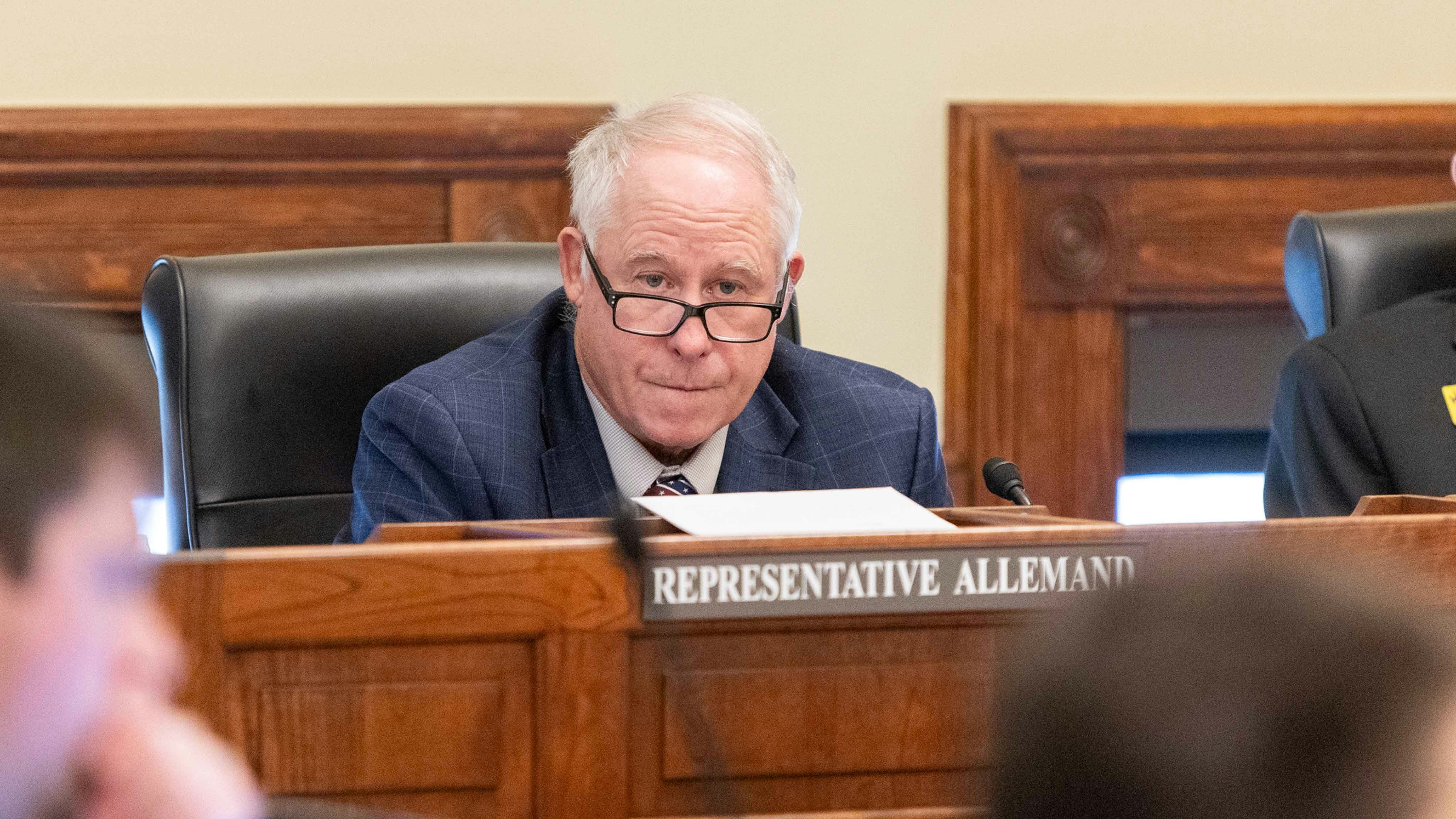
The prosecutor who charged a drunk-driving case against a Wyoming state lawmaker filed a 30-page argument Friday, urging a judge to keep the case and the evidence driving it alive for trial.
That’s after Rep. Bill Allemand, R-Midwest, asked the judge last month to dismiss the case, and called it a product of unfairly-gotten evidence.
The matter is set for a March 25 hearing in Buffalo Circuit Court.
Allemand had, through his attorney Mike Vang, filed a Feb. 25 motion accusing Johnson County Sheriff’s personnel of violating his constitutional rights. That includes a claim a deputy violated his right against unreasonable searches and seizures by handcuffing him after the deputy spotted a loaded pistol on the seat next to Allemand during a Dec. 28 midday traffic stop in Buffalo.
Vang’s motion challenges other pieces of evidence underpinning Johnson County Sheriff’s Deputy Caleb Campbell’s original traffic stop. It invokes a dispute over whether Allemand nearly caused a crash while Campbell watched, or whether the lawmaker was merely nosing into an intersection to survey traffic better.
Johnson County Deputy Attorney Joshua Stensaas countered Friday, in a motion asking Buffalo Circuit Court Judge Sheryl Bunting to keep the case alive for trial, calling Campbell’s evidence fairly gotten and his behavior supported by law.
“Because the initial stop was lawful, the detention was properly expanded, and the arrest was supported by probable cause, the exclusionary rule (blocking evidence) does not apply,” wrote Stensaas. “Suppression (of evidence) is an extraordinary remedy reserved for constitutional violations, none of which have occurred here.”
If convicted, Allemand faces up to six months in jail and $750 in fines.
Vang, whose emphasis is in defending people charged with DUI cases, told Cowboy State Daily in a Monday phone interview that he plans on responding to the state’s counter-motion, but he hasn’t absorbed the whole argument yet.
The filing is “bigger” than he’s seen on a misdemeanor-level DUI, said Vang.
“I’ve never seen them spend as much time to respond on a motion like this. So, obviously they (the prosecutors) feel it’s important. And we do too,” he said.
Vang clarified that he’s not seen such a “voluminous” counter motion on a misdemeanor DUI across the whole state – including but not limited to Johnson County.
He declined to theorize further about why the motion is so “voluminous.”
“I’m just saying I’ve got a lot to read and I haven’t read it all yet,” he said. “This got a bigger response than I had in my last aggravated vehicular homicide case.”
First, A Little Background
Allemand was arrested Dec. 28 after a caller contacted law enforcement to say a blue pickup truck with a topper was hitting rumble strips and swerving between lanes near the 260-mile marker on Interstate 25 near Buffalo, reportedly.
Court documents say Johnson County Sheriff’s Deputy Caleb Campbell arrived on scene, saw a blue pickup with a topper, plus a minivan matching the caller’s description of his own vehicle.
The blue truck nearly hit another vehicle as it attempted to enter an intersection off the exit ramp, documents say.
Campbell activated his lights to confront the driver at a gas station in Buffalo, and the driver, Allemand, didn’t notice Campbell at first, reportedly.
Court documents say once confronted, Allemand told Campbell he’d been drinking beer for his “anxieties” over interstate driving, and that Allemand made a movement near a loaded pistol on his front seat that prompted Campbell to detain him in handcuffs during part of his investigation.
Allemand’s attorney in a Feb. 25 motion called this an unlawful interrogation, saying Campbell asked Allemand questions while the lawmaker was confined without giving him warnings of his Miranda rights first.
The Argument
Stensaas in his motion derided what he called an “inaccurate” portrayal of the facts in Allemand’s motion. That’s regarding when Campbell removed Allemand’s handcuffs.
Allemand’s account says Allemand remained handcuffed throughout the traffic stop, while Campbell’s account – conveyed by Stensaas – says the deputy removed them once another deputy arrived on scene, and when he tried to have Allemand perform field sobriety tests.
In either case, Stensaas argues, the traffic stop, handcuffing, and the DUI investigation were all “constitutionally valid” under the U.S. and Wyoming Constitutions.
Stensaas lays out three types of police interactions with people: encounters, investigatory stops, and arrests.
Consensual encounters don’t implicate the Fourth Amendment’s protection against unreasonable searches and seizures, wrote Stensaas, referencing a 2012 Wyoming Supreme Court case.
Investigatory traffic stops do implicate Fourth Amendment protections, since stopping someone to investigate him is a seizure under the Fourth Amendment. But officers only require specific and articulable facts and rational inferences giving rise to a reasonable suspicion a person has committed or is committing a crime, to perform such stops, Stensaas’ argument notes.
An arrest is more intrusive than the investigatory stop or detention and requires probable cause. And probable cause is a higher standard than “reasonable suspicion.”
Stensaas argues in his counter motion that Campbell’s stop of Allemand was an investigatory stop supported by a detailed description from another driver who called in a drunk driving concern. It was also supported by Campbell’s own encounter of the blue pickup near the origin of that call and near the caller’s own vehicle; and Campbell’s own observations of Allemand’s dangerous driving, says the filing.
When Campbell confronted Allemand in the parking lot of a gas station, Allemand lacked balance, spoke with slurred speech, appeared confused and seemed to lack comprehension of some of the things Campbell said to him, the prosecutor’s argument says.
It was when Allemand reached into his pickup to retrieve his license that Campbell noticed the pistol on the seat, the document says. Campbell told Allemand to step away from the truck, and decided to handcuff him for safety until another deputy arrived on scene, Stensaas added.
“The defendant’s reckless movement and position in relation to a loaded firearm created the officer safety concern,” wrote Stensaas.
But, the prosecutor asserted, Campbell’s temporary detainment of the man for officer safety reasons didn’t convert the investigative stop into an arrest, nor trigger the higher evidentiary standard of an arrest.
That’s contrary to Allemand’s argument on the subject. Allemand asserted that Campbell asked him incriminating questions while he was handcuffed, making that detainment an unlawful interrogation since he hadn’t been warned of his Miranda rights.
Stensaas wrote in his argument that Allemand made multiple statements during the traffic stop, but many of them were voluntary, meaning Allemand gave them on his own and not because of questioning. The prosecutor said he’d air each of these statements at Allemand’s hearing on this matter so the court could weigh them.
Another deputy arrived on scene, and Allemand’s firearm “was unloaded and secured,” the prosecutor’s filing says.
Allemand’s motion had challenged whether it was appropriate for investigators to ask him to perform field sobriety tests, since he’s had knee replacements and other health issues.
Stensaas countered that Allemand didn’t ultimately perform field sobriety tests because his balance was so poor, he had to brace himself on his truck.
'Anxieties'
Deputies took Allemand to jail on other evidence, the prosecutor noted.
“While asking the Defendant standard medical questions for the (sobriety tests), the Defendant unprompted, stated he had two beers,” wrote the prosecutor. “When Deputy Campbell asked the defendant when he consumed his last beer, the defendant responded his last drink was about 15 miles down the road from Miller’s and Casper.”
Allemand said interstates bother him, and he’s learned “having a beer while going down the interstate was so much better, and he knew it was ‘highly illegal’ but it helped with his ‘anxieties,’” according to Stensaas’ filing.
Stensaas asserts that under the “totality of circumstances” standard under which courts evaluate Fourth Amendment arguments like these, the evidence shows that Campbell acted within the law.
“The traffic stop, investigatory detention, and the subsequent DUI investigation in this case were each constitutionally valid under both the fourth amendment to the United States and (the Wyoming Constitution’s version of it),” he wrote.
A later blood draw, gotten by a warrant, showed Allemand had a BAC of 0.24%, the document adds.
Stensaas on Friday in another motion also resisted a request from Vang for scientific materials regarding Allemand’s blood sample, saying Vang is asking for “items outside of the possession or control of the State.”
The state has already given Allemand the evidence to which Allemand is entitled, the prosecutor added.
Clair McFarland can be reached at clair@cowboystatedaily.com.


