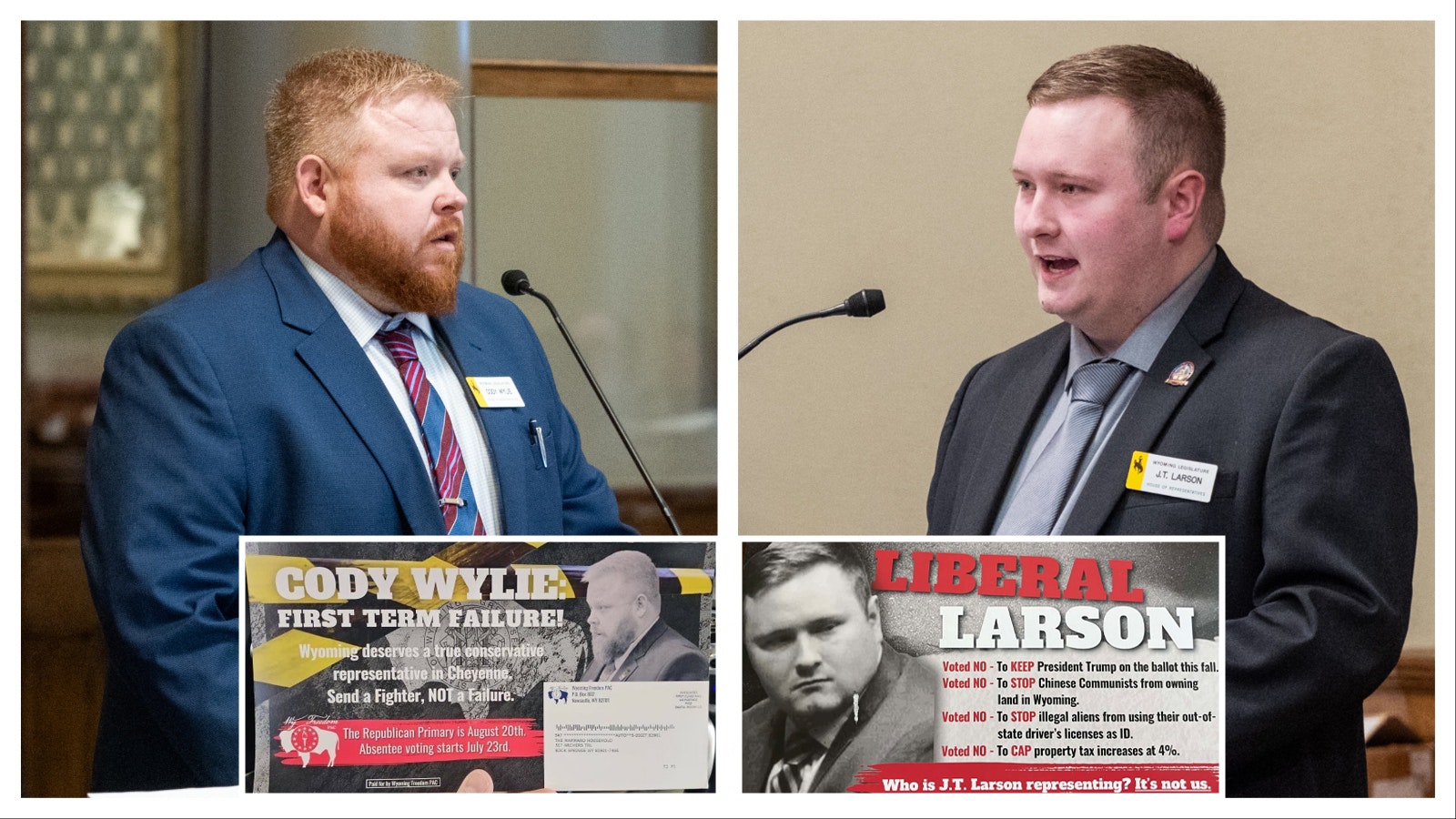
The Wyoming Freedom Caucus’s campaign arm is asking a Green River judge to end a defamation case against it without a trial and rule in the group’s favor.
State Reps. Cody Wylie and JT Larson, both Republicans from Rock Springs, sued the WY Freedom PAC in the summer of 2024 over mailers and text messages the PAC distributed to voters claiming Wylie and Larson had voted “with the radical left” to keep President Donald Trump off the ballot.
Wylie and Larson did not cast such a vote. Whether to keep Trump off the ballot did not surface as an issue before the Wyoming Legislature during the 2024 session that gave rise to this controversy.
The budget bill that session contained, rather, a footnote that sought to bar the Wyoming secretary of state from spending public money on out-of-state lawsuits in which the secretary was not a party.
The footnote as worded would not have barred Secretary of State Chuck Gray from joining such lawsuits using his own money or money from other sources, however.
Gray had, about four weeks before the Legislature debated that footnote, filed an amicus brief in the case of Trump v. Anderson, a legal challenge over whether Trump had disqualified himself from being on the ballot in Colorado based on his handling of the Jan. 6, 2021, U.S. Capitol breach.
Larson and Wylie, along with numerous other lawmakers, had voted to keep the footnote barring Gray from using Wyomingites’ public money to wage out-of-state lawsuits.
That footnote ultimately didn’t survive the state House and Senate’s joint negotiation committee.
The Ask
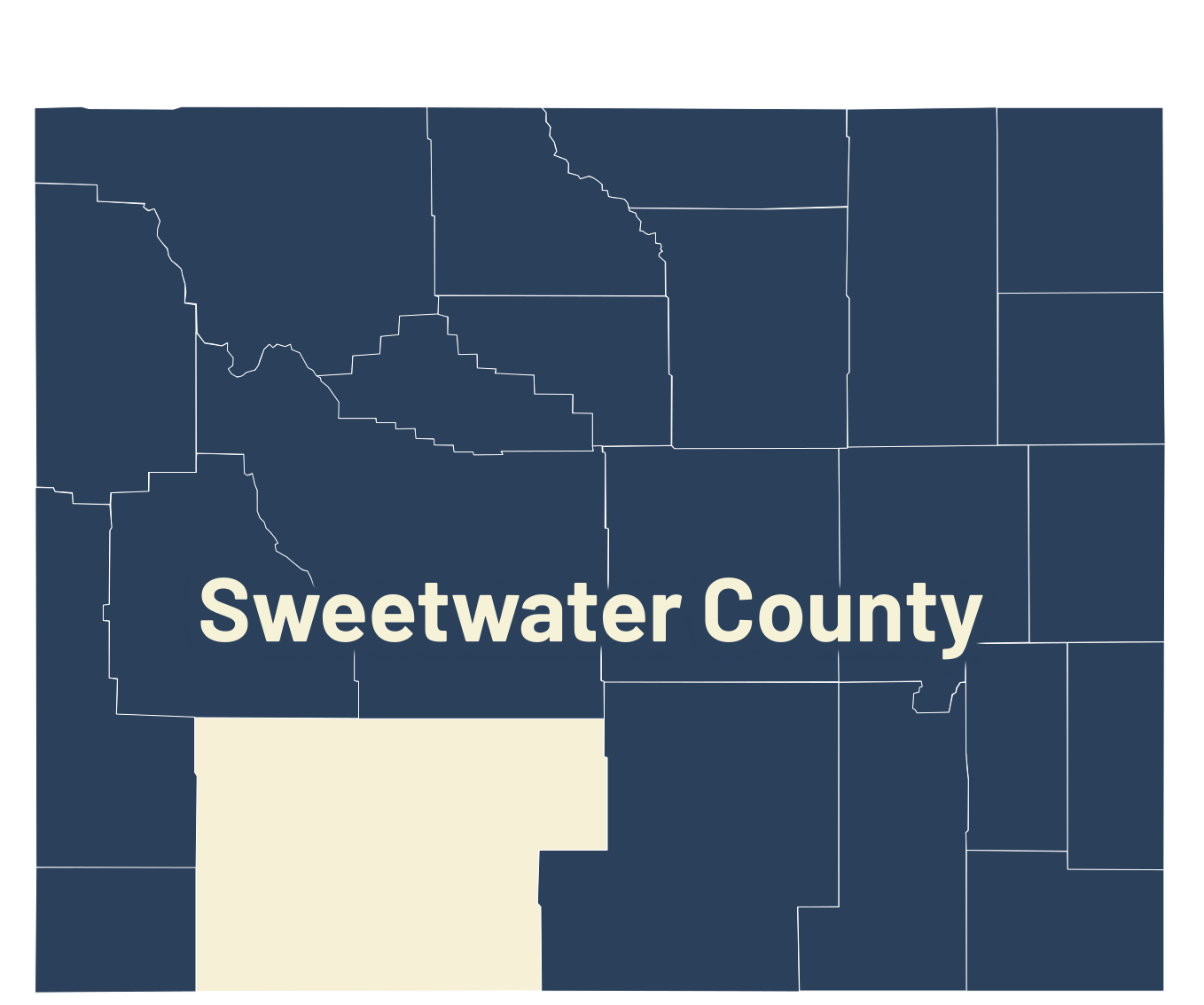
The WY Freedom PAC, which helps with the campaigns of Wyoming Freedom Caucus candidates, asked Sweetwater County District Court Judge Richard Lavery this month to judge the defamation case against it early, and in its favor.
To win on its motion for summary judgment, the PAC will have to prove that there’s no real dispute as to what happened and that the law tilts in its favor.
Larson and Wylie’s response is due March 20. Their attorney Clark Stith declined Friday to comment but noted his response deadline.
Rep. John Bear, R-Gillette, and WY Freedom PAC chair Kari Drost in 2024 discussed how to word the attack ads against Wylie, Larson, and others in the campaign season, court exhibits show.
An earlier draft of an attack ad said lawmakers had voted to keep Trump off the ballot in Wyoming, but Bear told Drost including the word “Wyoming” there was “a bit of a stretch,” says an exhibit.
The case about Trump was a Colorado challenge.
Bear testified in the Green River case that he believed Trump’s ballot eligibility could have hinged on the amicus brief Gray filed in Trump’s favor that January.
“Had he not influenced the court, we don’t know what the outcome would have been,” says a transcript portion from Bear’s deposition.
Drost testified that she believed everyone should have been fighting to keep Trump on the ballot, and that the footnote was retaliatory against Gray for his attempt to do so.
Gray’s was one of 76 amicus briefs filed in that case, across a spectrum of sources that included presidential candidate Vivek Ramaswamy, a coalition of retired state supreme court justices, the Republican National Committee and former U.S. attorneys.
The U.S. Supreme Court ultimately ruled that Trump was qualified to remain on the ballot.
More About That Trump Case
The WY Freedom PAC mobilized on Wylie and Larson’s votes to retain the budget footnote, during the 2024 primary election season.
The group sent out a text message blast to Republican voters claiming Larson “VOTED NO” to keeping Trump on the ballot and that Larson “voted with the radical left to REMOVE President Trump’s name from the ballot.”
The PAC targeted Wylie with mailers claiming he “voted with the RADICAL LEFT to remove Trump from the ballot.”
The lawmakers allege these claims damaged their reputations and prompted them to increase their campaign work and spending to counter the onslaught. For example, Larson dispatched a mailer emphasizing his support for Trump. The candidates also had to go door to door explaining their votes on that footnote, court documents say.
They sued WY Freedom PAC for defamation that July.
The Argument
Lavery ruled in March 2025 that the case had viable enough claims to overcome WY Freedom PAC’s request that he dismiss it.
The question now is whether enough factual dispute and legal issues remain to send it to trial.
The WY Freedom PAC’s March 2 filing says those elements are lacking. It claims, via its attorneys Mark Jackowski of Wilson, Wyoming, and Stephen Klein of Washington, D.C., that Larson and Wylie have shown inadequate evidence their reputations suffered.
It alleges the lawmakers’ two witnesses regarding their reputations were “recruited” into the case.
The PAC’s filing says that the alleged defamation also isn’t defamation “per se” or the kind of obvious defamation that doesn’t require evidence of reputation damages.
Courts recognize four kinds of defamation per se, says the filing. Those are: speech that imputes a criminal offense, a loathsome disease, a matter incompatible with business, trade, profession or office; or serious sexual misconduct.
The WY Freedom PAC’s filing turns to the third of those: whether by accusing Wylie and Larson of voting with the “radical left” to keep Trump off the ballot, it made claims incompatible with their offices as lawmakers.
Wylie and Larson had alleged that the false claims asserted matters that, if true, would render them incompatible with the offices they sought: The Republican nomination in the primary.
WY Freedom PAC in its filing urged Lavery to “reject any further attempt to distinguish Republican legislators from Democratic legislators for the purposes of the office of legislator.”
Parsing out what kind of claims would harm a Republican legislator more than a Democratic legislator would force the weighing of evidence to that end, when per se defamation is supposed to be obvious without evidence of specific damages, the filing asserts.
WY Freedom PAC’s filing casts the lawmakers’ attempts to counter its claims as minimal and its witnesses as inadequate.
“(They have not shown) evidence of scorn, shunning, hatred, contempt, dislike, disrespect, lost goodwill or confidence by a ‘substantial and respectable minority of the community,’” says the filing.
Wylie and Larson won the Republican nomination in that year’s primary election.
Bear said in his case testimony that the mailers “weren’t very effective,” the summary judgment argument says.
The group also emphasizes another point: that Wylie and Larson are public figures.
That makes it harder for them to wage defamation cases, because public figures have to prove the people who allegedly defamed them either knew they were lying or showed reckless disregard for the truth.
Citing Bear and Drost’s testimonies, the filing claims they both understood the footnote dispute as being “about keeping Trump on the ballot.”
Also attached to the PAC's summary judgment request is a text message exchange in which conservative podcaster Joey Correnti challenged Bear on the mailers' content, and Bear parried with an explanation similar to those in his later deposition statements.
"How does one twist that budget footnote into this claim and then mail it out to the electorate when that claim was never made on the floor or to the press while it was being debated?" asked Correnti of Bear. "What the hell were you guys thinking?"
Bear answered, "It is not a twist. The insiders were pushed until they admitted on the floor that the footnote was drafted because (the appropriators who formed the footnote) didn't like Chuck's behavior.
"What behavior?" Bear continued, "Working to keep Trump on the ballot in Colorado."
Bear then directed Correnti to the Feb. 15, 2024, House floor debate. "Everyone in that chamber knew what that vote meant," added Bear.
‘Unequivocally No’
In the Feb. 15, 2024, House floor debate on the footnote, Rep. Bob Nicholas, R-Cheyenne, who chaired the House Appropriations Committee at the time, said that the committee’s “primary concern is that (Gray) stay within the constitutional confines of what he’s directed to do and what his constitutional duties are – which would not normally be filing out-of-state litigation.”
Rep. Ken Pendergraft, R-Sheridan, said the chief person responsible for elections may find it “necessary” to be involved in some out-of-state litigation.
Rep. Rachel Rodriguez-Williams, R-Cody, asked for context on whether the Legislature had done such a footnote before – or if there was a similar footnote for the other four statewide elected officials.
Then-Rep. Tom Walters, R-Casper, countered, saying, “when we the Legislature start to see our top five electeds pushing the constitutional bounds of what they’re needing to do for the state of Wyoming, we the Legislature push back on those bounds… And remember, it’s for the state of Wyoming. Here within our borders.”
Walters said the Legislature has limited the state treasurer in past footnotes, for example.
Rep. Lloyd Larsen, R-Lander, who was then vice-chair of the House Appropriations Committee, pointed to other examples of footnotes limiting top executives' conduct.
Numerous Freedom Caucus-aligned House members pushed the appropriators for specifics.
Nicholas noted that the secretary of state is not normally the person who represents Wyoming in litigation, and said the footnote was “based upon the conduct” of the current secretary of state.
Rodriguez-Williams asked outright if it was an attempt to keep Trump off the ballot.
Nicholas answered, saying the footnote was “preventing (Gray) from doing what he does not have the authority to do.”
Larsen added: “In response, directly to (Rodriguez-Williams’) question, unequivocally: no.”
Trump did not come into the committee’s conversations and was not contemplated in the footnote, added Larsen.
During floor debate Jessie Rubino, Wyoming state director for the Freedom Caucus, texted a group of caucus-aligned House members, "Keep pushing - people make great mistakes when they're this mad."
"I'm REALLY MAD," answered then-Rep. Jeanette Ward, a Republican of Casper, who'd been among the Freedom Caucus members pushing the appropriators for specifics.
Clair McFarland can be reached at clair@cowboystatedaily.com.