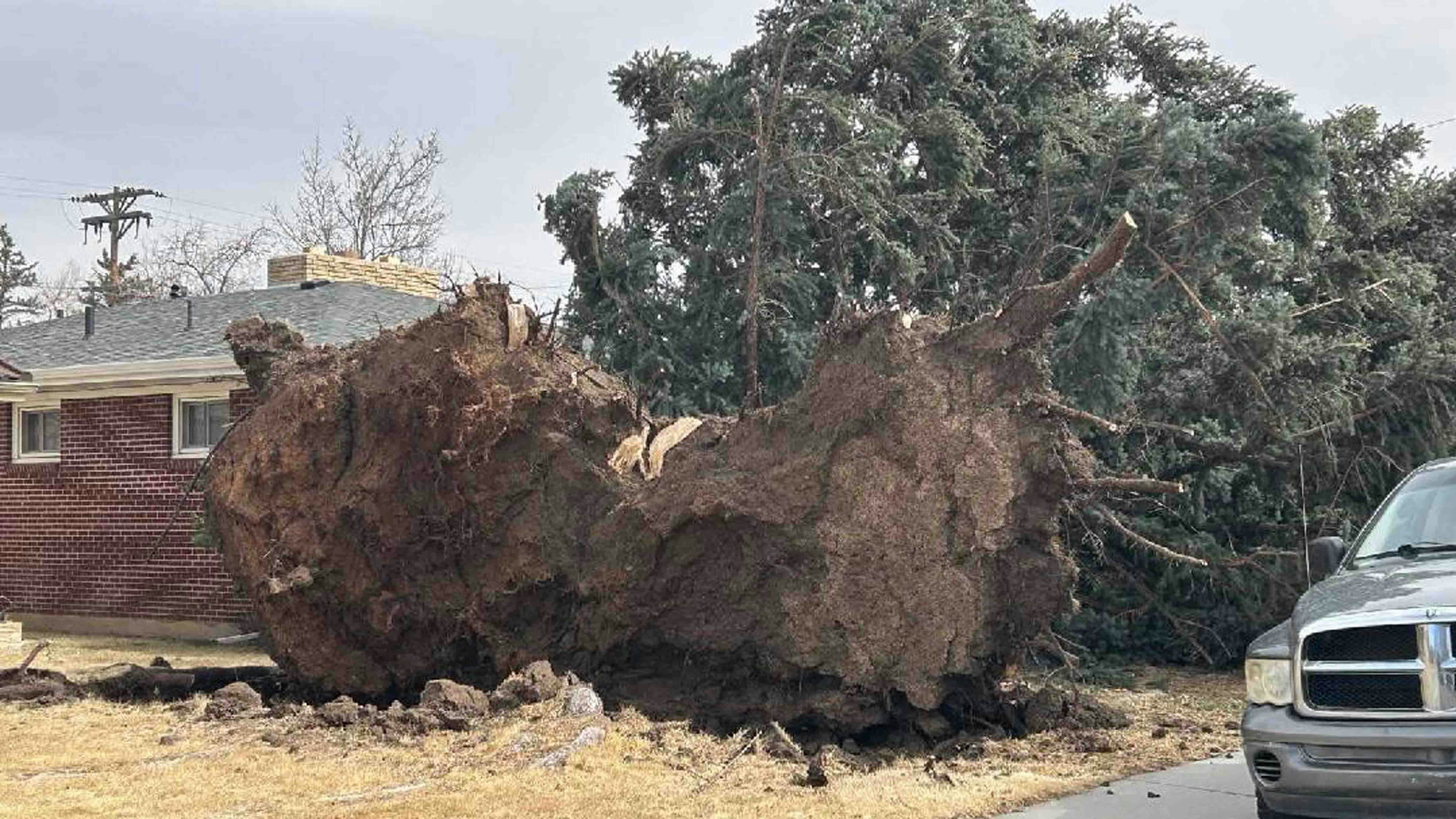
Downed trees littered the Cheyenne area a day after a record-breaking windstorm wreaked havoc on the city. While high winds were the obvious factor, area meteorologists and forestry experts say there is a bigger explanation.
Meteorologists and forestry experts traded theories for what else may have caused hundreds of trees to topple over during Thursday’s violent windstorm. The storm kicked up gusts as high as 109 mph west of Cheyenne and set a record 90 mph gust at the National Weather Service in Cheyenne.
Cheyenne’s urban forestry division was working to clear streets of downed trees Friday.
Urban forestry division manager Mark Ellison said his office was still trying to come up with numbers of downed trees on city properties.
He told Cowboy State Daily his office had already received calls to 75 addresses where trees have fallen, and there were hundreds of trees down on city properties.
“We do think the fact that this happened in March when the ground is not frozen and some snow and rain – that might have been a factor to help soften (the ground),” said Matthew Mclaughlin, a general forecaster with the National Weather Service in Cheyenne. “The combination of that and the high winds was just enough to push the trees over.”
Spruces Take the Brunt
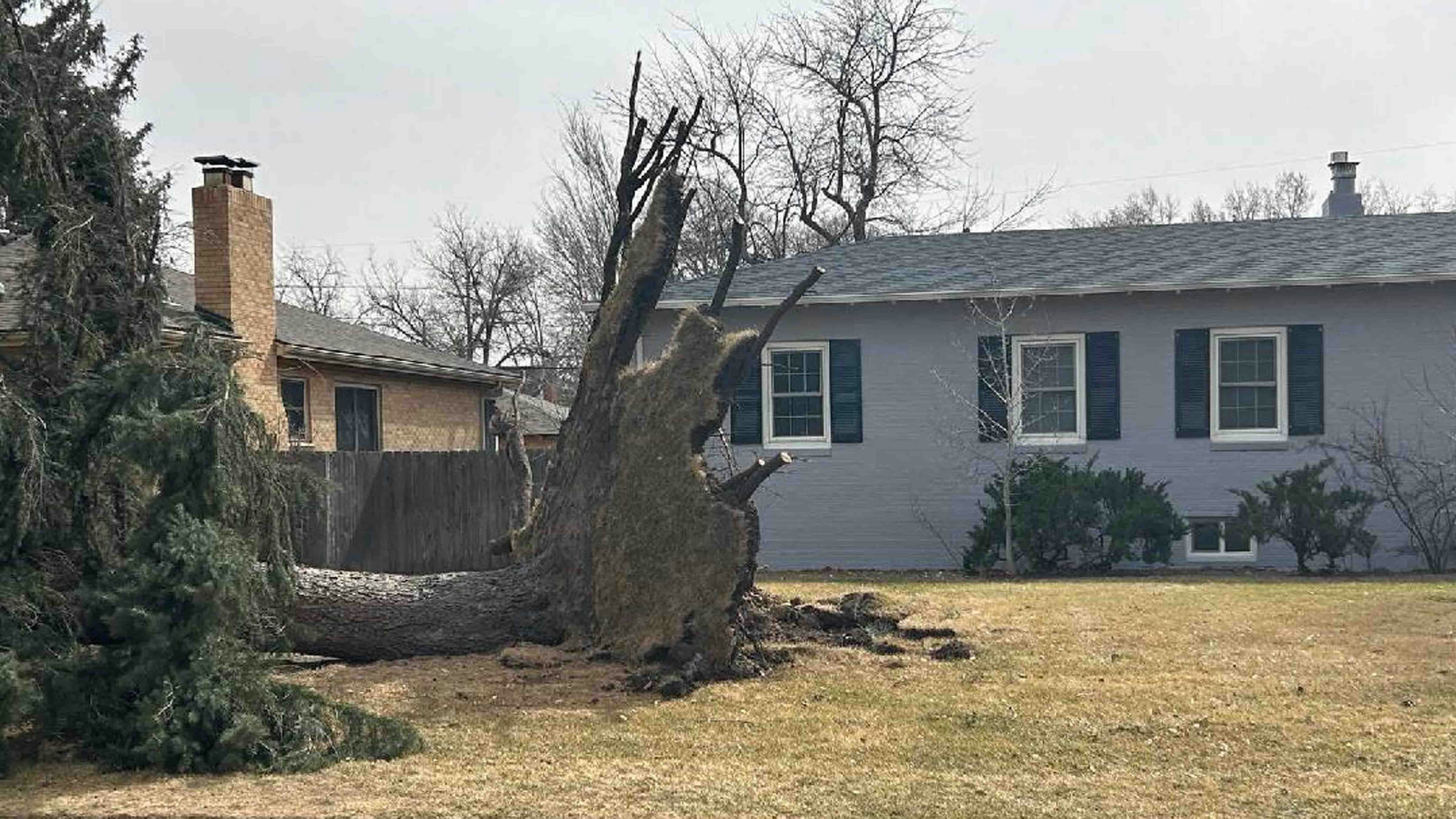
Multiple experts confirmed that a majority of the downed trees were spruces.
Conifers — the type of woody tree that typically features needle-like leaves — are most vulnerable to wind throw, said Ellison.
Within that category, “A lot of our spruce are probably the most vulnerable,” he said.
That’s because spruce have shallower roots than other conifers, he said.
Wyoming meteorologist Don Day said the root systems of spruce trees are generally shallow and spread out.
The older section of Cheyenne particularly has a lot of spruce trees, Day said. He added one tree he saw blown over in a yard must have been 75 to 80 feet tall.
“When they get really big like that, they’re kind of a sitting duck,” he told Cowboy State Daily. “The roots don’t pull out of the ground. The roots go sideways.”
Spruce is the second most common tree in Cheyenne, according to Ellison.
“We’re real vulnerable to wind throw,” he said.
“Skirted” Trees More Vulnerable?
One theory as to why spruces are often the first trees to blow down is that many of them are “skirted,” said Shane Smith, a horticulturalist who lived in Cheyenne for four decades.
That means tree branches toward the base of the tree have been removed to make mowing and pruning easier. But it could also mean the wind gets under those skirted trees, giving it more leverage to uproot them, Smith said.
Ellison said it’s a theory not yet proven.
How Moisture Plays Into It
Big tree blow-over events usually occur in the spring, after it rains or snows, according to Smith.
“But really, this has been such a dry winter, it equally makes it more amazing that so many trees went down,” Smith said. “The soil is not wonderfully wet.”
While parts of Wyoming have endured a drier-than-normal winter, Cheyenne received about 6 inches of snow and a half-inch of rain prior to Thursday’s wind, said Wyoming meteorologist Don Day.
“The ground was actually a little moist,” he said. “I think that probably loosened up the soil a little bit.”
Day said trees tend to be uprooted easier when big wind comes up after spring or summer rains.
Warmer Weather A Factor?
While warmer weather could be a factor in the tree blow overs, experts said it was hard to say for sure. Because of the time of year, Day said there typically isn’t a longstanding permafrost situation where the tree fall occurred. By March it’s common for the sun to have melted that permafrost layer.
But if Wyoming had encountered a more typical, colder winter, the ground could still be frozen this time of year and that could have led to a different story with the tree blow over.
Wyoming’s winter has been “unprecedented in some regards,” Smith said.
“I couldn’t tell you if that played in to it, but my gut says it does,” he said.
Now What?
Smith, who now lives in Colorado, was in Cheyenne for the weekend to visit family. “I pulled in right in the middle of the wind,” he said. “It’s devastating.”
The day after the storm, Smith told Cowboy State Daily, “I open the door and all I hear is chainsaws.”
Ellison said his department was trying to hire a few contractors to work in city parks, golf courses and the cemeteries. Help was needed to clear downed trees and remove trees that have become hazardous as a result of the damage they incurred.
Clearing tree debris and downed trees will be ongoing for the next week at least, he said.
“The sad thing is, what can you do to prevent it?” Smith said. “You’re not going to stake a tree and prevent it from blowing over.”
Ellison said species diversity is key to protecting Cheyenne’s canopy.
“This shouldn’t discourage people from planting trees,” Ellison said. “Trees are so important to our community. We encourage people to plant trees this spring.”
Kate Meadows can be reached at kate@cowboystatedaily.com.