How's Wyoming’s snowpack in March 2026? Anywhere from “just okay” to "a new record low" to “nonexistent," depending on where you are.
That’s the current state of Wyoming's snowpack according to Tony Bergantino, the director of the Water Resources Data System and the Wyoming State Climate Office (WSCO). He and his team are responsible for monitoring Wyoming’s snow water equivalent (SWE) in basins across the state.
“It’s an interesting mix,” he told Cowboy State Daily. “We’re running around the median in many basins, while others are basically horrible.”
After the warmest, driest winter on record for communities across Wyoming, the lack of snow is already alarming many Wyomingites. Bergantino isn’t panicking yet but thinks the next few weeks will make or break the rest of the year.
“We're looking at record low snowpack in several basins right now,” he said. “It's not too late to write this one off yet. Things can still turn it around, but people should be very, very aware of the current situation.”
Trickle Down Economics
Snowpack is one of the American West's most important and volatile natural resources. The amount of snow retained in the mountains determines the quality of spring runoff, which has a significant impact on river flows, agricultural productivity, and wildfire risk during the summer heat.
As temperatures rise, snowpacks melt and send water trickling into streams and soil. The livelihood of many people and industries is extremely dependent on the quality and quantity of that runoff.
With so much on the line, it’s not surprising that many western states are concerned by their alarmingly low snowpacks. As of March 5, all of Colorado’s basins are between 49% and 71% of their median SWEs, setting new record lows.
“The Colorado Climate Center measured the state’s snowpack on Feb. 7, then compared it to every Feb. 7 since they've been keeping snowpack data,” said meteorologist Don Day. “They determined this is the worst snowpack since 1981.”
Utah, which gets 95% of its water from snowpack, is setting its own record-low SWEs. Its basins range from 82% to 24% of their median, with Salt Lake City receiving less than three inches of snow during the entire winter season.
By comparison, Wyoming is doing better. And also worse.
“With Wyoming being the size that it is, you can have completely different conditions depending on where you are,” Bergantino said. “It can be a completely different world in two different basins.”
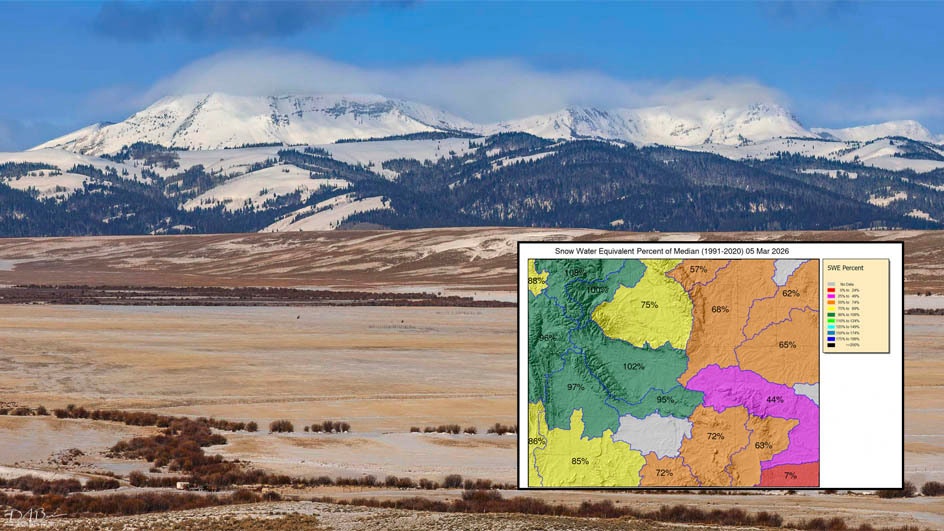
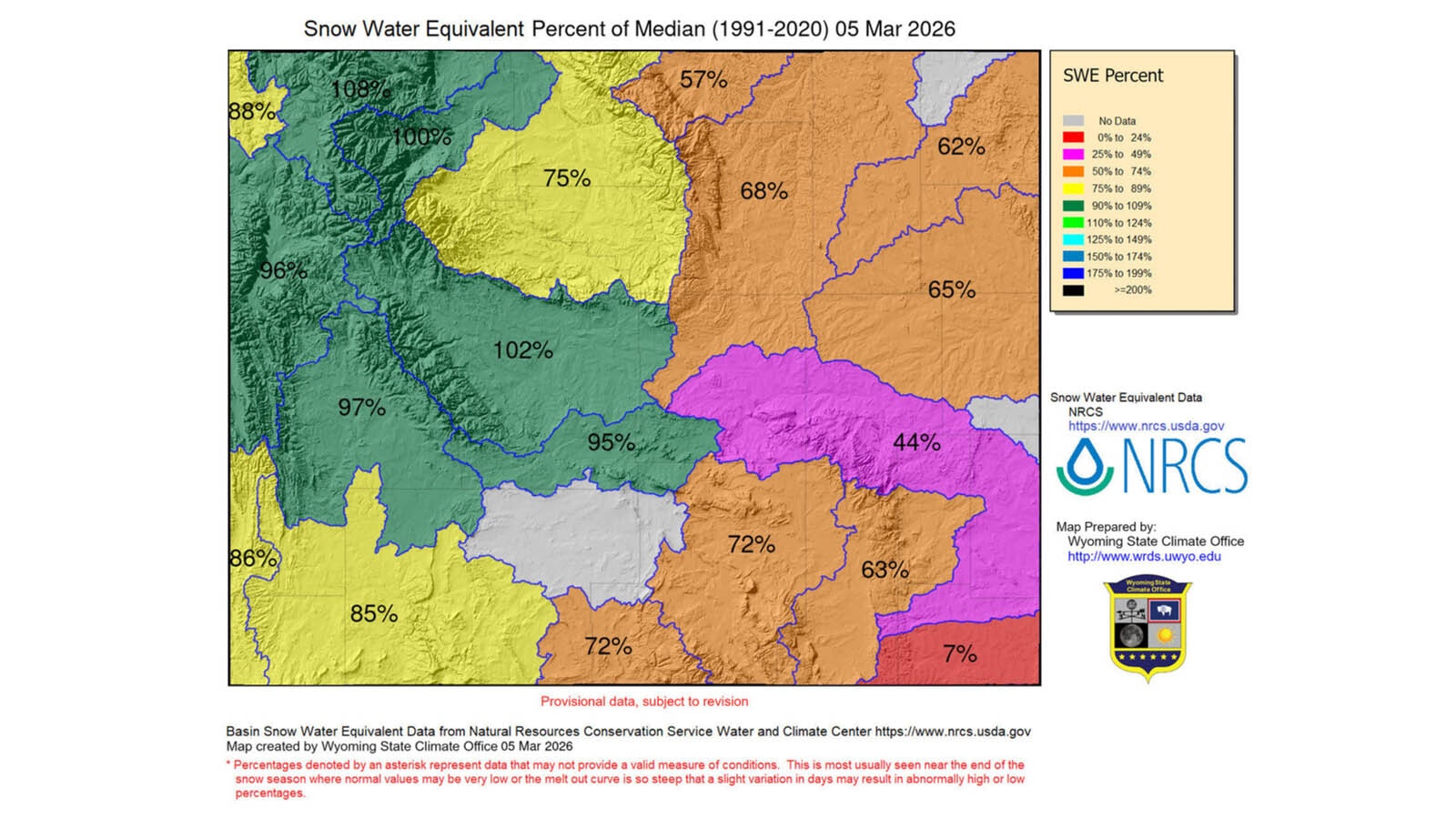
According to the WSCO, the Yellowstone Basin in northwest Wyoming was above average as of March 6, with 108% of its median SWE. Surrounding basins were similarly high, at or above their medians.
Meanwhile, the South Platte River Basin in the southeast corner of Wyoming is only at 7% of its median SWE. That's one of many basins currently at record-low SWE medians, according to Bergantino.
“I have shoveled less than a foot of snow in Laramie this winter, which is well under half of what I normally have by this date,” he said.
A Vicious Cycle
The most noticeable trend in Wyoming’s snowpack is the disparity between the eastern and western halves of the state. That’s been the dominant trend throughout meteorological winter, which ended on March 1.
There’s been plenty of winter weather this season, but it’s been siphoned away from Wyoming and the Rocky Mountain Region and sent eastward, leading to record-breaking snow and cold temperatures in the eastern U.S.
That same disparity is evident in Wyoming, too. It's been the dominant trend since the staggeringly low amount of winter snow started falling in November.
“The western half of Wyoming, particularly the northwest, is doing ‘fine,’ and that’s mostly in the high elevations,” Bergantino said. “The low-elevation snowpack is just nonexistent right now. There’s been very little on the ground, so most of what we have is confined to the higher elevations.”
The western mountains were doing well in December, when their SWEs reached as high as 143%. Those percentages have declined since then because of what Bergantino described as “an ongoing vicious cycle.”
“The warm temperatures we had in December, January, and February really hurt the situation,” he said. “With warmer temperatures, there’s not as much snow providing ground cover. With no snow cover, there was nothing reflecting radiation back into the atmosphere, so the warmer temperatures persisted.”
Western Wyoming is still holding significant snowpack, but conditions are noticeably worse further east.
That “vicious cycle” is enabled by Wyoming’s geography. It’s not a coincidence that the SWE medians are much worse on the eastern side of the Continental Divide.
“Arctic air tends to get hung up on the Continental Divide,” said Day. “It acts as a barrier that blocks the cold, dense air from going up and over the Rockies and into eastern Wyoming. When that air does get up and over, it tends to warm up and dry out as it descends. It’s literally a wall when it comes to weather.”
Run Off With The Runoff
Winter snowpack determines spring runoff. While it’s too early to say how Wyoming’s moisture situation will look in summer, farmers and ranchers are being forced to work with the information they have.
“I think their favorite thing to do is keep track of moisture,” said Todd Fornstrom, president of the Wyoming Farm Bureau Federation. “It’s an everyday conversation, and always a concern, but definitely more of a concern than normal this year.”
Farms and ranches in Lusk, Newcastle, and Sundance are currently looking at less than 70% of their median SWEs. It’s even worse in Douglas and Wheatland, where their swath of the North Platte River Basin is only at 44%.
The situation could improve, and Fornstrom hopes that it will. However, the agricultural industry can’t rely on tomorrow’s optimism when making hard choices today.
“Ranchers will be making decisions on what pastures they can and can't use,” he said. “They’ll have to decide whether to rely on their reserves of old grass, find new grass, or buy hay. Farmers are going to have to decide what spring crops they’re growing, especially if there’s a potential for a non-irrigated situation.”
Fornstrom said these decisions are “pretty normal,” but the drier-than-normal conditions and potential lack of runoff are adding more urgency to their choices. What farmers and ranchers decide today will determine their productivity and livelihood for the next year.
Nobody’s having serious discussions about worst-case scenarios yet, but Bergantino presented a harrowing image of the difficulties ahead if the snowpack situation in eastern Wyoming doesn’t improve.
“The biggest repercussion would be lack of water for basically anything,” he said. “That would mean administration of water rights, including calls to shut off junior water rights, if there’s a lack of water going into the growing season. That’ll be the biggest ramification.”
Will Better Be Good Enough?
December, January, and February are the driest months of Wyoming’s year. That’s, simultaneously, a source of concern and optimism from Bergantino’s perspective.
“The earlier part of the season is not that critical,” he said. “We really start to see SWE medians pick up with the wet springtime storms in March, April, and May.”
Bergantino could recall several years when a bleak snowpack outlook was rectified by a series of intense March snowstorms, even in basins with record lows in February. However, even he acknowledged that those years “weren’t quite as bleak” as current conditions.
Long-range models for spring precipitation, rain or snow, are a mixed bag, in Bergantino’s opinion. Most models are showing a stronger signal for more precipitation over the next two months, but with below-average amounts.
Then there’s the question of whether the snowpack situation has passed a threshold where it’s too little, too late. That should be a particularly concerning point for the agricultural industry.
“Even if there’s more runoff, how much of that is going to make it into the streams and rivers, and how much is going to be absorbed into the ground to replenish the soil column? I'm sure the ag interests are watching that very closely,” he said.
The long-term outlook isn’t ideal, but it’s better than what happened this winter. Bergantino called the next several months “a period of caution.”
“This is the time of year that’s critical for buildup,” he said. “Can it turn around? Yes, but there’s a lot of unknowns at the moment.”
That’s where long-range weather modeling can be a blessing and a curse. Hope or despair derived from one model can be assuaged or amplified by the next.
“I can show you 8,000 models, and those 8,000 models will have different results,” Day said. “March is off to a good start, and the southern half of the state is going to have some really good opportunities for rain and snow.”
Hurry Up And Wait
Wyoming’s western snowpacks are holding their own. Its eastern snowpacks left a lot to be desired, but there’s time and opportunity to cover more ground with snow and moisture.
“We’ve got a lot of disparity east and west, north and south," Bergantino said. "We can recover, and maybe even reach above median snowpacks in March and April, but we already have some problems ahead.”
The best Wyomingites can do is hope for the best and brace for the worst. Nobody can say how impactful Wyoming’s warmest winter has been, and how much the next few months can turn things around, until it’s all over.
Fornstrom farms in southeast Wyoming, where moisture is needed the most. He’s keeping a wary eye on the weather and his fellow farmers but has a practical perspective that helps him keep everything else in perspective.
“We're going to accept the conditions as they're laid out in front of us,” he said. “There's hope still, but Mother Nature gives us what we need, or she doesn't. There's not much change in that. How it turns out is yet to come.”
Andrew Rossi can be reached at arossi@cowboystatedaily.com.