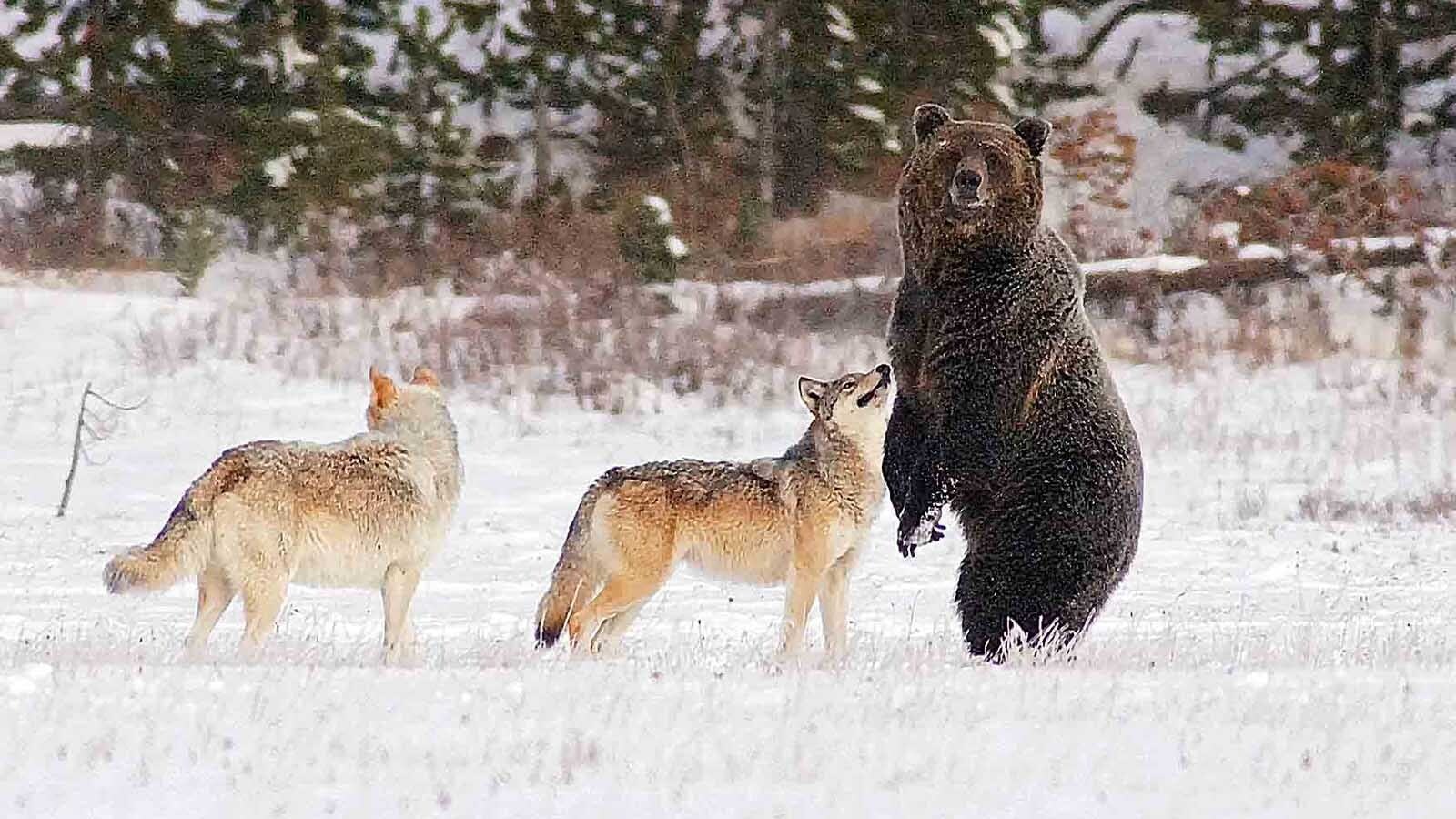
As competitive apex predator species, grizzlies and wolves only very rarely get into bloody fights, but neither are they going to be best buddies either, a wildlife biologist said.
A wildlife photographer who captured an image of two wolves and a grizzly right next to each other, all looking perfectly calm, said it was an almost impossibly rare moment.
At first glance, the photo might give the impression that the wolves and the grizzly were trying to make new friends. That wasn’t the case, photographer Pete Bengeyfield told Cowboy State Daily.
“It was a young bear and he was curious,” as it approached the wolves, he said.
“The wolves were standing there, and right as I took the photo, the bear stood up and looked at me,” he said.=
In most cases when grizzlies and wolves opt against fighting, it's because the risk of injury outweighs the possible reward of defeating a rival predator, biologist Cecily Costello told Cowboy State Daily.
“What’s the point of it? What’s the point of getting into a fight just because you run into each other?” said Costello, the statewide grizzly research biologist with Montana Fish, Wildlife and Parks (FWP).
Morning Get-Together
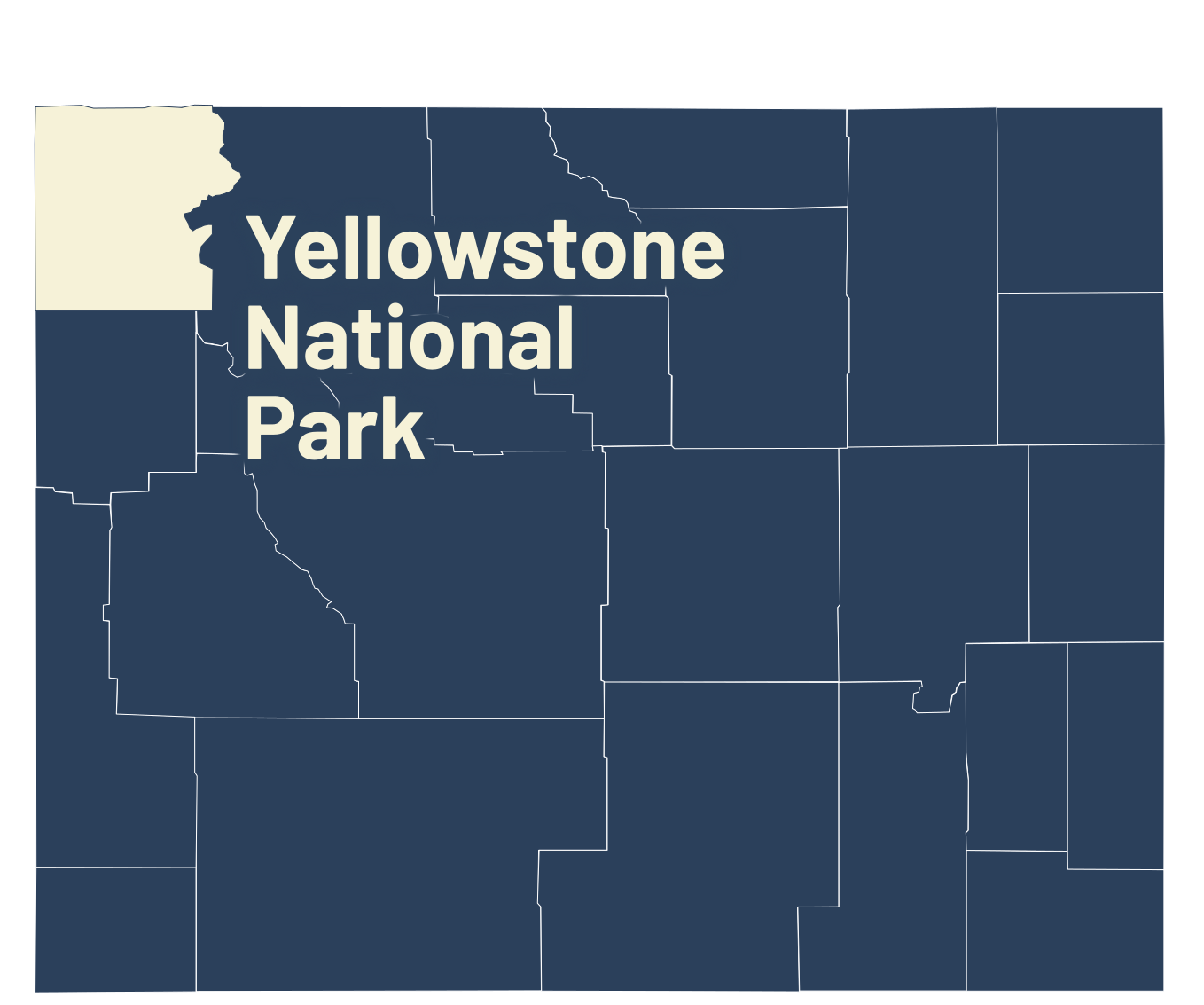
Bengeyfield said he got the photo just after dawn during a recent spring day in Cascade Meadows. That’s just south of Canyon Village in Yellowstone National Park.
When he first arrived, it was too dark to get photos, but he noticed three grizzlies, apparently a female with two nearly grown cubs.
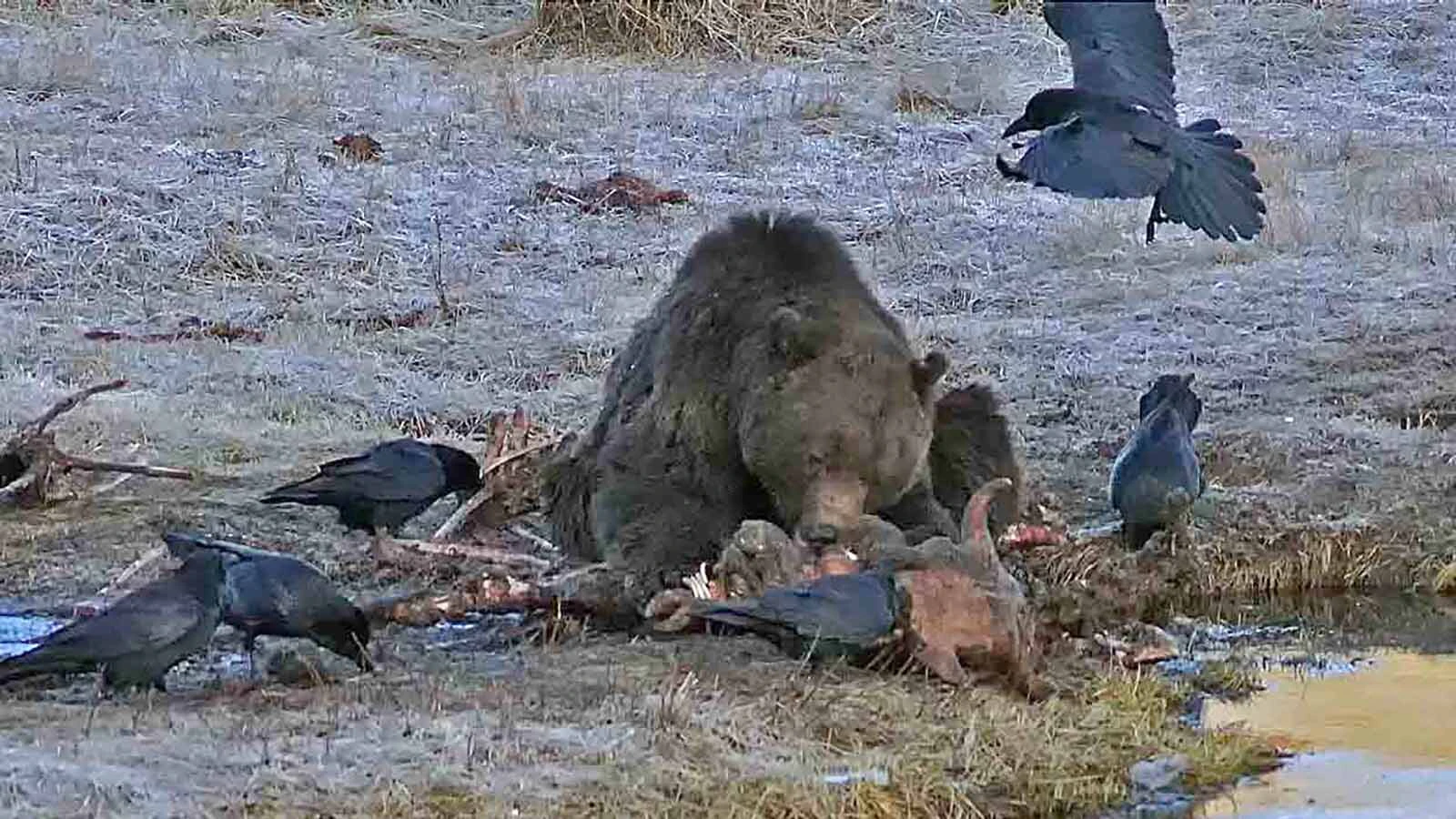
The grizzlies were feeding on a big game carcass, and four wolves were also there.
The predators were all calm, he said. The wolves were interested in the carcass but also seemed willing to stay back and bide their time – rather than charging in and starting a brawl with the bears, he said.
Just after there was enough light to shoot photos, one of the young bears ambled over toward the wolves, and he captured the photo at just the right moment.
The photo depicts such a rare moment, he recently posted it on a social media site “because I wanted to see how many people would accuse me of using AI (artificial intelligence),” he said.
Many of them did, saying Bengefyfield must’ve Photoshopped the image or used AI to alter it. He adamantly denies those claims, saying it’s 100% a real image.
Low-Key Conflicts Common
After he took the photo, the animals continued to mill around. At one point, the wolves half-heartedly “chased” one of the young bears, but it didn’t seem like anything serious, Bengeyfield said.
Finally, the mother grizzly got fed up and dragged the carcass into the trees, out of sight, he said.
He said he’s witnessed and photographed countless scenes of wolves and grizzlies gathering around carcasses and sometimes competing for the food.
Almost all the time, the “fights” are little more than tussles, he said.
“It all depends on the number of wolves, the age of the bear and the age of the wolves,” he said, regarding whether a wolf pack can harass a bear away from the carcass.
Most of the time, bears and wolves get along well enough, although the instance he photographed was the only time he’s seen a bear walk right up to wolves, with the wolves not seeming to care, Bengeyfield said.
‘Posturing’
Costello said bears, wolves and other predators avoid fighting because fights can lead to injuries. And injuries that impede a predator’s ability to hunt are a death sentence in the wild.
“Encounters between bears and wolves happen frequently” where there are fresh carcasses in Yellowstone, she said.
Disagreements over who gets to eat first almost never come to conflict.
And “even then, they rely more on posturing and displays of domination, more than on actual fighting,” she said.
After viewing Bengeyfield’s photo, she said it depicts a scene where there wasn’t much tension, likely because none of the animals were desperately hungry.
While bears and wolves might sometimes look to each other for cues on where food is, they’ll probably never join forces.
“There are situations where people have seen small predators following each other around, like coyotes and badgers,” she said.
She was referencing instances when badgers and coyotes team up to catch prairie dogs.
Such direct cooperation between apex predators like wolves and bears is highly unlikely, she said.
Mark Heinz can be reached at mark@cowboystatedaily.com.