
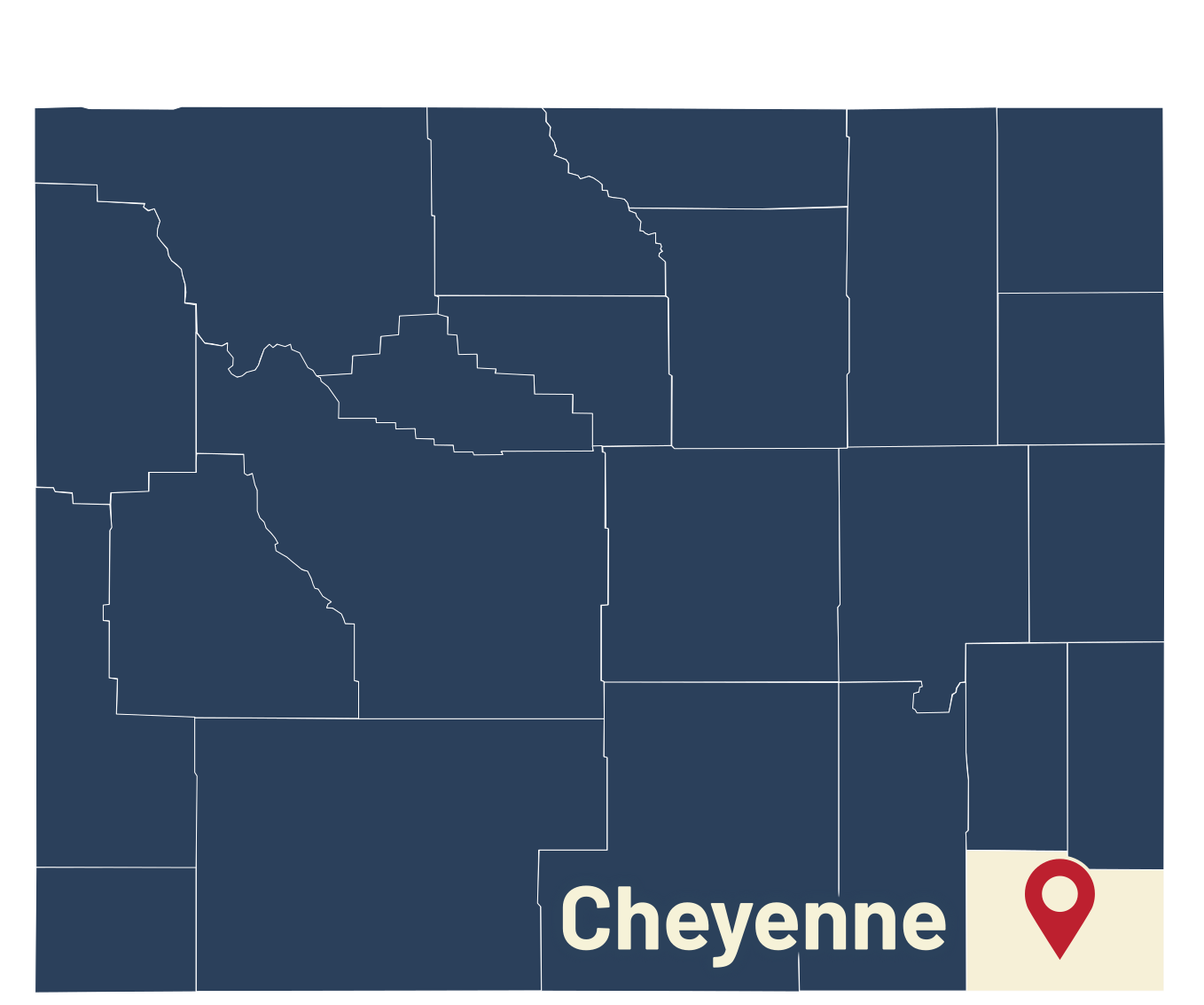
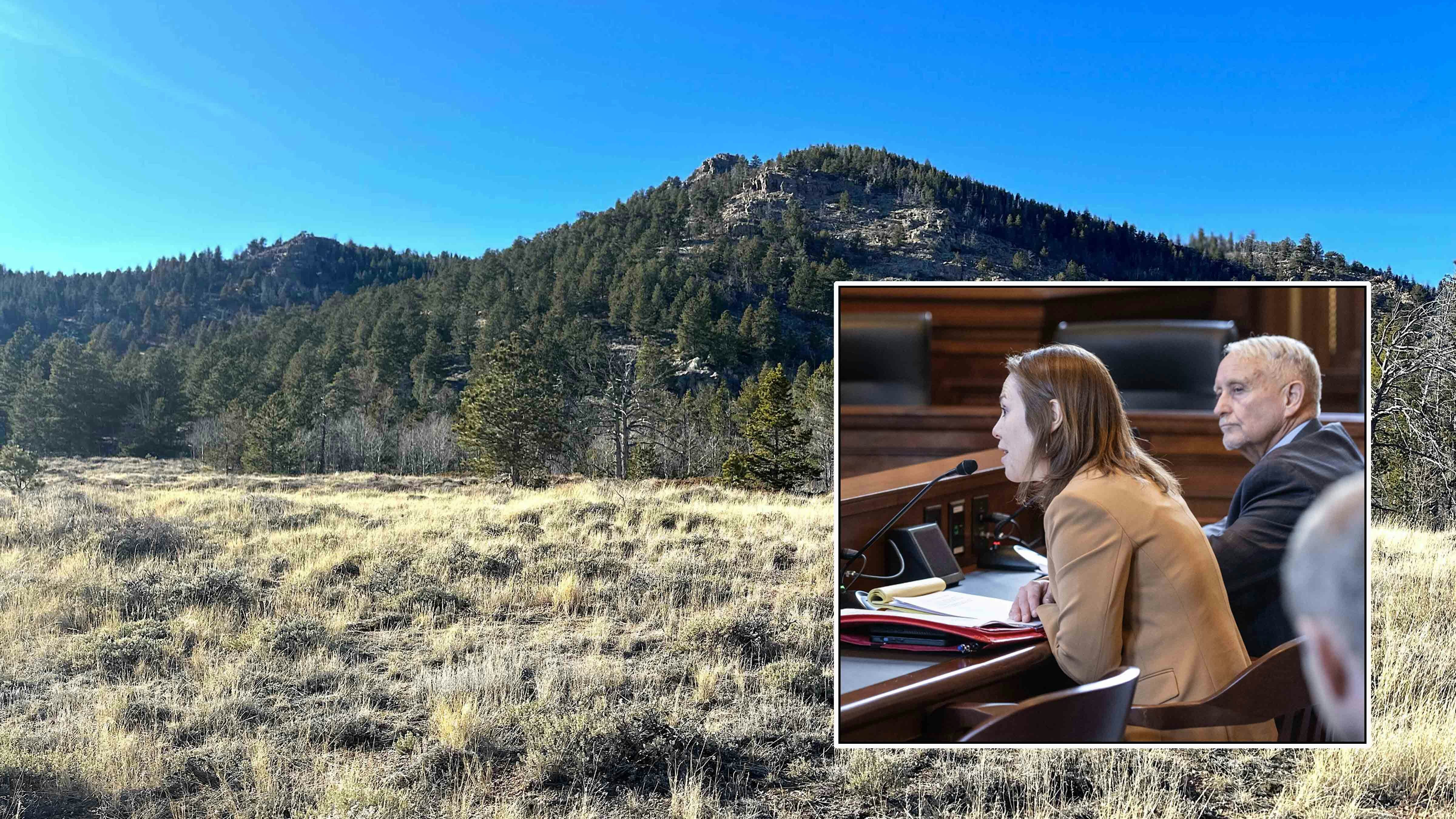
CHEYENNE — For most of February, hikers exploring the trails around Pole Mountain — the 9,040-foot summit that rises above Happy Jack Road between Cheyenne and Laramie — have found something unsettling underfoot: dirt.
No snowshoes needed. No postholing through drifts. Just bare, brown ground where a healthy winter snowpack should be settling in for the long melt into spring.
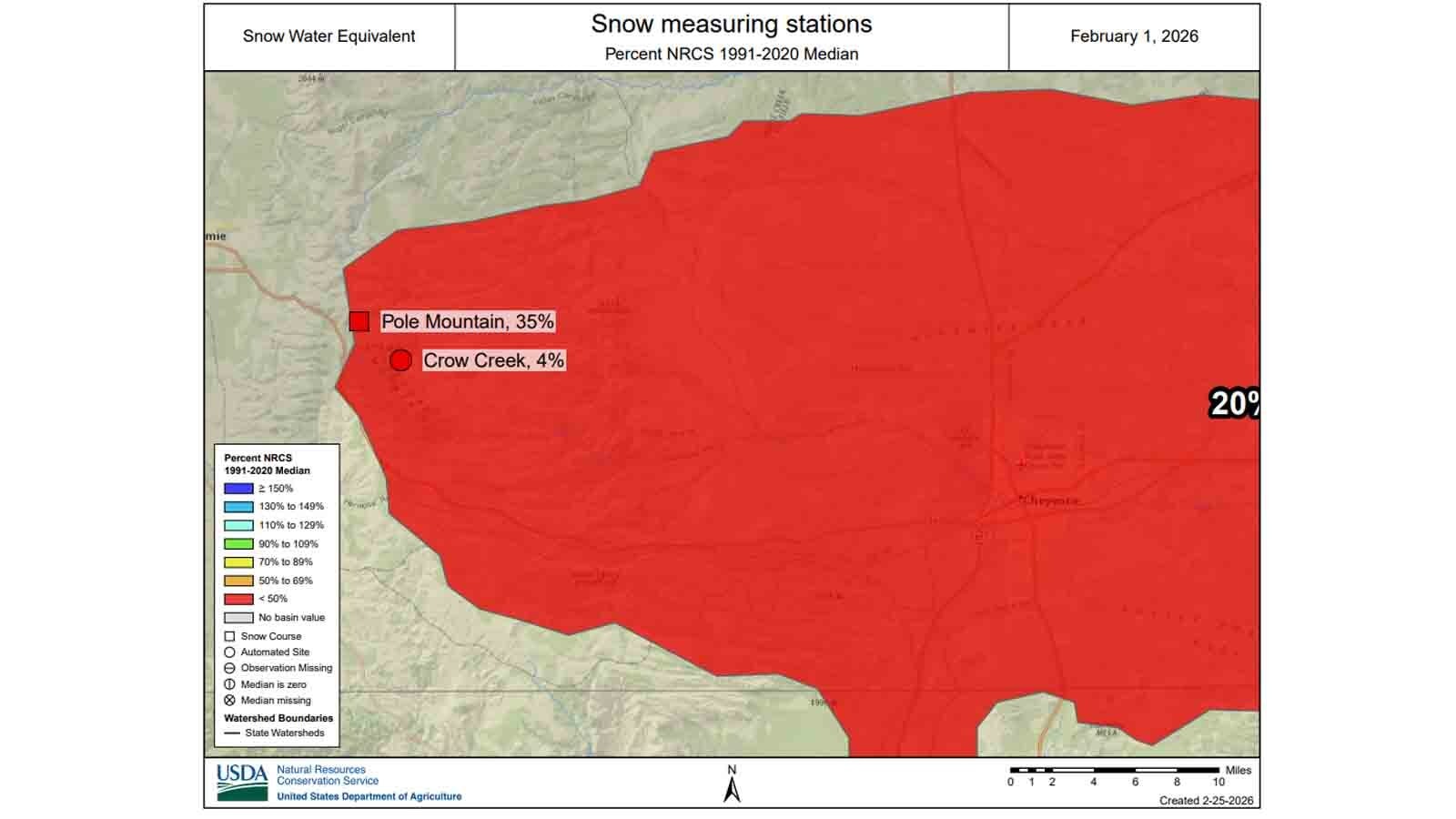
At the mountain's base sits a small, unassuming piece of federal monitoring equipment known as the Crow Creek SNOTEL site.
SNOTEL, or SNOwpack TELemetry, is an automated network that monitors snowpack and climate conditions across the Western U.S. and Alaska, tracking metrics like snow water equivalent .
What Crow Creek SNOTEL site is recording right now has caught the attention of water supply specialists, fire managers and state lawmakers alike: just 0.2 inches of snow water equivalent against a median of 5.8 inches. That's 3% of normal — essentially no snow water content at all at a site that should have nearly six inches of water locked in its snowpack by mid-February.
Because Crow Creek is the sole monitoring station in Wyoming’s South Platte basin, that basin's index is also 3% — the lowest of any basin in the entire state, and it's not close.
It's a number that helps explain why, 40 miles down the road in Cheyenne on Tuesday, state lawmakers were advancing legislation to put more firefighters in the field before the landscape ignites.
Legislative Push
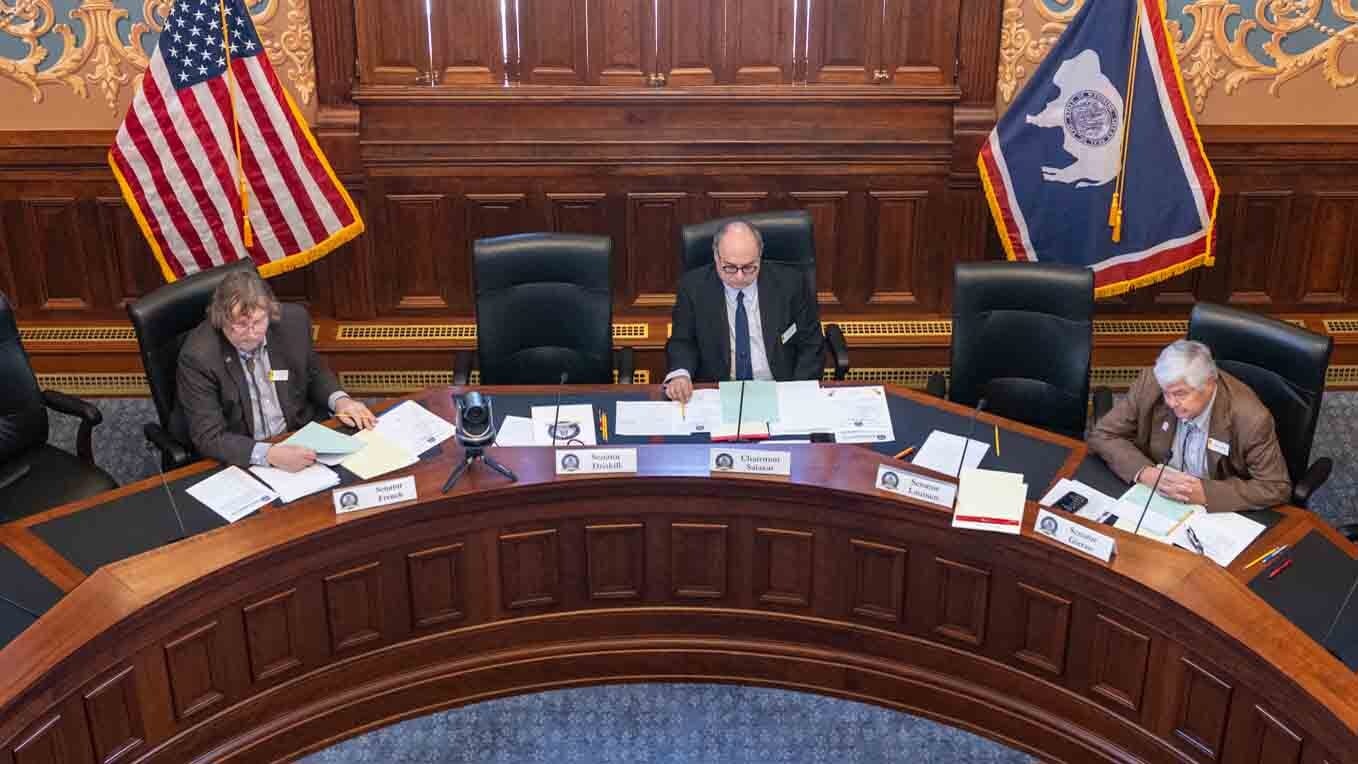
On Tuesday, the Senate Appropriations Committee advanced two bills aimed at bolstering Wyoming's wildland firefighting capacity ahead of what many fear could be another devastating fire season.
The committee, chaired by Sen. Tim Salazar, R-Riverton, voted 2-1 to advance House Bill 36, which authorizes 24 new positions and $5.14 million to stand up two wildland fire suppression modules — one on the east side of the state, one on the west. The committee also voted 3-1 to advance House Bill 106, which funds two new crew supervisor positions for the Smokebuster inmate firefighting program at $499,709.
Gov. Mark Gordon's policy director, Randall Luthi, described the current drought conditions.
"As we look at even today, we're nearing the end of February, and as you look throughout most of the state of Wyoming, it is dry, and not only dry, but damn dry, if you don't mind the expression," Luthi told the committee. "That just sets up well that we could have another big fire season. And we've had two big fire seasons, two of the last three years."
The lone no vote was cast by Sen. Tim French, R-Powell, who told Cowboy State Daily, “My question is, are we overreacting to a couple horrific fires? Is it a one in 25 year event? I kind of want to wait and see versus building a big infrastructure thing that may not do anything. If we don't have any big fires, I just wanted to kind of wait and see how this all played out.”

First Response
The central argument for both bills is speed — getting Wyoming's own firefighters on the ground before blazes grow into the kind of expensive federal operations that defined the last two fire seasons.
Wyoming State Forester Kelly Norris reminded the committee that the state is responsible for wildfire suppression across 32.7 million acres of state and private lands. She said the “modules” — or fire fighting teams — are designed to focus on initial attack, getting boots on the ground faster using state resources.
"Outside of that, when they're not fighting wildland fire, they're going to be doing fuels mitigation work," Norris told the committee. "And when we're doing fuels mitigation work, the ROI is about for every dollar on mitigation, it's about $7 in return for fire suppression costs."
The bill had been amended in the House to add a second team of firefighters. Norris noted that the Wyoming Rural Fire Association and the Fire Chiefs Association had originally asked Joint Appropriations for four modules — this bill represents half that request.
Volunteer Strain
Fire wardens and chiefs from across Wyoming lined up to testify in support, painting a picture of a volunteer firefighting force stretched to its breaking point.
Jerry Parker, the Park County Fire Warden, spoke to the toll on volunteers directly.
"There used to be a time where an employer would pay his firefighters to go out. The firefighter could leave for any amount of time that was necessary," Parker told the committee. "Today they can leave but may not get paid."
Lanny Applegate, representing the Wyoming Fire Chiefs Association, put Wyoming's capacity in stark comparison with neighboring states: South Dakota has 37 full-time firefighters, Utah has 140, Idaho has 93, and Arizona has 146.
"And they don't have near the landscape that we have," he said. "This is not a big ask. This is just a big help to our volunteers."
Inmate Crews
House Bill 106 addresses a different but complementary piece of Wyoming's firefighting puzzle: the Smokebuster program, a joint operation between the Wyoming State Forestry Division and the Department of Corrections dating back to 1964.
The program deploys pre-release, minimum-security inmates from the Wyoming Honor Conservation Camp in Newcastle for wildland firefighting and forestry management work.
The bill funds two new crew supervisor positions at a total cost of $499,709 for the biennium.
The program currently has 12 inmates and three crew supervisors. Assistant Fire Management Officer Christopher Fallbeck said the new positions would allow supervisors to take smaller squads into the field and build toward eventually fielding a second Smokebuster team.
Norris told the House Appropriations Committee earlier this session that the program currently has just one position qualified to lead the crew.
"When that person is sick or has a family member sick or they're out, it becomes unavailable — that crew — which is a barrier," she said.
Norris also noted the crew is "incredibly critical at this time of year when we won't have a module, but we still have high fire risk. Many times in February and March of the last couple years, they've been responding and supporting counties, such as Platte, helping with mop up and all of those things from unexpected wildfires at this time of year."
Broad Support
Both bills drew support from a coalition of agricultural organizations, conservation groups, and local government officials. Era Arino of the Rocky Mountain Farmers Union summed up the consensus: "You don't always get a unity, but today on this bill, you have it."
The legislative urgency is not theoretical. Wyoming has already recorded approximately 89 wildfires in 2026, burning about 114 acres. The largest — a 64-acre blaze near Riverton in early February that jumped the Wind River and triggered mandatory evacuations — underscored just how early and aggressively the fire season is starting.
Norris told the House committee that almost all wildfires reported this year have occurred on state and private lands, and that snowpack was currently under 70% in eastern Wyoming.
The data she presented from the last biennium was sobering: 383 firefighting crews were ordered to support wildfires in Wyoming, and over 90% came from out of state. The cost to Wyoming for crews and firefighting leadership alone was approximately $10.8 million, with firefighters arriving from 31 different states.
Snow Drought
But to understand the full scope of what Wyoming may face this summer, the Crow Creek SNOTEL site offers one window — and Jeff Coyle, the NRCS Water Supply Specialist for Wyoming, has been studying it closely.
"It is bad but has been worse. Let me explain," Coyle wrote in an email to Cowboy State Daily.
The Crow Creek SNOTEL site only has records going back to 2003.
"This is a fairly young SNOTEL site and there is going to be bias for extreme weather due to this," he wrote. As for what's driving the abysmal numbers, Coyle said it's straightforward: "It looks like it is just precipitation."
The site has received only 4.2 inches of total precipitation since Oct. 1 — 57% of the 7.4-inch median. The snow isn't melting away. It simply hasn't been falling.
A manual snow course called Pole Mountain sits right next to the Crow Creek station and has snow water equivalent data going back to 1937. That record shows 2026 as the 13th lowest snowpack year in 90 years of measurement — a poor year, certainly, but not unprecedented. An analysis of nine snow course sites within the South Platte basin with continuous data from 1952 to 2026 ranked 2026 as the fifth-driest snow year, behind 1981, 1977, 2013, and 2002.
The east-west divide across Wyoming is dramatic. While the South Platte basin sits at 3% of median, the basins in western Wyoming near Yellowstone and the Tetons are near or above normal — Yellowstone Headwaters at 109%, Shoshone and Wind River both at 100%, Snake River at 94%, and Upper Green at 93%. Everything east of the Continental Divide is hurting: the Lower North Platte at 34%, Tongue River at 54%, Laramie River at 56%, and Belle Fourche at 62%.
Several other individual SNOTEL sites are also registering near zero. Tie Creek in the Tongue basin reads 0.0 inches — literally no measurable snow water equivalent. Soldier Park in the Powder basin is at 1.1 inches, or 24% of median. Windy Peak sits at 1.2 inches, 22% of median. Casper Mountain is at 2.4 inches, 27% of median.
The drought conditions connect directly to wildfire risk. Before the Senate Agriculture Committee on Tuesday, Norris made the link explicit.
"Wyoming is considered the headwater state, meaning our forests hold the headwaters to the Colorado, the Missouri, and Columbia rivers," she said. "Protecting and restoring the source of Wyoming's water, specifically managing Wyoming's biggest reservoir, our snowpack, is an increasingly urgent priority."
She explained that when wildfire burns through forests, the damage cascades. Without living trees to shade the ground, snowpack can't accumulate and hold.
Asked about current conditions, she was blunt: "It's unnerving. We bumped up from 70% to 75% on the west side. On the east side, this last week, we were down to 70% snowpack. So, yeah, it's a little unnerving right now. We need moisture right now.”


