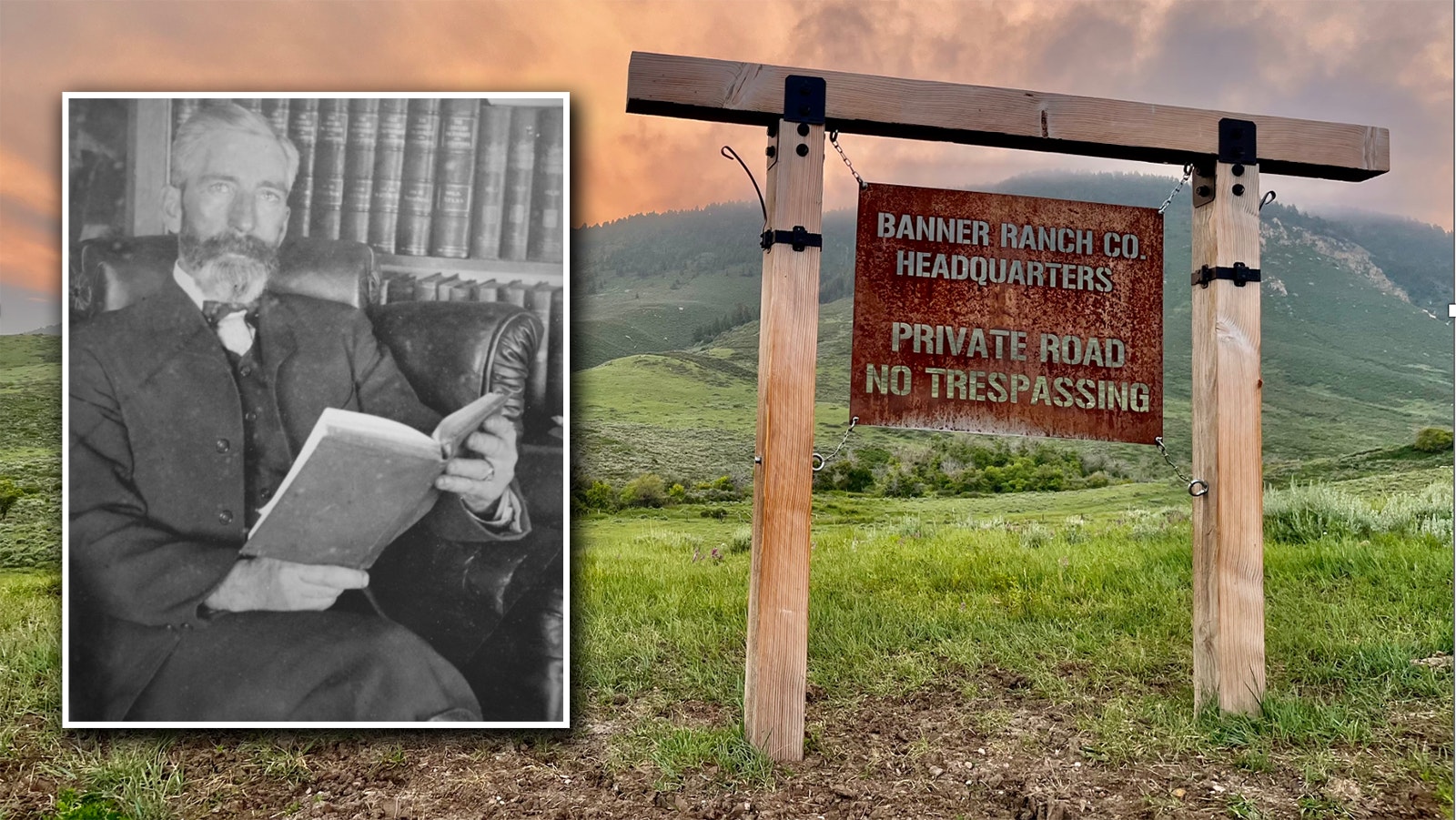
Nearly 144 years after Bryant Butler Brooks traded a trapper's six No. 4 traps and some flour for a cabin southeast of Casper, the legacy of the former rancher, businessman, Wyoming governor, and pioneer continues into the fourth, fifth, and sixth generations of his family.
Shelly McCleary Trumbull, a great-granddaughter of Brooks, shared the history of her family’s ranch before a crowd of more than 50 recently.
They were all gathered to learn more about the family’s ranching past and present at Fort Caspar Museum.
Trumbull weaved a story through the generations of a Wyoming family that began with a 21-year-old Brooks decided trapping in the Deer Creek area southwest of Glenrock and surviving in the mountains was a tough life.
“He learned wintering in the mountains was trying, as the snow depths were much more significant than in the Platte River Valley, and he struggled with isolation,” Trumbull said.
Brooks first arrived in Wyoming after spending his early years in Bernardston, Massachusetts, where he was born on Feb. 5, 1861.
His family moved to Chicago when he was 10, and his father, Silas, started a lock manufacturing business there after the Great Chicago Fire from Oct. 8-10, 1871.
The 19-year-old left the big city for Wyoming with a high school diploma and business education, looking to make his way in the world.
He spent time cowboying for Cheyenne and then Deer Creek ranches before trying his hand at trapping before trading for the cabin.
After acquiring the cabin, he launched his ranching career with help from his father and brother, forming B.B. Brooks and Co. with the V-Bar-V brand in July 1883.
Trumbull said Brooks traveled to Green County, Wisconsin, and bought 80 yearling heifers, then shipped the two trainloads of cattle to Rock Creek northeast of Laramie.
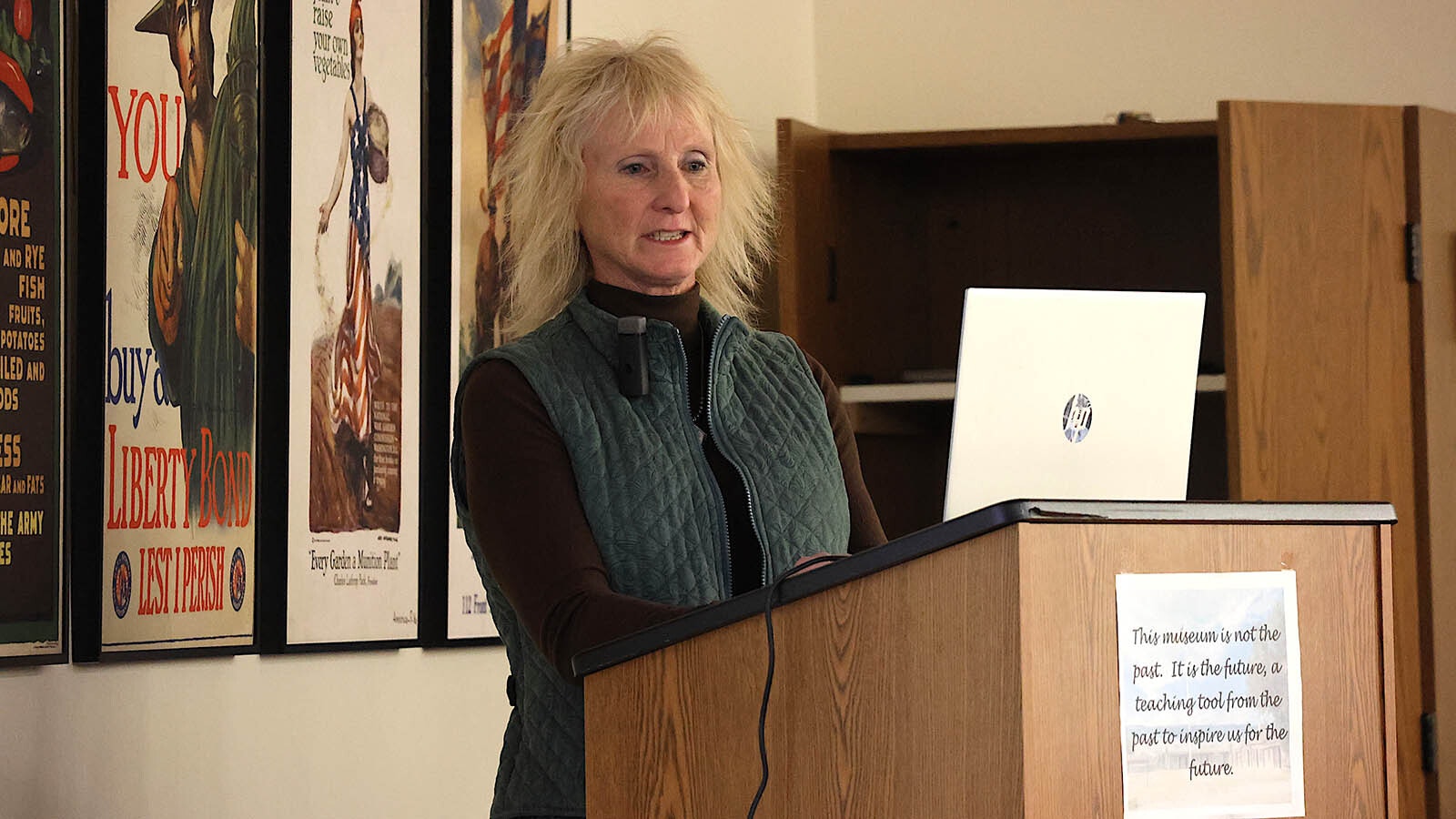
Shelly Trumbull, the great-granddaughter of B. B. Brooks shares her family’s history. (Dale Killingbeck, Cowboy State Daily) 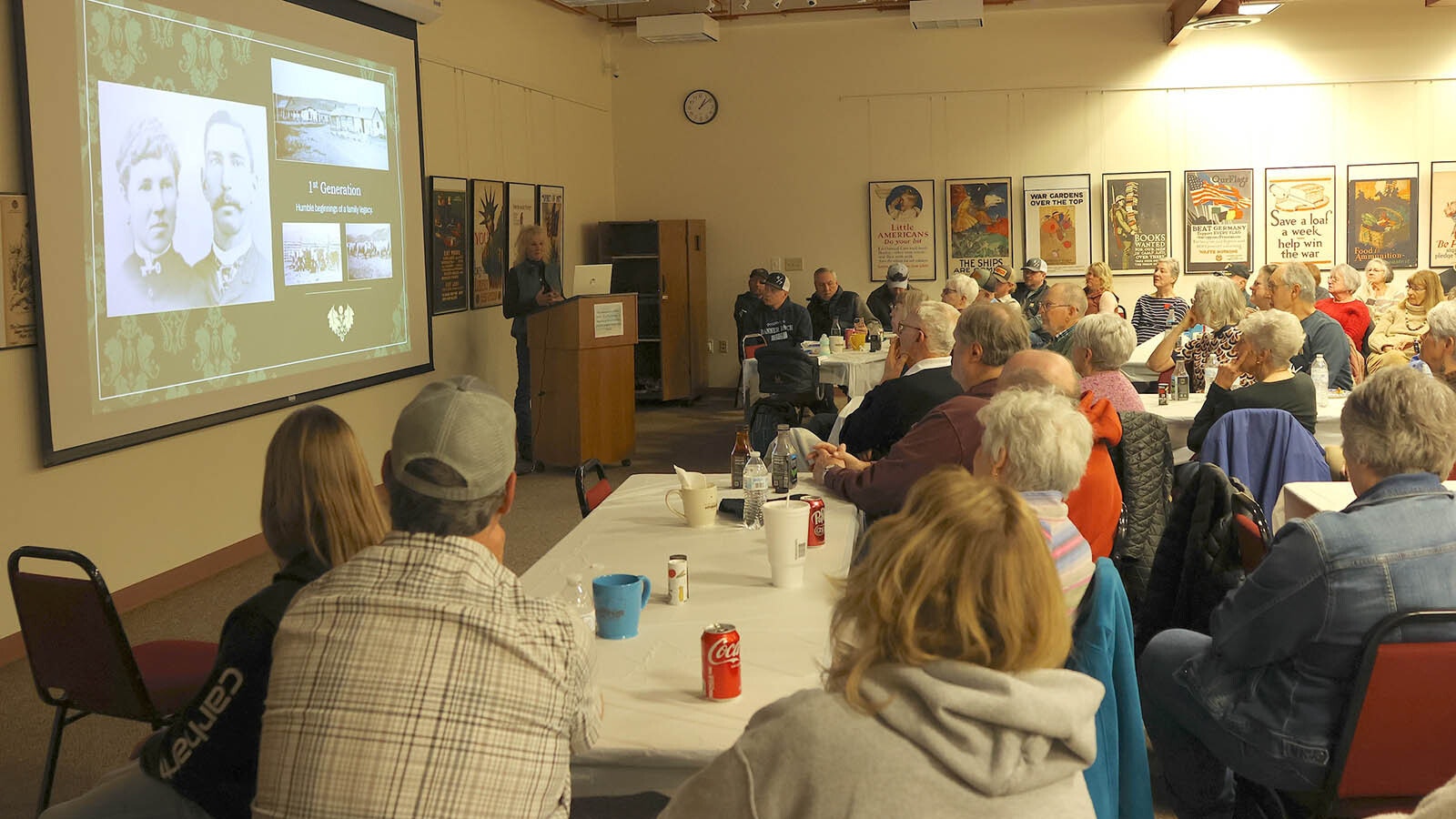
More than 50 people turned out to the Fort Caspar Museum on Jan. 31 to learn about the generations that have kept B.B. Brooks ranching legacy alive. (Dale Killingbeck, Cowboy State Daily) 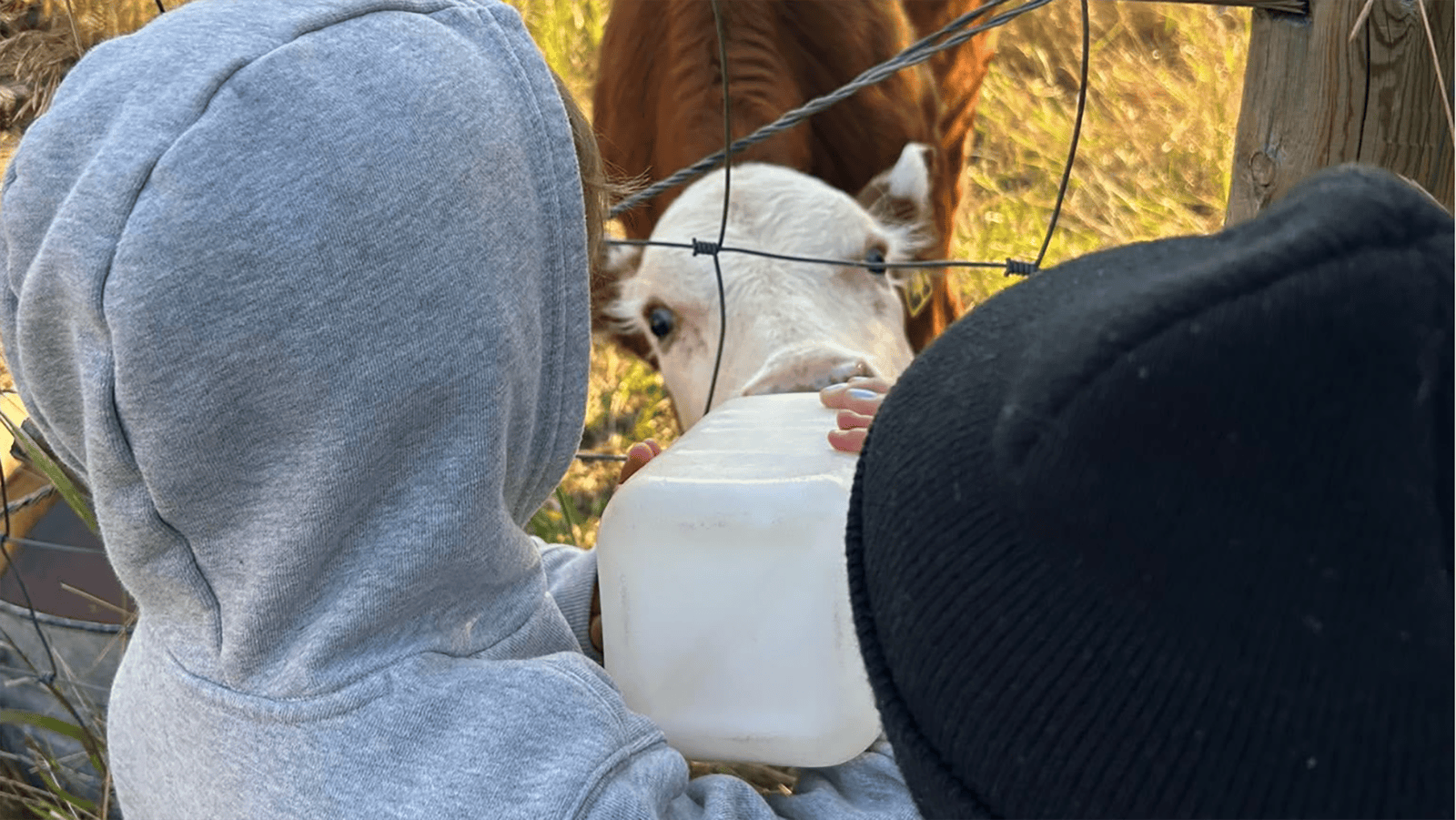
Members of the sixth generation of the B.B. Brooks family feed a calf on Banner Ranch. (Courtesy Shelly Trumbull) 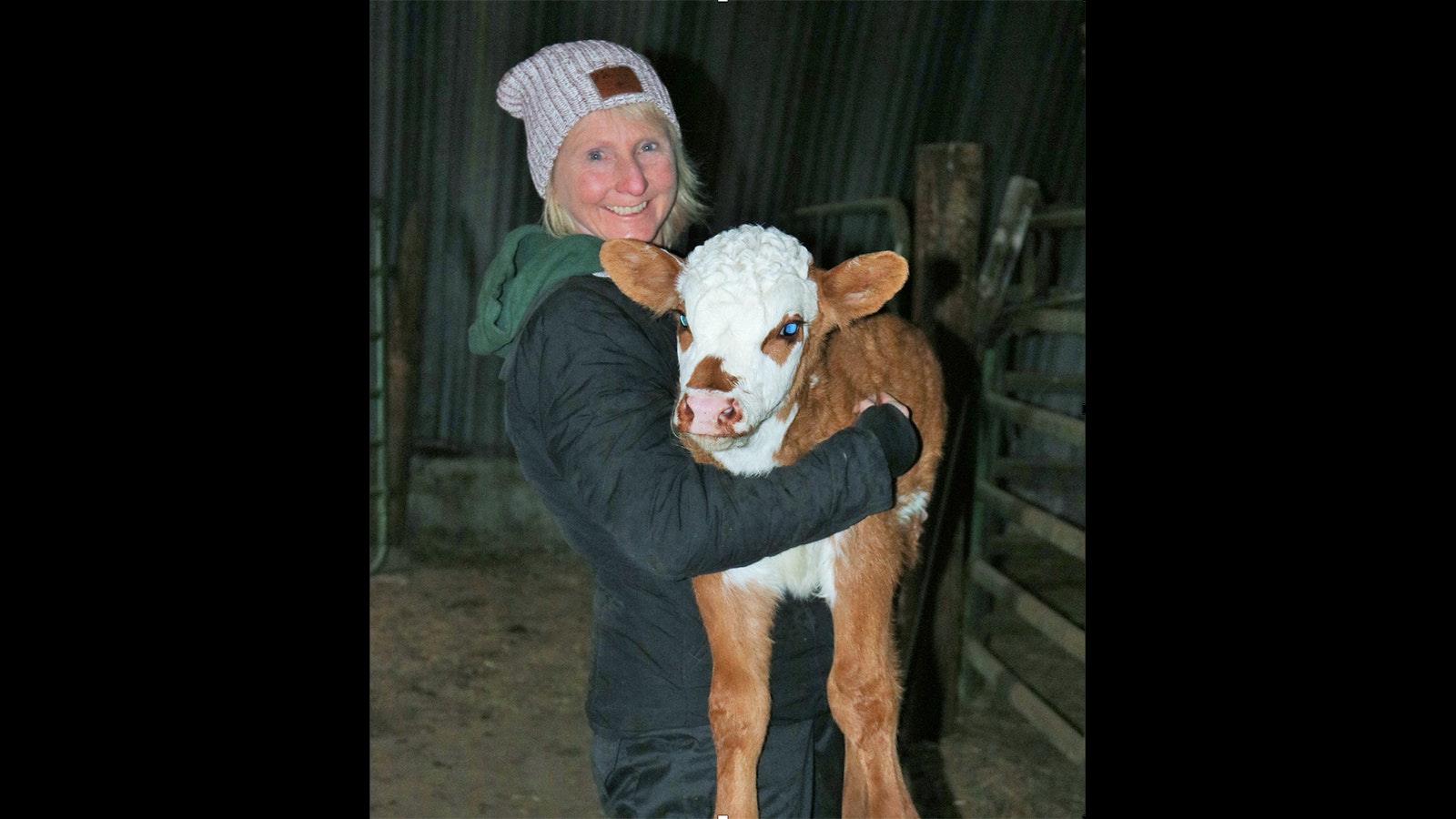
Shelly Trumbull holds a calf on the Banner Ranch. (Courtesy Shelly Trumbull) 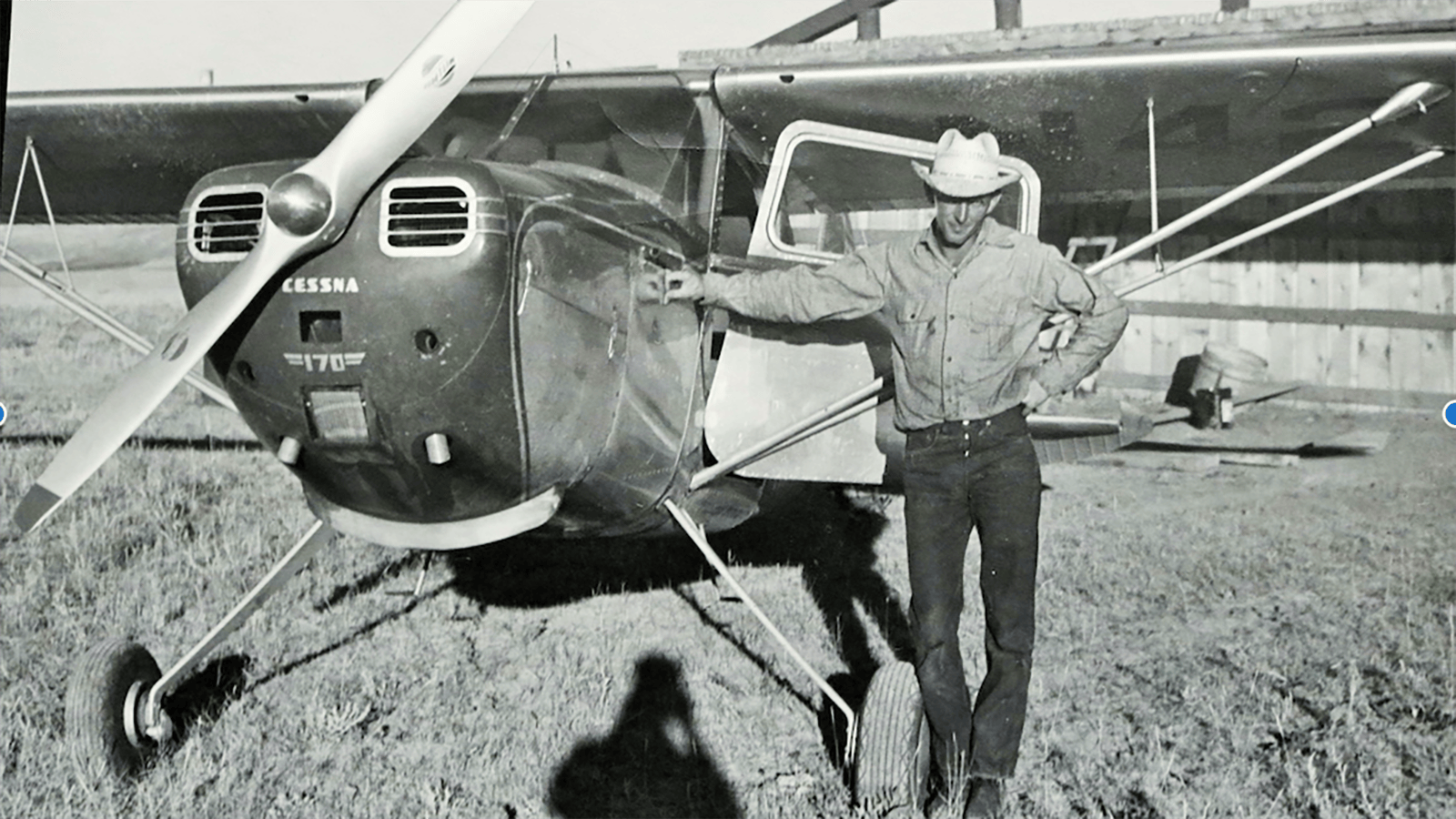
(Courtesy Shelly Trumbull)
Discarded Branding Iron
The story in the family is that he found a discarded “V” branding iron, branded his cattle, and headed to his home on Muddy Creek.
“It’s still in the family today,” Trumbull said about the branding tool.
Brooks married Mary Naomi Willard on March 11, 1886.
She was educated in Iowa and Nebraska, and was teaching in Nebraska when the couple married.
They returned to Wyoming to find heavy snow, took a stagecoach from Rock Creek station to Fort Fetterman, and then 40 miles on a buckboard to the primitive cabin home.
Trumbull characterized her great-grandmother as woman of grace, independence, strength and courage.
“She was a wife, mother, ranch cook, first lady, and managed cowboys in B.B. Brooks' absence,” she said. “Music was a staple in her life and that has been passed down for many generations."
Trumbull traced the family’s history through the generations beginning with the couple’s third of five children, Lena Natrona Brooks, who was her grandmother.
She was born in 1890, and her middle name reflects her father’s participation in creating Natrona County and serving as a county commissioner.
Among the family pastimes were hunting with hounds on horseback. Her grandmother continued that for most of her life.
“They would travel 16-20 miles round-trip hunting coyotes,” she said.
Brooks, who in addition to serving terms as a county commissioner and state legislator, became governor in 1905 after a special election forced by the death of Gov. Deforest Richards. He was reelected in 1906.
Trumbull said that the family was the first to live in the governor’s mansion built on 21st Street in Cheyenne.
Mansion Living
Stories in the family are that Lena, 14, and her younger sister, Melissa, wanted a second-floor bedroom in the rear so they could see the carriage house and the horse they brought with them from the ranch.
Neighborhood children were all invited into the mansion where they would perform plays in the attic, Trumbull said.
Among the photos that Trumbull showed from that time was one of her great-grandfather riding with Teddy Roosevelt in a Cheyenne Frontier Days Parade in 1910.
Her grandmother, Lena, went to the Red School House above Muddy Creek, then graduated high school in Cheyenne.
She went back East to Dana Hall School for girls for a year before returning to Wyoming and graduating from the University of Wyoming with a teaching degree.
Trumbull said that while on the East Coast, Lena Brooks traveled to Bath, Maine, where she christened the largest wooden schooner ever built named The Wyoming.
B.B. Brooks was among the investors in the six-masted ship that was designed to haul coal. An earlier five-masted ship had been built and christened in the governor’s name.
The bigger Wyoming vessel featured Brooks’ wife and brother John on hand with Lena to launch the ship.
“Miss Lena Brooks, daughter of Gov. Brooks of Wyoming, broke a huge bunch of cut flowers over the bow and softly murmured the words, ‘I christen thee Wyoming,'” The Times Record of Brunswick, Maine, reported on Dec. 15, 1909.
Trumbull said when the Maine Maritime Museum built a sculpture memorializing the ship, which sank in 1924 in a nor’easter storm, they contacted the family for information.
She said they didn’t have a lot except she knew much of the family’s resources went into the vessel as well as the ship named after her great-grandfather.
The 450-foot-long, 50-foot-wide Wyoming cost $175,000 to build in 1909, which in today’s dollars is about $6.2 million.
“In 2007, they had me come back and christen the sculpture, just like my grandmother had in 1909,” she said.
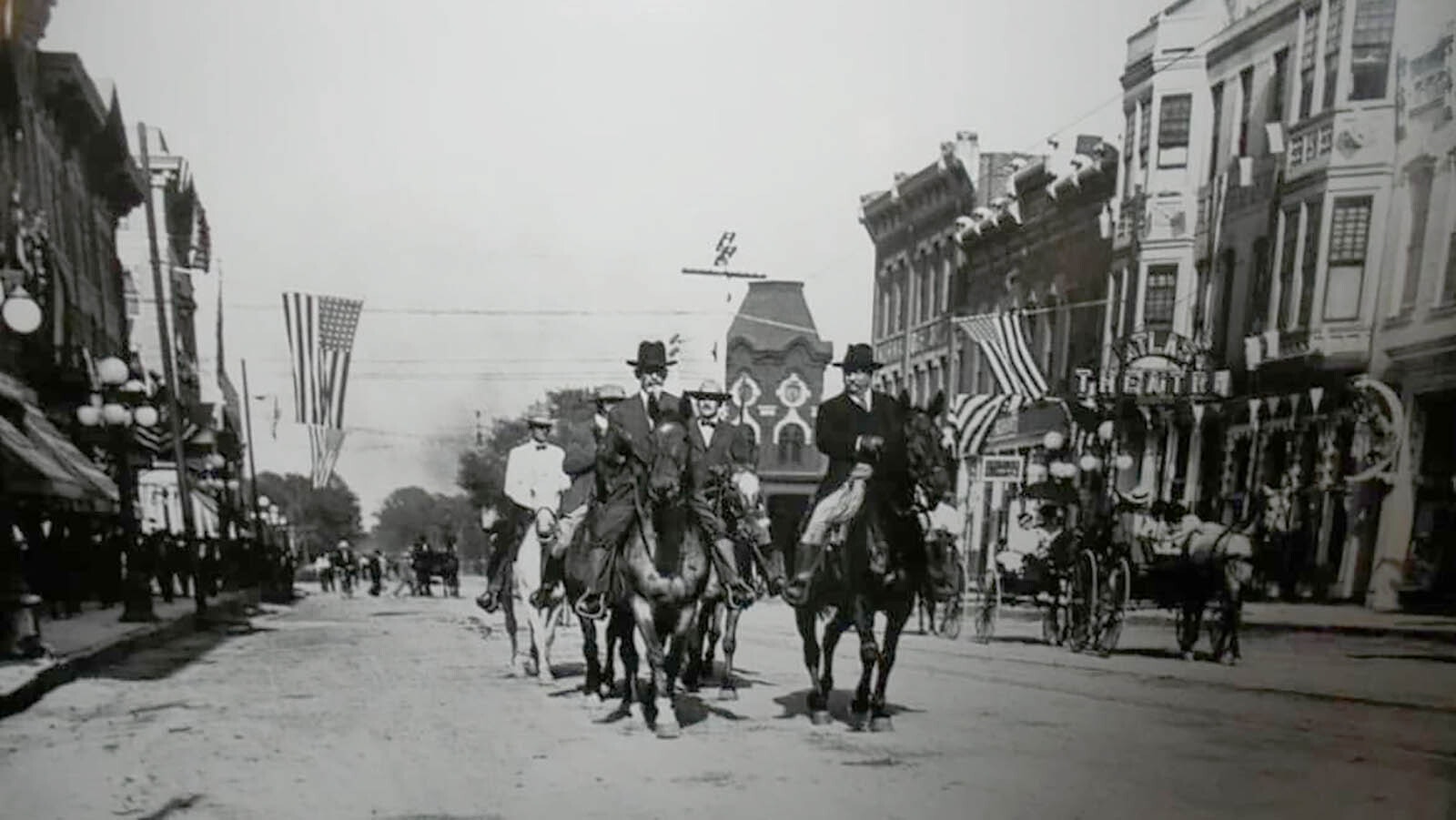
Wyoming Gov. B.B. Brooks rides next to President Teddy Roosevelt during a 1910 Cheyenne Frontier Days Parade. (Banner Ranch Co. via Facebook) 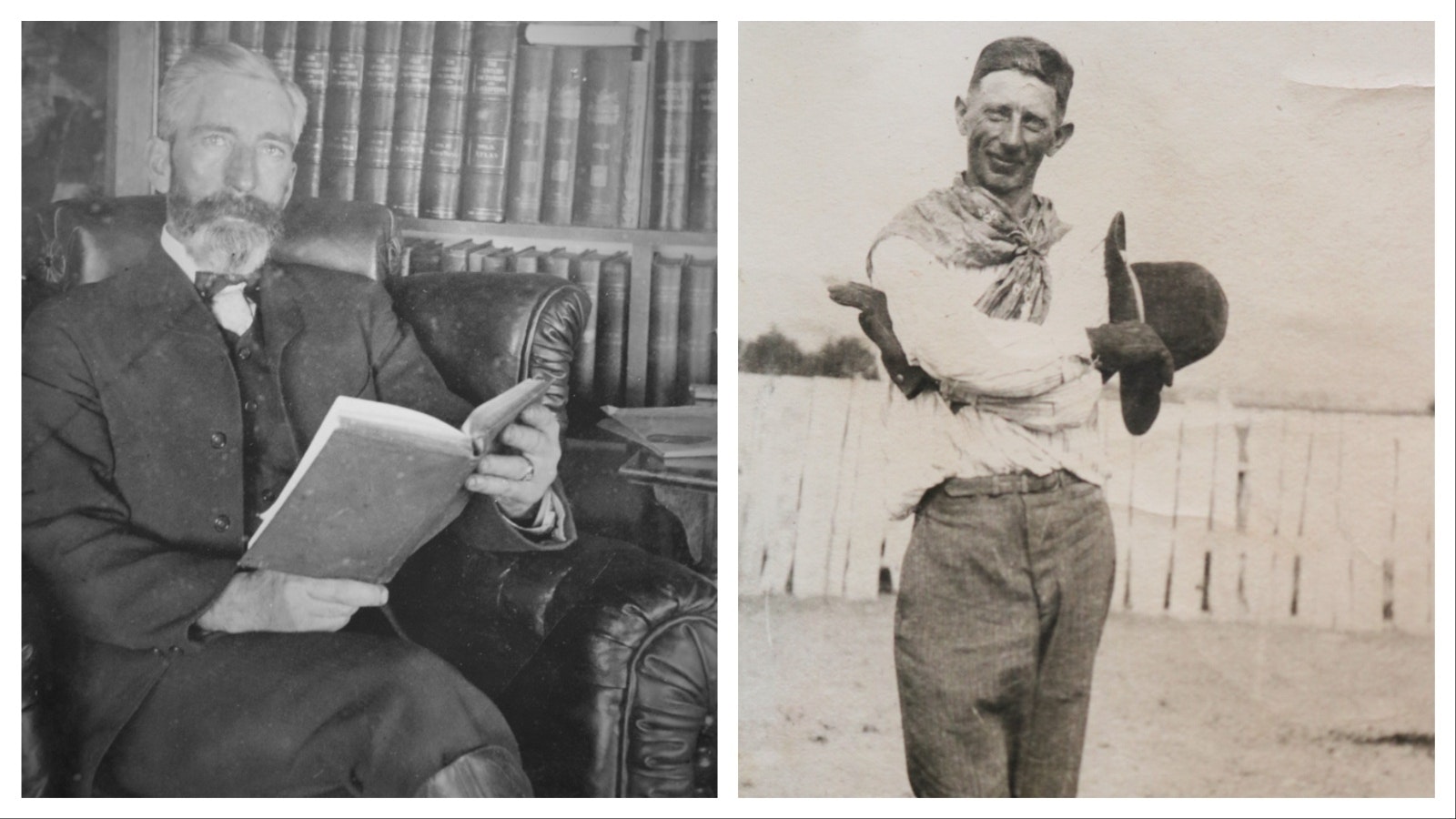
Left, B.B. Brooks, who served as Wyoming’s governor from 1905-1911 sits in a library. Right, Mike McCleary worked on B.B. Brooks' ranch in his 30s. He eloped with B.B. Brooks’ daughter Lena to Colorado on Sept. 21, 1919. (Courtesy Shelly Trumbull) 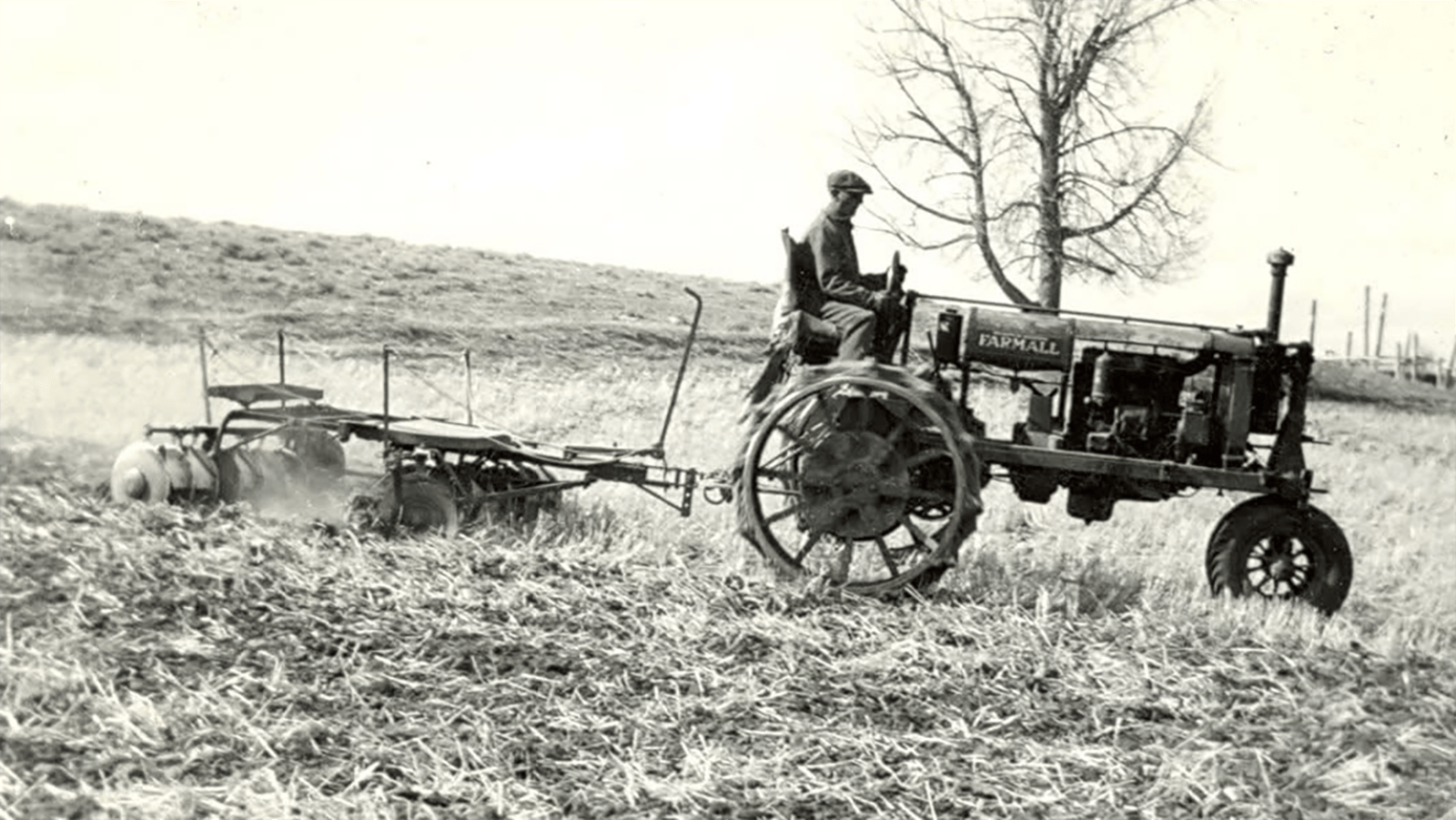
Technology arrives on the B. B. Brooks ranches. (Courtesy Shelly Trumbull) 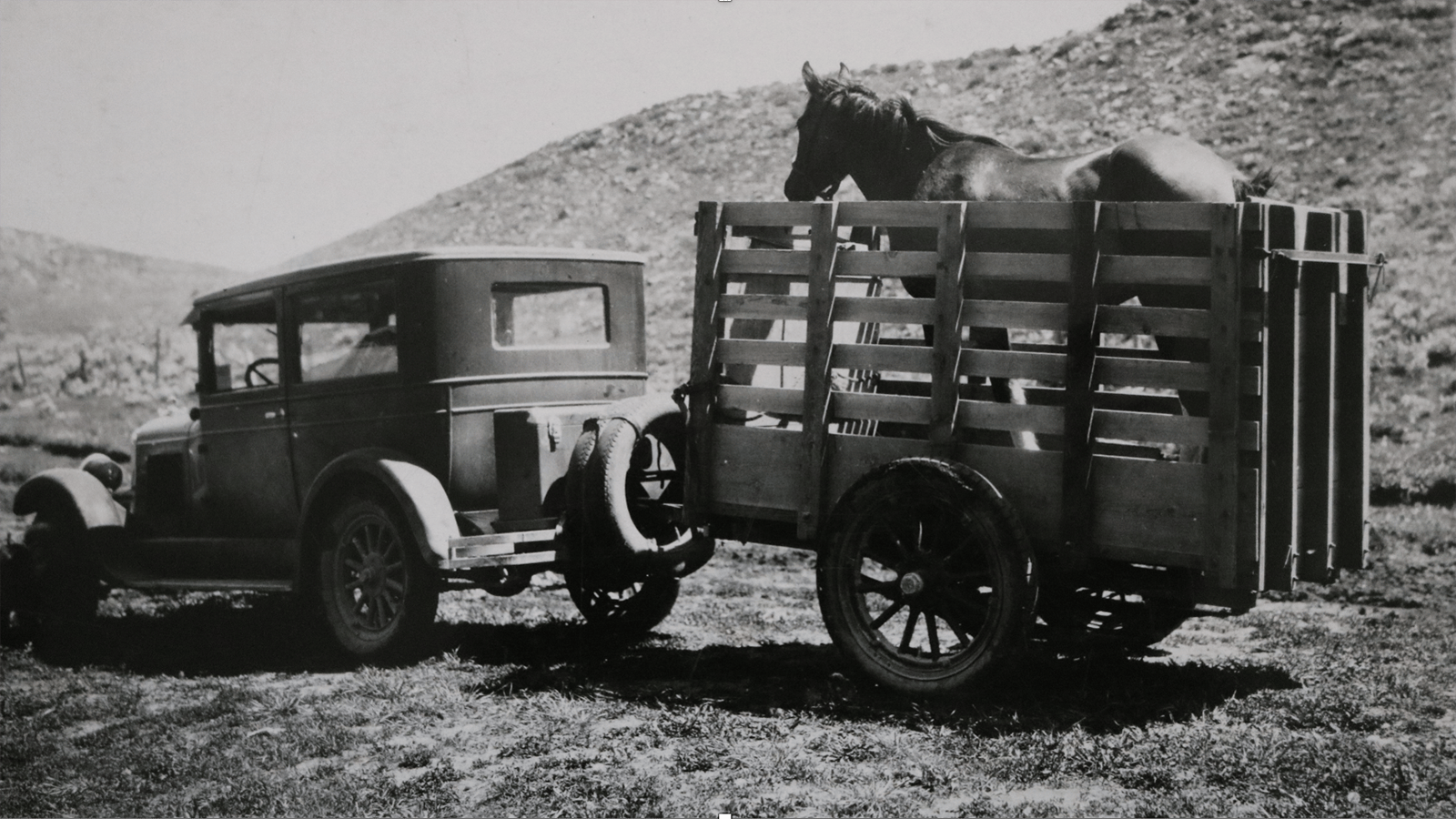
The first horse trailer on B.B. Brooks’ ranches. (Courtesy Shelly Trumbull)
She Eloped
Trumbull said that while the older daughters in the Brooks family married a doctor and a lawyer, respectively, Lena ran off and eloped with a cowboy from the ranch after she had nursed his leg that was injured in an accident with a team of horses.
The cowboy, Marion “Mike” McCleary, was from Illinois and left home at 15 working first with steam locomotives in Chicago, grain threshing crews in the Dakotas, and then a sheep outfit in Midwest, Wyoming, where his sister lived.
McCleary became a cowboy for B.B. Brooks while in his early 30s. Following their elopement to Colorado, the couple returned to Wyoming to run the Banner Ranch in 1920.
Trumbull said Brooks originally began with B.B. Brooks and Co.’s V-V ranch, then in 1905 bought the 680-acre Banner Ranch. Other ranches were acquired, and in 1947 the family switched from raising mostly sheep and cattle to exclusively cattle.
“At one time, B.B. Brooks had five different ranches and 100,000 acres,” Trumbull said. “The Banner Ranch is the only one left in the family.”
Successive generations weathered their own storms and brought technology into the business over the years.
Mike and Lena McCleary’s son, Bryant — nicknamed Cactus — was born in 1921. He married twice, and his second wife, Barbara, was Trumbull’s mother. Their blended family had seven children.
Among the additions to the Banner Ranch was an apple orchard started by Mike McCleary from cuttings on B.B. Brooks V-V Ranch orchard.
Now, just a third of the orchard remains alive on the Banner Ranch.
Trumbull said she is working with a specialist to graft the heirloom apple trees onto new trees, and currently has 17 new trees in the orchard.
Trumbull said her father rode broncs in rodeos throughout central Wyoming and for the University of Wyoming, but was called home from the university during World War II to become a foreman for the family’s sheep operations.
“Wool production was at high demand for the military,” she said.
Cactus McCleary also inherited the musical genes in the family and could play any stringed instrument but was identified with the accordion.
He and his band, Whiskey Mountain Four, played dance halls and barn dances across the region.
Technology And Planes
Cactus McCleary went on to bring technology to the ranch and took training to become a pilot.
He used his planes often to check on cattle, Trumbull said.
He also joined an organization for other flying ranchers across the state, and they sometimes competed in and event involving dropping flour sacks trying to hit a bull’s eye.
Trumbull said her mother, Barbara, was known for making large meals for the branding and dehorning crews at the ranch.
Her books of recipes include those for more than 60 people and Trumbull said her “home always had the smell of homemade bread, pies, or cookies.”
An interesting family heirloom is the sourdough starter that was given to her dad in a sheep camp in the late 1930s. She said she and her brother, also named Mike McCleary, still have starter from that batch.
The ranch today still uses horses during branding operations and moving cattle, but has turned to ATVs to help with cattle operations because they are cheaper than good horses.
Trumbull said her father loved being on horseback, but in his older years bought a Honda Rancher ATV, and in less than five years put more than 30,000 miles on it overseeing his ranch.
“His last year helping in the hayfield was in 2010 at the age of 88,” she said. “Cactus remained an intricate part of Banner Ranch and its management until the day we lost him.”
Bryant “Cactus” McCleary died on Jan. 16, 2013, at age 91.
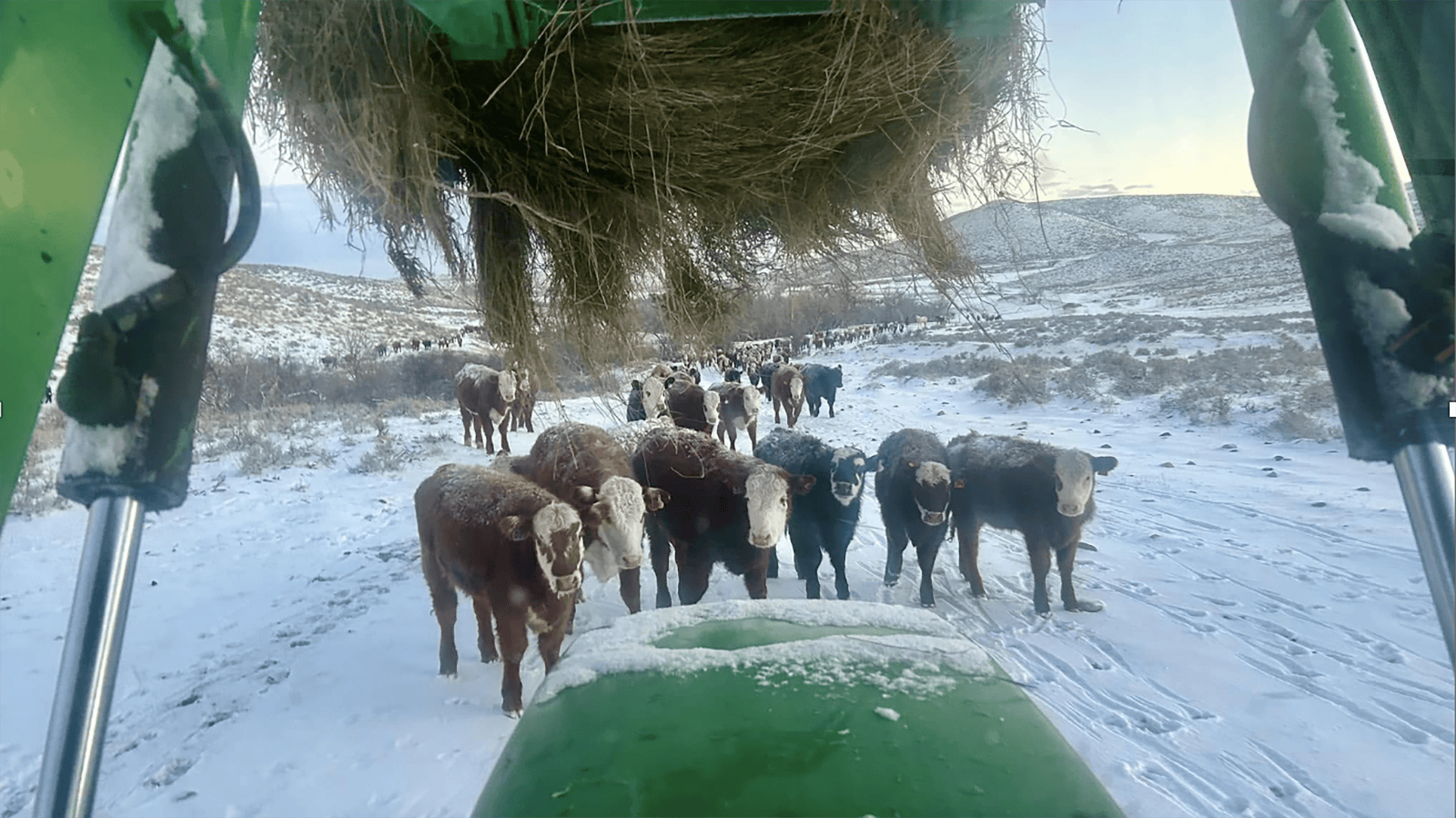
Cattle on the Banner Ranch prepare to get fed during a past winter. (Courtesy Shelly Trumbull) 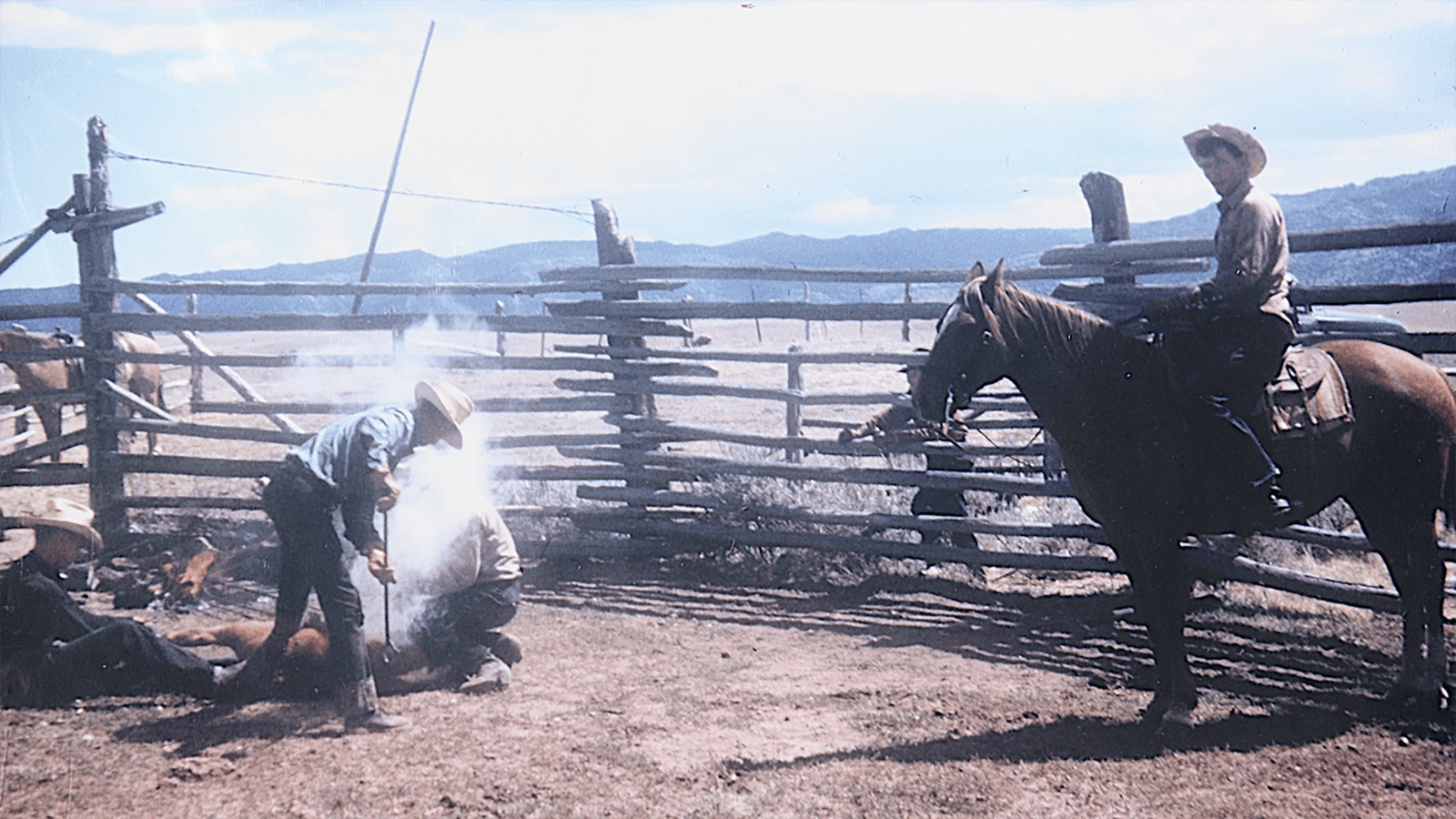
Cowboys brand cattle on the Banner Ranch in the 1950s or ‘60s. (Courtesy Shelly Trumbull) 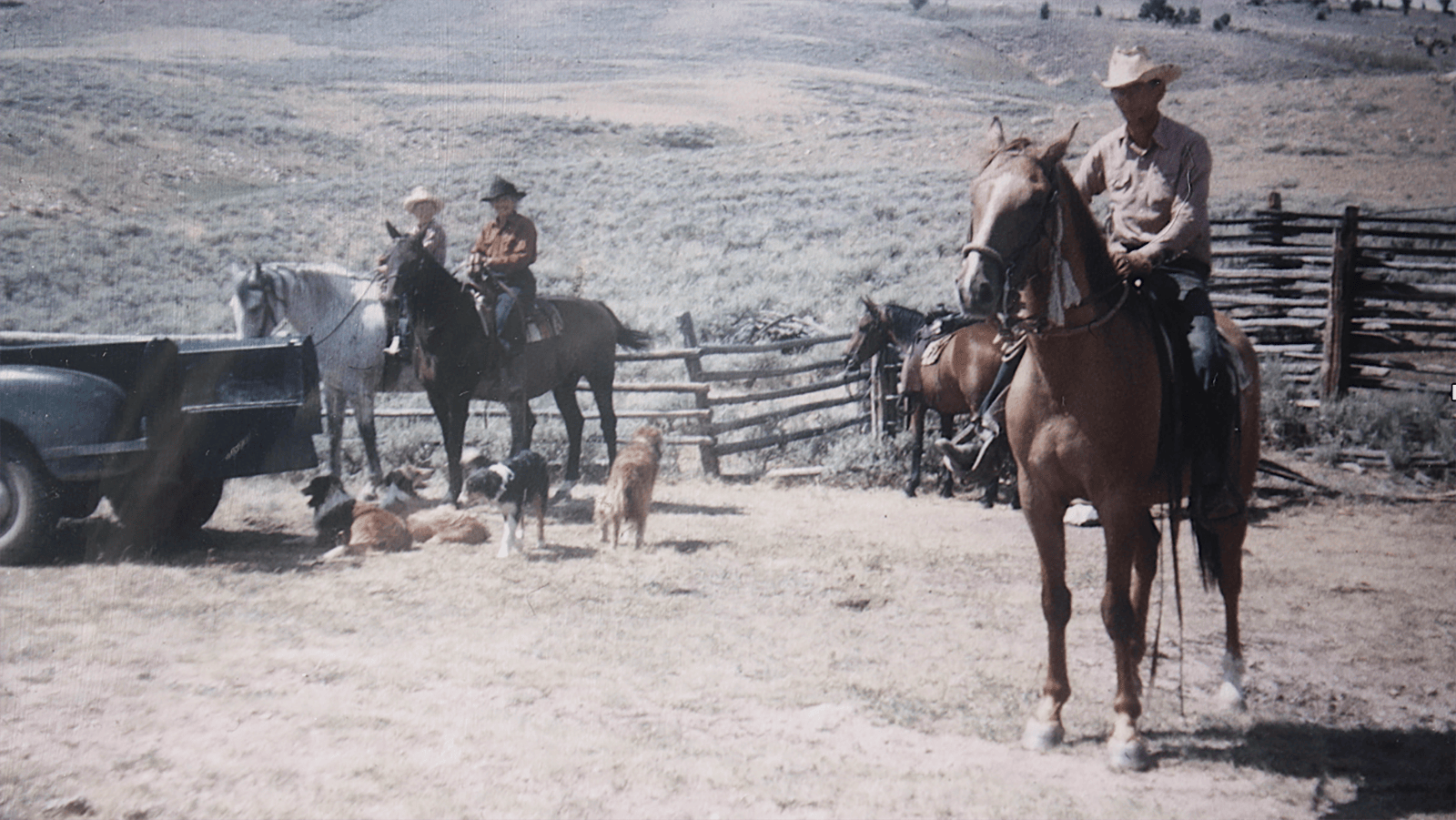
Horses are an extension of ranch hands at the B.B. Ranch. (Courtesy Shelly Trumbull) 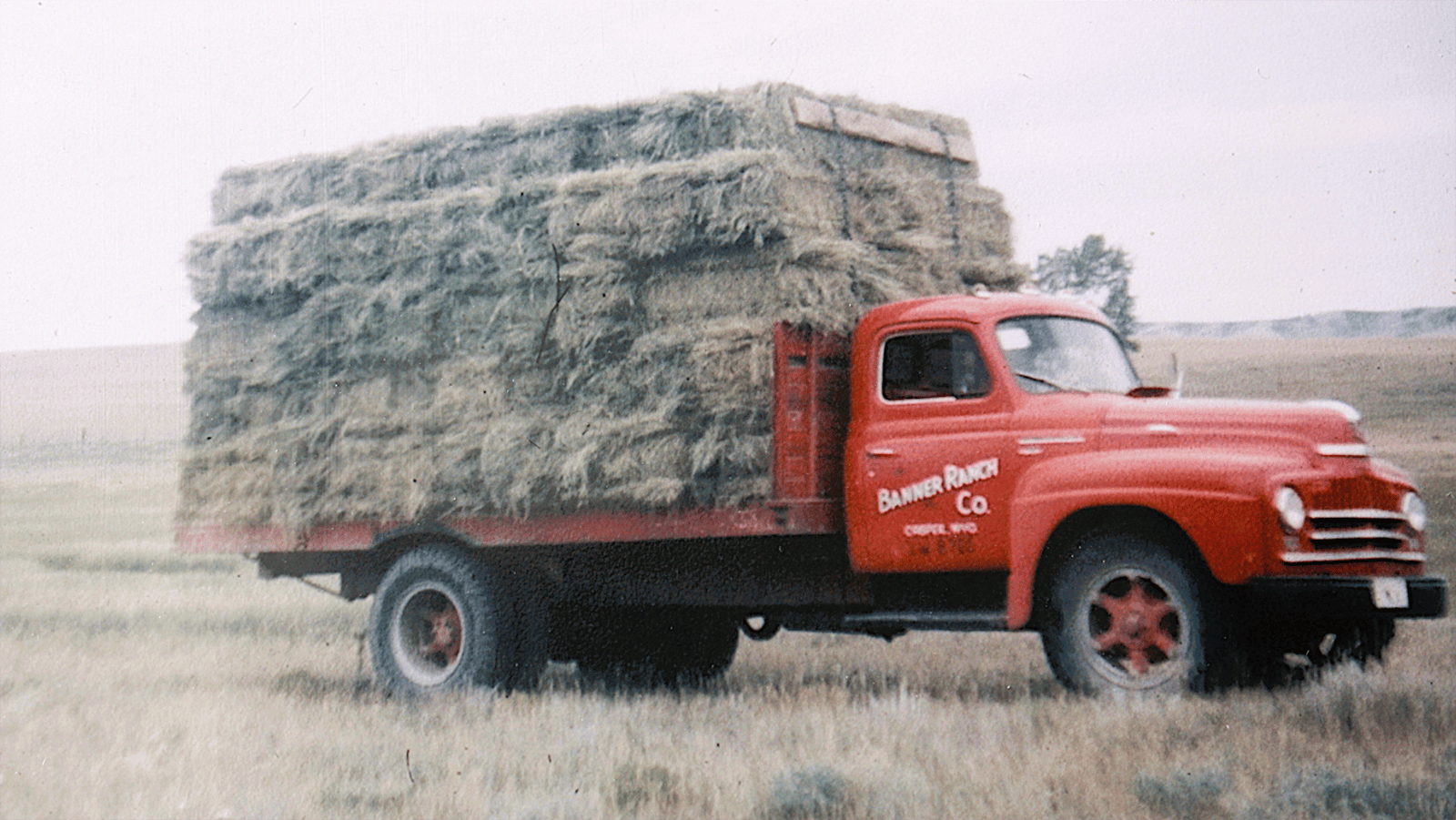
A Banner Ranch truck loaded with hay sits on a ranch field. ( (Courtesy Shelly Trumbull)
Generational Work
Trumbull, 57, said she and her brother continue to run the Banner Ranch with help of their children and now grandchildren.
The ranch now has just under 20,000 acres of deeded and leased lands.
Among the technology she has embraced in their cow-calf operation is what she called a “calf cooker,” a warming device for newborn calves.
“When you find a calf out in the snow and it’s froze down and not doing well, we haul them into the cattle barn on a sled,” she said. “We stick them in that for an hour or so and watch them, and usually when you put them in there they are not doing so well, and you come back and they are trying to stand up or they are laying up and ready to go.”
Trumbull said responding to ranch needs as a family sometimes means appropriating her daughter Kristen’s BMW SUV and temporarily making it a ranch rig to haul ATV tires that need to be repaired, or sometimes miniature goats.
“Keeping our way of life, heritage, and family legacy is important to us,” she said. “It is all so humbling being able to walk in the footsteps of past generations on a daily basis and take in all they built for us.”
Dale Killingbeck can be reached at dale@cowboystatedaily.com.