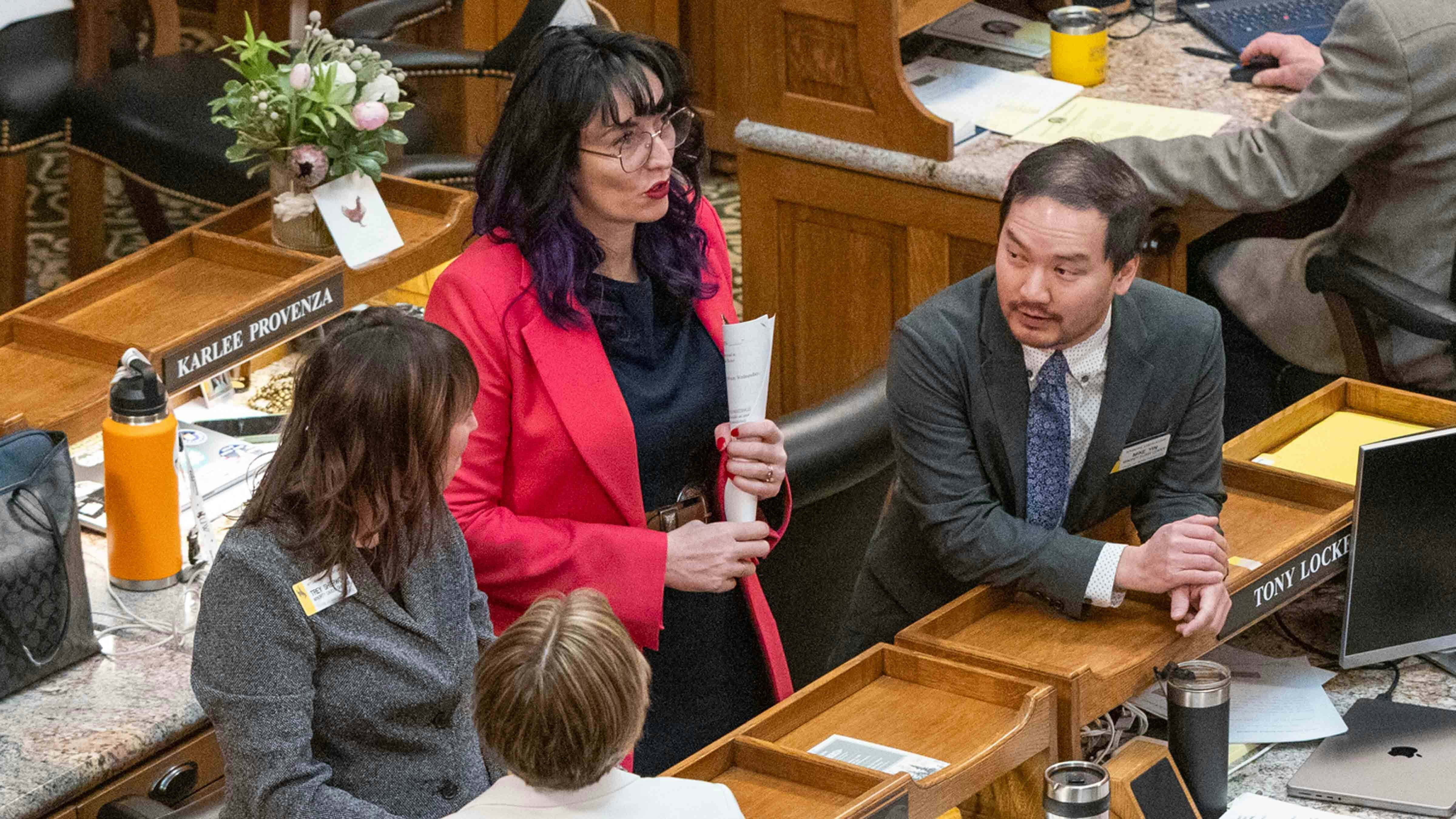

CHEYENNE — The Wyoming Senate on Thursday unanimously passed Senate File 123, the Wyoming Energy Dominance Fund, on a 31-0 vote that carried not only the full support of the chamber, but a formal endorsement from the White House and President Trump's National Energy Dominance Council.
The bill, sponsored by Senate President Bo Biteman, R-Ranchester, would redirect roughly $105 million in severance tax revenues into a matching grant and loan program administered by the Wyoming Energy Authority.
That money would be used for projects tied to coal, natural gas, uranium, enhanced oil recovery, pipeline infrastructure, rare earth and critical mineral processing, and baseload energy development.
Wind and solar projects are explicitly excluded.
A Feb. 12 letter from the White House Office of Intergovernmental Affairs and the National Energy Dominance Council declared that the two offices "strongly support Senate President Bo Biteman's Wyoming Senate Bill 123, The Wyoming Energy Dominance Fund."
The letter called the bill "bold legislation" that "powerfully advances President Trump's energy dominance agenda by channeling resources into reliable and dispatchable energy sources like coal, natural gas, uranium, critical minerals, and baseload power — while steering clear of intermittent renewables."
"Wyoming is leading the charge, and SB 123 positions the state as a model for unleashing energy dominance," the letter adds.
It was signed by Alex Meyer, deputy assistant to the president and director of White House intergovernmental affairs, and Blake Deeley, special assistant to the president and deputy executive director of the National Energy Dominance Council.
Floor Debate
Biteman framed the legislation as a strategic accelerator for projects tied to national security and Wyoming's economic future.
"Ladies and gentlemen, Wyoming needs to be the tip of the spear, the energy dominance plan," Biteman told the Senate when first introducing the bill. "Apparently, there are projects in the works that need a little bit of assistance to get these things going."
He rattled off project after project that could benefit from the fund.
"Projects that come to mind could be possibly a uranium conversion plant," Biteman said. "There's only going to be one built in the United States, probably in the next 20 to 30 years. We're competing with other states with that. We need a pipeline to get CO2 up to the Big Horn Basin to unlock untold billions of barrels of oil that would directly benefit the state of Wyoming in severance tax revenue and revenue in our schools.
"You've got rare earth projects happening in Wyoming that need support,” he continued. "These are vital to our national security. I've been working with the current administration to make this happen. I think the states can lead."

Industry Reaction
Travis Deti, executive director of the Wyoming Mining Association, said the White House's interest in the bill reflects how closely it tracks with the administration's federal energy agenda.
"I think the White House and the administration are interested in this bill because it dovetails really nicely with what they're trying to do at the federal level," Deti told Cowboy State Daily.
He said state-level action can move faster than federal policy, giving the national agenda more staying power.
"What we do in Wyoming gives the federal administration, and their national policy of energy dominance, more durability," Deti said. "It legitimizes what's trying to be accomplished with Senate Bill 123."
Rob Creager, executive director of the Wyoming Energy Authority, said the bill grew out of Biteman's alignment with the Trump administration's energy priorities.
"President Biteman was looking at what President Trump's doing, right? They stood up the Energy Dominance Council," Creager told Cowboy State Daily. "Wyoming, if America's gonna be energy dominant, Wyoming has to be the lead in that."
Creager said the fund would give his agency money to work with that doesn’t come from taxpayers, but instead from the taxes energy industries already pay.
"It's not coming out of the general fund or anything like that," he said. "It looks like a bill that we can rock and roll the day it goes into law if it does."
He described the legislation as a natural extension of the authority's existing work.
"We partner with the White House, we partner with industry every day to try to advance projects in Wyoming, and this is another tool in that toolbox," Creager said.
The legislation's findings section states that energy contributes up to 25% of Wyoming's gross state product, has generated nearly $95 billion in total economic impact since 2015, and that the mineral and energy industries support more than 60,000 Wyoming jobs paying about $2 billion in annual wages.
The bill concludes that "it is in Wyoming's and the United States' best interest to unlock the full potential of our affordable and reliable energy resources. Doing so will drive economic opportunity across the state, strengthen the communities that have fueled this nation for generations and reinforce economic and national security, ensuring that Wyoming remains the energy backbone of the United States for decades to come."
About The Council
The National Energy Dominance Council was established a year ago by executive order on Feb. 14, 2025.
Trump's order declared it "shall be the policy of my Administration to make America energy dominant" and tasked the council with advising the president on expanding energy production, streamlining permitting and developing a National Energy Dominance Strategy.
The council is chaired by Interior Secretary Doug Burgum, with Energy Secretary Chris Wright serving as vice chair.
Its membership spans several senior federal officials, including the secretaries of State, Defense, Treasury and Commerce, along with the EPA administrator and heads of the offices of Management and Budget, Science and Technology Policy, and the councils on Environmental Quality and Economic Advisers.
On Jan. 16, the council announced what it called a landmark agreement with a bipartisan group of governors to expand energy supply and support data center development.
The Interior Department said the initiative would advance more than $15 billion in new power-generation projects designed to strengthen grid reliability and meet surging energy demands.
A coalition of technology companies committed to funding the new generation capacity so that costs would be carried by the tech sector rather than taxpayers, according to the Interior Department announcement.
"High electricity prices are a choice," Wright said in the announcement. "The Biden administration's forceful closures of coal and natural gas plants without reliable replacements left the United States in an energy emergency."
David Madison can be reached at david@cowboystatedaily.com.