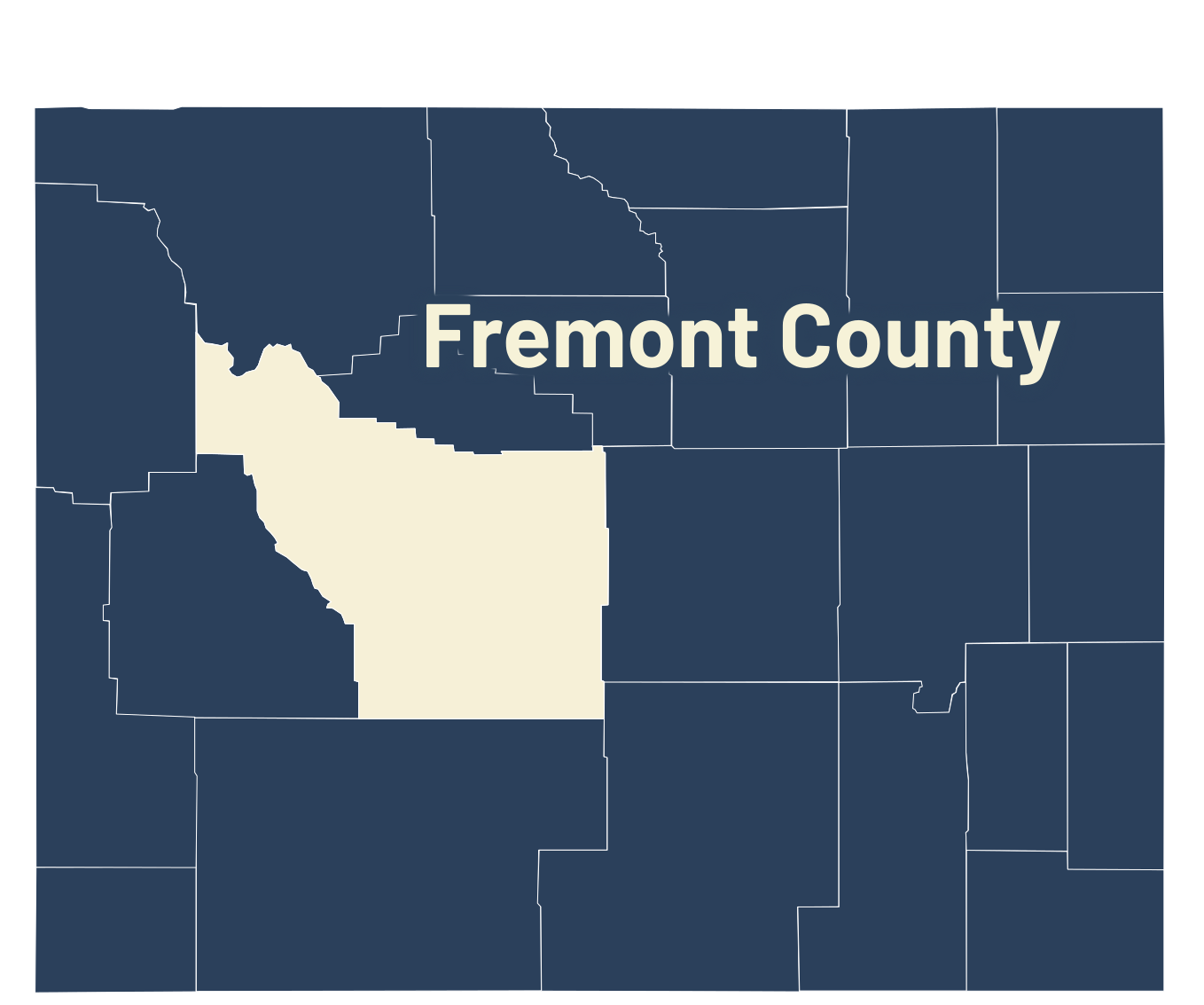
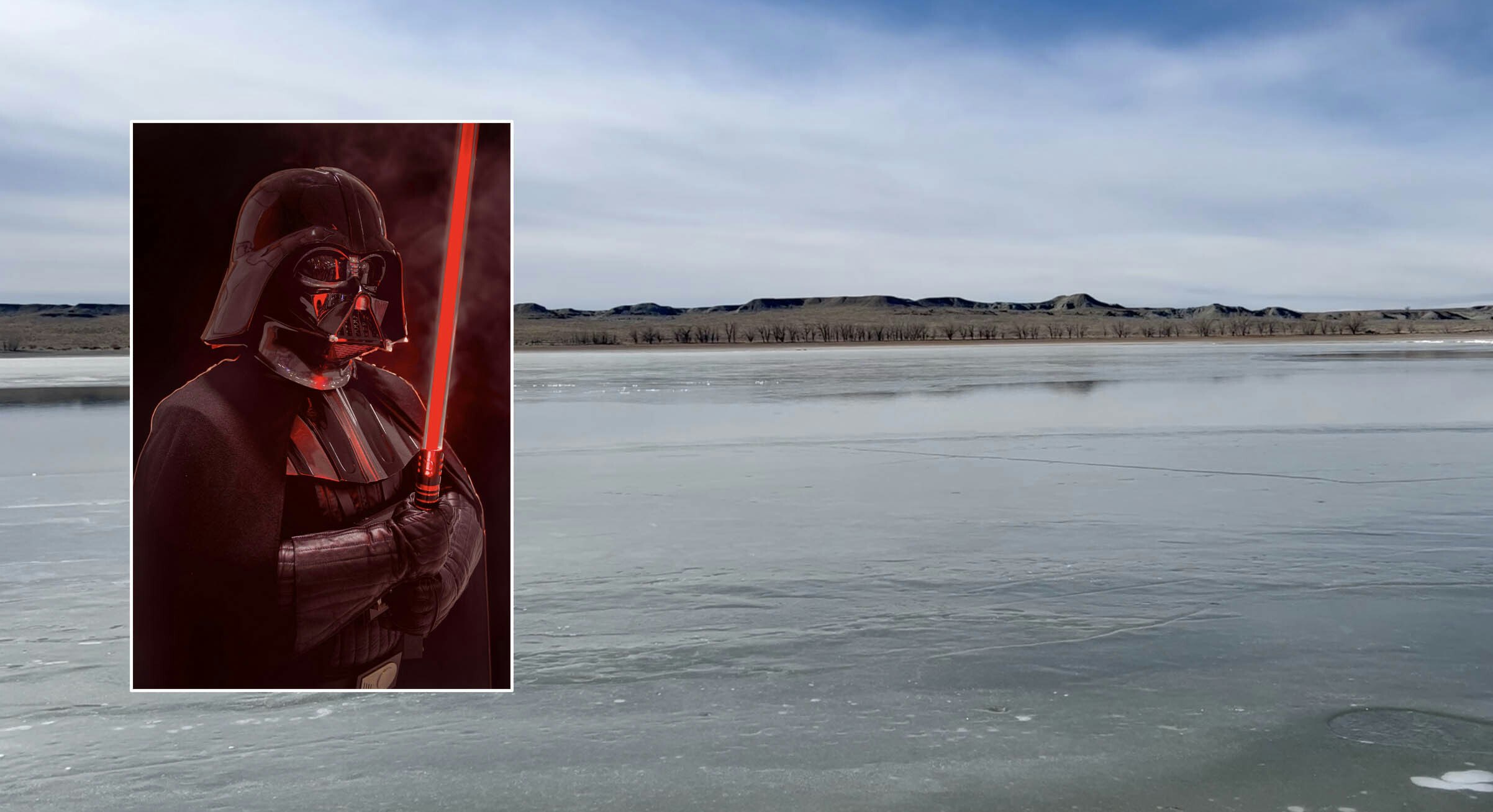
About midmorning on Sunday, as the temperature crept above freezing, the ice sheet on Boysen Reservoir in Fremont County started making sounds like something out of a science fiction movie.
To the untrained ear, it might have sounded like characters from the “Star Wars” movies were battling with laser pistols and lightsabers under the frozen surface.
The sounds grew more frequent and steadily louder for about an hour, then stopped as suddenly as they’d started.
The strange phenomenon had a natural cause. To sum it up: soundwaves, much like light waves, can separate into a spectrum of different frequencies under the right circumstances.
The bizarre sounds echoing up into the shallow end of Cottonwood Bay, on the reservoir’s west side, resulted from ice cracking under warming temperatures far out in the reservoir’s depths.
‘I Have Heard That Noise Before’
Meteorologist Don Day of Cheyenne likes to ice fish and told Cowboy State Daily that he’d previously heard what sounded like laser gun sound effects.
“I have heard that noise ice fishing before. I’m pretty sure it is ice expanding or contracting making the noise, but I’m not 100% sure. I have heard it when it was really cold out but guess you can have that noise if it is melting,” he said.
His observation about it happening with melting ice makes sense. It was unseasonably warm on Sunday, with temperatures soaring into the 50s as the day wore on.
Ice fishing opportunity came exceptionally late to Boysen Reservoir this year, with the water still being almost entirely open in early January.
It finally froze over later that month, and some ice anglers ventured out. But conditions on Sunday indicated that their heyday might be brief this year.
Drastic Temperature Fluctuations
Fishing guide Ryan Hudson also told Cowboy State Daily that he’s familiar with the laser-gun sounds.
He owns Wyoming Fishing Company Guide Service and takes clients out night ice fishing for burbot on Fontenelle Reservoir in Lincoln County.
He said the ice makes “crazy sounds” that can frighten the uninitiated as they huddle in ice fishing huts far out on the reservoir.
The laser effect is part of the ice’s creepy repertoire, he said.
"It comes from the ice shifting during temperature changes. It’s common during drastic temperature fluctuations,” he said.
‘A Superconductor Of Sounds’
Famed Wyoming photographer Dave Bell told Cowboy State Daily that he’s heard ice making what sounded like laser blasts.
And also, what sounded like “whales” and “moaning and some popping,” he said.
Many of those sound effects can be attributed to the water under the ice, he said.
“Water is a superconductor of sound. As the ice cracks or shifts, either freezing or thawing, it makes sounds from those events. It’s the ice doing its thing,” he said.
Splitting Frequencies Make For Weird Sounds
Experts explain that splitting sound frequencies are behind the “laser pew-pew” and other unsettling sounds that frozen lakes and reservoirs produce.
In the immediate vicinity of ice cracking, it sounds like exactly that, a sharp crack, Mark Hamilton, a professor of acoustics at the University of Texas at Austin, told Live Science.
But the listening experience can change drastically with distance.
Soundwaves are made up of a spectrum of frequencies, ranging from low to high.
High-pitched sounds come from shorter sound waves, lower-pitched sound from longer ones, he said.
And the shorter waves travel faster. So, the sound of ice cracking splits between the higher and lower frequency, he said.
And the greater the distance from the crack, the greater the split between the frequencies will be. And hence, the stranger the sounds will be as they hit a distant listener’s ears.
"It takes distance for the higher frequencies to outrun the lower frequencies," Hamilton told Live Science.
Mark Heinz can be reached at mark@cowboystatedaily.com.