A pair of Wyoming ranchers is taking a stand for private property rights as they relate to energy leases. Their strong reaction comes as the Wyoming Legislature and residents debate private property rights and the merits of wind and solar farms.
In a letter to the editor submitted to Cowboy State Daily, Rob Hendry and Scott Sims say a landowner's right to develop their property as they see fit has always mattered.
Private property rights, they argue, are not an abstract political talking point in Wyoming.
A Partisan Wedge
Hendry ranches on more than 50,000 acres, a combination of deeded, federal- and state-owned land, between Casper and Riverton.
“There is movement afoot to talk about private property rights in the legislature,” Hendry told Cowboy State Daily.
In their letter, Hendry and Sims write that "energy should never be a partisan wedge."
Members of Wyoming’s Freedom Caucus are all for private property rights, Hendry said, but “they spin it a little different.”
The Freedom Caucus believes “your neighbors have just as much say about your private property rights as you do,” Hendry said, because “what you do on your private property affects their private property.
“That’s not right,” he said.
The Wyoming Freedom Caucus describes itself as a group of legislative representatives dedicated to limited government with an interest in protecting the freedoms of Wyomingites.
Former Freedom Caucus Chairman Rep. John Bear, R-Gillette, told Cowboy State Daily he cannot speak for the Freedom Caucus as a whole, but that he intends to always be a champion for private property rights in the state.
“I’ll always try to do everything I can to create an even playing field,” he said.
Bear said he has worked hard to protect property owners from eminent domain for wind transmission lines.
“It doesn’t do you any good to have a wind on your private property if you can’t get the energy off the private property,” he said.
He also told Cowboy State Daily that “woke wind can’t survive without government subsidies. … Do we want to subsidize woke wind?”
Wyoming Freedom Caucus chairwoman Rachel Rodriguez-Williams, R-Cody, did not return Cowboy State Daily’s request for comment prior to publication.
Hendry sees protection of Wyoming’s energy industries as vital. A decision to support energy development through leasing private property should be the sole decision of the property owner, he said.
Sims grew up in the middle of an oil field and his grandfather worked for an oil company.
“It’s always something we’ve had to live with,” he told Cowboy State Daily. “We’ve had to work hand-in-hand (with energy development).”
Sims, who runs cattle on 26,000 acres that include his own deeded land, land he leases from other ranchers and state and federal land, said he lives right in the middle of the intersection of ranch land and energy development.
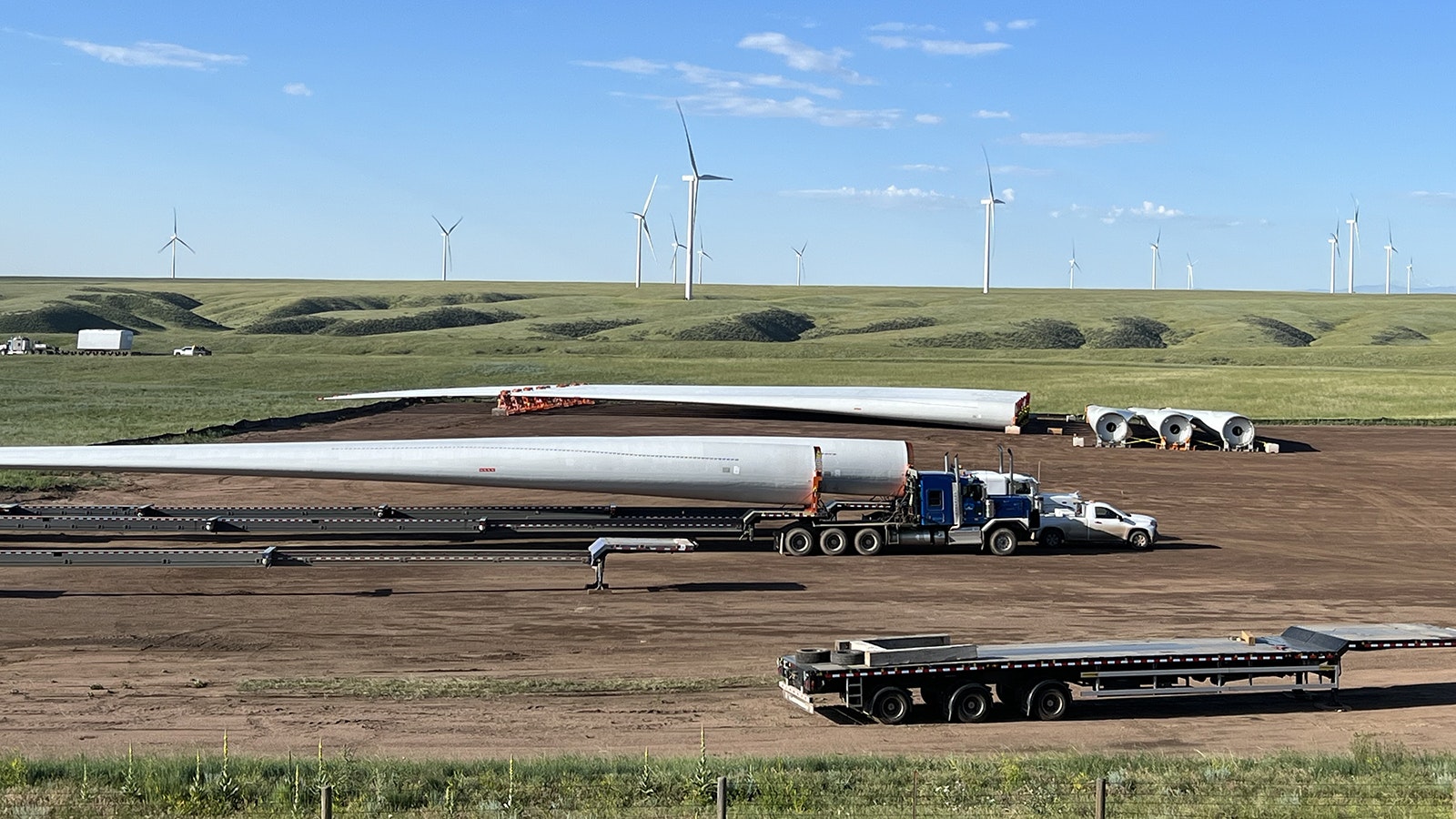
There are no wind turbines on his own property, but ranch he leases adjacent to his property contains wind turbines.
“It’s important to me to have opportunities to add layers to your land,” he told Cowboy State Daily.
Economic Boosts
Energy leases boost state and county economies through tax revenue and job creation. Hendry pointed to Converse County as an example, saying that prior to wind towers showing up there, the county was “damn near broke.” Now, he said, “They’re feeling pretty good in Converse County.”
Money from a wind farm lease north of Casper allowed a rancher there to afford building new fence, he added.
“It helps the whole economy,” he said.
Hendry, who served as a Natrona County Commissioner for 16 years, blasted the Wyoming Freedom Caucus, telling Cowboy State Daily they say “no” to everything.
“They don’t compromise,” he said. “That word is not in their vocabulary. I think Wyoming has suffered because of that.”
Sims said allowing energy leases on private property is another way for a rancher to earn income. When an oil company requested to drill on his land, his family earned surface benefits.
The equipment created more paid work for the family, as pumping wells had to be routinely checked.
Land Diversification Is Key
Both Hendry and Sims say responsible energy production is becoming a common way for Wyoming ranchers to diversify their livelihood.
“It allows ranchers and farmers to adapt to changing markets, weather cycles, and economic pressures,” they write. “Adapting to what the market supports is part of the life of a rancher.”
While beef prices are enjoying record highs meaning higher earnings for ranchers, the story doesn’t end there.
“This year was the absolute best year we’ve ever had,” Hendry told Cowboy State Daily, adding that beef prices have been incredible.
But, he said, those prices can’t last.
At the same time, expenses to run the ranch are increasing. Hendry said insurance for his ranch has increased by 20%.
“Diversification is not a luxury; it is survival,” he and Sims write.
Sims told Cowboy State Daily he takes a lot of pride in running cattle and being profitable in it. But, he said, there are other needs out there, and “we don’t know what’s coming.
“You’ve got to take advantage of every opportunity you get,” he said.
Keeping Ranches Family-Owned
Taking advantage of opportunities is one way to safeguard a family-owned ranch, Sims said.
The owners of the ranches he leases aren’t interested in selling, he said, but their families aren’t interested in ranching.
“We don’t know what our future is with those ranches,” he said. “If we have a chance to buy those ranches, we know we can’t do it with cows.
“I would prefer to have Wyoming as just wide-open spaces,” Sims said. “That’s my biggest dream. But that’s not practical.”
Kate Meadows can be reached at kate@cowboystatedaily.com.