
House Speaker Chip Neiman said it plainly last Wednesday: "I would rather have sent Wyoming Business Council money to the towns and to the counties and do streets, do infrastructure, do sewer line and water lines."
Someone needs to tell him. That's a huge part of what WBC does. Has done for decades. Across all 23 counties.
When the legislative Joint Appropriations Committee voted last month to strip the Wyoming Business Council from the Governor's recommendation of $54.6 million down to a $2 million closeout budget, the committee didn't shrink a bureaucracy.
It cut off the statewide tool that helps counties and towns build the public infrastructure on which private investment depends.
The results surface in plain, concrete ways. A town extends water and sewer. A county upgrades an industrial site. A community fixes a downtown block, then new storefronts open. A business expands because utilities and access roads exist. Families see new jobs and steadier local services because basic infrastructure no longer blocks growth.
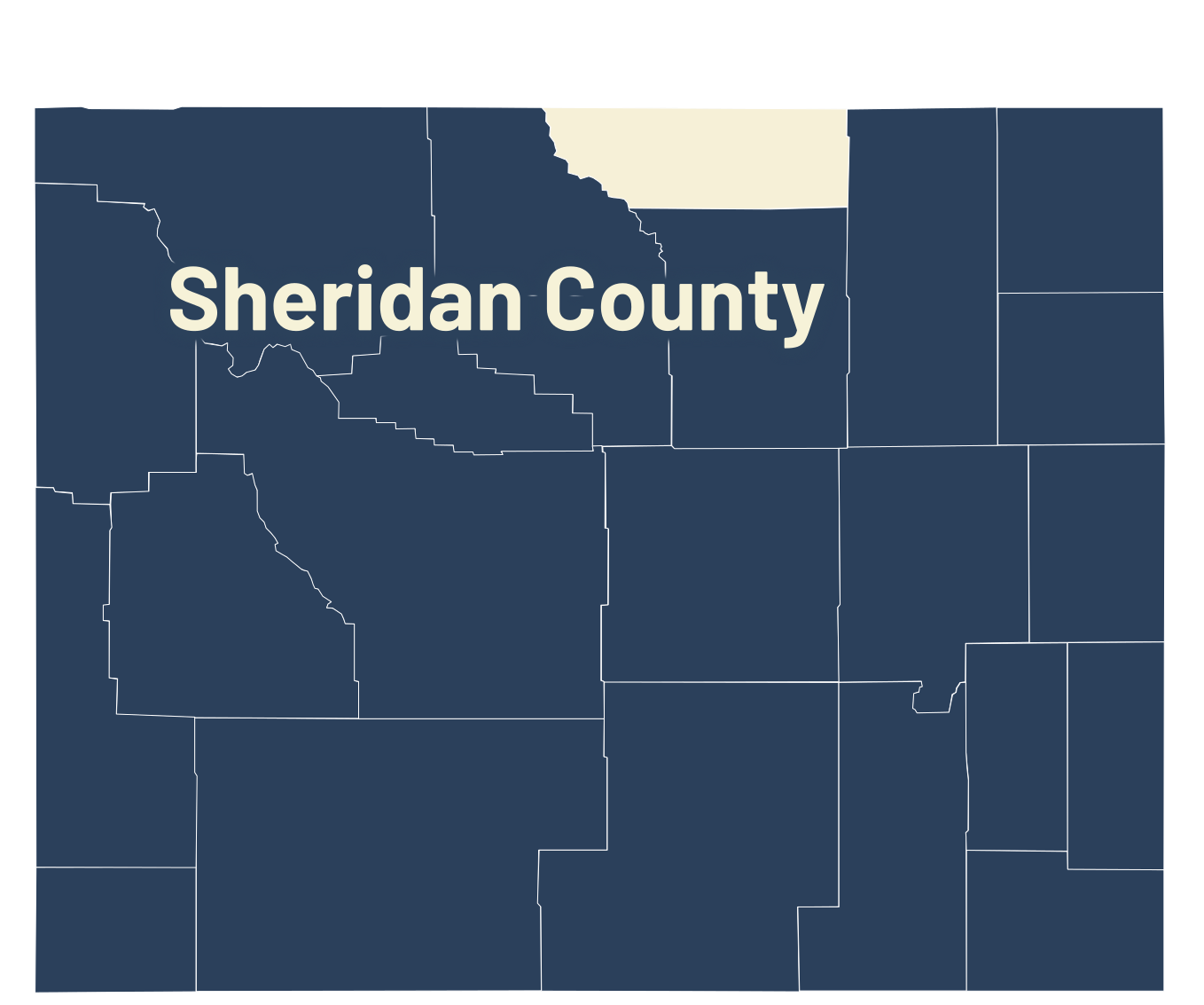
In Sheridan, a new high-tech business park is underway. In Lincoln County, a long-awaited regional sewer system is now funded. WBC grants modernized airports in Rock Springs and Cheyenne, expanded community centers and industrial parks, and extended broadband to over 40 rural towns across the state: from Aladdin to Yoder.
In Neiman's own district of Weston and Crook Counties, Newcastle received a Rural Growth Initiative grant. Sundance got funds for a facility upgrade. The program reaches his backyard. He should know that.
This infrastructure doesn't just serve the present. It builds the conditions for private investment that follows. As one local official put it: "Without the BRC program, projects like our industrial park or airport upgrade would likely fail."
Small counties don't lack need.
They lack staff time and funding options. Grant writing, project management, compliance review—tasks that larger counties handle in-house. The Business Council functions as a capacity bridge. When the legislature deletes the agency, it deletes that capacity along with the money.
Supporters of the defunding bill repeat catchphrases as a substitute for analysis. Let's take them one at a time.
"Picking winners and losers." That phrase creates an image of bureaucrats choosing one business over another while the rest wither. That's not how it works. WBC builds capability that doesn't and couldn't exist without statewide support. Every community with an upgraded industrial site or extended water line is a winner.
"It helps out-of-state businesses." When Weatherby decided to move from California to Wyoming, that made Wyoming a winner and California a loser. Wyoming got a manufacturer, jobs, and tax revenue. I'll take that trade every time.
"Political slush fund." The charge is that WBC violates the constitutional provision prohibiting appropriations to private entities. It doesn't. The program structure centers on public-purpose projects with public applicants. Counties, towns, and joint powers boards apply. Public funds go to public infrastructure, with competitive award processes and required local matches.
"Costly bureaucracy.” WBC has 40 employees across 10 programs and 6 regional offices. From 2000–2025, the agency's economic development work created over 1,000 jobs statewide. Forty employees. Over a thousand jobs. That's not a bureaucracy. That's a return on investment.
The reach matters, too. Recent summaries show WBC projects across all 23 counties. Every county has skin in this game. A statewide cut becomes a county-by-county problem, with towns competing for fewer options and no coordinating framework to fill the gap.
Here's what made Wednesday worse than the Speaker's comment. JAC voted to defund the primary statewide economic development capability in Wyoming. No public comment. No in-depth discussion of consequences. No consideration of impact on already approved projects. No plans for replacement capability. Just a unilateral decision along ideological lines.
This isn't governance. This is flexing power because they can.
The Legislature needs to act. But first, an honest admission: the Wyoming Business Council should face a thorough review of its structure, programs, reporting, and outcomes. That kind of accountability is fair and overdue.
That didn't happen. What happened instead was demolition.
Treat oversight and demolition as separate tasks. Create a select committee with legislators, local economic development leaders, and business representatives. Run a public review with input from counties, municipalities, and businesses. Deliver recommendations ahead of the 2027 general session.
In the meantime, restore the WBC budget to the Governor's recommendation. That step protects ongoing infrastructure work and keeps the statewide framework intact while the review moves forward.
Wyoming builds trust by investing in what works and holding it accountable; not by tearing it down without due diligence.
Readers may reach Gail Symons at Gailsymons@mac.com