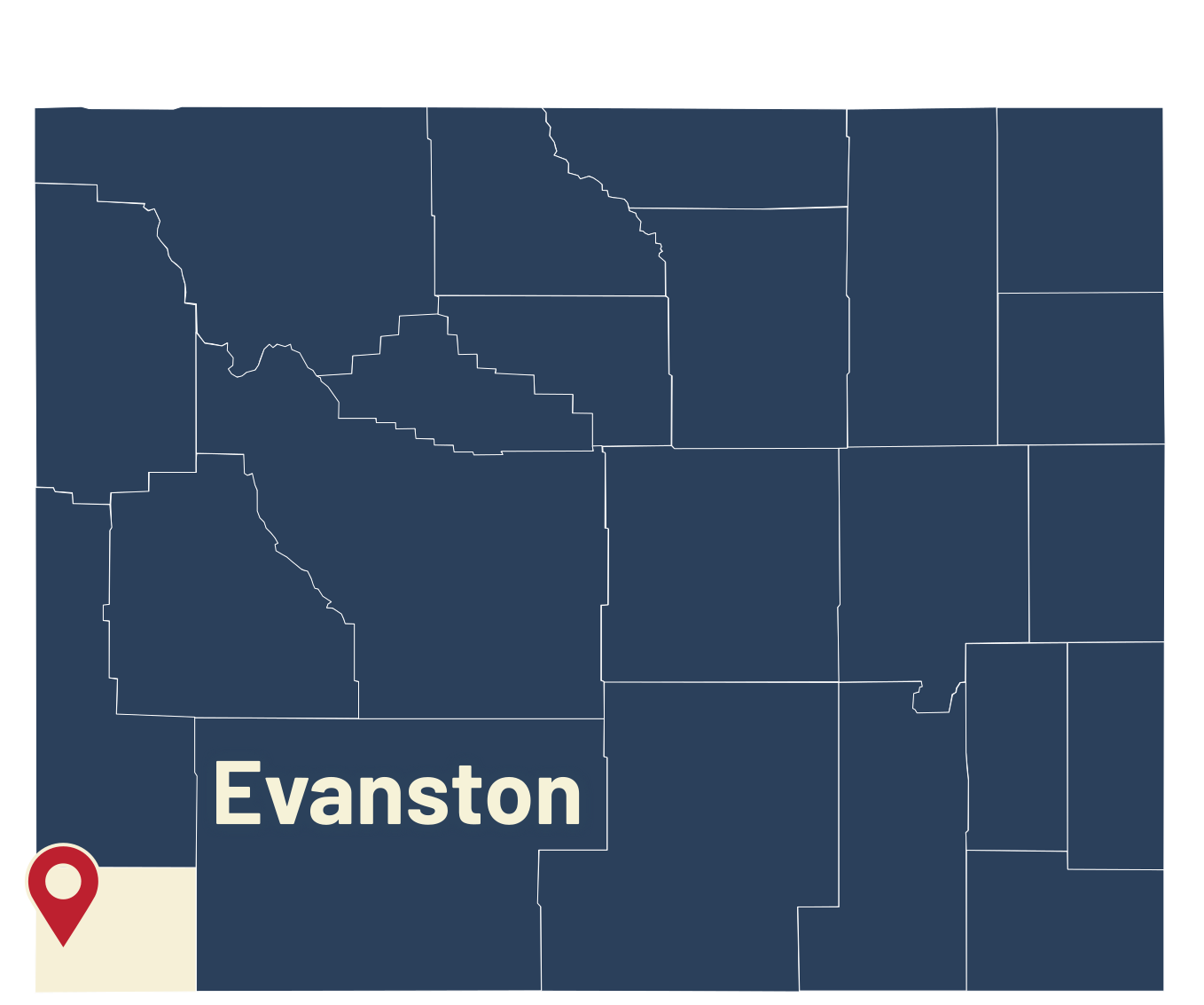
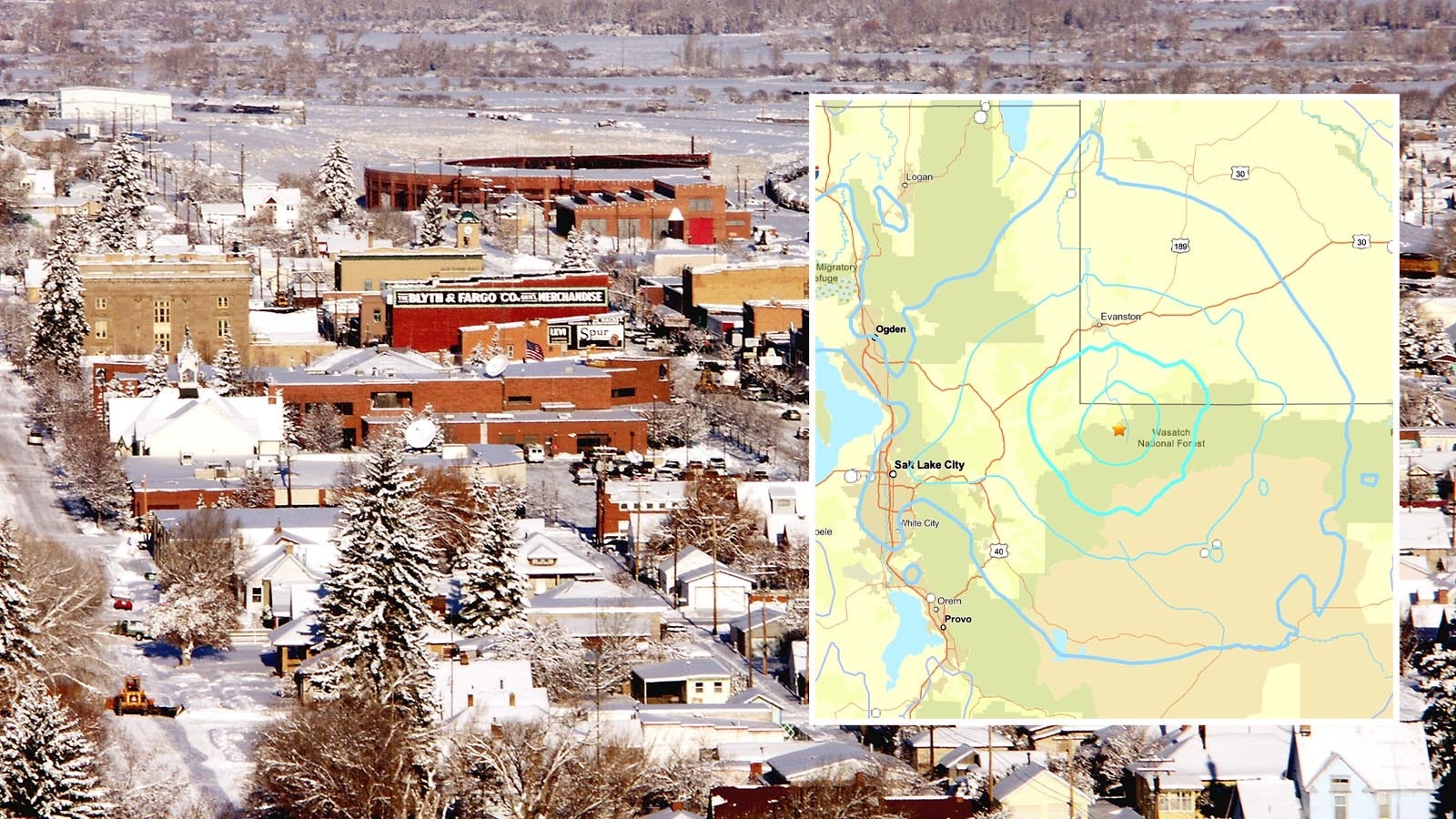
A magnitude 4.7 earthquake that hit about 25 miles south of Evanston just over the Utah state line on Thursday morning shook up the Wyoming border town.
One of the many people in Evanston who unexpectedly felt its intensity was Tessa C., who described it as “a wave crashing over (her) house for a quick second."
“I was drinking a cup of coffee on my bed when I felt it,” she said. “I’m new to town and just waking up, so I was wondering if there was a moose trying to get into the house as I was my little baby wiggle around next to me.”
After a few befuddling moments, Tessa realized it was an earthquake, and that it wasn’t strong enough to cause alarm.
“I’m familiar with earthquakes,” she said. “I was in Los Angeles for the big quake in 1994, and lived in Japan for a few years, so I wasn’t scared. I get a kick out of those things.”
Unusual
James Mauch, a geologist with the Wyoming State Geological Survey (WSGS), said the earthquake occurred just before 8 a.m. Thursday at a depth of 15 kilometers.
Its epicenter was just inside Utah but detected by seismographs much farther away.
“Seismic waves were picked up by our Elk Mountain seismograph about 54 seconds (from) the origin time,” he said, “That’s 230 miles from the epicenter."
Mauch said the earthquake happened in what is known as the Intermountain Seismic Belt. It’s a seismically active area with multiple faults from different geologic events, making it prime territory for earthquakes.
“There are a number of tectonic faults in the region,” he said. “They’re associated with both Basin and Range extension of the crust, as well as some older faults that are associated with the uplift of the Uinta Mountains.
"It’s difficult to assign this particular earthquake to a particular fault, but it occurred on the north flank of the Uinta Mountains.”
While it’s classified as a seismically active area, Mauch still categorized Thursday’s magnitude 4.7 as “fairly unusual.”
Earthquakes of similar magnitude have been recorded in the region, but they’re infrequent.
“It’s certainly not unprecedented, but this one was stronger than the typical earthquakes we see in this area,” he said.
Mauch said there have been several earthquakes of similar magnitude over the last 25 years.
The most notable one in recent years was a magnitude 5.9 just west of Salt Lake City in 2020, and a magnitude 4.9 between Evanston and Cokeville in 2010.
Enough To Be Felt
As of Thursday afternoon, more than 3,700 people had submitted “felt reports” to the USGS. Most of those reports came from the Wasatch Front Urban Corridor, the stretch of eastern Utah from Logan to Provo.
From her home in Evanston, Tessa said the earthquake lasted between 15 and 20 seconds. It felt like “a vibration” but didn’t cause any damage or knock anything over inside.
“Nothing fell down, so it wasn’t alarming,” she said. “It hit like a wave and drifted off into nothing.”
Mauch said the WSGS hasn’t received any damage reports and isn’t expecting any. Earthquakes of that intensity typically aren’t enough to be felt on the ground, let alone cause any damage.
“A lot of people wouldn’t even recognize it as an earthquake,” he said. “Earthquakes of that intensity might feel fairly noticeable on the upper story of a building, but on the ground, it might have felt similar to the vibration of a passing truck.”
Magnitude and intensity are differently quantifiable concepts for earthquakes.
An earthquake of a given magnitude can have a lot of different intensities depending on its depth, surface geology, and distance from the epicenter.
Tessa's Evanston home was closer to the epicenter than those in Salt Lake City, so the wave she felt was probably more intense.
“Damaging earthquakes typically come in at level 6 intensity,” he said. “Most of the felt reports from this earthquake are in the level 3 intensity, which is less than we’d expect to cause damage.”
Share Your Feelings
Mauch encouraged anyone in Wyoming who felt Thursday morning’s earthquake to submit felt reports to the USGS.
These reports, which can be submitted anonymously, ask a few simple questions that help USGS and WSGS geologists better understand the seismic activity in the neighborhood.
“People can basically explain the level and type of shaking they experienced, which is helpful when geologists come back to look at how shaking was distributed across the region,” he said. “It’s just a little plug for citizen science that adds a lot to our work.”
Tessa wasn’t alarmed by the morning earthquake, but she’s going to be on her guard. If she has to hunker down in the bathroom, she’ll be ready.
“I’ve been thinking about aftershocks all day,” she said. “If something happens in the house, we're headed for the bathtub, just so we’re in a protected space.”
Mauch doesn’t think there’s much reason to be alert for aftershocks. This was a stronger earthquake than normal, but it’s probably isolated and not indicative of anything bigger than itself.
“We have records of earthquakes this size and larger that have occurred in what’s known to be a seismically active area,” he said.
Andrew Rossi can be reached at arossi@cowboystatedaily.com.