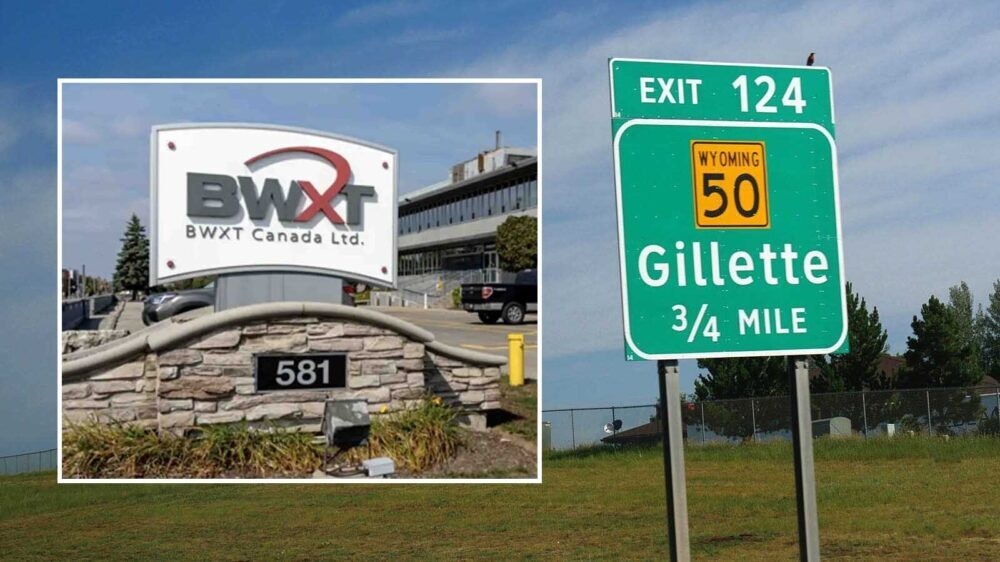
With Russian imports of uranium banned, Wyoming is aimed to dominate the nuclear sector with 54% of domestic market share.
But now, with a $100 million award to BWXT, the state is about to do something it has never done before — turn that raw material into actual fuel for a nuclear plant.
The Wyoming Energy Authority announced $100 million in matching funds to BWXT late Friday afternoon, support that is a game-changer for the Cowboy State, Gov. Mark Gordon said.
“Energy Matching Funds are not about government picking winners,” Gordon said in a statement. “They are about responding to market signals and investing where private capital, innovation, and demand are already moving.”
BWXT has to provide a minimum, 1:1 match for the project under the legislation that created the Large Energy Project funding in 2024. The legislation defined large projects as any qualifying energy project where the state contributes at least $50 million.
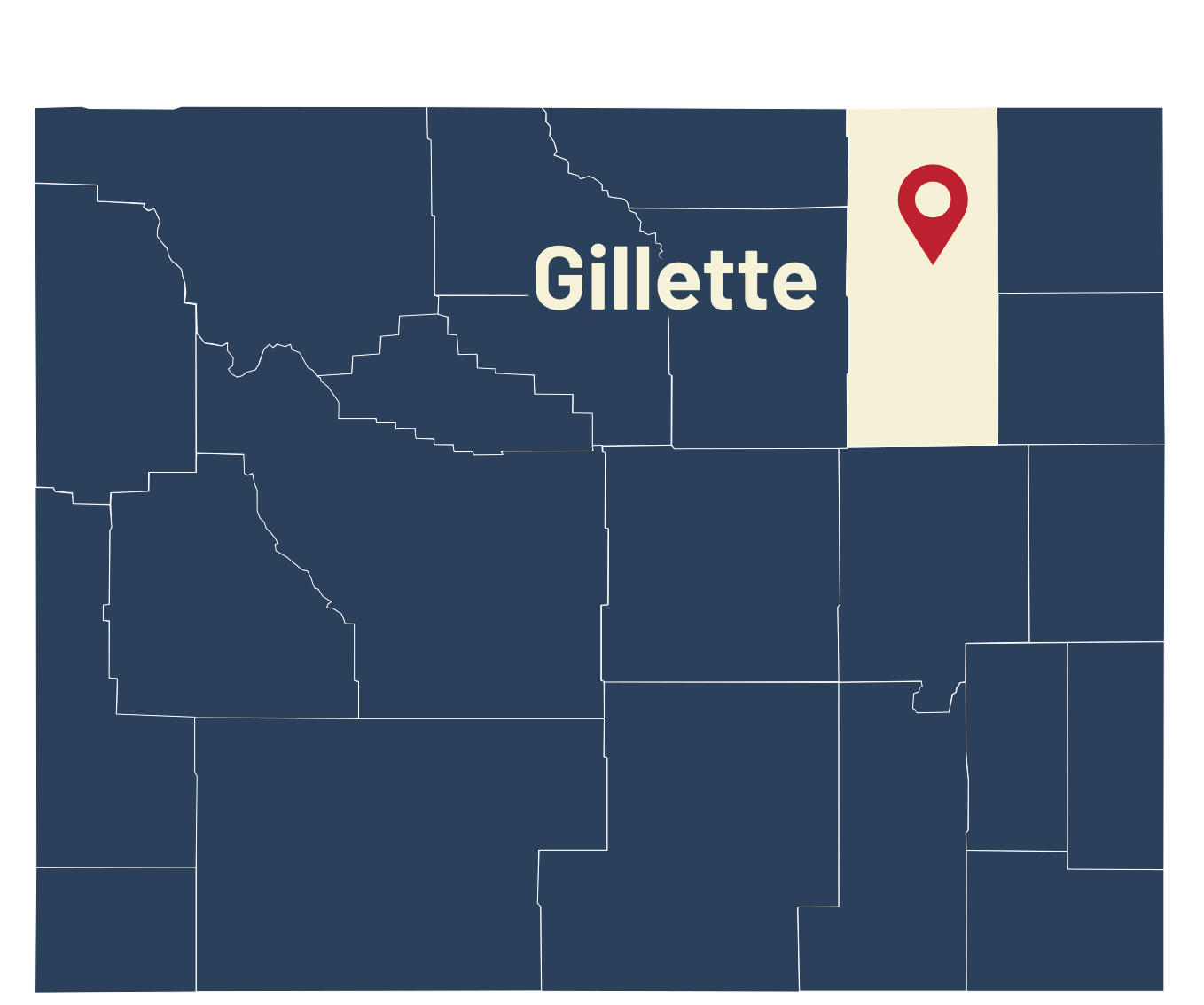
BWXT’s contribution of $473,602,061 far exceeds its required minimum threshold, for a TRISO fuel fabrication facility it plans in Gillette.
“Today is a powerful day for Gillette and for the future of Wyoming,” Gillette Mayor Shay Lundvall said. “Governor Gordon’s decision to award BWXT significant matching funds is a clear vote of confidence in our people, our community, and our role in America’s energy and technology future.
“Gillette has always powered this nation,” Lundvall continued. “And now we are expanding that legacy. I want to thank Governor Gordon for his vision and leadership, and BWXT for believing in Gillette. This partnership represents momentum, opportunity, and pride and it reinforces that the best days for Gillette and Wyoming are still ahead.”
Timeline For Construction, Jobs
With the award, BWXT is set to begin an environmental analysis for its TRISO fuel plant, with construction commencing thereafter.
BWXT has stated publicly it plans to use as many local contractors as possible to build the plant, which will bring immediate economic benefits to the state. Wyoming Energy Authority (WEA) provided further details about that in a summary of the project online.
“The facility is estimated to cost $266,500,000,” WEA wrote in a response to community questions during a public comment period about the project. “If BWXT uses local contractors for 40% of the project (that) equals $106 million in local economic activity. BWXT is committed to use as many local contractors for as much of the project as possible in the construction of the facility.”
Once operational, the plant expects to employ 200 new workers whose wages will average over $100,000 each.
“With $20 million in new payrolls, the community (of Gillette) is going to see increased economic activity and economic growth,” WEA added. “BWXT will pay real property and personal property taxes on the facility and equipment that isn’t eligible for exemption under Wyoming law.”
Economic modeling shows an additional 194 direct and induced jobs will be generated by the plant, adding another $20 million in new payrolls to the northeast Wyoming area.
BWXT facilities are expected to contribute about $100 million to Gross State Product each year on average during the first 10 years of the plant’s operation.
The Nuclear Regulatory Commission’s license for this type of a facility is a minimum of 40 years. Extensions of such licenses are not uncommon, and several facilities in the United States have operated for nearly 70 years.
Why TRISO Fuel Is So Different
BWXT has also been working on deploying small micro nuclear reactors that generate less than 300 megawatts of power in Wyoming for the trona industry.
The small reactors are typically designed for off-grid operation, with remote areas in mind, and have their roots in the defense industry for things like naval submarines.
“For the microreactor it’s more about on-demand power, where transmission is expensive or you need very high temperature steam or high temperature gas for an industrial process,” BWXT President of Government Operations Joe Miller told Cowboy State Daily in a February interview. “It’s a little bit more niche than utility scale power. The cost, because you don’t have the economy of scale, will be a little different.”
That makes SMRs useful for peaking, which refers to high-demand periods where additional power is needed suddenly. It’s also useful for baseload power in industrial settings or in remote locations, which don’t have economically feasible access to transmission lines.
While both SMRs and TerraPower’s nuclear plants both use enriched uranium 235, the fuel cores manufactured for each facility are quite different.
TerraPower’s Natrium reactor, which will produce 345 megawatts of power, will use HALEU in metal form, which will be fabricated into fuel rods that are inserted into the reactor core.
BWXT, on the other hand, has a special fuel design it calls TRi-structural ISOtropic, or TRISO fuel kernels.
These are about the size of a ballpoint pen and look a little like BB gun pellets.
“You start off with a very small kernel that’s a uranium oxycarbide,” Miller said. “And that kind of fuel kernel has been manufactured for several decades worldwide.”
The fuel kernel is wrapped in several layers, including a graphite buffer to provide space for fission gas and carbon monoxide accumulation, as well as absorbing fission recoils and heat.
There’s also a pyrolytic carbon layer to keep chlorides away from the fuel kernel, and a silicon carbide layer to further assist in retaining fission products inside the core.
The design is all about safety.
“One aspect of this TRISO fueled micro reactor is that as the temperature increases, the ability for the chain reaction to be sustained decreases,” Miller explained.
That means that well below the melting point of the fuel, the whole reaction will plateau and choke itself off.
Miller believes this type of fuel will not only be safer, but easier to dispose of in the future.
“Spent fuel is a hot topic,” he said. “It’s important for us in the nuclear industry to address that. And it’s something that we’re doing as part of our site evaluations in Green River.”
Not About Picking Winners
BWXT’s award isn’t about government choosing winners and losers, Gordon said, it’s more about ensuring Wyoming is competitive with other states that are also vying for these projects.
“This is about meeting real energy demand with real projects,” he said. “Energy Matching Funds are not about government picking winners; they are about responding to market signals and investing where private capital, innovation, and demand are already moving.”
The $100 million grant helps ensure Wyoming keeps some of the value chain for improving nuclear fuels, instead of exporting its uranium outside of the state, and then adding all the value somewhere else.
“States across the country are competing for these projects every day,” Gordon said. “Wyoming is in that competition, and it’s one we intend to win.”
Wyoming has already lost out on one such opportunity. Radiant Nuclear in October announced it would build its nuclear microreactor manufacturing plant in Tennessee instead, after months of controversy over spent nuclear fuel storage.
Big Deal For America
Energy Secretary Chris Wright, while touring Idaho National Laboratory in December, described BWXT’s project as an example of a “nuclear renaissance.”
“You know we’re at the early age of a nuclear renaissance where we’re talking about all these reactors being built,” he said. “They’re going to run on fuel. Wyoming’s been a tremendous energy state across the spectrum. I would add nuclear fuel to that if I was Wyoming. And I love the great town of Gillette.”
BWXT’s TRISO plant won’t just be huge, though, for Wyoming, though. It’s really huge for America as well.
Once completed, BWXT’s plant will be the first nuclear fuel fabrication site built in the United States in decades. That will help reduce America’s reliance on foreign-manufactured nuclear fuel.
“A TRISO fuel fabrication plant in Gillette strengthens Wyoming’s role in national energy security, supports a reliable and secure fuel supply for advanced reactors, and keeps the United States at the forefront of nuclear innovation,” Wyoming Energy Authority Executive Director Rob Creager said in a media release. “BWXT choosing Wyoming means new jobs, new investment in the state, and a chance for our workforce to help continue to lead the country in reliable baseload energy.”
Wyoming has been mining uranium since the 1950s and has America’s largest known reserves. What it hasn’t been able to do until now, however, is capture some of the manufacturing value after the product is mined.
Long-term, success in capturing some of the manufacturing value chain in the nuclear sector will also help the state create infrastructure that can help diversify the state’s economy, a long-time goal for economic developers across the state.
Renée Jean can be reached at renee@cowboystatedaily.com.