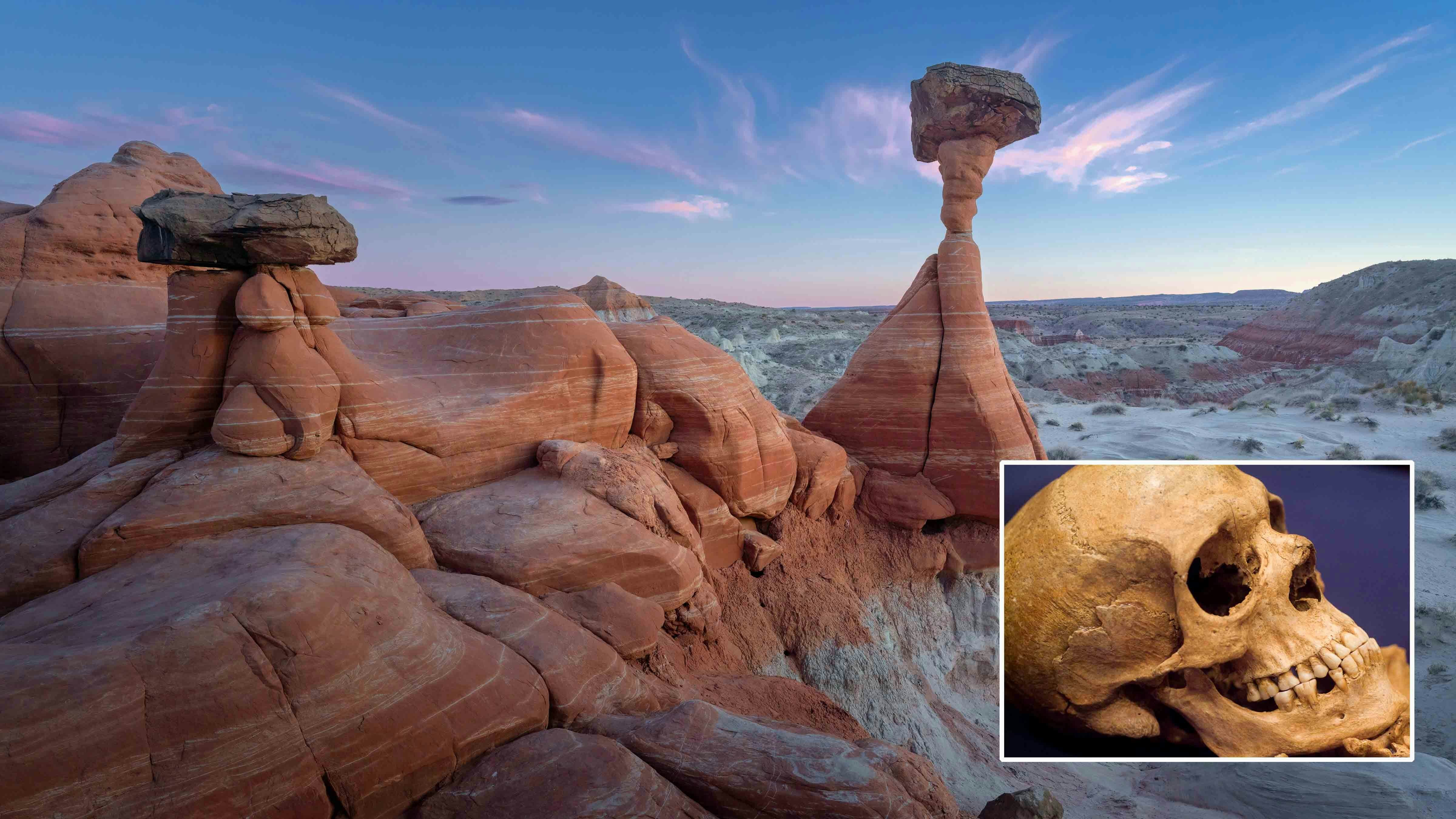
A human skull has been stolen from an archaeological site in southern Utah. Now, archaeologists and law enforcement officers are attempting to find the person responsible for this "disturbing and disgusting act."
The Utah School and Institutional Trust Lands Administration is offering a $3,000 reward for information leading to the arrest and conviction of the individual who stole a human skull from a protected archaeological site near Kanab, Utah.
"It came to our attention in January," said Joel Boomgarden, lead archaeologist for the Trust Lands Administration. "Someone posted a photo of themselves holding the skull as their Facebook profile picture."
Boomgarden can't share the photo, and he wouldn't even if he were permitted to. Even if it could help identify the culprit, sharing a photograph of human remains would be "ethically inappropriate."
Boomgarden hopes someone living in or near Kanab has information and will come forward. Ideally, they'd like to return the skull to its final resting place, where it rightfully belongs and should never have been removed.
"In my 25 years with the agency, this is the first case of theft of human remains," he said. "I'm not even sure what to call it. The fact that (grave robbing) is still happening in this day and age is shocking to me."
Dignity Of The Dead
The investigating agencies, including the Utah Attorney General's Office, aren't sharing many details on the incident or the site where it occurred. They want to protect the site from further desecration, and fear sharing too much information will draw unwanted attention.
Boomgarden shared that the site dates back to the Basketmaker culture, a pre-Ancestral Puebloan culture that lived across southern Utah, Colorado, New Mexico, and Arizona.
"We got a radiocarbon date of 240 A.D. from a corn cob found at the site," he said. "'Basketmaker' doesn't refer to a particular tribe or people, but a reference to a timeframe that's convenient for archaeologists."
The burial site is located on trust land near Kanab. When the Utah School and Institutional Trust Lands Administration saw the photo of the skull, they visited the site and confirmed that a grave had been disturbed and that a skull had been removed.
Boomgarden can't fathom why anyone would disturb a protected burial site, let alone steal human remains.
"I know people have a general fascination with these sorts of things, but disturbing a grave and taking a skull home with you? That's on a different level that I don't understand," he said.
Even professional archaeologists don't disturb burial sites when they're found. There was a time when they might excavate a known site for research, but now they do everything they can to avoid disturbing the dead.
"Removal of remains is the absolute last option," he said. "We don't want to do it. We don't want to take people out of the ground. We want to leave them absolutely where they're at. And in this case of this site, there is no reason to remove any remains from that site."
"Disgusting"
Vandalism of archaeological sites is egregious enough for both the public and professional archaeologists. It often causes irreparable damage to these sites, which are protected by state and federal laws and sacred to many indigenous tribes.
In November, Daniela Ganassim Ericksen of Ivins, Utah, was sentenced to pay nearly $15,000 in restitution and serve 12 months of probation after being convicted of defacing petroglyphs on the Wire Pass Trail, also located near Kanab. The Bureau of Land Management in Utah said the $7,000 of damage she caused "can never be made 100% whole again."
Defacing petroglyphs and stealing artifacts is one thing, but the theft of human remains is unconscionable for most archaeologists.
"It's disgusting," said Bonnie Smith, president of the Wyoming Association of Professional Archaeologists. "What happened at Kanab is awful."
Archaeologists used to excavate and even display human remains found at significant archaeological sites, but ethics have changed over the years. Smith and her colleagues believe that's for the better.
"When I worked at the Buffalo Bill Center of the West, we had possession of a couple of sets of human remains," Smith said. "One was from the Mummy Cave site near the East Gate of Yellowstone National Park, and those remains were on display at one time."
"Mummy Joe," the skeleton recovered from Mummy Cave, was eventually taken off exhibit. Smith recalled hearing negative feedback that the remains were removed from public display, and her response was succinct.
"Do you want your grandfather on exhibit? The whole goal is to return human remains to the tribes, not to steal more. We don't hear a lot about theft of human remains, especially from burials, so I can't even say how disgusting it is when it happens."
Crime And Punishment
According to an assessment by the Wyoming Cultural Records Office, at least 157 of Wyoming's 666 known petroglyph sites have been vandalized. Other sites have been vandalized by people looking for arrowheads, pottery, and other artifacts.
The Wyoming Game and Fish Department is offering a $10,000 reward for information on the people responsible for vandalizing and looting an archaeological site near Dubois.
“Right now, we’re looking for people who might have information,” Jason Hunter, regional wildlife supervisor for Wyoming Game and Fish’s Lander office, told Cowboy State Daily in October. “If we can figure out who did this, we can start looking to get back what was taken.”
If the Utah School and Institutional Trust Lands Administration finds the person responsible for stealing the skull, they'll be charged with several crimes. Even posting the photo of the skull is a Class B misdemeanor.
"It'll be illegal for me to release those photos, even though the perpetrator posted them on Facebook," Boomgarden said. "I could be charged if we allowed those photos to get out."
Boomgarden hopes to find and prosecute the person responsible, but that won't do anything to assuage the "disturbing" nature of their actions.
"I don't understand what makes a person do that," he said. "It's so wrong on so many levels."
The ultimate goal is to recover the stolen skull and return it to its burial site. For Boomgarden, restoring the dignity of the dead is as important as prosecuting the perpetrator.
"It's best practice to leave (human remains) where they are," he said. "The greatest triumph here would be to find those remains and get them back to where they belong. They were perfectly fine right where they're at, and that's where they belong."
Anyone with information on the theft can contact the Utah Attorney General’s Office. Individuals with tips may remain anonymous.
Andrew Rossi can be reached at arossi@cowboystatedaily.com.