
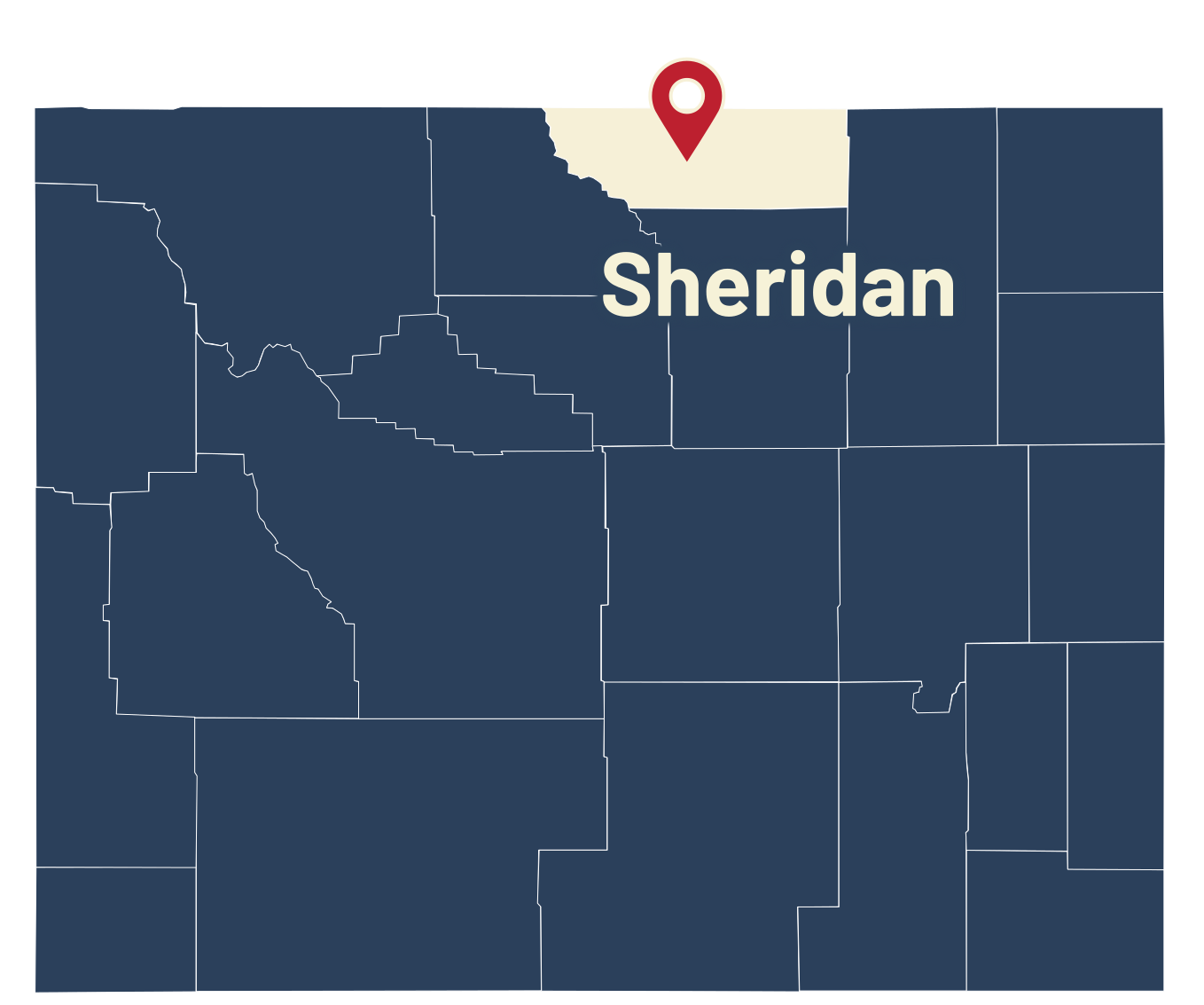

Robots showed up at Nolan Schaffer’s workplace at EMIT Technologies in Sheridan, but their arrival didn’t make him worry about his job.
In fact, it made him feel more confident about his job’s future.
“I knew it was coming,” he said. “I was informed way before it arrived because I was a part of the installation and all that.”
Robots are taking over repetitive welding jobs at EMIT, but they’re not replacing any workers. Instead, they’re freeing human welders for more difficult jobs that require dexterity or involve work too varied for repetitive routines. That’s allowing the company to produce more and creating demand for more workers to support the growth.
People are still part of the robotic welding loop, Schaffer added.
“You still have to babysit it,” he said. “But rather than it taking six to 12 people to weld out a full order of stuff, now it’s just one person with a robot. That’s freed up a lot of space downstream for a lot of the manual welders to have more time to do their stuff.”

Hiring Crunch Strategy
Welders have been difficult for EMIT to hire, CEO Casey Osborn told Cowboy State Daily.
“We probably need 70 welders and we’re not going to get 70 welders fast enough,” he said. “But there’s a good mix of some parts we can robotically weld. Parts with high repeatability.”
Osborn is targeting mid-November to have four robotic arms up and running, freeing an estimated 22 welders.
“Then we can shift those other welders into some other work we’re doing across the way,” Osborn said.
Each robotic arm is programmed for a specific part. Operating it requires little welding experience or training, Osborn added. In fact, how much training is required is one of the questions he asks to decide if such tools will be a good fit for EMIT.
The equipment still starts at the human push of a button.
EMIT made a major investment in manufacturing equipment in 2019. At that time, it had roughly 25 welders. Now, in 2026, it has 55 and still needs more.
“The only reason we buy those machines is because they help us do more faster,” Osborn said. “That usually creates opportunity.”

Small Population Barrier
Wyoming’s population once was a big strike against it when it came to attracting manufacturers.
“It used to be a problem that we only had 600,000 people,” L&H’s Mike Wandler told Cowboy State Daily last year. “You were kind of insane to be manufacturing in Wyoming.”
But lower population isn’t such a barrier now, and Wandler credits the combination of Wyoming’s skilled workers and advancing technology.
“One tradesman can manufacture so much more than they used to be able to because of automation and intelligence,” he said. “Our lack of population isn’t a barrier. We’re manufacturing $120 million worth of parts, and we’re Wyoming headquartered. We have two locations in Wyoming and most of the manufacturing happens there. We ship this stuff all over the world.”
Wyoming, Wandler added, is actually a better place for manufacturing, in his opinion, than larger population centers.
“I have shops in Phoenix, Arizona, and I thought, ‘Oh, my hiring problems are done. I’ve got what, 3, 4 million people to draw from,’” he said. “But it’s way easier to hire talented young people with a work ethic who are gear heads in Gillette, Wyoming, or Sheridan, Wyoming, than it is in the middle of Phoenix.”
Wandler credits Wyoming’s work ethic as well as the experience farm kids get solving problems with sometimes limited resources.
“Our manufacturing IQ is way above everybody else and the world is noticing that right now,” Wandler said. “They’re coming and they’re talking to me about it.”
Training Pipeline Is Key
Robotic colleagues might help Wyoming manufacturing overcome hiring crunches, but maximizing the effect is likely to require training.
“You’ve got to have training ahead of growth,” former Sheridan mayor Dave Kinskey told Cowboy State Daily.
Kinskey learned that lesson while pursuing a company that wanted to make extruded plastics. He showed its representative available sites, but the company chose a different Wyoming city.
When Kinskey called to ask why Sheridan had lost the opportunity, the answer was, in a nutshell, a shortage of workers with the training the company needed. It wanted people who could operate computer numerical control machinery, generally called CNC equipment.
“You don’t have a critical mass of those kinds of people,” Kinskey recalls the manufacturer telling him.
Those skills could transfer between manufacturers, whether their equipment was making products from wood, plastics or metal.
Eventually, Sheridan College invested in CNC equipment and expanded its welding program. That training pipeline was ultimately key to attracting manufacturers such as Vacutech and Weatherby to Sheridan, helping populate its business park.
Making Parts While He Sleeps
At L&H, machinists also program the equipment they run. They don’t simply load a part and push a button. They tell the machine how to make it, too.
That’s the kind of employee Taylor Wendtland eventually wants for his own machine shop.
“I need someone who can program the part, maybe even design the part, design the fixturing, program everything, get the machine set up and run it,” he said.
For now, Wendtland does most of that work himself, with occasional help from a student intern. He hopes the additional production his robot makes possible will eventually generate enough revenue to support that hire.
Wendtland’s robot is designed to load raw material into his machining equipment, then remove the finished part and repeat the process with little supervision once properly set up.
It reminds Wendtland a little of an old 3D printer he bought when he was still a student.
“I originally had one in my room that was printing at night while I was asleep,” he said. “It was just random things for around the house. Additions for my car.”
Wendtland had an old Subaru Outback with a bunch of broken hose clamps.
“If you ordered them, they were going to be like $50,” he said. “So I printed them.”
Eventually, Wendtland envisions his machine shop producing parts while he sleeps.
“The table will just be loaded with a bunch of raw pieces of material,” he said. “Then the robot will come over, pick it up, put it in the machine, pull out the finished part, and put it back where the raw material just was.”
If it works the way he hopes, Wendtland could arrive at work the next morning to find a table full of finished parts ready for the next production stage.
“If I program it right, we’ll do it 24/7. That’s how it’s supposed to work,” he said. “We’ll see if it actually does.”
Renée Jean can be reached at renee@cowboystatedaily.com.


