
Midwest became the first spot in the nation to play high school football under lights in 1925. Now grades 6-12 of the Wyoming K-12 school are on the Natrona County School District cut list.
Natrona County School District leadership is considering closing the secondary grades, 6-12, at Midwest School beginning with the 2027–2028 school year, according to a message sent to parents Thursday by interim principal Walt Wilcox and viewed by Cowboy State Daily.
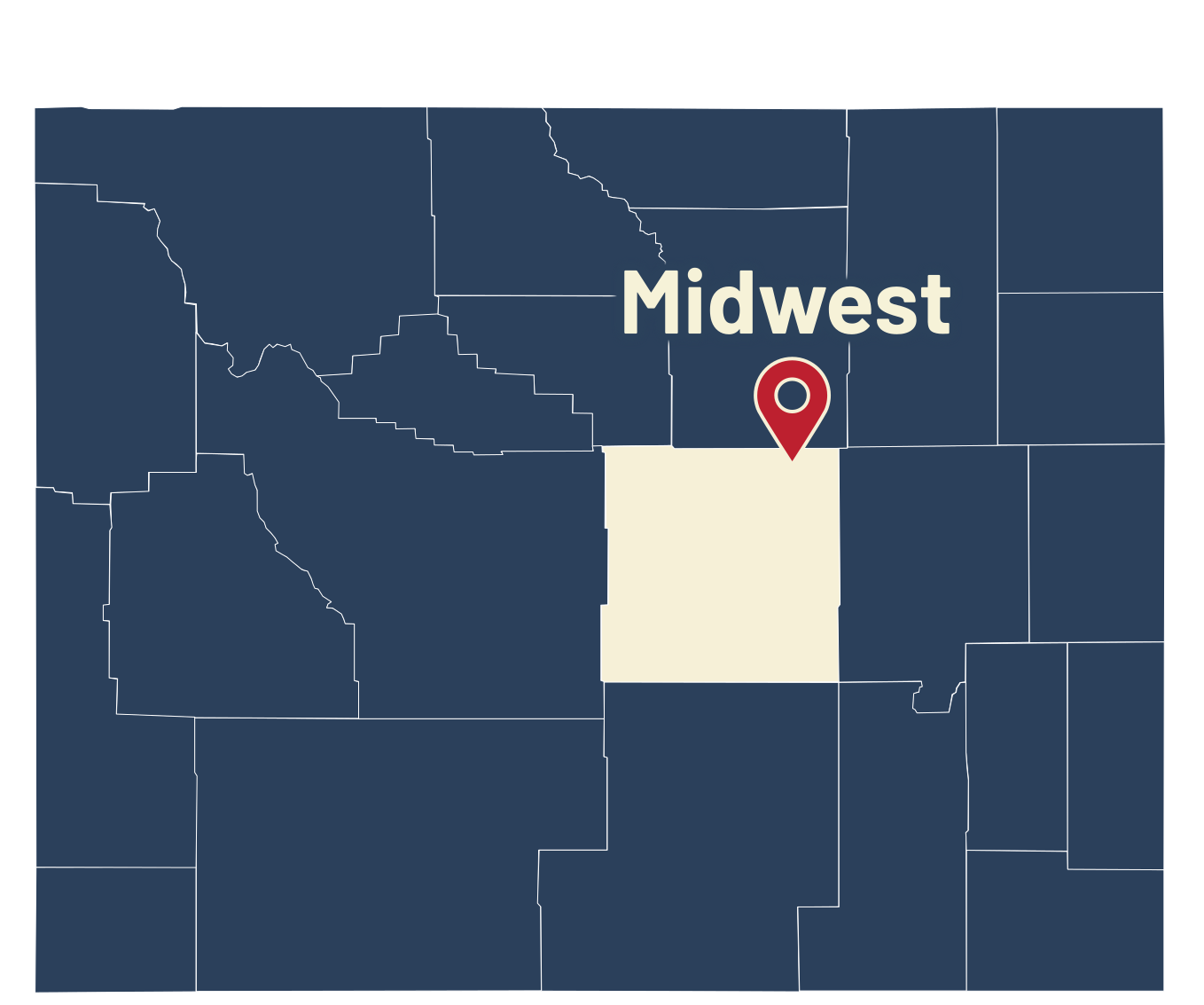
The message cites funding and staffing challenges as reasons for the possible closure, noting that changes to Wyoming's school funding model have made it increasingly difficult to maintain the staffing necessary to provide a secondary education in Midwest, a town of about 285 people with a rich athletic tradition located roughly 44 miles north of Casper.
The school is also facing “considerable ongoing facility improvement needs.”
"This is a difficult process," the message reads.
District leadership will provide a report at the upcoming Board Infrastructure Planning Committee.
If the committee opts to forward the consideration to the Natrona County School District Board of Trustees, the item will be discussed at the Oct. 26 and Nov. 9 board meetings.
For Midwest Mayor Ricky Provence, the possibility alone is alarming.
"To me, this is a town killer for a community like ours," Provence told Cowboy State Daily on Friday.
Provence, who became mayor three months ago, said he learned about the potential closure through social media rather than any formal communication from the school district.
"It hasn't made it to our community from the school district," he said.
In a town as small as Midwest, however, news travels quickly.
"It does not take long for things to get around," he said.
Wilcox did not respond to Cowboy State Daily's request for comment before publication. Neither did Natrona County School District representative Tanya Southerland.
Friday Night Lights
For generations of Midwest residents, the school has been more than a place where children learn to read, write and do arithmetic.
It has been a source of community pride, particularly on the football field. Midwest holds a distinctive place in American high school football history.
On Nov. 19, 1925, the Midwest Yellow Dogs faced the Casper Mustangs in what is recognized as the nation's first completed high school football game played under electric lights.
The Midwest Oil and Refining Co. installed the lights for the historic contest, which Casper won 20-0.
The game, which was played with a white ball to help the players see it, was the beginning of a tradition that would eventually become synonymous with high school football across America: Friday Night Lights.
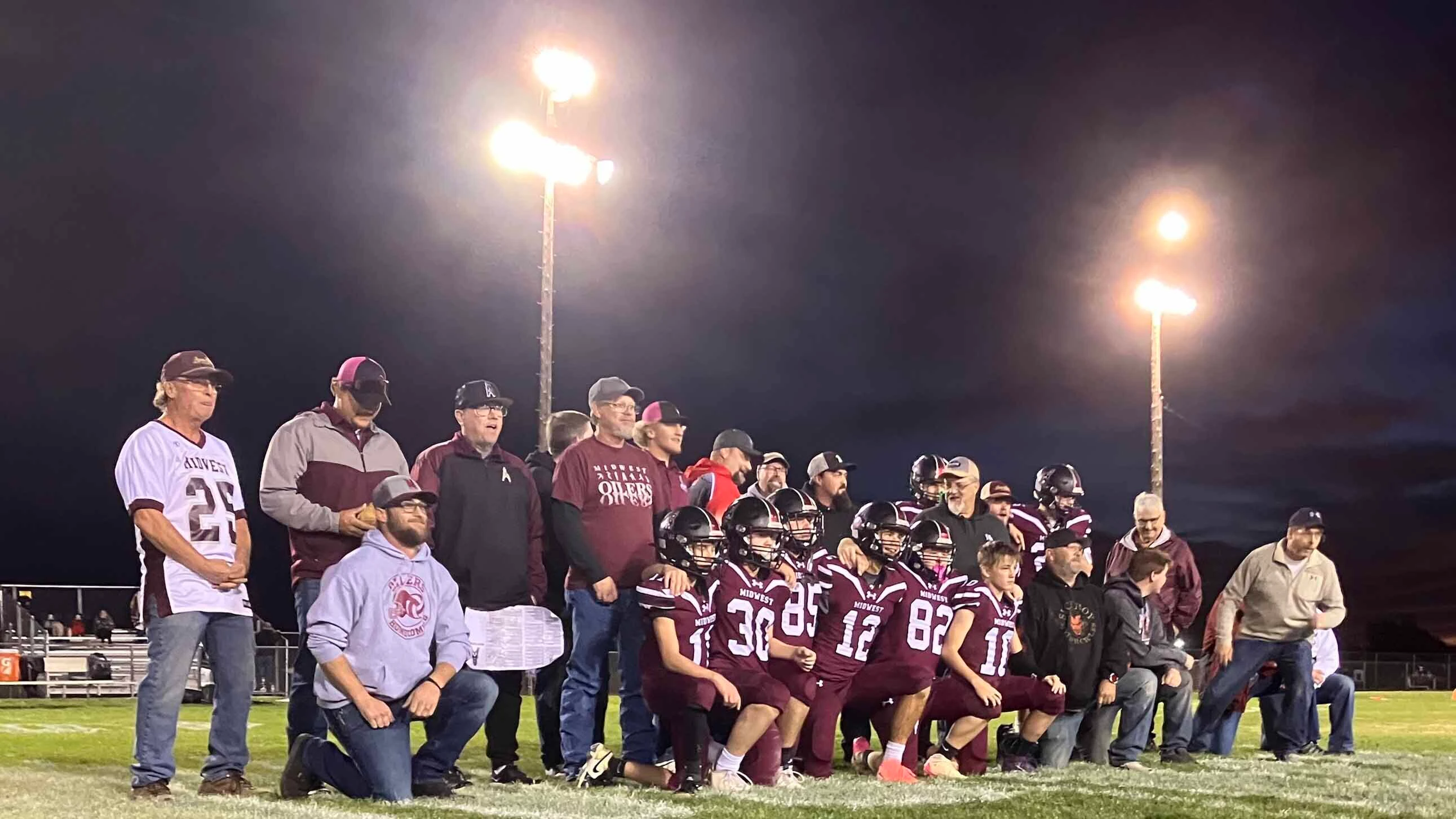
Last October, Midwest celebrated the 100th anniversary of that historic game with a ceremony honoring generations of Oilers football players.
A century-old football used in the original contest was brought out from the Salt Creek Museum, and former players joined the current team to commemorate the occasion.
The celebration brought together generations of Midwest families whose ties to the school and its football program stretch back decades.
Among them was former Oiler Guy Chapman, who played from 1974 to 1977. His father, brother and uncles also played football for Midwest.
The school's football program was a powerhouse during the late 1970s and 1980s, according to former player Phil LeMaitre, a 1986 graduate who returned for the centennial celebration.
Today, the Oilers compete in 6-Man football, but the school's history remains a point of pride for the community.
That history makes the possibility of losing the secondary grades particularly painful for residents who have watched generations of Midwest children grow up wearing the school's maroon and white.
A Town's Future At Stake
Provence, who grew up in Casper and returned to Wyoming about four years ago after spending four decades out of state, said Midwest is already struggling.
The possibility of losing its middle and high school grades represents another serious blow.
"This is one more massive step that is going to hurt us," he said.
His concerns extend beyond the classroom.
Midwest has a long and proud football tradition, including a historic athletics field that helped put the community on the national map a century ago with high school football’s first night game.
If the upper grades close, Provence fears that field could fall into disuse.
"We have a beautiful football field and it's going to end up being a mudhole because it won't get used," he said.
He also worries that students who would have to travel to Casper for school could lose opportunities to participate in athletics and extracurricular activities, particularly if transportation home after practices and games is unavailable.
There are questions about what would happen to teachers and their families, including those who live in district-owned housing in Midwest.
Provence fears that teachers who lose their jobs could also lose their homes, potentially driving more families out of town.
And he questions whether the elementary grades would survive long after the secondary grades disappear.
"They could more than likely kill the rest of it in a couple years," he said. "That, to me, would be the writing on the wall."
Parents Worry About Their Children
For Adrianna Hays, the possibility of closing grades 6–12 is not an abstract discussion about school funding.
It's a decision that could affect all three of her children, who attend Midwest School and range in age from kindergarten through eighth grade.
Her husband, Dale, graduated from Midwest School 11 years ago in a class of 18 students.
He came to appreciate the small class sizes and individual attention students received from teachers, Hays said.
Those are among the qualities she wants her own children to experience.
Her eighth-grader plays football for Midwest, and she worries about what a move to a larger school would mean for his athletic opportunities.
"The possibility of losing that experience, or having to compete in a much larger school where the opportunities to participate may be different, is a serious concern for me," she said.
But athletics are only part of the equation.
"A decision to close grades 6–12 would affect my children at different stages of their education, potentially separating them from the school community they know and changing the path they expected to follow," Hays said.
"I want my children to have stability, continuity, and the opportunity to grow within a community that knows them and cares about their future."
If the upper grades close, Hays said she and her husband would consider sending their children to schools in Kaycee or Glenrock rather than to Casper.
"We would not send our kids to a big school or another school within Natrona County School District again," she said. "I want the district and our state leaders to understand that rural students deserve the same consideration, investment, and opportunities as students in larger communities."
"Our children did not create the funding model, and they should not be expected to bear the consequences without a serious effort to find sustainable solutions."
A Statewide Problem
Steve Harshman, a Midwest School graduate and longtime Wyoming legislator, sees the situation as a warning about the future of rural education across the state.
Harshman, who is running for superintendent of public instruction, graduated from Midwest School in 1981 in a class of about 25 students.
His oldest brother graduated in a class of 40.
When Harshman returned to speak at a Midwest graduation several years ago, there were just eight students receiving diplomas.
The shrinking graduating classes reflect the challenges of operating a school in a small community, where the costs of maintaining buildings, staffing classrooms and providing services don't necessarily decline in proportion to enrollment.
"I think the big issue we've recognized previously is that there are costs with operating a small school because you don't have the economies of scale," Harshman told Cowboy State Daily.
Harshman pointed to changes in Wyoming's school funding model approved by lawmakers during the last legislative session, saying they reduced funding for small schools while limiting districts' flexibility in how they allocate resources.
"You take away any flexibility to have the support that helps run the school, from administrative to custodian to maintenance," he said. "Gosh, it gets tougher. You can't run in the red."
Harshman said he hopes lawmakers can revisit the issue before more rural communities face similar decisions.
"I'm hopeful we can fix this," he said, "because it's going to be a challenge facing a lot of small schools in Wyoming."
More Than A School
Midwest's history is closely tied to the Salt Creek oilfield, which once helped make the community one of the largest population centers in Natrona County.
The community's past is still visible in its housing, including a neighborhood known as Navy Row, a reminder of the U.S. Navy's presence in the area during the era of the Teapot Dome oil scandal.
Some of those homes eventually became school district housing for teachers, Harshman said.
Now, Provence wonders what will become of that housing if the school loses its secondary grades and teaching positions disappear.
He also wonders what will become of the town if families with school-age children decide there is no longer a reason to stay.
For Hays, the question is not simply where her children would attend classes.
It's whether the next generation of Midwest children will have the same opportunities to grow up in a close-knit school community that their parents and grandparents knew.
And for Harshman, who went from playing football for the Midwest Oilers to coaching at Natrona County High School, the potential closure raises a larger question about Wyoming's commitment to preserving its rural communities.
"We certainly don't want to shut down small-town Wyoming," he said.
Kate Meadows can be reached at kate@cowboystatedaily.com.


