
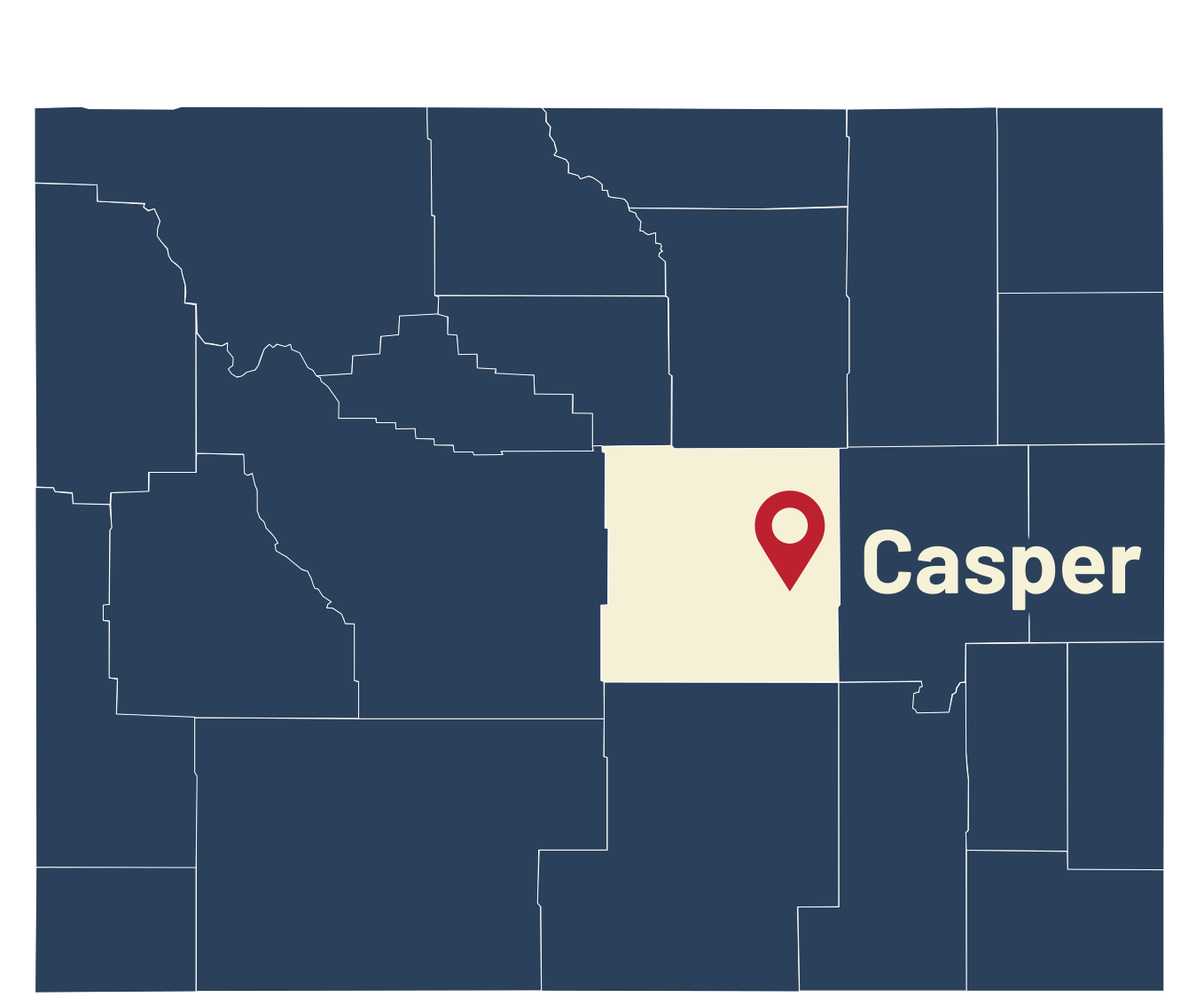

A 51-year-old Casper woman apologized Thursday morning to the guardian of her former patient and to her former employer for tying a patient’s hair to a bed at the nursing facility where she worked.
Julie Ann Cross’ apology for her July 2025 conduct at a NOWCAP Services facility on the east side of Casper, a positive pre-sentence report, and remarks from the victim’s guardian as well as the prosecution and defense attorneys were enough for Natrona County District Court Judge Catherine Wilking to go along with a plea deal put before her in May.
The judge sentenced Cross to a four- to six-year sentence in prison. She then suspended the sentence and ordered Cross to complete three years of supervised probation on a charge of intentional abuse, neglect, or abandonment of a vulnerable adult.
“I understand why the plea agreement was entered into,” Wilking said.
Cross made her apology to her former employer and to the patient’s family after the victim’s guardian, registered nurse Cheryl Cox, told the court she didn’t believe Cox had “ill will” in her actions.
“This could have gone bad in so many ways,” Cox said. “It could have caused (the patient) to break her neck.”
Cox said the patient is her cousin and she suffers from a condition that causes her seizures. She said Cross cared for the victim for a long time and knew her condition.
She asked the court to ensure that Cox did not have “contact with patients anymore.”
Assistant District Attorney Patrick LeBrun advocated for the judge to accept the plea deal he outlined before her May 7. He said the pre-sentence report showed Cross did not have a criminal history and that she had worked at the NOWCAP facility on the east side of Casper for several years.
'Justice' Served
LeBrun said the report showed that Cross also enjoyed her job.
“Justice in this case can be served by this felony conviction,” he said. “She’s going to have to find another way to make a living.”
He asked the judge to impose the plea deal.
Defense attorney Dylan Rosalez said the means of the “Alford plea” where the prosecution used a police affidavit to determine the guilt of his client did not mean she did not take responsibility for her actions.
He said the pre-sentence report showed Cross admitted she made some “grave” mistakes. Rosalez characterized Cross as “timid, caring, and attentive.”
“She cares about her work,” he said. “She now struggles to find employment that meets her needs … I think this case has taken a lot out of her.”
Rosalez told the judge his client would “do well” on probation and also asked Wilking to accept the terms of the plea deal.
Wilking said at first if was hard for her to “figure out” how the incident occurred and that an explanation from Cross contained in the pre-sentence material “made sense.”
'Vulnerable People'
Wilking said as a judge she deals with guardianship issues and “views these cases in a different light because of the vulnerable people” that require the help of society and the courts.
“You feel like you get to know these people,” she said.
Wilking commended Cox for the “grace” contained in her letter and remarks. She also noted that while Cross’ actions “shattered” any trust in her caregiving, her history in caring for the vulnerable and willingness to serve was evident.
Wilking then imposed the plea agreement and the terms of Cross’ probation, telling her that she needed to “lead a worthy and law-abiding life.”
“You need to be employed on a full-time basis,” she said.
As part of the plea deal, a second charge of false imprisonment was dropped.
The case against Cross revolves around a July 14, 2025, incident at a NOWCAP Services facility in the 300 block of North Walsh Avenue.
The Background
Cross’ co-workers found a 54-year-old woman who was under her care on the night shift tied to the bed with a scarf.
Police interviews with them revealed that one of the workers tried to roll the patient over to pull up her pants, but she saw that she could not because a blue scarf in the patient’s hair was tied to the bed.
A colleague joined her, and then Cross allegedly came into the room and attempted to push the first worker to the side while reaching for the scarf, according to the affidavit.
The worker asked Cross why she tied the woman with the scarf, and the worker told police Cross replied, “It was to keep (the patient) from moving.”
The affidavit states Cross left the room and the second care worker spent five minutes getting the scarf untied from the patient’s hair.
During an interview by phone, Cross reportedly told the officer she was the solo worker on the night shift, the affidavit says.
Early on July 14, the patient was awake and tossing her head back and forth, Cross said, adding that the patient needed to be changed and her hair “smelt.”
So, she tied it with one of the patient’s silky scarves into a ponytail and said the “rest of the scarf was on the pillow.”
According to the affidavit, Cross said she checked on the patient in the early morning hours and found the end of the scarf had “fallen and wrapped around the bed.”
She said she put the end of the scarf back on the bed next to the resident and, during another check, it had not moved.
“Morning staff came in and she told them about the scarf and how it had gotten wrapped around the corner of the bed,” the affidavit states Cross told the officer. “She believes that (the patient) was tossing her head side-to-side and the scarf got wrapped around again.”
During his investigation, the officer had the morning care worker show him how the scarf was physically tied to the bed.
The NOWCAP Services director also provided the officer with an “in-depth report on the incident and photographic evidence taken while the scarf was still tied to (the patient) and the bed,” the affidavit states.
Dale Killingbeck can be reached at dale@cowboystatedaily.com.


