
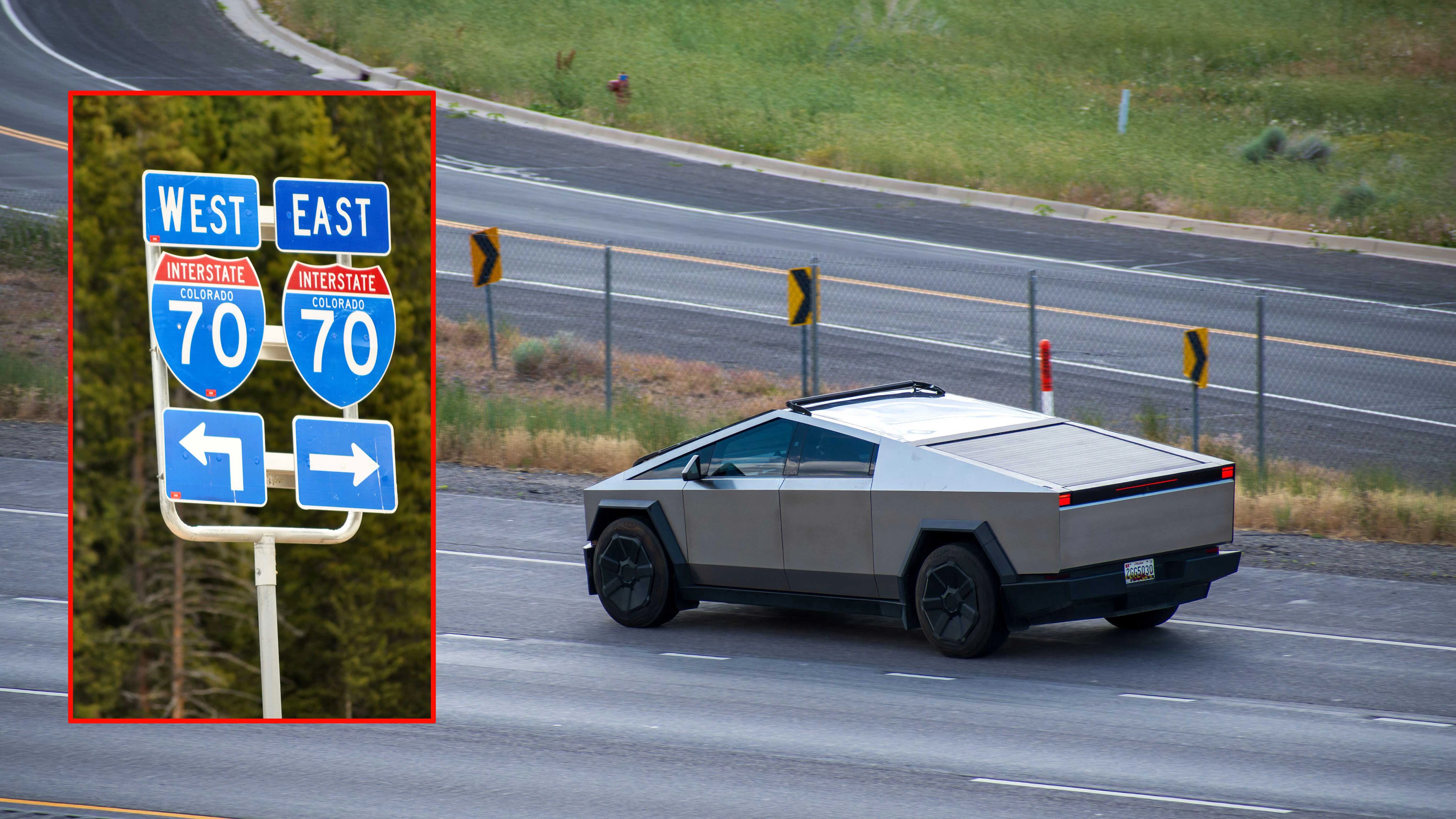
A Tesla was rolling west through Colorado’s mountains on Saturday when another motorist noticed something strange enough to call police.
The person behind the wheel — and the passenger, no less — appeared to be asleep.
Colorado State Patrol confirmed Monday that it received the unusual report of the Tesla traveling westbound on Interstate 70 near Georgetown.
"Troopers were unable to locate the vehicle, and we did not contact it,” said Trooper Gabriel Moltrer of the Colorado State Patrol.
He confirmed, “It is illegal to be asleep at the wheel.”
Colorado may let the car do some of the work, but not enough for the human to take a nap.
For Wyoming Tesla driver Eric Secrist, though, accidentally dozing off while the car does much of the driving isn’t hypothetical.
Secrist drives Uber full time and said it has happened on the long drive home after longer trips, when he was tired and had Tesla’s “Full Self-Driving (Supervised)” system engaged.
The system is a partially automated driver-assist feature that still requires a fully attentive human driver.
“I just accidentally doze off, and the car just continues driving safely, driving down the road,” he said. It didn’t let him stay asleep. “It sees you dozing off, and it does wake you up with general alarms,” Secrist said.
No, You Can't Take A Nap
Secrist happened to be driving from Cheyenne back home to Laramie when Cowboy State Daily reached him Monday.
Or, as he put it: “Actually, right now my Tesla’s driving me back home.”
Tesla calls its current system “Full Self-Driving (Supervised).”
It can follow curves, negotiate intersections and roundabouts, make turns, change lanes and enter and exit highways, but Tesla is explicit about what that does not mean.
“You are driving Model S at all times,” the company’s current owner’s manual says.
Tesla says the system requires a “fully attentive driver” who is ready to take control at any moment.
A cabin camera monitors attentiveness while the system is engaged.
“The car does everything for you, but you still have to pay attention and take over, just in case it runs into a situation that it can’t handle,” Secrist said.
His older Tesla, he said, watches his eyes. If he closes them for too long, messages flash on the screen telling him to pay attention.
Continue ignoring it and alarms begin sounding.Tesla similarly says that if a driver doesn’t resume manual steering when required, the vehicle can sound a continuous chime, activate its hazard lights and pull over.
So despite a name that sounds like permission to crawl into the back seat and read a book, “Full Self-Driving (Supervised)” isn’t that.
Who's Driving That Car?
That increasing capability is exactly the sort of problem Wyoming lawmakers started contemplating more than a decade ago.
Five years ago, they came remarkably close to answering a question that sounds considerably less theoretical today: When does the computer become the driver?
The Wyoming Legislature’s history of autonomous-vehicle discussions stretches back to at least 2016.
A year later, lawmakers considered requiring the Wyoming Department of Transportation to account for autonomous vehicles in an Interstate 80 master plan.
That proposal passed the Senate but died 25-33 in the House.
Then Wyoming got considerably more serious.
The result was Senate File 7, introduced during the 2021 legislative session.
SF 7 would have created a section of Wyoming law governing autonomous vehicles, including licensing, registration, insurance and operation.
More importantly, it drew a legal line between technology that merely assists a human driver and an “automated driving system” capable of performing the entire driving task.
When a qualifying automated driving system was engaged, the bill said the automated system itself would be considered the driver for purposes of complying with Wyoming traffic laws.
Not the person sitting behind the steering wheel, but the computer.
A qualifying autonomous vehicle could even operate on Wyoming highways without a human driver inside.
Lawmakers contemplated some of the strange consequences that would follow.
The legislation addressed insurance and liability and even what a driverless vehicle should do after a wreck.The vehicle would have to remain at the scene and, if technologically capable, call police on itself.
It Died 29-29
SF 7 passed the Wyoming Senate before reaching the House Committee of the Whole on March 25, 2021.
The vote was 29-29, with two lawmakers excused.
It died.
Five years later, Wyoming still hasn’t enacted the comprehensive framework envisioned by the bill.
A 2025 legislative review concluded that despite years of discussion, “no legislation regulating autonomous vehicles has been enacted to date.”
Wyoming does have ordinary traffic laws that could come into play when someone stops paying attention.
State law prohibits careless driving, while reckless driving means driving with “willful or wanton disregard for the safety of persons or property.”
What Wyoming doesn’t have is a special “sleeping while your Tesla drives” offense or the broader autonomous-vehicle framework lawmakers contemplated in 2021.
And today’s FSD (Supervised) isn’t the sort of hands-off, mind-off autonomous system that bill envisioned when it proposed allowing the computer to legally become the driver.
Tesla itself says the human remains responsible.
Wyoming Wants To Try It
The conversation didn’t die with SF 7.
Last September, Wyoming officials were again discussing autonomous vehicles — and this time they weren’t talking only about regulating them.
They were talking about using them.
David Pope, a liaison for Gov. Mark Gordon, told lawmakers he had exchanged initial emails with Tesla about potentially testing autonomous vehicles in Wyoming, including the possibility of using them in the state’s vehicle fleet, Cowboy State Daily reported.
The pitch almost sounded designed for Wyoming.
Instead of proving the technology in a tidy urban grid, Wyoming offers enormous distances between towns, lonely highways and weather that can turn I-80 into a white-knuckle drive in a hurry.
Sen. Chris Rothfuss, D-Wyo., of Laramie, said lawmakers would essentially have to revisit the work they’d done years earlier and see what other states had done since.
"The liability side on AI is really very tricky,” he said.
I-80 Before Robotaxis
Robotaxis probably aren’t going to swarm Wyoming cities anytime soon, but cars capable of doing more and more of the work on Interstate 25 and I-80 are another matter.
Automotive technology analyst Sam Abuelsamid told Cowboy State Daily last year that Wyoming’s weather remains a formidable problem for fully autonomous vehicles; he predicted highway automation would reach rural places sooner.
“You’re likely to see things like automated highway driving long before you probably see robotaxis in Bozeman or Jackson, Wyoming,” he said.
Secrist is already experiencing a version of that.
The more capable his Tesla becomes, he said, the less often he has to intervene.
“As far as somebody falling asleep, it doesn’t surprise me,” Secrist said.
What would concern him, he said, is someone deliberately trying to fool the safeguards designed to make sure the driver is still paying attention.
Secrist said he’s seen people put photos of human faces in front of Tesla’s cabin camera — even Barbie doll heads — in an attempt to trick the driver-monitoring system into thinking an attentive person is behind the wheel.
“It’s a stupid thing to do,” Secrist said.
Too Much Trust
Federal investigators have spent years examining another side of increasingly capable cars: The better automation becomes, the easier it can be for humans to trust it too much.
The first U.S. fatal crash involving a vehicle operating in partial automation happened in Williston, Florida, in 2016.
A Tesla operating with automation collided with a tractor-trailer crossing its path.
The National Transportation Safety Board found the truck driver failed to yield, but also concluded the Tesla driver’s inattention and overreliance on automation contributed to the crash.
The problem isn’t limited to Tesla.
In March, the NTSB concluded that driver overreliance on Ford’s BlueCruise hands-free partial automation contributed to two fatal 2024 crashes in Texas and Pennsylvania that killed three people.
In both crashes, investigators recorded no driver-applied or system-initiated braking or steering in the moments before impact.
For Secrist, there’s an important distinction between trusting the technology and abandoning responsibility for the car.
His Tesla has caught him dozing and woken him, but the fact that it can do that doesn’t turn him into a passenger.
Kolby Fedore can be reached at kolby@cowboystatedaily.com.


