
In 1890, two Arizona cowboys discovered a beast that, until then, only lived in the legends of the Plains Indian tribes.
A giant featherless bird frightened their horses. The two ranchers attempted to chase it down on foot.
The Arapaho called a similar creature the Thunderbird. Legendary Wind River Reservation master storyteller Elder Paul Moss said that when it blinked, lightning would flash.
The Thunderbird was to be respected as a reminder of the power and danger of nature and of the need to respect the rules of the tribe, according to Moss in “Hinóno'éínoo3ítoono/Arapaho Historical Narratives.”
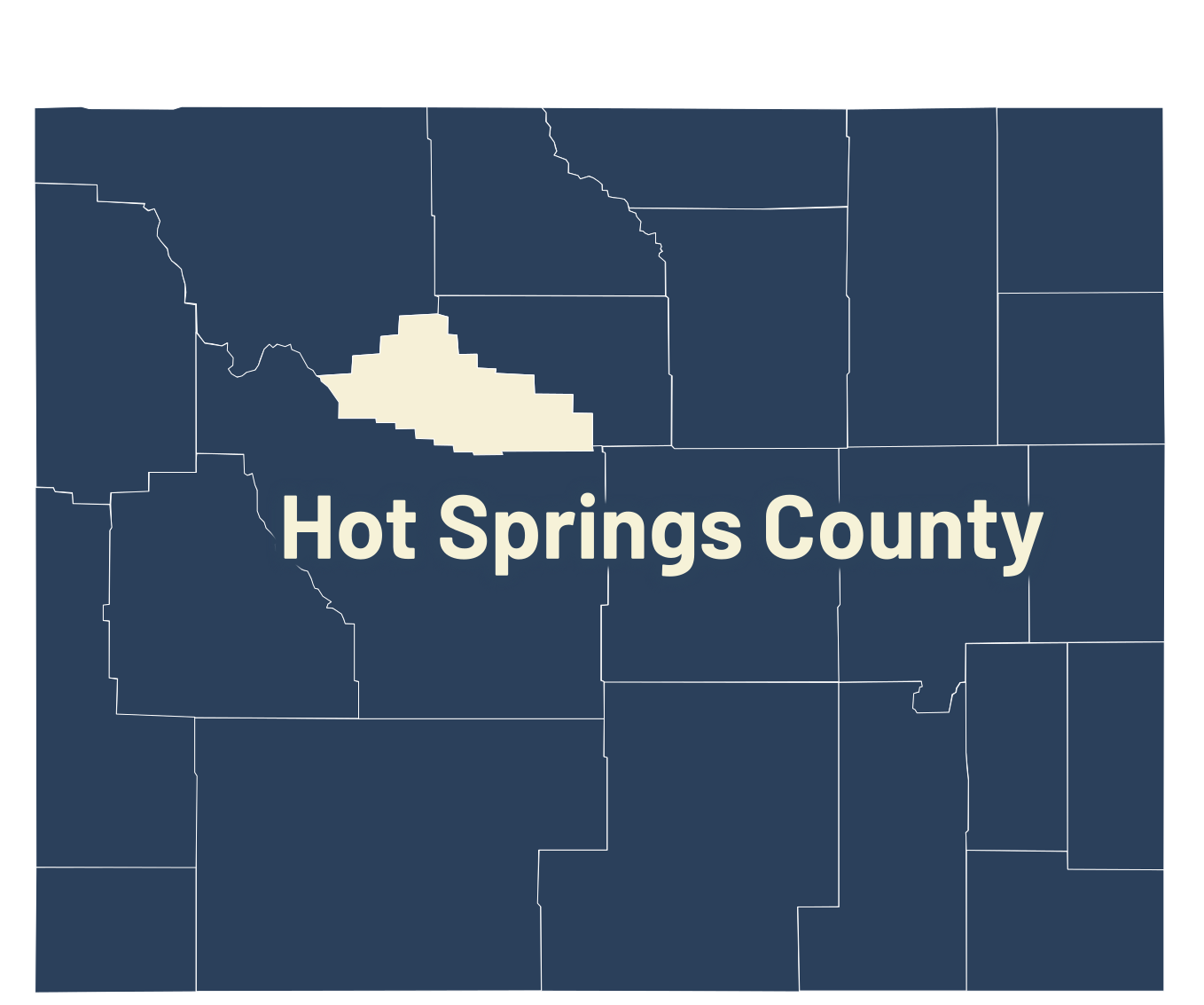
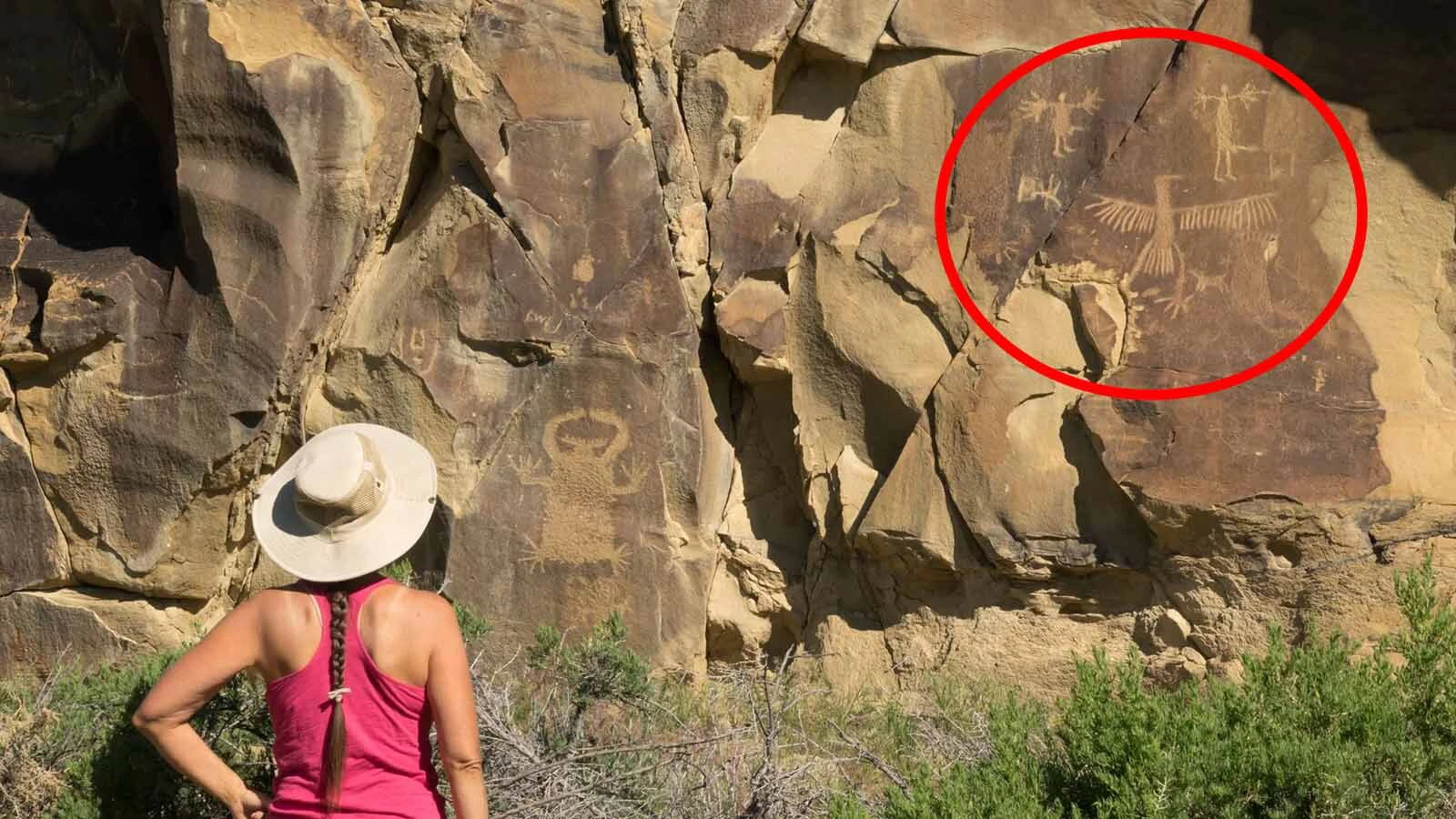
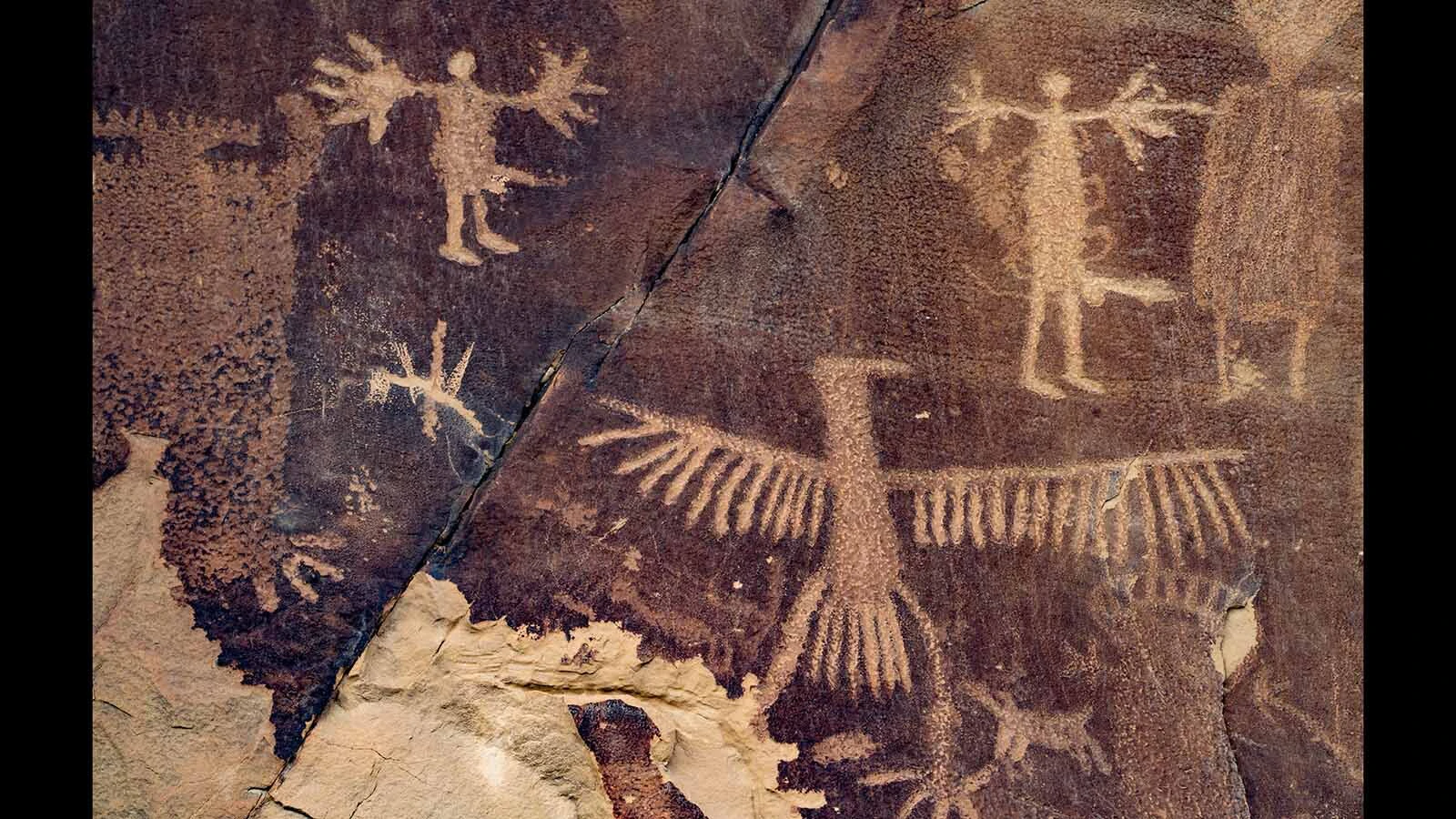
The Thunderbird has soared over Wyoming skies for centuries, according to various tribal legends. At Legend Rock Petroglyph Historic Site in Hot Springs County, an image of the giant bird had been pecked into the cliff.
The bird is surrounded by other images, some dating back 10,000 years, in a sacred area in Hamilton Dome known as “poho kahni” by the Shoshone Tribe — a “house of power”. It is a place believed by many to hold great supernatural power and to be a portal and home to ancient spirits.
Research and oral traditions show that petroglyphs were created to graphically depict the visions received and experienced by many different individuals during altered states of consciousness. The Shoshone and other Numic-speaking groups throughout the Great Basin went on vision quests to acquire knowledge and supernatural powers. The Sheep Eaters, a band of Shoshone, called these rituals “puhawilo” which mean “sleeping at medicine-rock”.
We well never know the full story of the bird pecked into the stone, if it was a vision or represented a real creature. But now, two cowboys claimed to have faced a live version of this mythical bird.
Now, two cowboys claimed to have faced a live version of the mythical bird.
The 1890 Cowboys
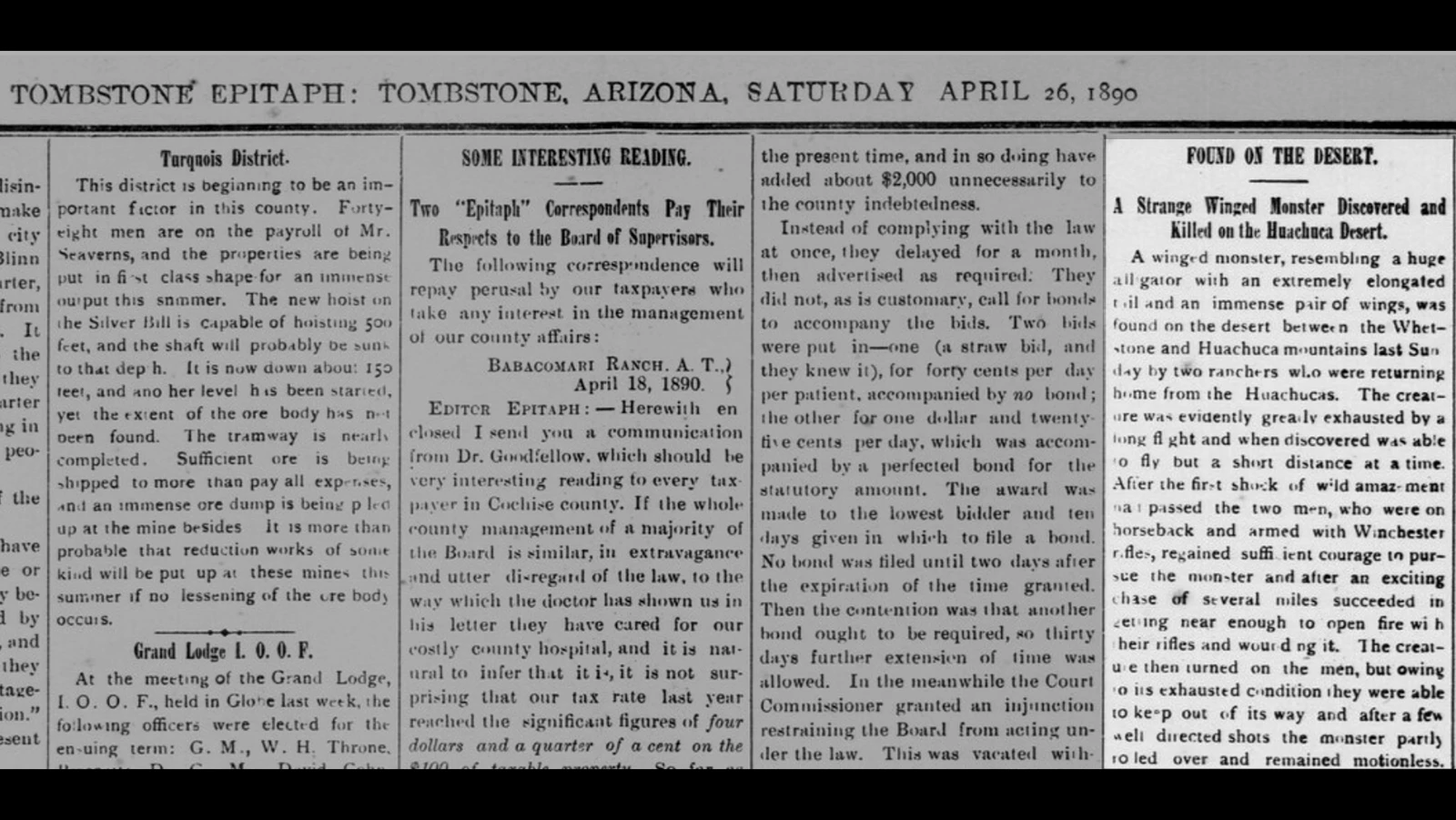
Buried on Page 3 of the April 26, 1890, Tombstone (Arizona) Epitaph, the headline read simply, “Found On The Desert,” and went on to detail a fantastical tale of a winged monster discovered between the Whetstone and Huachucas Mountains of southern Arizona.
The newspaper said it a huge alligator with an extremely elongated tail and an immense pair of wings.
“The creature was evidently greatly exhausted by a long flight and when discovered was able to fly but a short distance at a time,” the Tombstone reporter wrote. “After the first shock of wild amazement had passed the two men, who were on horseback and armed with Winchester rifles, regained sufficient courage to pursue the monster.”
According to the paper, the cowboys chased the creature for several miles and finally got near enough to wound it with their rifles.
“The creature then turned on the men, but owing to its exhausted condition they were able to keep out of its way and after a few well directed shots the monster partly rolled over and remained motionless,” the Tombstone reported. “The men cautiously approached, their horses snorting with terror, and found that the creature was dead.”
The cowboys claimed the creature measured about 92 feet in length and the head was about 8 feet long. It had strong, sharp teeth and it’s eyes were as large as a dinner plate.
The wings measured 78 feet and were composed of a thick and nearly transparent membrane. The entire body was devoid of feathers or hair.
Reportedly, the men cut off the tip of one wing and took it home.
“Late last night one of them arrived in this city for supplies and to make the necessary preparations to skin the creature, when the hide will be sent east for examination by the eminent scientists of the day,” the Tombstone reported. “The finder returned early this morning accompanied by several prominent men who will endeavor to bring the strange creature to this city before it is mutilated.”
That was the last written report of the strange creature until 80 years later.
The Legend Continued
In Fall 1969, Old West magazine author J.K. Parrish wrote about the tall tales of the Old West in an article, “Our Country’s Mysterious Monsters.”
He opened his article with the 1890 story and imagined what the scene would have looked like with the rearing horses and the sandstorm created by the giant creature’s wings.
Parrish said the incident was either one of the most important (and most ignored) events in the annals of science or was a complete and utter hoax.
“At this late date there is no way of finding out which, but don’t dismiss it as the prank of a hard-drinking newspaperman or as a tall tale by some displaced Texan,” Parrish wrote. “It just may be possible that to these two cowboys fell the privilege — or the infamy — of slaying the last surviving Thunder Bird.”
Parrish quoted from the various tribal stories of a giant bird in the sky and wondered if the creature was a living relic of another age.
Despite his extensive research, he could find no other mention of the ‘extraordinary event’ and questioned where the hide would be if the ranchers had indeed returned to skin it. Or if the whole story was a hoax.
Parrish appealed to his readers and asked for letters from anyone who could possibly know anything about this unbelievable event.
Surprisingly, Parrish got his letter.
The Local Lore
Harry F. McClure of Colorado Springs, Colorado, wrote that he had been familiar with this “fantastic, although true,” story all his life.
“It’s altogether possible that I’m one of the few persons living today who has any knowledge of it whatever,” McClure said. “Everyone I knew, including the elite, believed thoroughly the cowboys’ tale. And it went very much like the author related it with some exceptions.”
McClure said the incident happened before he was born but was a favorite topic when he was a small boy living in the Southwest 60 years earlier.
“I was personally acquainted with friends of these cowboys and once knew their names,” McClure said. “These fellows were not riffraff, but respected citizens and well-known cattlemen. Therefore, it is unthinkable that they would fabricate such a wild yarn just for kicks.”
McClure claimed that the men were too sincere and sober-minded for any jesting and frivolity and that the story was not a hoax, but was exaggerated by the newspaper.
“The representation of the Tombstone flying monster was very good on the whole and jibes with my understanding of what it was like, except for its size,” McClure wrote.
McClure said the 160-foot wingspan was not credible. The beast was still huge and described to him as a 20- to 30-foot wing span.
“Its eyes were like saucers; its two legs and feet up at the front part of its body were the size of those of a horse; its hide was a leathery one, instead of a feathery one,” McClure wrote.
The Legend Lives On
McClure said the other fact he disputed from the newspaper account was that the creature survived. He wrote that it had “lit on the ground once at a safe distance from the two cowboys, but it took to the air again soon afterwards only to come down a second time, as if desiring rest, although at a greater distance still from the men.”
A whirlwind was made from the force of its great wings, but the cowboys he spoke to never mentioned it being exhausted or falling from the sky.
“The way the story was told around Lordsburg, the cowboys never succeeded in killing this primordial winged creature, although they fired upon it with their .30-30 carbines,” McClure wrote. “The monster was out of range of their low velocity rifles and was not struck by the bullets, which probably did not carry that far.”
McClure explained that the .30-30 is not accurate beyond 150 yards.
“Not only were the cowboys startled and horrified by this notable spectacle, but their mounts were frantic with fear, and just could not be left alone while the thing was being pursued on foot,” he wrote.
He wrote that the men’s high-heeled boots would prevent them from sprinting in the sand and loose dirt after the beast.
“Therefore, they could not get close enough to get a good shot at it,” McClure ended his letter. “At least this is what I’ve always heard.”
Five years later, McClure died. He was, perhaps, the last of those who knew the true story of what had been found in the desert over 130 years ago.
The only evidence remaining of this fantastical tale are the oral histories, Native American legends and images of the bird at Legend Rock Petroglyph Site in Hot Springs County.
Jackie Dorothy can be reached at jackie@cowboystatedaily.com.


