Wyoming cattle ranchers and agricultural experts say they don’t think the potential return of Mexican cattle to the U.S. will affect the state’s cattle market, but they are divided about whether consumers would see lower beef prices.
President Donald Trump’s administration closed the border nearly a year ago after a flesh-eating parasite, the New World screwworm (NWS), made its way from Central America to Mexico.
The administration has proposed a phased-in approach to reintroduce cattle from Mexico.
Trump, who has promised to lower beef prices that have skyrocketed, has said it is part of his plan to meet consumers’ demands.
Mark Eisele, a Cheyenne-area rancher and former president of the National Cattlemen’s Beef Association, said a phased-in approach may be good for consumers because historically, a large share of U.S. beef has come from Mexican cattle.
But Dennis Sun, publisher of the Wyoming Livestock Roundup and a Cowboy State Daily columnist, isn’t so sure.
"Trump seems to think that more cattle coming in will cheapen the beef at the grocery store,” Sun said. "I’m not sure that it will make much difference."
An official announcement about the proposed reintroduction is expected in late April or early May, according to a statement made by U.S. Agriculture Secretary Brooke Rollins.
Rollins addressed media about the possible phased reopening of the border while at the Texas Southwest Cattle Raisers Convention on March 28.
“We’re looking at it every single day,” she said.
What Is NWS?
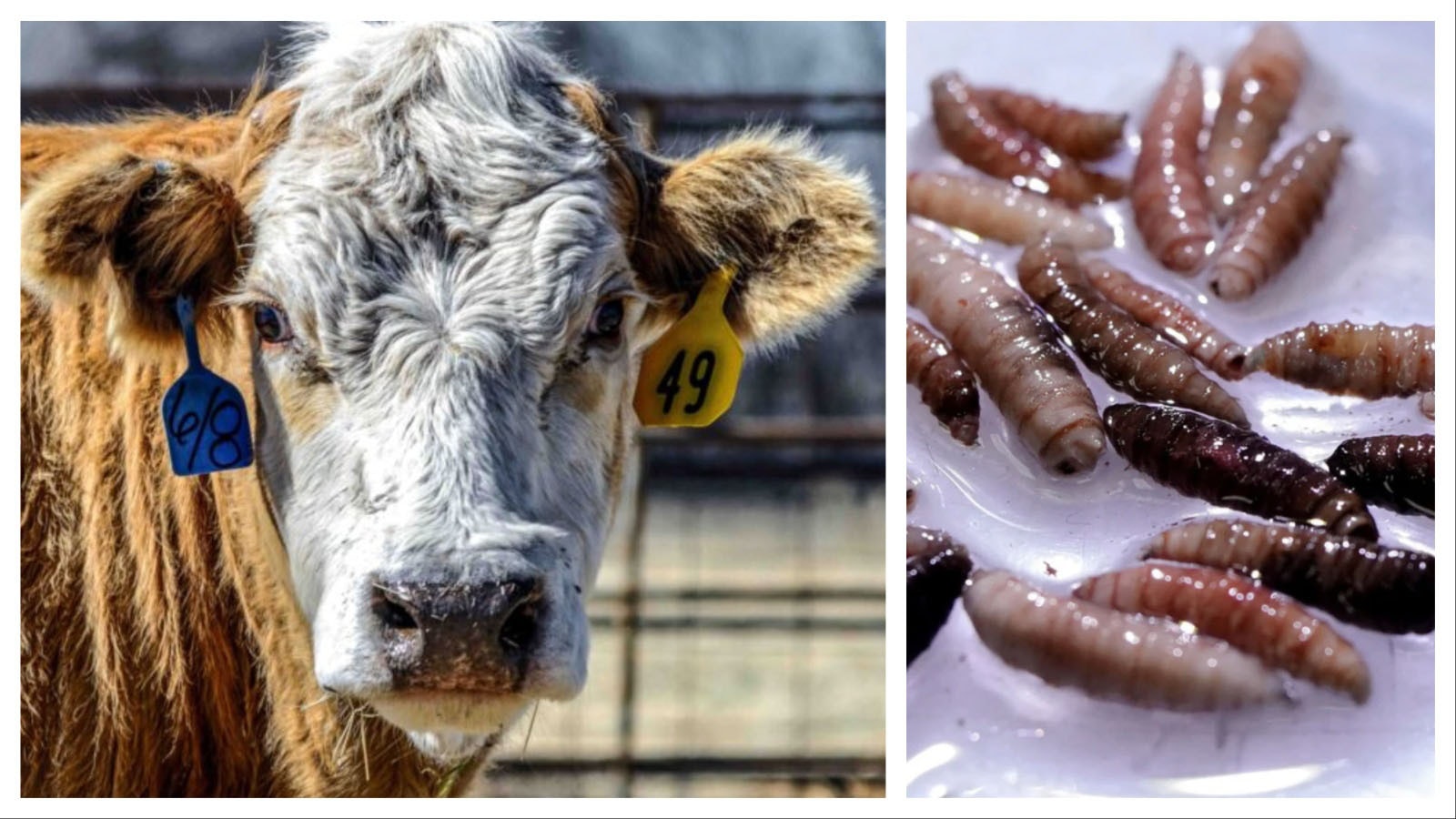
New World screwworm is a highly destructive fly, similar in size to a common housefly, that lays its eggs in open wounds.
Larvae feed on the flesh of its host — livestock, wildlife, pets and humans — causing the open wounds to grow.
The name screwworm refers to the maggots' feeding behavior as they burrow, or screw, into a wound, feeding as they go like a screw being driven into wood. The maggots cause extensive damage by tearing at the hosts’ tissue with sharp mouth hooks.
NWS thrives in South America, and in recent years it has made its way north, through Central America and Mexico.
The fly was eradicated from the United States in 1966. But a major ongoing outbreak of the destructive fly began in Central America in 2023 and has been working its way north ever since. Cases continue to be reported in northern Mexico.
“Boy, down in Mexico and down there in central America, they’ve got the screwworm to beat heck,” Sun said.
What A Phased Re-Opening Means For Wyoming
Wyoming Department of Agriculture spokesman Derek Grant told Cowboy State Daily his agency is passively monitoring the news.
But Wyoming is so far north that a phased re-opening of the U.S.-Mexico border would not likely lead to any notable increase in cattle numbers for the Cowboy State, nor a risk to Wyoming cattle.
“Thankfully, Wyoming is far enough north for it not to be a concern,” Sun said.
Eisele agreed, telling Cowboy State Daily a phased re-opening of the U.S.-Mexico border would probably not be of any real consequence to Wyoming.
Wyoming cattle ranchers typically don’t get cattle from Mexico, he said, adding, “most of what comes in goes to a Texas feedlot.”
“Very few people bring those kind of cattle up here to run on summer pastures,” he said.
Some large feedlots have just shut down in Texas because they depend on Mexican cattle to run their operations.
While a phased re-opening could be good news for the cattle industry, which is navigating a record low population, it also presents potential health risks to U.S. cattle.
“There are going to be people who are greatly opposed to it,” said Eisele.
“If they did find NWS in Arizona or Texas, it would hurt a lot of the transportation to cattle coming out of Texas,” Sun said. “They could quarantine the whole state.”
No cases of NWS have been reported in cattle in the U.S. since the 1960s.
Rollins said the USDA is looking at opening one of multiple cattle ports on the U.S.-Mexico border about 800 miles from the closest confirmed case of NWS.
Fighting Flies With Flies
One of the strongest defenses against the spread of NWS is the production of sterile flies.
Sterile male screwworm flies that mate with fertile female screwworm flies cause the population of screwworm flies to decrease until it eventually dies out.
The U.S. Department of Agriculture is pumping $750 million into a domestic sterile production facility at Moore Air Force Base near Edinburg, Texas.
The facility, built with the help of the Army Corps of Engineers, was originally expected to open this year but now is not expected to be fully online until 2027. It will produce some 300 million sterile flies per week.
“If they get this fly facility finished, I think we’re going to be in good shape,” Eisele said. “I think it will finally come to bear fruit.”
Another concern is that NWS lives on more than just cattle. Eisele said if NWS makes it way into the U.S., it likely won’t be on cattle.
“It will be wildlife,” he said, pure and simple.” It will be on a coyote or a deer or any other furry, four-footed animal.”
That’s why putting out the sterile flies is so crucial, he said.
Does Mexico Care?
Sun expressed disappointment at what he sees as Mexico’s lax attitude toward eradicating the pest, saying the United States is doing most of the work to keep the devastating fly at bay.
“They just live with it,” Sun said. “They don’t seem to really care.”
Eisele agreed, saying the Mexican government has been slow to help the Mexican ranchers.
Meanwhile, Sun said, it’s up to the United States to go down there and try to keep the bugs out.
“I’m hoping the Mexican government will do their part,” said Eisele.
“Mexico’s got to get on board,” Sun said.
Easing Beef Prices?
Mexican cattle imports plunged in 2025 due to NWS. The outbreak comes during a difficult time in the cattle industry, as record low cattle population in the US is driving up beef prices.
A phased reopening would do little to curb the nation’s cattle shortage, as less than 4% of the U.S. cattle population historically comes from Mexico.
But Sun said the re-opening could help meat packers, because they’re having trouble reaching capacity.
Before the border closed, U.S. imports of Mexican cattle averaged 1.18 million head annually, according to Beef Magazine.
As of April 6, there were 1,201 active cases of NWS in Mexico, down from 1,433 cases six days earlier.
An isolated case of NWS was reported in Nuevo Leon last September, about 70 miles from the border. There have been no cases within 100 miles of the border since.
Kate Meadows can be reached at kate@cowboystatedaily.com.