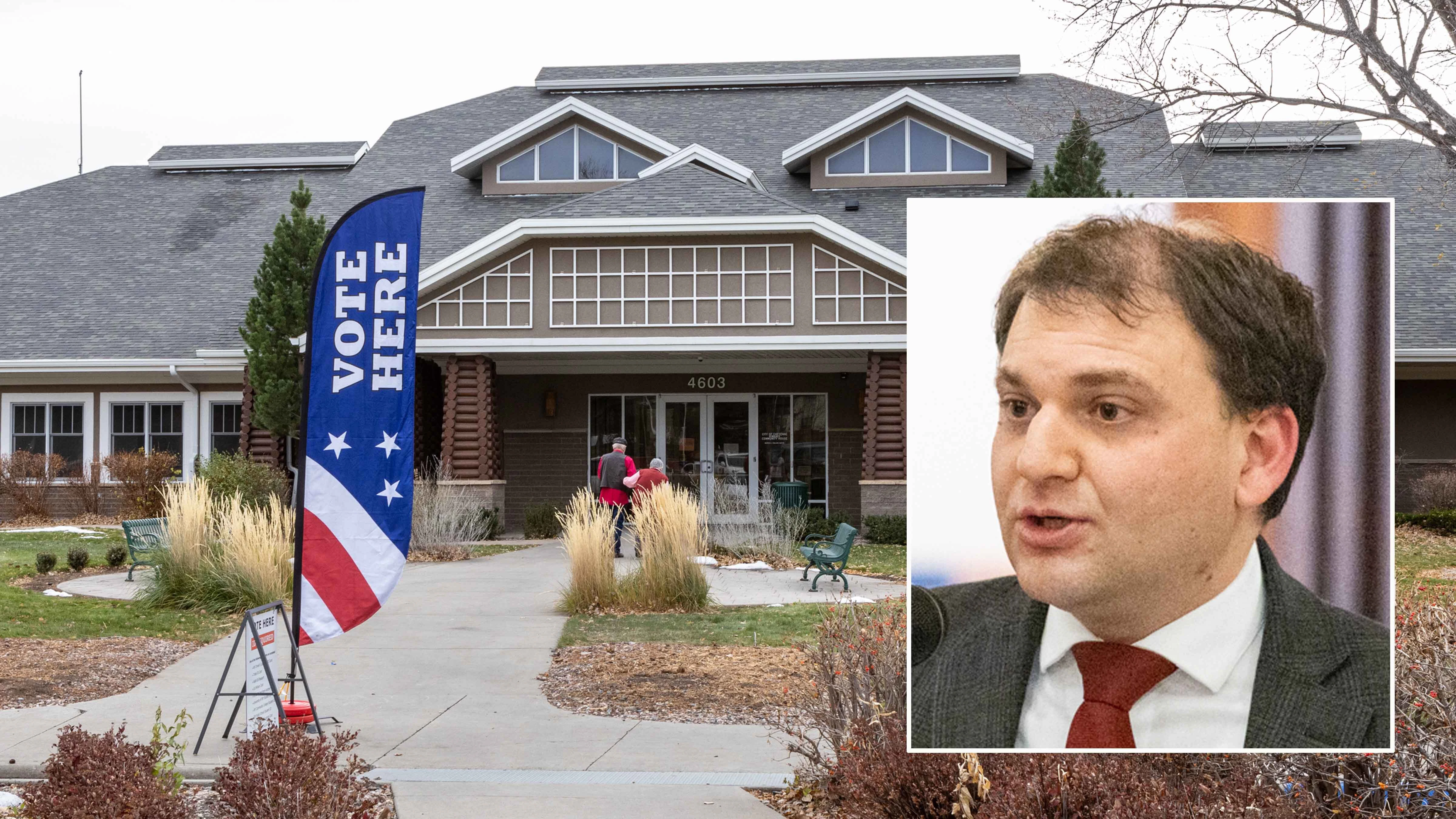
While Wyoming was among the first states to hand sensitive voter data to the U.S. Department of Justice last year, six Republican-led states and 23 Democrat-led states are still fighting the federal initiative in court.
Last year, the Trump administration started asking states for voter rolls that included names, birth dates and specific identifiers, like partial social security numbers or driver’s license numbers, court documents say.
The DOJ cited the Help America Vote Act (HAVA), the National Voter Registration Act (NVRA), and the Civil Rights Act of 1960 (CRA).
Wyoming Secretary of State Chuck Gray said he was granting that request in an Aug. 28 letter to assistant U.S. Attorney General Harmeet Dhillon.
He claimed that after conferring with the Wyoming Attorney General’s Office, “We agree that disclosure of the requested records is proper under the Civil Rights Act.”
Referencing “assurances” that federal privacy provisions would apply, Gray wrote that, “We anticipate that the Department of Justice will maintain the confidentiality of these records in accordance with Wyoming law.”
Wyoming’s election law says records containing Social Security numbers, portions of social security numbers, driver's license numbers, birth dates, phone numbers and other personally identifiable information “are not public records and shall be kept confidential.”
The state’s public records act echoes that, saying a document is not a public record if it’s “privileged or confidential by law.”
Gray emphasized in a Tuesday email to Cowboy State Daily that he stands with the Trump administration’s push for election integrity, and reiterated his assertion that he worked in close consultation with the AG, while deriding Wyoming Democrats and other groups.
According to the Brennan Center, Wyoming is among the 12-state minority of jurisdictions that have either handed over unredacted voter rolls or pledged to do so. The DOJ puts the number of complying states at 17.
The DOJ sued 23 blue states and the District of Columbia for their refusal to give the data, and also sued seven Republican-led states: Utah, Oklahoma, West Virginia, New Hampshire, Georgia, Idaho and Nevada.
Nevada has a Republican governor but a Democratic elections chief.
Three federal judges in Oregon, California and Michigan dismissed three of the DOJ’s cases for lack of legal grounds, and the DOJ appealed those cases.
Rather than ask the court to curb the DOJ’s demands, Oklahoma capitulated to the agency by reaching a settlement within one month of being sued.
Utah And The Strange Bedfellow
Conversely, Wyoming’s fellow Western red state of Utah answered the DOJ with a fight, filing a motion to dismiss the federal case March 31.
“The Framers envisioned a robust system of dual sovereignty in which the States maintained a strong independent role — including in running elections,” says the motion on behalf of Utah’s Republican elections chief, Lt. Gov. Deidre Henderson. “(The DOJ) now aims to upset that balance.”
Henderson alleges that:
• The DOJ has not given a factual basis to support its demand for private data.
• It’s trying to bootstrap the enforcement mechanism in the 66-year-old Civil Rights Act law to list maintenance requirements in the more recent Help America Vote Act.
• The data it seeks doesn’t fit under the kind the government can compel under the Civil Rights Act.
Henderson’s request that the judge dismiss the case is pending before the U.S. District Court of Utah.
Nevada Secretary of State Francisco Aguilar filed a motion to dismiss on similar grounds in his own case, which is also pending before the U.S. District Court of Nevada.
In the meantime, Utah has attracted the help of at least one incongruous bedfellow, the Democratic National Committee.
The DNC’s brief to the court was much more pointed than Utah’s motion, accusing the DOJ of suggesting it’s pursuing routine enforcement while committing an illegal “deception” to hand people’s personal information to the U.S. Department of Homeland Security (DHS).
Filed April 1, the DOJ’s case against Idaho is newborn: the state had not filed a motion to dismiss it as of Tuesday, though the National Association for Advancement of Colored People and the Idaho Alliance for Retired Americans have both asked the court to let them help the Western state’s cause.
Red State Fights
Georgia asked its federal court to dismiss the DOJ’s Jan. 23 legal challenge.
U.S. District Court Judge Eleanor Ross, of the Northern District of Georgia, is holding a June 3 hearing for oral arguments on the matter.
A March 5 motion New Hampshire’s attorney general filed on behalf of Republican Secretary of State David Scanlan called the DOJ’s request for its sensitive voter information a “sweeping and novel demand.”
It says the department has not complied with federal privacy laws necessary for it to collect that information, “even if it were otherwise entitled to it.”
That motion centers around claims the DOJ tried to short-cut the civil process and skip a phase where the judge would scrutinize whether it has legal grounds to proceed.
What Does The Fed Say?
West Virginia’s case on the matter is pending in the early stages; the state hadn’t filed a motion to dismiss as of Tuesday afternoon.
The DOJ filed a motion to compel the records along with an argument on Friday, however.
“This is a straightforward case,” wrote the federal agency, adding that the Civil Rights Act empowers the federal government “to immediately obtain those records, including West Virginia’s statewide Voter Registration List.”
The law broadly authorizes the U.S. Attorney General to compel all records and papers that “come into … possession” of election officers, the agency added.
While at least three judges have rejected that view and Utah cast it as a poor definition for records the state generates itself, that case is pending.
Powers’ Second Rodeo
Cheyenne-based attorney George Powers started plying Gray’s office with public records requests when the controversy emerged.
This isn’t the first time Powers has launched a transparency battle: He sued the Wyoming Department of Education for a records law breach in 2023 and won that case in 2024.
At first, Powers told Cowboy State Daily in a Tuesday interview, he asked Gray’s office to give him whatever it gave the DOJ, records-wise.
The list the Secretary of State’s office gave Powers was redacted, he said.
So he asked the office to give just the data as it pertained to him.
His sensitive data were, again, redacted, he said.
Powers emphasized that he’s not a data law expert, though he believes agencies like the IRS that handle sensitive data have strict framework dictating how they do so.
DOJ has not issued any public notices or privacy assessments about this new data collection, NPR reported.
Federal privacy laws require such documents before a federal agency collects or disseminates personal, identifiable information about the public for a new purpose, the outlet added.
What matters to Powers in this case is that Wyoming law calls voters’ driver’s license and Social Security numbers confidential, he said.
“And once it’s out, it’s out,” said Powers.
“I’m not an information guy, not an expert in how the internet works, how the information filters out on the internet,” he said. “I do know, however, state law says this information is supposed to be confidential — and I know what the word ‘confidential' means.”
Powers added, “I’d still like to know why this happened.”
Powers said Gray has cited attorney/client privilege in his communications with the Wyoming Attorney General’s Office, so he doesn’t know “what questions were asked or what answers were given” there.
Wyoming Attorney General Keith Kautz did not return a Tuesday voicemail request for comment by publication time.
Powers said he has another request pending with Gray’s office: what notice, if any, Gray gave to the public or press of the data transfer.
‘The Radical Left And The Media’
Gray in an email response to Cowboy State Daily’s request for comment said that, “The Radical Left and the media will stop at nothing to undermine our work to ensure election integrity and security, and this is nothing more than Trump Derangement Syndrome, clothed in an attempt to use lawfare and the leftwing media to attack my actions on election integrity.”
Gray continued: “The Democrats’ false claims are driven by Trump Derangement Syndrome and left-wing hysteria, not the truth. These claims are false, defamatory, and made with malice.”
The secretary said he worked in close consultation with the Wyoming AG and the AG’s office to comply with “a lawful request from a federal law enforcement agency charged with enforcing voting rights, to ensure Wyoming’s voter rolls were compliant with the Help America Vote Act and the Civil Rights Act.”
He said that information remains confidential under the law, contrary to the claims of the “Wyoming Democrats” and the League of Women Voters.
“I think it’s very telling and quite troubling that the media and the democrats are siding with states led by leftists and insiders, and are ignoring the growing number of states, especially within the past month — including Nebraska, Ohio, Oklahoma — that are following Wyoming’s lead and voluntarily complying with the Department of Justice’s lawful requests,” he said.
Gray asked, “Instead of cherry-picking which cases to discuss, why isn’t this publication examining cases in Nebraska and Oklahoma, which reinforce our position?”
Cowboy State Daily had researched Oklahoma’s case before receiving Gray’s comment.
As for Nebraska, it faced a nonprofit group’s lawsuit calling for a judge to halt its release of data. The state released sensitive voter data in February after that case was dismissed without prejudice.
The group Common Cause appealed the dismissal.
Gray said his office has worked to comply in good faith with Powers’ “repeated and constantly changing demands, which are amounting to an attempt to engage in leftwing lawfare to try to intimidate our office for our work with the Department of Justice to ensure compliance with multiple federal laws, including the Help America Vote Act.
“I'm proud of our work with the Trump Administration to advance election integrity,” Gray added. “Any claim by Mr. Powers that our office's consultation with the Attorney General's office was limited to one call are false.”
Powers had written in a guest column for Cowboy State Daily that Gray said he gave the Wyoming Attorney General a copy of the demand letter, had a 30-minute phone call with the AG and members of his staff, and received an ancillary email from the AG.
Those discussions were properly withheld as attorney-client communications, said Gray, who also said his office has identified them as such to Powers.
Gray reiterated his statements about standing with the Trump administration to advance election integrity, complying with the law and working with the attorney general.
Clair McFarland can be reached at clair@cowboystatedaily.com.