Wyoming rancher Levi Kosmicki has supplemented his cow/calf operation of 300-350 mother cows near Yoder with a lucrative side gig for the past 12 years.
He works as an independent representative for ABS Global selling bull semen to producers and genetics companies.
Bull semen is a big driver of rising bull prices, and the industry is booming.
The reason is simple: artificially inseminating a heifer with genetically appealing semen produces cows that are more profitable.
Prized genetics coupled with high demand continue to drive up prices and can make a bull with desirable traits worth big bucks.
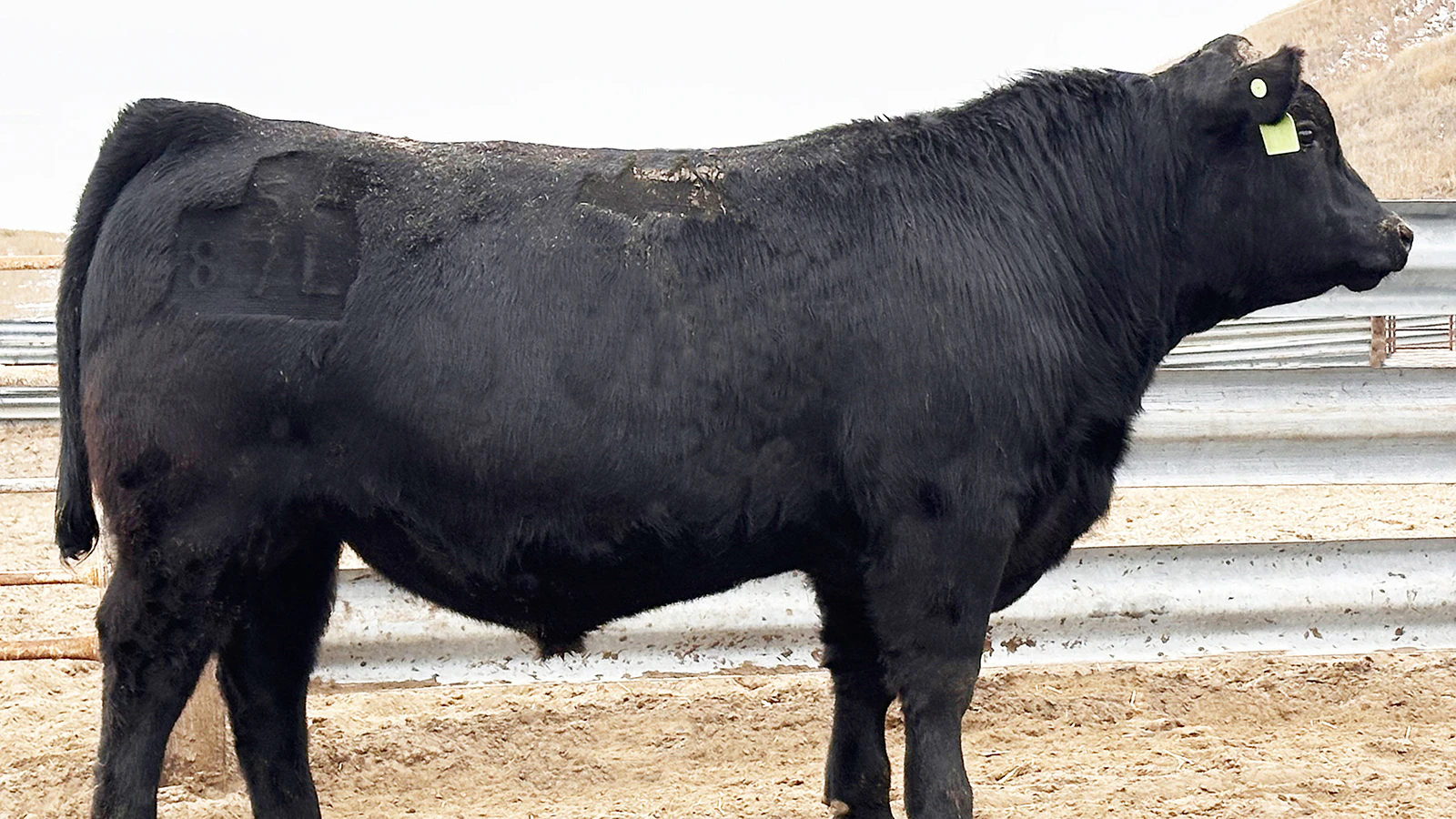
A recent spring bull sale at a ranch in the Nebraska Sandhills resulted in a bull selling for $110,000. The California company that bought the bull will use the animal for its semen and will likely make that money back on semen sales alone.
All About Genetics
Bull semen is valuable for its genetic potential.
It makes scouting prime bulls as important to the cattle industry as talent scouts are to professional sports.
ABS collects semen from bulls in two geographic locations — DeForest, Wisconsin, and Billings, Montana.
The semen is collected and packaged, then sent to producers or sales reps like Kosmicki.
Kosmicki said that among the most desirable traits is calving ease, a sire whose semen is proven to increase the likelihood that a calf is born unassisted.
A single bull can produce thousands of doses of semen, called “straws,” which can be shipped all over the world.
From the production side, buying these straws is cheaper than purchasing a bull. And when the producer has some control over the genetics, choosing a semen sample over the animal itself can be a win-win, Kosmicki said.
Conversely, a genetically superior bull, like the bull that recently sold for more than $100,000 in Nebraska, becomes an enticing investment because it will produce sample after sample that will be sold for top dollar.
“We’re able to source one bull and distribute its semen to anywhere in the world,” Kosmicki said.
Six-Figure Bulls
The spring bull sale at the fourth-generation Connealy Ranch in Whitman, Nebraska, resulted in the sale of 564 bulls, netting a total of more than $9.2 million, with the average bull selling for $16,343.
The bull that sold for $110,000 was the highest price for the 2026 sale, but it did not set a record, said the bull’s former owner, Jerry Connealy.
The ranch's record for the highest selling bull ever was $500,000 in 2022.
“(The buyers) fully intended on collecting semen from him,” Connealy said.
Regardless of the price, the Connealys’ top-dollar bulls always sell for their semen potential, he told Cowboy State Daily.
“That’s the intent, is for that bull to grow into a stud and they collect his semen and sell it nationwide, if not worldwide,” he said.
Profitability is the name of the game.
“In a nutshell, we try to keep our customers profitable,” Connealy said. “That means, from a genetic standpoint, we want to make sure that the bulls that leave our place are genetically programmed to make the buyer profitable from all kinds of different vantage points.”
‘White Gold’
For that to happen, the Connealys themselves rely on what they call the cattle industry’s “white gold.”
The Conneally ranch has depended on artificial insemination (AI) of its cattle since the early 1960s. Connealy said his father was one of the first AI technicians in the country.
By artificially inseminating virtually every cow, the Connealys can determine specific DNA traits from the get-go — traits they know will be sought-after by cattle buyers.
“From that vantage point, we get into the industry and try to buy the very best semen we can,” Conneally said. “We keep our customers profitable.”
Speaking of their 2026 top-seller, Connealy said, “All the stars kind of lined up for that bull.”
Connealy said the bull was “a 12 o’clock: as close to perfect as you can get.”
“He was very attractive, correct, muscular, had a good disposition,” he added. “His DNA profile came back very, very favorable.
“His pedigree is deep in that we’ve got generations of cows behind him that we’ve selected the same way. He was a stud.”
Even though no one understands the value of bull semen better than Connealy, he said he is always surprised when an animal sells for as high as his top-dollar bulls have.
But, he said, “It only takes two people that really like the animal and that have deep enough pockets to go that high on a bull.”
Bulls are sold at auction, meaning they go to the highest bidder.
“It’s a capitalistic market,” Connealy said. “Someone sees something they really like and think they can profit off that by selling the semen.”
A Growing Industry
Kosmicki said he doesn’t believe bull semen is used nearly as much as it could be. But every year, he said, “there’s slow to steady growth” in the industry.
“You can breed all your cows to one top bull,” he said. “And, you can do it at a fraction of the cost (of buying a bull).”
Artificial insemination is cheaper than turning a bull loose on a ranch and waiting for heifers to get pregnant.
Bulls with high-value traits and gleaming pedigrees command higher prices at auctions, driven by their ability to produce sought-after semen.
Even so, Kosmicki said, manual labor is required, and that can be a big problem for some ranchers.
“Everyone is short on labor,” he said. “And you still have to handle the cattle to get them artificially inseminated.”
Kate Meadows can be reached at kate@cowboystatedaily.com.