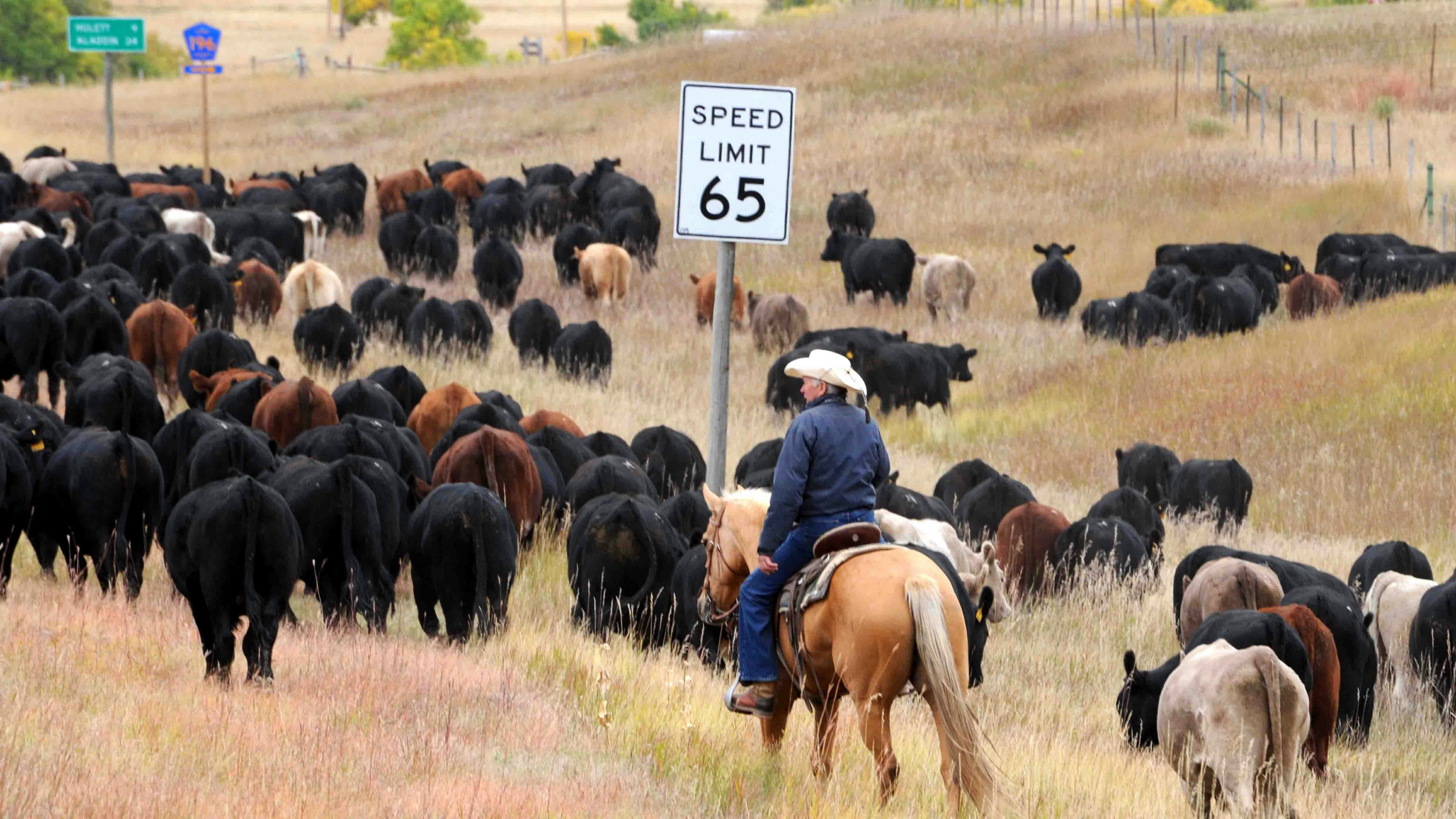
More than 10,000 farms and ranches covering more than 28 million acres of land that contribute $1.6 billion to Wyoming’s annual economy.
The numbers that define Wyoming’s agriculture show just how foundational it is in a state where cows outnumber people by more than two to one.
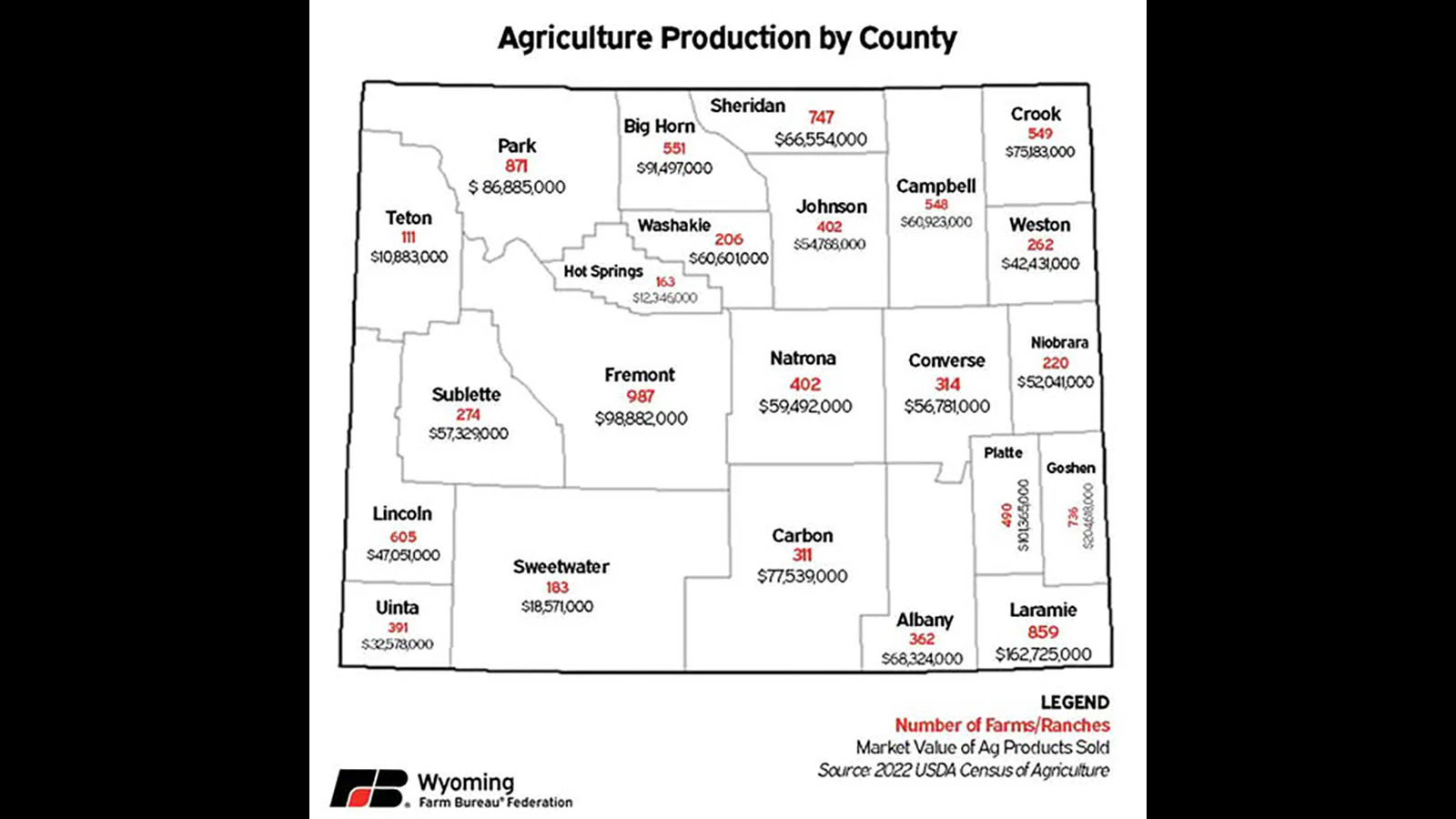
The Wyoming Farm Bureau has released a map showing agriculture’s annual economic impact by county — both in terms of production and in acreage of land.
Goshen County, one of the smallest counties in the state by population, earned the top spot for value of ag production at $204.6 million. Laramie County earned the second-place slot at $162.7 million. Platte County hits at $101.3 million, which makes the southeast corner of the state worth about $469 million.
Carbon County claims the most ranch and farmland at 2,866,440 acres, and Campbell County is close behind at 2,599,124 acres.
Agriculture is another billion-dollar industry for Wyoming, along with:
• $11.3 billion impact annually from energy, according to the Wyoming Energy Authority.
• $6.4 billion for the government sector, according to the Wyoming Economic Analysis division.
• $4.9 billion contributed by the travel and tourism industry, as reported by Visit Wyoming.
Wyoming Farm Bureau spokeswoman Callie Hanson said she pulled the agriculture numbers from the 2022 USDA agricultural census, the most recent census the U.S. Department of Agriculture has produced.
It’s the first time the Wyoming Farm Bureau has put together a map reflecting the value agriculture contributes by county across the state.
“Numbers can speak,” said Kerin Clark, executive vice president of the Wyoming Farm Bureau. “We wanted to utilize the data and paint a picture so we can really visualize the story.”
What The Numbers Say
According to the data, the market value of products sold by Wyoming farms and ranches topped $1.6 billion. Cattle are the No. 1 agricultural commodity in the state, with hay being the second largest.
Goshen County’s agricultural production is greater than that of any other county in the state, easily topping $204 million.
“Goshen County is the cattle capital of Wyoming,” Clark said.
Along with scores of cattle, the county is also home to a lot of irrigated agriculture, which means good hay production.
Lane Hageman, who operates a cattle ranch with his father and brother near Fort Laramie in Goshen County, said he saw the Farm Bureau map.
While he was not surprised that his home county ranked first for agricultural production value in the state, he said he was surprised by the nearly $42 million margin between Goshen County and the second-largest agricultural production value of neighboring Laramie County.
Stepping into his barn in the middle of the afternoon to speak with Cowboy State Daily, he said one of the big advantages Goshen County has compared to other Wyoming counties is access to water.
He lives next to the North Platte River, with Glendo and Guernsey reservoirs nearby.
That water and the milder climate of southeast Wyoming make for terrific soil quality for farming, he said.
The top three counties in terms of agricultural production are all in Wyoming’s southeast corner — Goshen, Platte and Laramie.
Along with being major cattle producers, the counties reflect a diverse topography and in general encounter milder weather than other parts of the state, Clark said.
The five counties with the most ranch/farmland are connected to one another, extending from Wyoming’s southern border to its northern border in the central-eastern section of the state. Carbon County comes out on top, with 2,866,440 acres of ranch/farmland.
The statistic does not surprise Carbon County Commissioner Travis Moore.
“I knew we were up there,” he told Cowboy State Daily, adding that many of the ranches represent multiple generations and have been around for more than 100 years.
What The Numbers Don’t Say
While the numbers are a great way to measure the value of agriculture in Wyoming, Clark said there are also values to agriculture that can’t be quantified, “things you can’t put a number on.”
“The economic footprint of Wyoming agriculture goes beyond the farm and ranch receipts,” Clark said.
Farmers and ranchers across the state are foundational drivers of market activity, she said. They contribute to job growth, tax revenue and support small businesses such as local veterinarians, feed stores and locally owned grocery stores.
“All of that money goes back and has a ripple effect in the communities,” Clark said.
According to the USDA report, an estimated 93% of Wyoming farms and ranches are family owned.
Moore said that in Carbon County, many ranchers work hard to provide scholarship money for youth and assist in community fundraisers that give back to local nonprofits.
“They’re always doing their share and then some to support the local communities,” Moore said.
The work ethic of the ranchers and farmers inspires others, Moore said.
Hand-in-hand with the work ethic is the many hats ranchers and farmers have to wear, he said.
“These folks are scientists out there,” he said.
They have to have a huge knowledge of how to grow hay, how to prevent weeds and pests. They have to learn the best ideas for grazing in certain places and at certain times and they have to know the best times to sell. They are part economist, part scientist, part jack of all trades to keep the place running.
“And they greet you with a smile,” he said.
In Goshen County, Hageman said the families involved in agriculture bring a lot of big-ticket items – and big animals – to town for services. Local mechanic shops, feed stores and vet clinics all benefit from the work of local ranchers, he said, adding, “We spend a lot of money in the community.”
Farm and ranchland also provide precious habitat for wildlife, including critical winter habitats, Clark said.
“It is so important that those lands stay as working lands,” she said. “You can’t quantify the value.”
How The Map Came Together
The USDA releases an agricultural census every five years. Farmers and ranchers from across the country respond to survey questions for each census, and the USDA generates numbers based on the responses.
Hanson said close relationships to other farm bureaus in the region led to the idea of creating the Wyoming map. The Idaho Farm Bureau had done something similar.
“We thought it was a great idea for our area,” she said.
The map puts information into a picture that is easy to look at, Clark added.
Educational Tool
Clark said the map is proving to be both an educational tool and a conversation starter.
“We’ve had such a great response to it,” she said. “Folks are sharing the map. There’s definitely a lot of conversation around the information.”
Clark called agriculture a “legacy industry to the state.”
“We hope (the map) sparks a lot of conversation in our Wyoming communities,” she said.
Kate Meadows can be reached at kate@cowboystatedaily.com.