
A March 2026 report from Blackridge Research identified Wyoming among the states where the Stargate AI infrastructure project — a joint venture of OpenAI, Oracle and SoftBank — might expand beyond its initial Texas base. That mention put Wyoming alongside Michigan, Wisconsin, New Mexico, Georgia, Ohio and Pennsylvania in the emerging data center sweepstakes.
The competition is fierce. According to Bloom Energy’s 2026 Data Center Power Report, total U.S. data center load capacity is projected to reach roughly 150 gigawatts by 2028, nearly double the 80 GW from 2025.
Power availability is redrawing the map of where these facilities get built, and states are scrambling to offer the right combination of cheap electricity, fast permitting and tax incentives to land them.
At least 36 states now offer tax incentives to attract data center projects. But a backlash is growing in tandem — at least 12 states have filed moratorium bills this legislative cycle to pause new data center construction while they sort out impacts on electric grids, water supplies and public health.
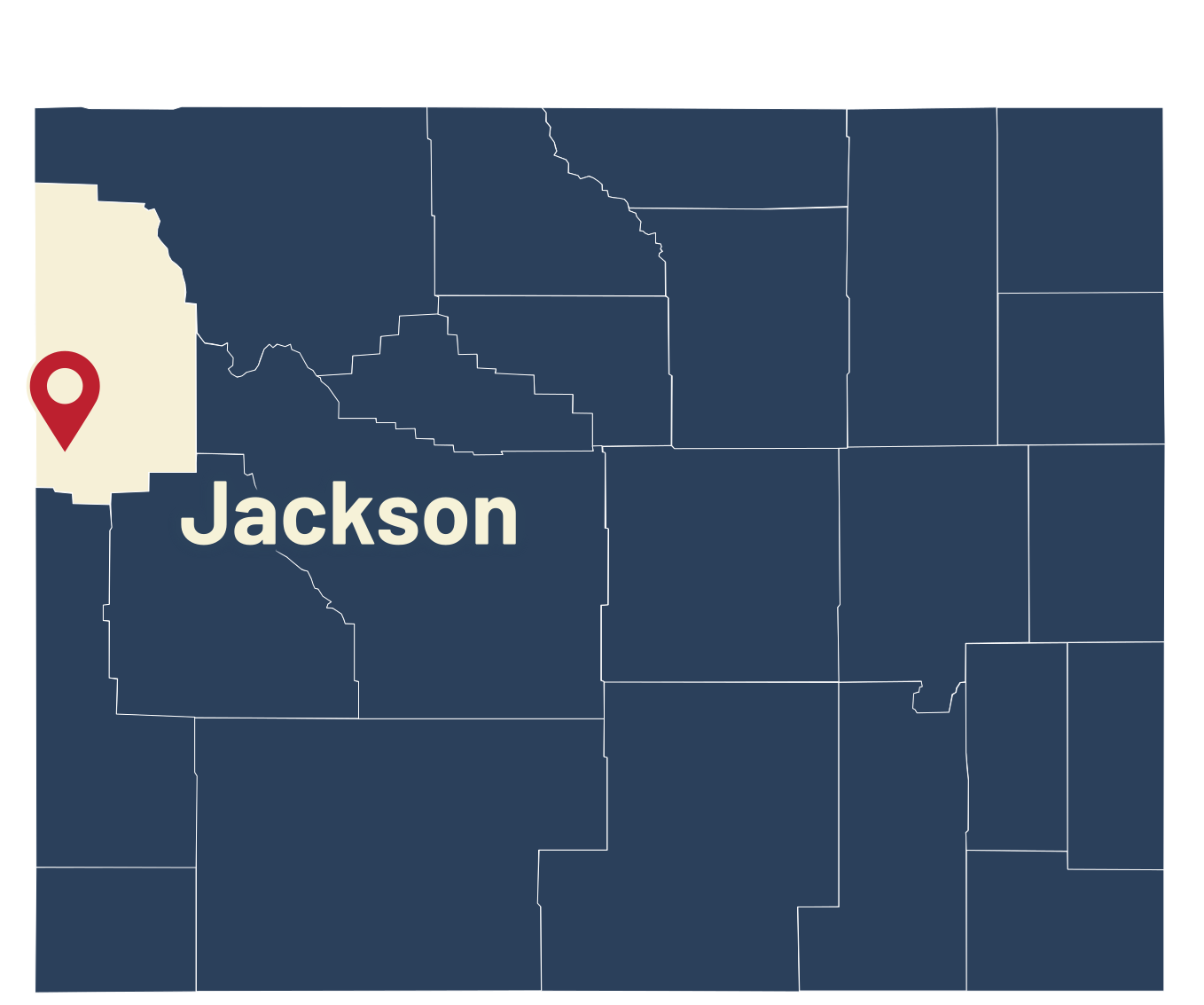
Against that backdrop, the closed-door “Data x Power” summit in Jackson April 1-2 will convene about 50 senior leaders from hyperscale technology companies, energy developers, government agencies and academia to explore whether Wyoming belongs in the conversation.
“The question, it’s not, ‘Will the next data center be built?’” said Paul Bonifas, co-host of the summit and director of 9H and GeneCo Datacenters. “The question we have to ask ourselves is, ‘Will it be built in Wyoming?’”
“A proposed data center by any of the big names that you’ve ever heard of is going to be built,” added Bonifas. “They need it, they have the capital infrastructure, they have the resources. And so the question is, ‘Are they going to build it in Texas, in Ohio, or are they going to build it in Wyoming?’”
Supporters of building more data centers in Wyoming point to several competitive advantages: vast parcels near transmission corridors in the lowest-population-density state in the Lower 48, firm power pathways including TerraPower’s Natrium reactor in Kemmerer, streamlined permitting, no state corporate or personal income tax, a semi-arid climate averaging 45 degrees with low humidity that enables free-air cooling most of the year, and an industrial workforce experienced in pipelines, power plants and high-voltage transmission.
The summit grew out of a smaller gathering at the Ucross Foundation last summer, where organizers brought together industry leaders, government officials and academic scholars to tackle four priority areas they saw as opportunities for Wyoming: critical minerals, wildlife management, water management and data center buildouts.
“Of those four, there was a special interest in data center buildouts, both in the industry sector, the idea that Wyoming might be a place of great opportunity for these investments,” said Jake Hochard, the Knobloch Associate Professor of Conservation Economics at the University of Wyoming’s Haub School of Environment and Natural Resources, who is the summit’s other co-host. “So we decided to double down on that and spin it up to a slightly larger, but still very intimate gathering of industry leaders.”
The state of Wyoming can play an important role “in what is probably the greatest capital mobilization in the history of the planet,” Hochard told Cowboy State Daily. “It’s happening right now around AI infrastructure.”
A February report from Futurum Group, a technology research and advisory firm, tracked the capital expenditure commitments of the five largest U.S. cloud and AI infrastructure providers — Microsoft, Alphabet, Amazon, Meta, and Oracle — which have collectively committed to spending as much as $690 billion in 2026.
The reason Wyoming has a shot at joining in the boom, Bonifas said, comes down to electricity.
“Essentially, the only reason why data centers are not popping up absolutely everywhere is because the United States does not have enough electricity to power these data centers,” he said. “Any significant data center that is going to be built is going to need to bring and build their own power supply. And that means working with utilities, that means working with energy developers, and that means working with regulators.”
That dynamic actually favors communities where data centers land, Bonifas argued, because the facilities bring their own stable power load and protect existing ratepayers from cost increases.
“Wyoming exports almost all of its electricity,” Bonifas told Cowboy State Daily. “And consuming it here would mean we’re not letting other states get rich on the back of Wyoming industry. The electricity is already being generated, so why not consume it here?”
Heavy Hitters
The summit’s guest list reflects interest from some of the largest technology and energy companies on the planet. Four of the seven “Magnificent Seven” NASDAQ companies — Google, Microsoft, Meta and Amazon Web Services — will have representatives in the room.
The U.S. Department of Energy is sending its principal deputy undersecretary for science, and EPA Region 8 Administrator Cyrus Western will participate in a panel on federal policy and the regulatory environment.
Gov. Mark Gordon will deliver remarks and take questions on the opening night.
In an email to Cowboy State Daily, the governor’s office offered a preview of the governor’s remarks.
“Wyoming has been the backbone of America’s energy supply for more than a century, and our approach has always been about answering the call to power the nation and the nation’s economy on our terms,” stated Gordon. “As our industries evolve, we need to keep focused on providing high-paying jobs and nurturing healthy communities.”
Gordon also acknowledged the national security push to increase power generation and data center development.
“This call involves the kind of scope and urgency this nation saw in the early 1940s, as we powered up to face our adversaries in a world at war,” added the governor. “Wyoming can answer the demands of this new 21st century call if we lead with seriousness and enact appropriate policies to protect Wyoming ratepayers, our natural resources and balance growth responsibly — never losing sight of the Wyoming we love. Wyoming has shown time and again that we can grow without compromising our values or our character.”
Gordon will be joined by the Wyoming Energy Authority, the Wyoming Business Council and Cheyenne LEADS, among others, in Jackson.
“Pulling those people into the same room just creates evidence of the interest that there is in major data center investments in the state of Wyoming, but also the opportunity that it presents,” Hochard said. “There just seems to be a consensus here that Wyoming is an interesting place for these major investments.”
The three headline sponsors are CoreWeave, the AI-focused neo-cloud operator that is developing a data center with Related Digital outside of Cheyenne; TerraPower, the Bill Gates-backed advanced nuclear company building its Natrium reactor in Kemmerer; and Torus, which builds next-generation modular power plants including flywheel and battery energy storage systems.
Other companies on the attendee list include Crusoe, Tallgrass, Hecate Energy, BWXT, Black Hills Energy, Panattoni, General Catalyst and Kimley-Horn.
Cheyenne Momentum
The summit arrives at a moment when Cheyenne is already building momentum as a data center hub.
Related Digital broke ground last October on a $1.2 billion, 115-acre campus in the Cheyenne Business Parkway with up to 302 megawatts of critical IT capacity. CoreWeave signed on as anchor tenant for 88 megawatts. That first phase alone is expected to generate more than $250 million in tax revenue to the state and city over 15 years and create over 700 construction jobs, according to an announcement by Related Companies.
Microsoft and Meta already have a presence in the capital city, and Crusoe has been developing capacity in the area as well.
“Wyoming, amongst other things, as a rural state, is very appetizing for data centers, not only because you have the infrastructure buildout that is happening and has happened in Cheyenne — whether it be with Microsoft, Meta, Crusoe, CoreWeave, Tallgrass — but also our natural weather and cooling climate,” Bonifas said. “It’s cold. And when it’s cold, you don’t have to use as much AC to cool down the processors. So it is more efficient to locate a data center here.”
The summit’s Day 2 agenda includes a dedicated panel on “The Cheyenne Data Center Campus” featuring CoreWeave’s VP of sustainability, Related Digital’s senior VP of energy and Black Hills Energy’s general manager of power delivery.
Cheyenne LEADS, a private nonprofit economic development group for Cheyenne and Laramie County, will be part of a panel about business, siting and infrastructure readiness.
Cheyenne LEADS says its data shows a return of $7.40 in fiscal revenue for every $1 in land incentives provided.
Beyond Cheyenne
Development interest is beginning to spread throughout southeast Wyoming and possibly beyond. Bonifas said he is involved with Project Buckhorn, a data center development outside of Laramie through a joint venture between his 9H/GeneCo operation and Panattoni Development Company.
Panattoni’s partner and head of data centers, Adam Kramer, is on the summit’s attendee list and will participate in a panel on hyperscaler and developer perspectives.
“Most of the data center projects are in the Cheyenne area, but for many reasons, people are wanting to expand throughout the state where it makes sense,” Bonifas said.
Tax Question
According to the hosts, one of the central themes of the summit will be how to make data centers a good deal for Wyoming residents, not just for the companies building them.
“I don’t think enough attention is generally paid to the property tax revenue that comes from data center investments,” Hochard said. “One of the overarching themes is, ‘How do we make these data centers a deal for Wyoming? How do we make sure that the people of Wyoming benefit from them?’”
Bonifas offered a ballpark figure: a 100-megawatt data center campus in Wyoming would generate $6 million to $10 million a year in state and local tax revenue, an estimate he called conservative and evidence-based.
Workforce is the other challenge, given Wyoming’s sparse population.
“Is there going to be enough labor in Wyoming to pull off these massive builds?” Hochard said. “Those are open questions.”
Water Concerns
As a conservation economist, Hochard said he often encounters questions about the environmental impact of data centers.
“I think there’s a lot of interest in the water demands of data center buildouts,” he said. “I think there’s also a lot of potential misperceptions. A lot of these new closed-loop systems, like some of the ones that have been proposed in Cheyenne, are not uses of water — they’re non-uses. They recycle, they reinject.”
The technology itself holds promise for solving environmental challenges, Hochard argued, not just creating them.
“This technology itself holds tremendous promise to solve some of our outstanding questions about environmental policy, governance, scarcity,” he said.
Land-Grant Mission
In a statement released with the University of Wyoming’s announcement of the summit, Hochard framed the effort as consistent with the university’s founding purpose.
“Wyoming’s long history as an energy powerhouse has always placed us at the center of the nation’s most consequential infrastructure conversations, and the rise of AI presents a new chapter in that story,” he said. “By bringing together the innovators building the digital future with those who power and govern it, we honor our land-grant tradition and ensure the benefits of technological transformation strengthen Wyoming’s economy, workforce and communities for generations to come.”
Haub School Dean John Koprowski called the summit an embodiment of the university’s mission “to convene industry, policymakers and educators to explore practical opportunities for the state.”
Four University of Wyoming students from the College of Business and the Haub School will be working and participating in the event.
“They’ll probably get jobs after this event,” Hochard said.
The summit is closed to media, though organizers say participants will be available for interviews. A future event, timeline to be determined, is planned to be open to the public and press.
The two-day gathering takes place at the Cloudveil hotel on Jackson’s Town Square, with an evening reception and dinner at The Kitchen restaurant. The event operates under Chatham House Rules, meaning participants can use the information they hear but cannot attribute it to specific speakers without permission.
David Madison can be reached at david@cowboystatedaily.com.


