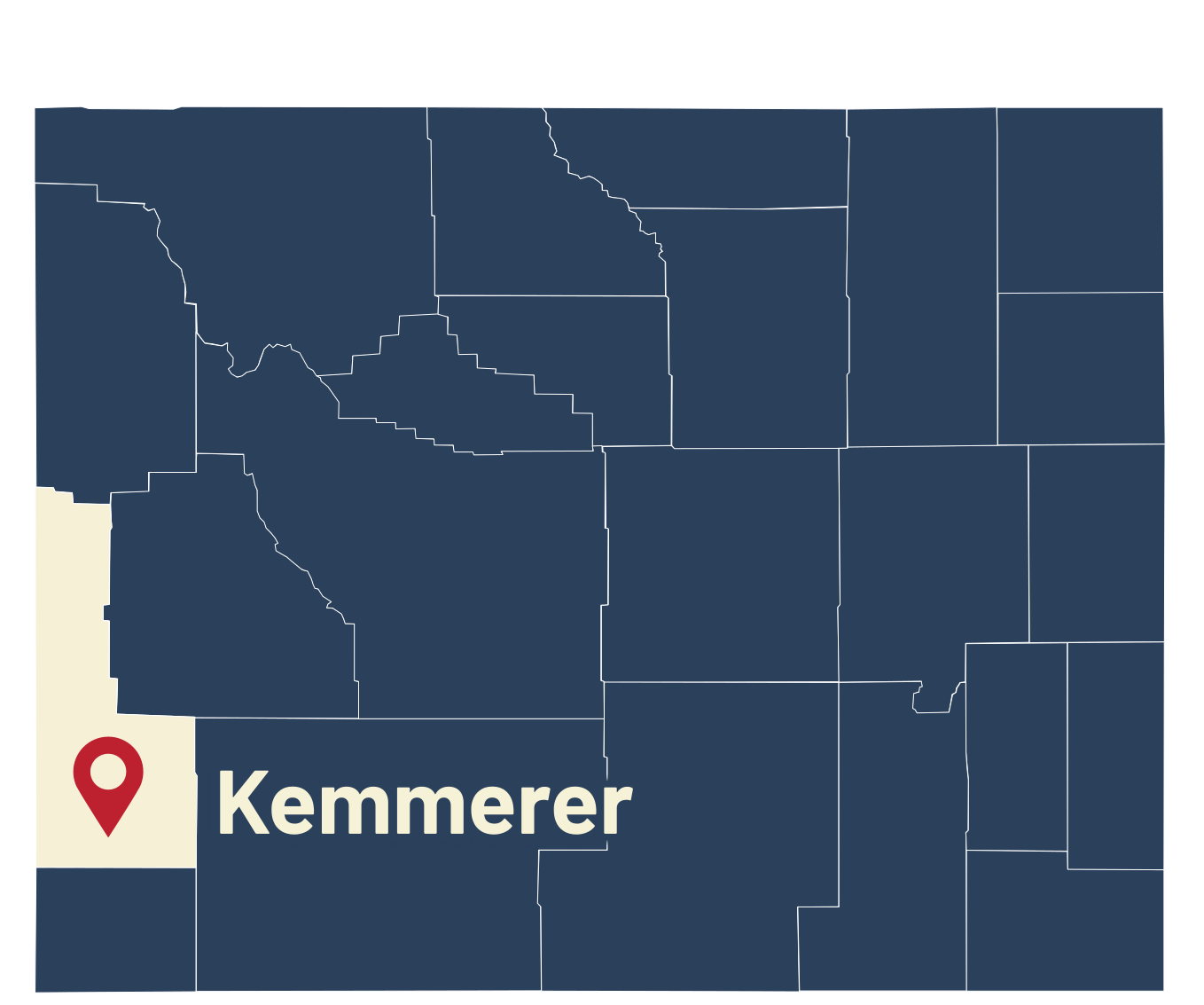
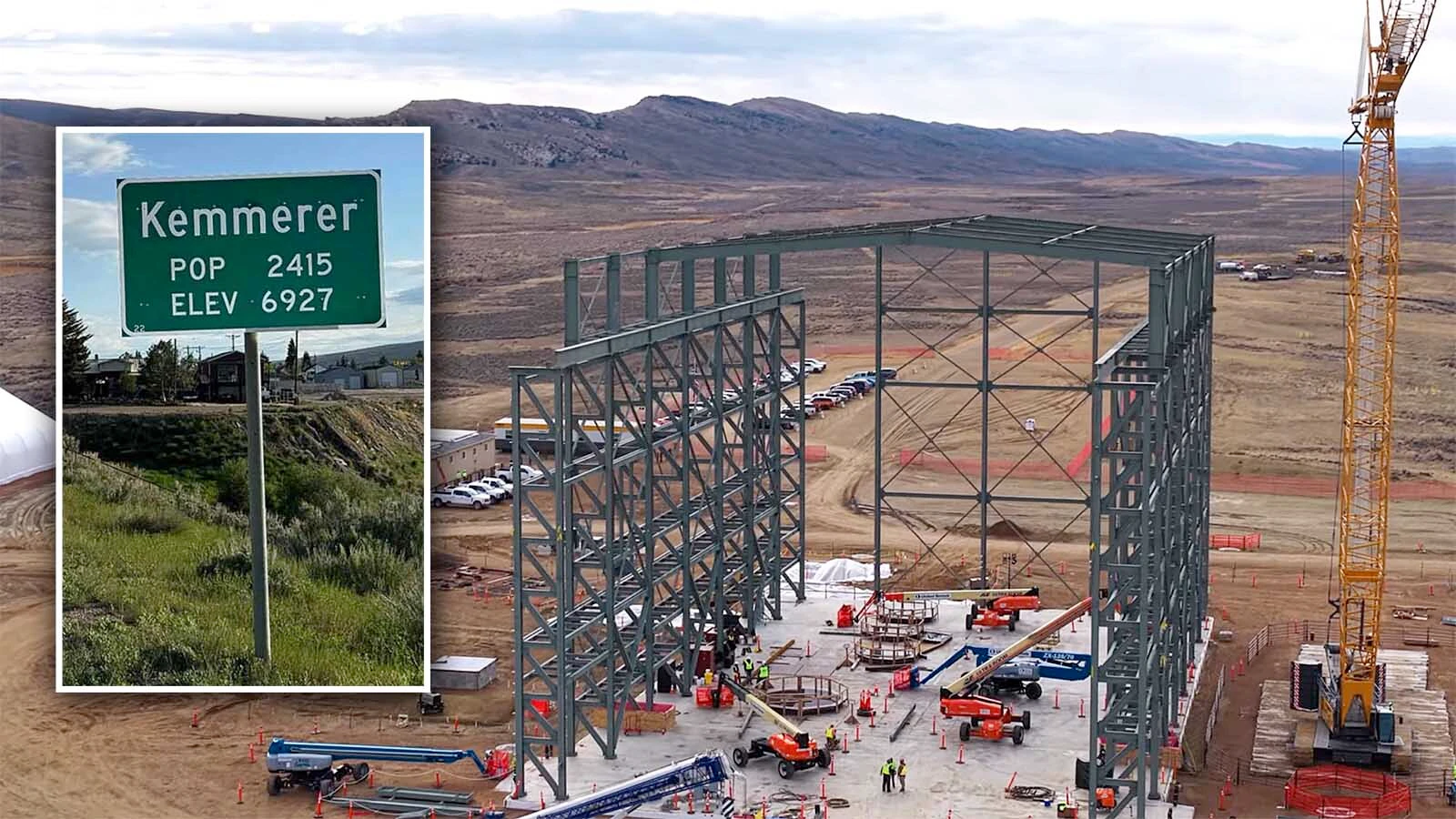
At a recent ceremony where the Nuclear Regulatory Commission signed TerraPower’s construction permit for the Natrium reactor in Kemmerer, Dr. Rian Bahran, DOE deputy assistant secretary for nuclear reactors, delivered the defining quote of the moment.
“For years I’ve been saying we’re at a tipping point,” said Bahran. “And it feels like we’re finally tipping.”
Bahran called TerraPower’s permit essential to unlocking capital and public confidence.
“I like to tell my team, 'We have to get points on the board,'” he said, underlining the Department of Energy’s push for more nuclear power generation.
“This is points on the board,” concluded Bahran.
Tara Righetti, co-director of the University of Wyoming's Nuclear Energy Research Center and a professor of law and energy policy, said Bahran's language points to something concrete.
"I believe when Dr. Bahran said we are at a tipping point, he was referencing the fact that this is the first commercial advanced reactor licensed by the NRC," Righetti told Cowboy State Daily. "At various points over the past several decades, politicians have announced that nuclear energy would have a renaissance, but those promises have not come to bear.
"Authorizing construction for a non-light water reactor is a tangible milestone potentially heralding a new era of nuclear construction."
TerraPower’s work in Kemmerer adds gravity to this tipping point moment in the nuclear industry, raising questions about whether the U.S. is moving into an era when all newly built electricity generating power plants are nuclear.
Sean Schaub, nuclear industry coordinator at the Wyoming Energy Authority, doesn’t see that, but does recognize a surge in demand for nuclear power.
“There’s a lot of factors that determine what type of energy you’re going to go somewhere,” Schaub told Cowboy State Daily. “In my mind, it’s not just like a clear-cut answer of one thing versus another.”
Schaub said he sees a convergence of bipartisan policy alignment, private capital flowing in from the tech sector and a regulatory machine retooling itself for speed.
Global electricity demand is projected to increase 4.5% in 2025 and grow at least 2.8% annually through 2030, according to the World Resources Institute, citing BloombergNEF analysis.
The jump is driven by expansion of electric vehicles, industrialization, greater demand for cooling in developing countries — and the rapid growth of U.S. data centers, which has upended years of flat demand. Executive orders from the Trump administration have set a target of 400 gigawatts of nuclear power by 2050, quadrupling current capacity.
“Things certainly are moving along really well now, but that’s the result of over a decade or more of positioning for this moment in time,” he said. “Nuclear has been one of the few things that has enjoyed really pretty strong bipartisan support.
"And so you’re seeing the policy alignment, and then of course with just the energy demand signals that are pretty evident now, the financial situation sort of come together in a way that wasn’t really there prior.”
Twenty Sites
The NRC posted on social media Monday that it had identified more than 20 sites across the country where large nuclear reactors could be built using licensing work already completed. The commission has committed to reviewing applications within 18 months.
States with sites under consideration include South Carolina, Florida, Michigan, Virginia and Texas.
Scott Burnell, an NRC spokesperson, said the documents prepare the agency for utilities that may want to use licenses they’ve been sitting on, reactivate ones they surrendered or swap the reactor technology on an existing permit.
"The basic intent is to make sure that the agency is prepared for utilities to potentially come in and say, ‘Hey, we’re going to use these licenses that you issued,’” Burnell said. "Either that we’ve just kept on file or that, for one reason or another, we decided to give up on.”
The NRC is also clearing the way for pre-license construction. Agency documents state that companies could potentially begin site preparation, fabricate reactor components and even install entire non-nuclear energy islands before final approval, a fundamental shift for a regulator that historically required sign-off before a shovel hit dirt.
“TerraPower is the first commercial nuclear power plant with an advanced design, and it is the first of many such applications that we either actually have in house or that we are expecting in the near future,” Burnell said.
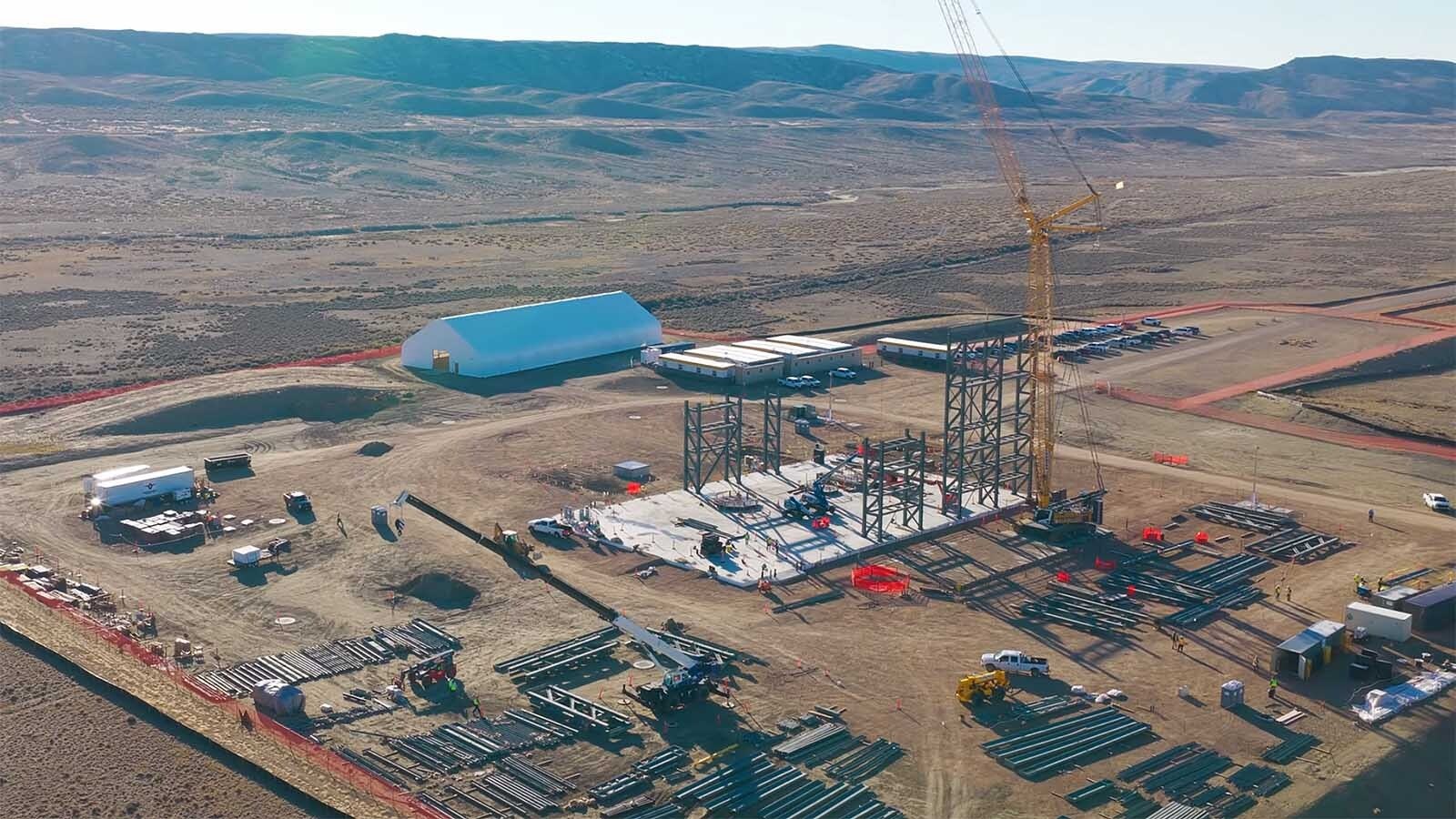
The federal Nuclear Regulatory Commission has found that Kemmerer Natrium project poses “no adverse impact to the environment.” It is the first advanced commercial facility to receive such a distinction. (TerraPower via YouTube) 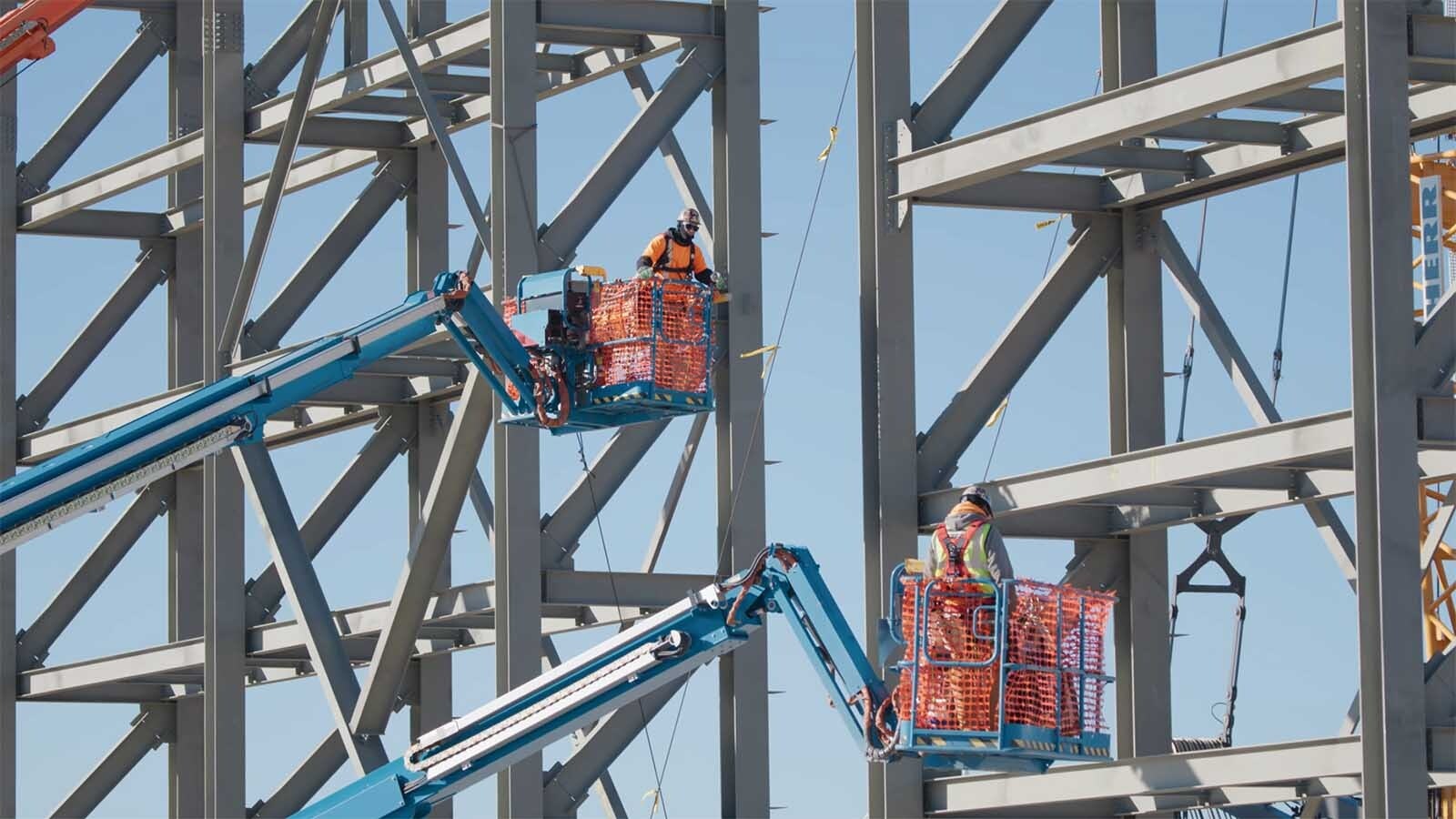
The federal Nuclear Regulatory Commission has found that Kemmerer Natrium project poses “no adverse impact to the environment.” It is the first advanced commercial facility to receive such a distinction. (TerraPower via YouTube) 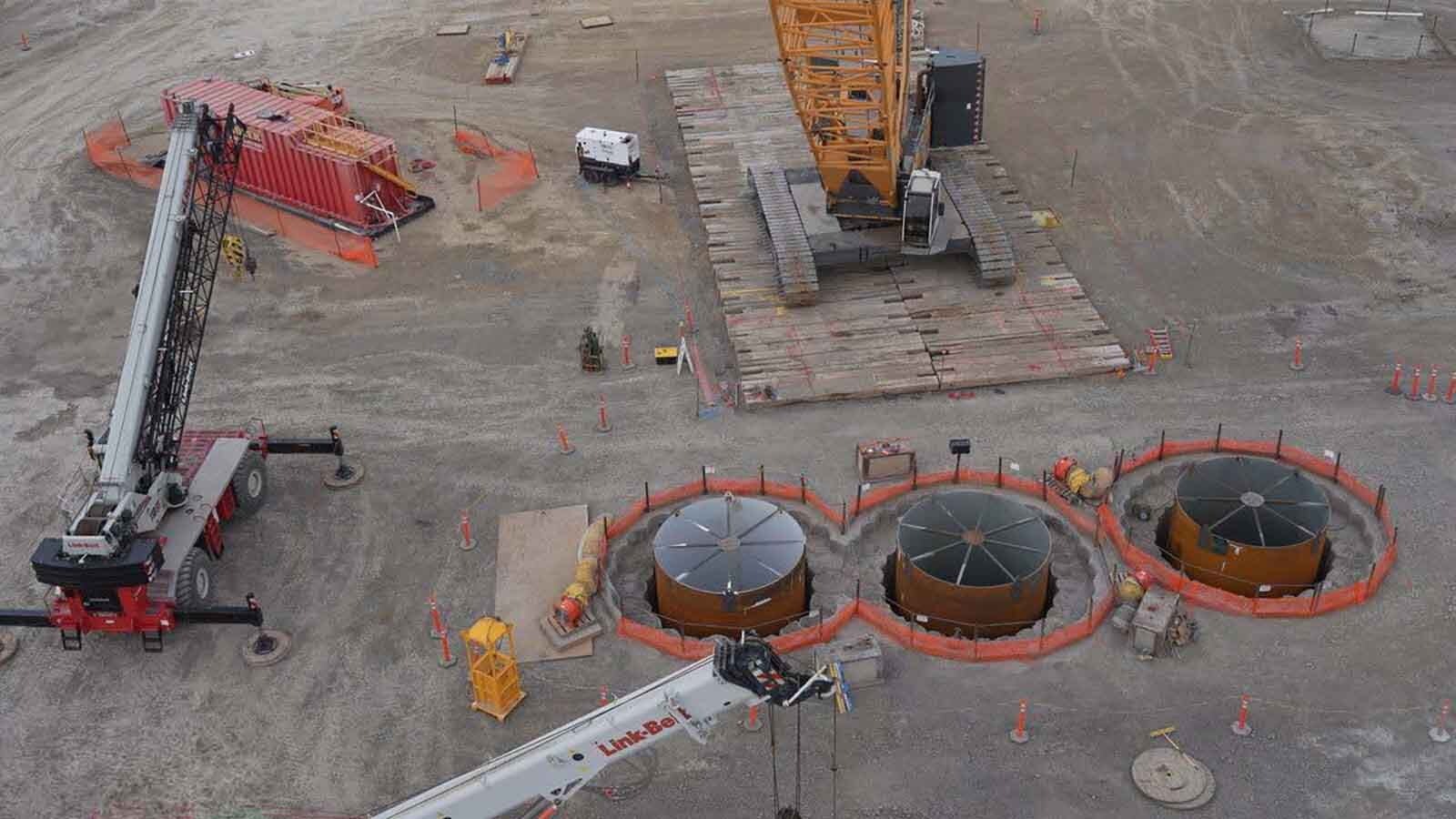
TerraPower has begun construction on portions of its Kemmerer nuclear facility that don't require approval from the Nuclear Regulatory Commission. (Courtesy TerraPower) 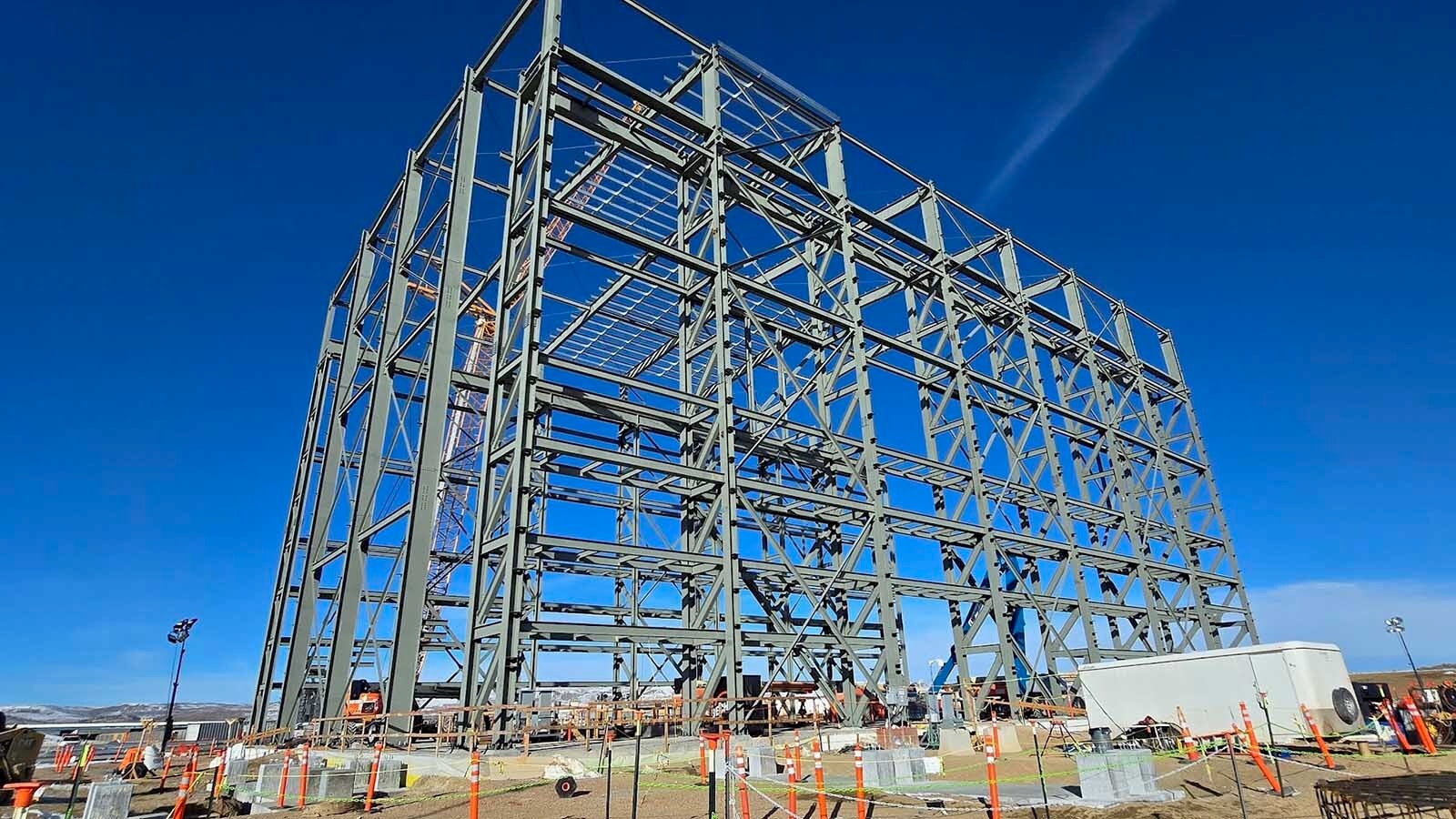
TerraPower is building a massive mechanic shop for its Natrium plant in Kemmerer, called the Test and Fill Facility. The crane behind the building is 200 feet tall, while the building is 167 feet tall. (Renee Jean, Cowboy State Daily) 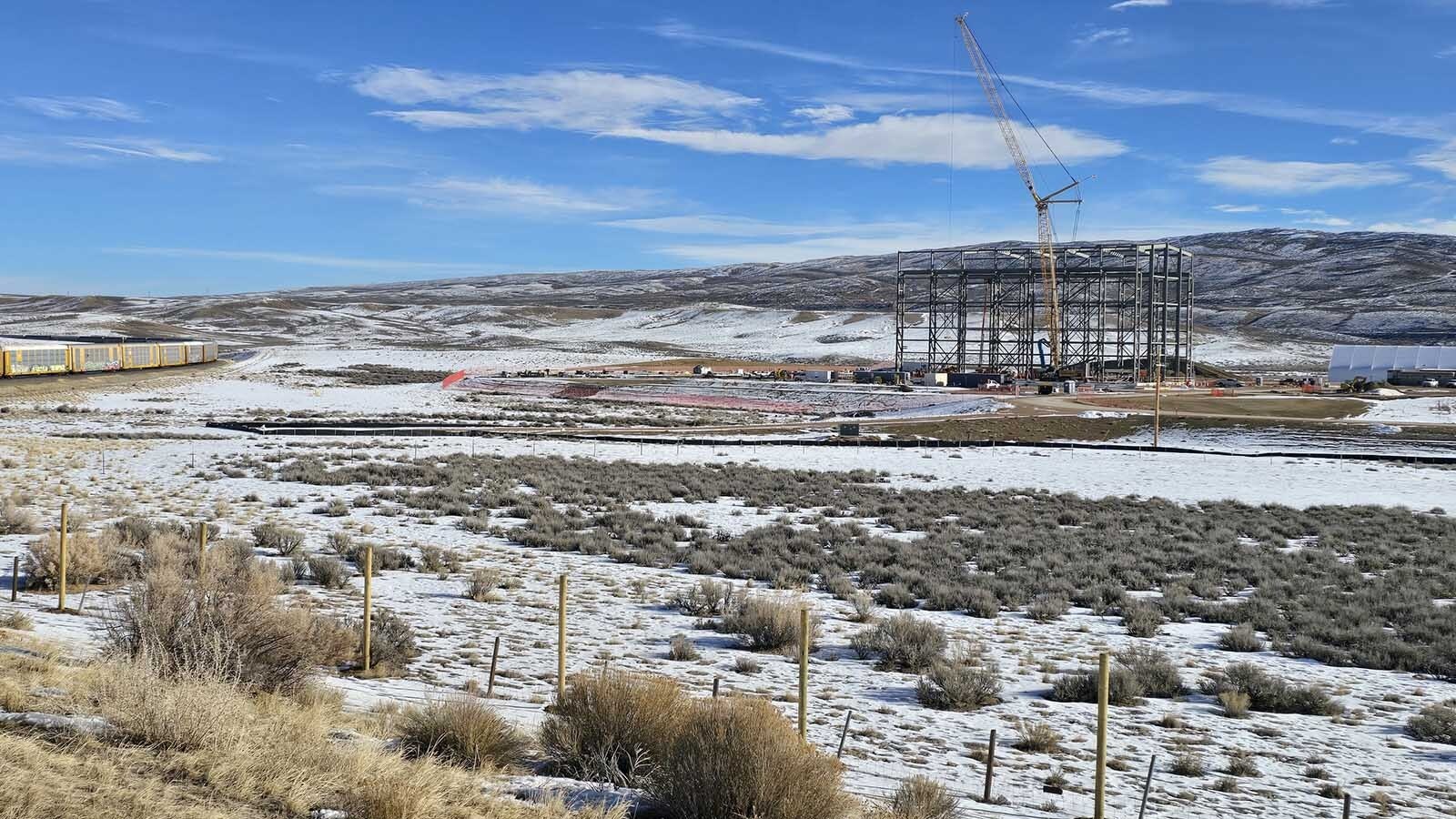
TerraPower's Test and Fill Facility from a distance looks fragile against the snow-covered hills. But it's a massive structure, rising 167 feet in the air with beams that individually weigh as much as 90,000 pounds. The location is near the railroad, and a spur could be built on site relatively easily, but the equipment is too large to deliver that way. (Renee Jean, Cowboy State Daily)
Our Place
The TerraPower Natrium plant — the first commercial advanced reactor approved for construction in the U.S. — is the flagship project for the current nuclear push.
“The importance of that project can’t be overstated,” Schaub said. “It’s a really exciting development for Kemmerer and that local area, but also just as the nuclear industry writ large.”
Beyond Kemmerer, Schaub said the Wyoming Energy Authority is focused on specific phases of the nuclear fuel cycle — the critical industrial steps between mining raw uranium and fueling a reactor.
Those steps include conversion, enrichment, deconversion and fuel fabrication.
The nation has limited capacity for several of them, according to the WEA, especially after the ban on Russian imports removed a large share of the global supply.
“That creates a gap, but in our view creates a really big opportunity for places like Wyoming to step up,” Schaub said.
Spent fuel storage and waste management will always be part of the public conversation as Wyoming expands its role in the nuclear industry, but Schaub said the near-term economic opportunity is concentrated in the front end of the fuel chain.
“Each of those steps is really critical and necessary,” he said. “And those pieces, no matter what the reactor technology is for the most part, it’s required by all of them.”
Existing Wyoming manufacturers already have capabilities that could translate to the nuclear supply chain. Companies like L&H Industrial are finding opportunities, and the state’s new Energy Dominance Fund could evaluate proposals for conversion and enrichment facilities.
Digital Boost
TerraPower on Wednesday announced a partnership with SoftServe and NVIDIA to build an AI-powered digital twin platform that compresses nuclear plant site engineering from 18 months to as little as eight weeks.
Built on NVIDIA’s Omniverse operating system, the platform analyzes thousands of variables simultaneously — geotechnical modeling, grid interconnection, site layout — allowing teams to see constraints in 3D before a dollar goes to construction, according to TerraPower’s announcement.
“Nuclear site engineering has always been expensive to get wrong — and until now, teams couldn’t really see the constraints until they were already committed to a layout,” said Dennis Loktinov, senior director of enterprise solutions at SoftServe. “The bottleneck was never due to capability — it was the time it took to trust the design. We’ve removed that.”

De-Reg Concerns
As the NRC and DOE continue to press their bureaucratic accelerator buttons, some worry about the current pace of deregulation.
“There has been a huge deregulatory effort of the nuclear industry over the last year which culminated recently in DOE proposing to exclude advanced nuclear reactors from environmental reviews,” wrote John Burrows, energy and climate policy director at the Wyoming Outdoor Council, in an email to Cowboy State Daily.
“We know Wyoming communities have real and sincere questions about these new technologies and both the state and federal government need to do more to guarantee that our land, water, public health are protected,” he added.
Forum Ahead
Those looking to dig into nuclear-related questions and concerns will have a chance next month.
The University of Wyoming’s Ruckelshaus Institute is convening a Nuclear Energy Emerging Issue Forum on April 13-14 at the Rochelle Gateway Center in Laramie, organized with the UW School of Energy Resources and the Wyoming Energy Authority.
Schaub said he’ll give a talk and moderate a panel on economic development opportunities across the fuel cycle. Tara Righetti, co-director of the nuclear energy research center at UW, will join for a discussion on why nuclear and why Wyoming.
“Outside of the uranium industry, Wyoming is relatively new to this space,” Schaub said. “People have a lot of questions, which is great that they’re asking those.”
David Madison can be reached at david@cowboystatedaily.com.