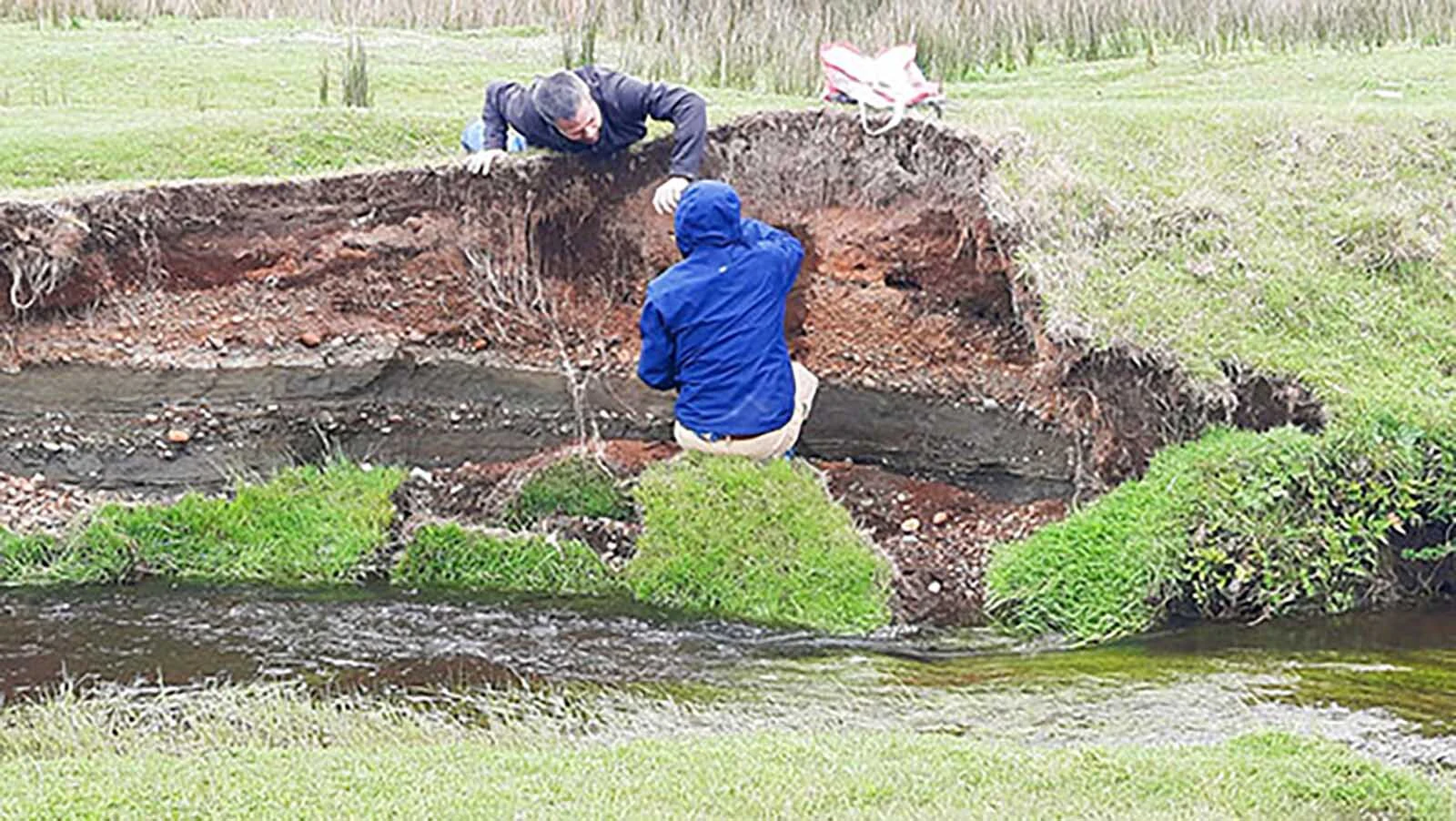
A University of Wyoming archaeologist is the lead author on a new paper that has potentially upended what we know about the history of humanity in the Americas.
Todd Surovell, a professor and director of the George C. Frison Institute of Archaeology and Anthropology at the University of Wyoming (UW), led an international, multidisciplinary team of scientists on an expedition to Monte Verde in southern Chile, one of the most revolutionary archaeological sites in the world.
The evidence they collected and analyzed from Monte Verde pushed back the arrival of humans in the Americas by thousands of years.
According to Surovell, the site has been “the foundation” of a theory that humans migrated and settled in North and South America over 20,000 years ago.
Surovell studied the same evidence and reached a much younger, more controversial age.
He and his team dated Monte Verde to 8,200 years, at the oldest, rather than the 14,500 years that has been “an unquestionable scientific fact” for most archaeologists.
“This site is now 5,000 years younger than the first Clovis settlements, instead of 1,500 years older,” Surovell told Cowboy State Daily. “Monte Verde was supposed to be game-changing. It was supposed to be paradigm-changing, a settled matter of science. In our interpretation, they got it wrong.”
The Clovis First Model
To understand the earth-shattering implications of Surovell’s new paper, some archaeological context is required.
The date of humanity’s arrival in the Americas is “a hotly debated topic,” according to Surovell. The most widely accepted theory, until Monte Verde, was the “Clovis First” model.
“That was the idea that the first peoples managed to get past the continental ice sheets in the northern part of the continent and flooded into North and South America around 13,000 years ago,” he said. “This was evidenced by these big, fluted spear points we call Clovis points, which are evidence of people hunting large animals like mammoths.”
The “Clovis first” model was presented in 1936 and was “the” theory for human arrival in the Americas for 60 years.
That all changed with Monte Verde II, first excavated by archaeologists Tom Dillehay and Mario Pino in 1977.
They discovered a prehistoric campsite in southern Chile that contained charcoal, animal hides, stone tools, and other artifacts that indicated humans had lived there for a prolonged period.
“They claimed to have evidence of rectangular wooden structures, cordage, medicinal plants, and plant foods,” Surovell said. “It suggested that there was a lot that we didn't understand, and there was this deep missing prehistory in North America.”
When Dillehay and Pino used radiocarbon dating to determine the age of the bones and charcoal at Monte Verde II, they found an average age of 14,500 years old.
The findings at Monte Verde, published in 1997, rocked the archaeological world and effectively disproved the “Clovis First” model. This led to the pre-Clovis theory that humans had arrived in the Americas thousands of years before the Clovis.
Since then, the pre-Clovis theory has been buffeted by the discovery of other sites in North and South America that are older than 13,000 years. Footprints preserved at White Sands National Park in New Mexico have been dated to between 21,000 and 23,000 years.
And none of that sat well with Surovell and his understanding of humanity’s history in the Americas.
How?
Surovell’s archaeological research at UW has focused on the first people of the New World. He published dozens of papers on Paleoindians, including the ground-breaking discovery of bone beads and needles at the La Prele Mammoth Site near Douglas.
Surovell heard Dillehay give a presentation on his findings at Monte Verde while he was a graduate student at the University of Wisconsin. As he continued to build his expertise through fieldwork and research, Monte Verde II seemed too “anomalous” to fully accept.
“It’s been the backdrop of my entire career,” he said. “I was in my second year of graduate school when this dropped, and I’ve always been skeptical of it. It doesn't fit in so many ways.”
One reason Surovell was skeptical is that Monte Verde is at least 500 years older than any known archaeological sites in Alaska.
The accepted theory, to this day, is that America’s first peoples reached North America by crossing the land bridge from Northeast Asia to Alaska, migrating south from there.
“How do you get people to southern Chile over 14,000 years ago, while leaving basically an invisible record further north? Occasionally, we find remarkable things, but Monte Verde was a statistical outlier in terms of age, location, and human behavior,” he said.
Even as he taught classes at UW that included Monte Verde, he was stuck on how unusual it was for a site of that age to exist so far south. It left him with a desire to return to the important site, collect more evidence, and either confirm or refute the work from the past.
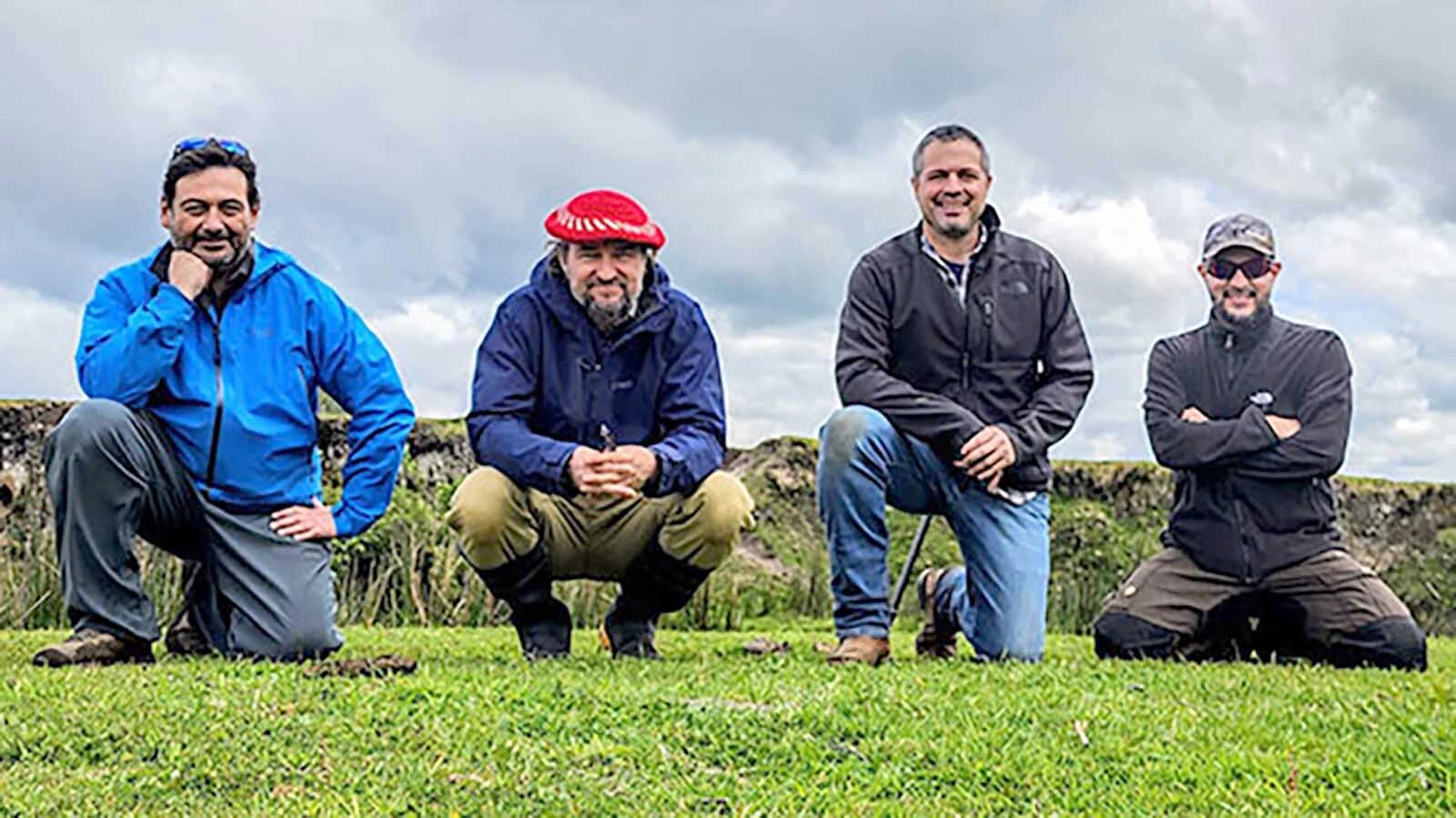
“I developed a research project with Claudio Latorre, a paleoecologist and my collaborator in Chile,” he said. “We expanded our team to include archaeologist Cesar Mendez, geomorphologist Juan Luis Garcia, and two radiocarbon dating specialists.”
Surovell, Latorre, and their team received a permit from the National Monuments Council of Chile to return to Monte Verde in 2023. It was the first independent archaeological investigation of the paradigm-shifting archaeological site since 1997.
Layers Upon Layers
As soon as they arrived at Monte Verde, Surovell said his peers were questioning what had been an “unquestionable scientific fact” for the last 29 years. The first clue came from Latorre’s assessment of the site’s geological context.
“He's looking at the deposits and immediately recognized what he thought was a problem with the dating of the site,” he said. “At that point, we decided that we needed to collect data to test this idea.”
If the number wasn’t enough of a clue, Monte Verde II isn’t the only archaeological site of interest at this spot. Monte Verde I is a distinct site below Monte Verde II, but it’s an older layer that preserves evidence of a treeless periglacial environment.
“Monte Verde is in what's called a glacial outwash plain between the Andes to the east and the Pacific Ocean to the west,” Surovell said. “If you go there today, you can see 14,000-year-old remarkably well-preserved pieces of wood sticking right out of the bank.”
The wood was preserved by an organic marsh deposit, which was buried by a layer of volcanic ash.
That volcanic ash was very important to Surovell’s work at Monte Verde because of its “unique chemical fingerprint.”
“All volcanic ashes are geochemically unique,” he said. “Once you do the geochemistry of the ash, you can identify exactly what ash it is, the volcano it came from, and its age. It’s a regional stratigraphic marker.”
The volcanic ash layer was dated to 11,000 years, while the wood in the organic marsh layer was dated to 14,000 years. Then, those layers were buried by the outwash from glaciers moving in and out of the area, covering the ash and the marsh with more sediment.
This layered explanation is critical to Surovell’s conclusions because these layers remained buried until Chinchihuapi Creek, which still exists today, began eroding through the glacial, volcanic, and marsh layers, spreading sediment and organic material throughout the area.
That leads to the critical “old wood problem.”
The Old Wood Problem
When Monte Verde II was dated in 1977, one of the materials used to date the site was charcoal. That was, unquestionably, the remains of wood burned by the ancient peoples who settled there.
Charcoal is excellent for radiocarbon dating. Surovell said it’s very common for archaeologists to date sites with charcoal, even though there’s one significant caveat that can make all the difference.
“When you radiocarbon date charcoal, you’re dating the age of the wood that was burned, not the time it was burned,” he said. “If I go out to the Laramie Basin today, burn an old western red cedar, and date the charcoal, I'm going to get a radiocarbon date of 600 BP. That’s not when I burned it. That’s the age of the red cedar.”
It’s well within the realm of possibility. Last year, a team of scientists published research on more than 30 whitebark pine trees exposed by melting snow in the Beartooth Mountains, which were nearly 6,000 years old.
The “Old Wood Problem” isn’t a problem at most archaeological sites, as wood typically doesn’t preserve unless it’s burned into charcoal. Unburned wood often decays before it can be recovered.
However, Monte Verde II isn’t a typical archaeological site. Surovell said it’s unusual because it preserves a large amount of ancient wood, which can still be recovered in the 14,000-year-old organic marsh layer underneath the 11,000-year-old volcanic ash layer.
“This site has a really unique preservational situation,” he said. “The Chinchihuapi Creek cut through these layers, so you would have Ice Age wood and organic matter piling up on the surface that ancient people would have been living on.”
Using radiocarbon dating, tephrochronology (a technique for dating volcanic ash), and optically stimulated luminescence dating, the team redated nine alluvial layers and the volcanic ash layer at Monte Verde.
They determined that the sediment that buried and preserved Monte Verde II was between 3,000 and 8,000 years old. The wood and charcoal were still dated to around 14,500 years, but Surovell believes that’s due to the redeposition of much-older wood at the much-younger archaeological site.
“If you’re trying to date when people were at Monte Verde, but you're dating redeposited wood from the Ice Age, you're going to have a serious dating error of at least 6,000 years,” he said. “The reason why they thought this occupation was 14,500 years old is that they were dating wood and organic matter that was redeposited onto this 8,000-year-old surface.”
Prove Us Wrong
Surovell’s paper was published in Science on March 19. The reaction was immediate and intense, as would be expected for anything that upends nearly 30 years of established knowledge.
Dillehay, the original investigator, has already said he disagrees with the paper’s findings.
He told Live Science that “there is no 11,000-year ash layer under the Monte Verde II site” and they are projecting the geologic context from another site onto their interpretation of Monte Verde II.
Surovell noted that he approached Dillehay “in a collaborative spirit” to join his team for their project.
“I'll just say that he said, ‘No, thank you.’ He wasn’t interested,” Surovell said.
In fact, Dillehay and other members of the 1977 team objected to this new project. Surovell said they tried to prevent the National Monuments Council of Chile from issuing a permit for them to return to Monte Verde.
“Getting access to the site and actually being able to do this work was challenging,” he said. “We required permission from the National Monuments Council of Chile, and I'm really grateful they gave us a permit.”
David Melzer, an archaeologist who was part of an independent team that verified Dillehay’s conclusions in 1997, told Live Science there are “several problems” with the new research. One problem he believed was that Surovell’s team worked in sediment that was “tens to hundreds of meters distant,” which he feels is too far to provide an accurate analysis of the Monte Verde II site.
Surovell is aware of the positive and negative feedback on his paper and isn’t deterred by the dissent. In fact, he’s encouraging it.
“If anybody wants to replicate what we've done, or try to show that we've done something incorrectly, I 100% encourage it,” he said. “If anybody wants to re-date any of the samples that we're currently in possession of that we collected for this study, they are more than welcome to.”
Independent Replication
One of the major problems Surovell encountered is that Dillehay and the original team maintained exclusive permits to Monte Verde since they found it. That’s made independent investigations difficult, if not impossible, without the consent of the original team.
Surovell and his team got their permit to work at Monte Verde in a brief window when the original permits expired. Even if their findings are completely refuted by future research, he believes the archaeological community needs to be more open to independent research.
“Independent replication is a standard part of science, but it has never really been a serious part of archeological research,” he said. “For basically five decades, (Monte Verde) was never independently investigated by anybody. If you're going to make an extreme claim, you should encourage other researchers to come, have access to the site, and do independent work to try to verify those results.”
Everything Or Nothing?
While the study is still new, the broad consensus is that even if these new findings are accurate, and Monte Verde isn’t a 14,500-year-old archaeological site, it doesn’t change much. Since 1977, enough pre-Clovis sites have been found to support the theory that humans settled in the Americas before the Clovis arrived 13,000 years ago.
Surovell cautioned his peers against complacency. He harkened back to the need for archaeology to embrace independent replication, especially for pre-Clovis sites.
“All of these pre-Clovis sites are unusual, unreplicated finds,” he said. “Each site needs to be considered on its own merits, independently. But in most cases, nobody else has been able to go into these sites and independently validate those results.”
Based on his career of research, buffeted by the findings at Monte Verde, Surovell believes there’s more merit to the original “Clovis First” model that many archaeologists have discounted because of the discovery of Monte Verde.
“We have hundreds of Clovis sites that have been independently found by hundreds of people,” he said. “Of those sites, a couple dozen have produced the exact same style of spear point that are all unusual in the way they’re made, and date exactly to the same time. We’ve found the same thing at different locations in North and South America. You can say that for Clovis. You can’t say that for pre-Clovis.”
He also believes that the archaeologists supporting the much older pre-Clovis sites should be open to more independent research. That, in his opinion, is “the more extreme claim” for the origins of America’s first peoples.
“They should be encouraging independent investigation so we can validate the strength of their claims, and that’s never happened,” he said.
The Keystone In the Arch
Even Surovell admits his research at Monte Verde doesn’t invalidate the pre-Clovis theory, but redating the site from 14,500 years to 8,000 years, at the oldest, would be a significant blow to its support. He called it “the keystone in the arch” of the pre-Clovis theory.
Many archaeologists have called Surovell’s new paper “controversial.” That’s an expected reaction, and one that he knows will come with criticism and skepticism from his peers.
“You're going to get a range of opinions, depending on who you talk to,” he said. “I very much believe in the science that we did, but I'm certainly open to the possibility that we’re wrong. If other researchers do their own independent work to verify or refute those results, that’s great.”
While he stands by his science and its conclusions, he hopes it will cajole more people to investigate and independently verify the age and significance of pre-Clovis sites.
That’s bigger than any one paper, site, or artifact. It creates a stronger scientific future for archeology.
“I hope this encourages other people to go to controversial sites and to try to replicate the initial results,” he said. “Until we have some (research) that has been truly, independently replicated by people completely unrelated to the original investigators, I don't think we should take these other claims terribly seriously.”
As it stands, the understanding of humanity’s arrival in the Americas has been upended, once again, by Monte Verde.
America’s first people might have arrived 13,000 years ago or over 24,000 years ago. Archaeologists worldwide will be arguing over Surovell’s findings at Monte Verde for years, but as long as they’re channeling their opposition into solid research, that’s a win for Surovell.
“The debate continues, but it's a much broader debate than it was yesterday,” he said.
Andrew Rossi can be reached at arossi@cowboystatedaily.com.