I have seen the future. It looks a lot like today—only different. Oops. It just changed again. Never mind.
Whenever I am in Dallas, one of my favorite lunch companions is futurist Jeff Wacker. Last week, over Chinese food, he laid out why Wyoming may be better positioned than most places for what’s coming.
That got my attention.
At Hewlett-Packard—a company with 300,000 employees—Jeff was the futurist. Just one. That always told me something.
Now he’s retired and writing books. But he is still thinking ahead. Way ahead.
AI And Robots
He believes artificial intelligence will dominate the workplace sooner than expected. It will touch just about every job and replace many. At the same time, robots will become commonplace—visible, physical, everywhere.
Two different trends. Same destination. So, what about Wyoming?
Jeff says we are in a strong position for five reasons.
First, energy. Wyoming is the nation’s energy breadbasket. In a world driven by supply and demand, we have what everyone needs—and a government willing to develop it.
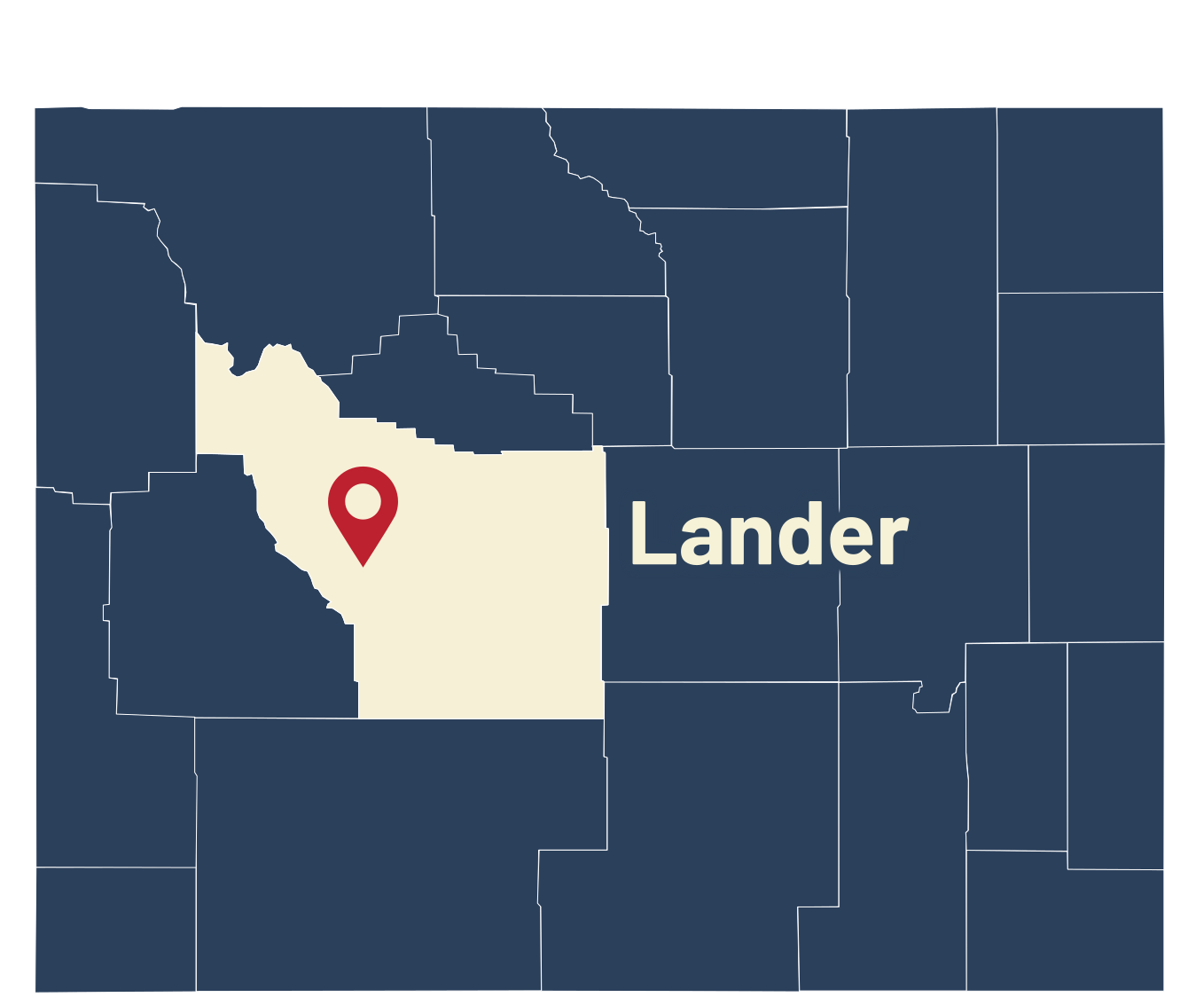
Second, no big cities. That’s an advantage. Big cities come with big problems. Wyoming does not. And increasingly, people can work from anywhere. Many are choosing places like Wyoming. Small towns like Sheridan, Buffalo, Lander, Riverton, Douglas, Green River, Newcastle, Afton, Evanston, Green River, Saratoga, Powell, Cody and many others are attracting “Lone Eagles,” those folks who can live anywhere to do their jobs. Internet and reliable air service are two for their biggest needs.
Third, our people. Wyomingites tend to be conservative, grounded, and realistic. Jeff believes that mindset will age better than more progressive approaches in a fast-changing world.
Fourth, innovation. We may be rural, but we are not backward. Wyoming has a long tradition of figuring things out. That fits well in an AI-driven future.
Fifth, wide open spaces. Distance becomes an asset. In crowded places, large concentrations of idle people can create problems. Wyoming has room to breathe. Many of us like to call our home state “The Big Empty” for good reason.
Then he went a step further.
Jeff believes the “singularity”—when artificial intelligence catches up to human intelligence—could arrive around 2030. Simply put, the singularity is when the rate of change goes exponential, he says.
Maybe sooner. After that, things get harder to picture.
He says time itself may change—not the clock, but how fast decisions are made. He talks about human time, machine time, and “cyber time.”
In that world, decisions happen in millionths of a second. Faster than we can comprehend. That’s where the danger lies—even if we cannot fully define it yet.
What About Jobs?
And then there’s work.
Jeff grew up on a small farm in western Nebraska. He believes in work. So do I. But he says most jobs will be replaced by AI and robotics sooner than we think.
He does not like the idea of universal basic income. But he thinks it is coming anyway. “People will need a paycheck, whether they have a job or not,” he says. Think about that. Money without work. Large numbers of people with time on their hands. That is a formula for trouble—at least until society figures out a new balance.
Money without work defines socialism. It also describes those recent turbulent times when COVID affected us all. Somehow, we survived but the nation’s workforce never recovered. Still way too many people not working.
Which brings us back to Wyoming. In the middle of all this, Jeff says we may be just fine. We are not as fast. Not as crowded. Not as complicated.
He called Wyoming a bastion of common sense. Then he said something that stuck with me: “Our advantage is our small population.”
Fewer people. Fewer moving parts. Less chaos. In a world that is speeding up, that may matter more than we think.
For decades, we have viewed our small population and isolation as weaknesses. This flips that idea on its head. So, what does the future look like? Here is my takeaway:
The future is not something coming down the road. It is already here. It just depends on where you live.
In Dallas, it is fast, crowded, digital, and expensive.
In Wyoming, it is slower, steadier, and still grounded in real life.
And if the world really is about to accelerate beyond our control, then living in a place that still runs on human time might be a pretty good place to be.
Bill can be reached at bill@cowboystatedaily.com