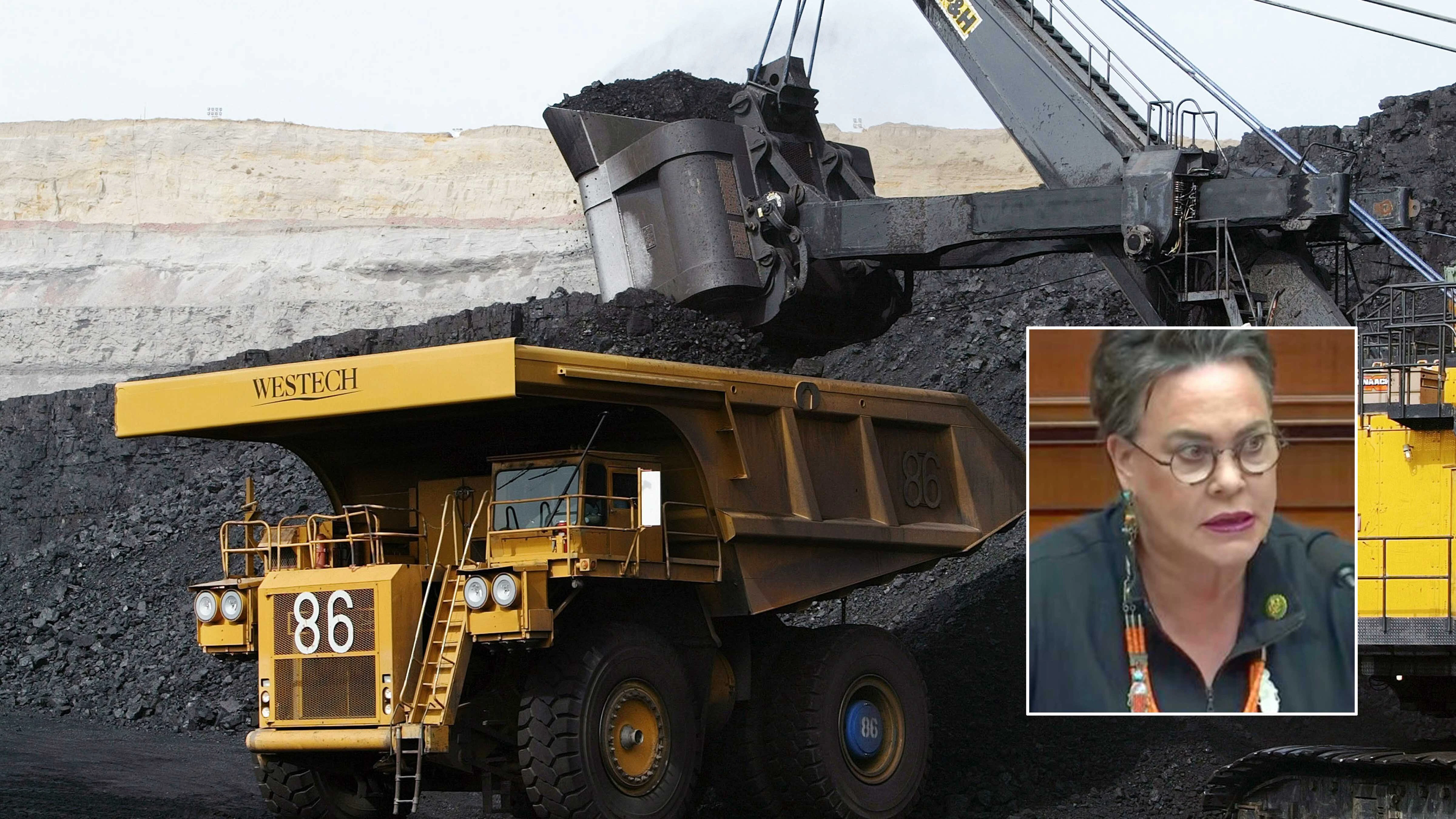
A looming coal supply crunch and the stalled permitting of solar projects on federal lands dominated a House Natural Resources subcommittee hearing this week, with Wyoming’s lone representative and a top state energy official warning that federal policy is failing to keep pace with the nation’s growing electricity demand.
The Energy and Mineral Resources Subcommittee convened to consider several bills, including H.R. 7872, introduced by U.S. Rep. Harriet Hageman, which would extend the payment schedule for federal coal lease bonus bids from five years to 10.
In her testimony, the Wyoming congresswoman laid out the stakes.
“Wyoming has led in coal production since 1986, now producing about 40% of the nation’s coal,” Hageman told the subcommittee on Wednesday. “In 2024, we produced 191 million tons and shipped 171 million tons to 26 different states.”
A February report from the Wyoming Energy Authority formed the centerpiece of Hageman’s argument. After more than a decade without new federal coal leasing, the study found that domestic and international demand could outstrip supply within just a few years.
“After 14 years of no new leasing, demand for coal by our domestic and international markets could outpace supply as early as 2030, just four years away,” Hageman said.
“Do nothing on this important issue is simply not an option,” she added. “Ignoring the situation poses a real risk of compromising power availability for our citizens.”
Grid Reliance
Hageman pointed to the late January winter storm Fern as evidence of the grid’s dependence on coal-fired generation.
“In the recent winter storm Fern, coal-fired electricity use increased by 31% in just one week to meet growing power demands,” she testified. “Without Wyoming coal, Americans will go without heat and power in the most dire of times.”
The congresswoman emphasized that her bill would not reduce federal revenue — only spread payments over a longer timeline that better matches the reality of mine development.
“I also want to be clear that this does not change the amount of the bonus bid payment,” Hageman said. “The companies will pay the same amount into the national treasury.”
School Funding
Education funding in Wyoming is directly tied to coal bonus bids, a point Hageman pressed repeatedly during the hearing.
“In Wyoming, coal bonus payments fund K-12 school construction,” she said. “In 2005, $400 million was generated for school construction and another $100 million in 2017. But as Washington, D.C. sought to dry up new leasing, so did the education funding in the state.”
Later in the hearing, Hageman returned to the broader theme.
“We can’t keep the lights on or the houses warm without Wyoming coal, yet federal policy itself is one of the barriers to production,” she said.
State Perspective
Kyle J. Wendtland, deputy director at the Wyoming Energy Authority and a University of Wyoming graduate — who opened his testimony with a “Go Cowboys” — provided technical context for Hageman’s bill.
The five-year bonus bid payment structure, Wendtland testified, forces mining companies to finance massive upfront costs years before a new lease can generate any revenue.
“The five-year payment term of the bonus bid further discourages new federal coal leases because companies must finance the upfront five-year payments as a sunk cost before revenue is generated from a new lease due to the extended permitting time frames,” he said.
Wendtland warned that earlier estimates of available coal reserves were misleading because they counted total leased acres rather than recoverable tons.
“That constraint in supply is coming much faster now than anybody ever anticipated,” Wendtland testified.
Under questioning from Hageman about what communities stand to lose if coal leasing stalls, Wendtland was direct.
“What we have to lose is our baseload, affordable energy,” he said. “Coal plants are the battery to this system. And right now, more power is more power. When you go to your wall and turn on your light switch, I don’t think a lot of people understand that coal still is a big part of what the electrons are that make that happen.”
Opaque Pricing
Wendtland also raised concerns about the Bureau of Land Management’s method for calculating fair market value of federal coal tracts, calling the process opaque.
“It is not transparent,” Wendtland said of the BLM’s valuation model. “You have to go back to when the Powder River Basin was moved to maintenance track leasing, and at that time BLM chose to use a comparative sale rather than a market-based system. And to this day, we still don’t know what exactly goes into that calculation.”
When asked whether the BLM’s fair market value process needs reform to support new leasing, Wendtland said, “The answer to that is yes. It does need the fair market value — needs to move away from comparative sale and to an actual market determination on what the value of a ton of coal is priced at, at the point of sale with an appropriate discount rate.”
He told Hageman the Wyoming Energy Authority would need the committee’s help pressuring BLM on the issue.
“I do believe we do need the help from this committee to keep moving that forward,” Wendtland said.
Bonus Bids
The education link came up again during questioning from Rep. Paul Gosar, R-Ariz., who told the panel he is originally from Wyoming.
“They’re a big part of why Wyoming has the schools they do today, because the bonus bids were earmarked exclusively for K-through-12 capital construction,” Wendtland said of coal bonus payments.
Asked whether extending the payment schedule would incentivize new production and generate more education revenue, Wendtland said it would — and that the longer timeline would “stabilize that income stream and revenue over that longer period and be more predictable in the budget.”
The BLM expressed support for Hageman’s coal bonus bid bill, with BLM Eastern States Director Mitchell Leverett testifying that extending payments from five to 10 years would “potentially encourage more people to bid on coal sales.”
Full Committee Chairman Bruce Westerman, R-Ark., also backed the measure, saying it would “spur capital investment in new resources and help invigorate the much-needed coal mining industry.”
Both the Wyoming Mining Association and the National Mining Association submitted letters in support of H.R. 7872.
Solar Stalemate
The hearing also featured sharp exchanges over the federal government’s treatment of renewable energy on public lands. Ranking Member Nadia Ansari, D-Arizona, pressed Leverett on how many solar and wind permits the bureau has processed in the past year.
Leverett acknowledged that an executive order has required solar and wind projects to be “elevated to the Department for more robust review” but could not provide a specific number of permits processed.
“That would be appreciated, because as far as I can tell, I believe the answer is none,” Ansari said of wind permits.
Ansari confirmed that a July 2025 memo requiring Interior Secretary Doug Burgum to personally sign off on dozens of individual permitting actions for wind and solar remains in place.
“As far as I’m aware, that memo still is in place,” Leverett said.
Colocation Push
A separate bill considered at the hearing, H.R. 5639, the Co-Location Energy Act, would allow solar and wind facilities to be built on existing oil, gas, coal, and geothermal leases with the consent of the current leaseholder.
Adam Met, executive director of Planet Reimagined, testified that 2.3 million buildable acres across the West could support co-located solar, generating an additional 406 gigawatts of energy.
“Instead of starting over somewhere new, this bill allows additional energy resources to be developed on those same sites,” Met told the panel.
The BLM, however, called the bill unnecessary, saying it already has authority to approve overlapping uses on federal lands. Met pushed back, saying the existing permitting process is too opaque for communities and developers to navigate.
“They have made it very clear that they want this, but they don’t know how to make it happen,” Met said of stakeholders across Utah, Colorado, and New Mexico. “And when you get that kind of response from the community, that means that there’s a problem in the process.”
Planet Reimagined bills itself as a research-driven organization focused on solving energy and climate challenges through bipartisan, pragmatic solutions.
“Interest in the co-location model is emerging across the political spectrum, from environmental NGOs to energy developers and other stakeholders,” added Met. “That level of alignment across sectors is not common, and it’s happening here because the approach is practical.”
David Madison can be reached at david@cowboystatedaily.com.