The COVID-era censorship lawsuit that exposed the Biden administration’s numerous demands toward social media companies over the content of posts ended Wednesday, when a judge approved an agreement between some federal agencies, the governments of Missouri and Louisiana, and three individuals.
The federal government’s demands that social media companies censor some COVID-19 information and some 2020 election content ranged so broadly, they impacted memes showing Leonardo DiCaprio pointing at a TV screen, a news story about Hunter Biden’s laptop, posts saying COVID-19 originated in a laboratory, and posts critical of the COVID vaccine, court documents say.
The Wyoming Department of Health found itself in the case’s evidence pool, since it couldn’t get its public health messaging through Facebook’s tight algorithms at the time, a court order says.
By accepting the consent decree on Wednesday that the government and its challengers reached on Tuesday, U.S. District Court Judge Terry Doughty ended the four-year-long litigation in the case, Missouri v Biden.
The consent decree is narrow, applying only to a handful of federal agencies and the case plaintiffs, and enforceable for 10 years.
The Brownstone Institute panned the settlement's concessions as "decorative." The agreement restrains the surgeon general, the Centers for Disease Control and Prevention (CDC), the Cybersecurity and Infrastructure Security Agency (CISA) and their employees from threatening Facebook, Instagram, X, LinkedIn or YouTube into censoring protected free speech.
But the agreement is still a victory of sorts, Eugene Volokh, who is a legal scholar specializing in the First Amendment and founder of the law blog the Volokh Conspiracy, told Cowboy State Daily in a Wednesday interview.
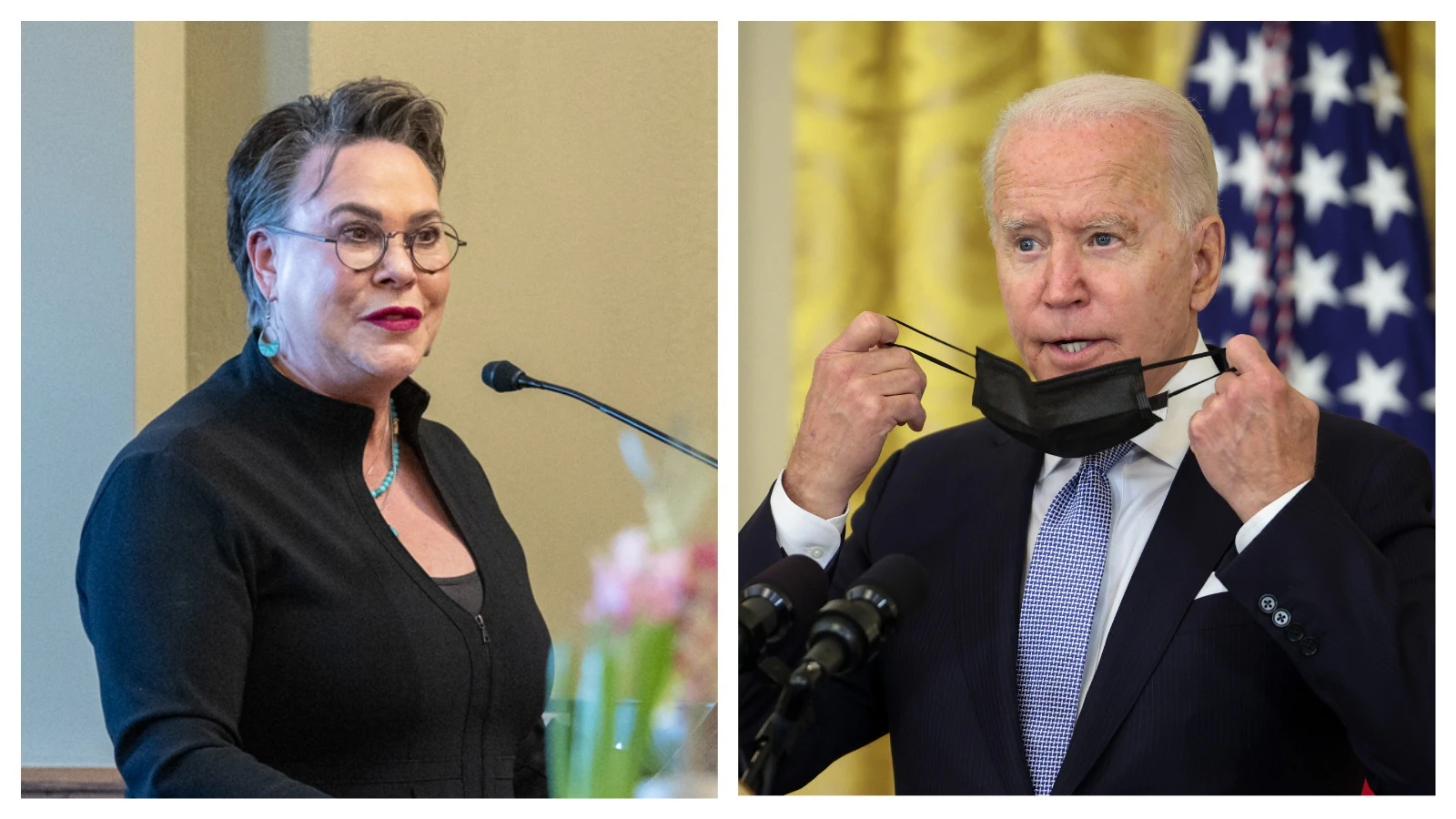
Wyoming’s lone U.S. House member Rep. Harriet Hageman agreed with that characterization in her separate phone interview Wednesday.
First, Eugene Volokh
Among Volokh’s many titles are Thomas M. Siebel Senior Fellow at the Hoover Institution at Stanford, and Gary T. Schwartz Distinguished Professor of Law Emeritus and Distinguished Research Professor at UCLA School of Law.
He noted Wednesday that he’s on the advisory board for the New Civil Liberties Alliance, which represented two of the individual plaintiffs.
Volokh said he’s not involved in the case specifically, and he gave the interview on his own behalf, not the plaintiffs’.
“Here’s the big picture,” said Volokh, recalling a 2025 U.S. Supreme Court case in which the high court ruled against the practice of district courts issuing nationwide injunctions. Generally the court can only block unlawful laws to help the people who sued to block them, he said.
“I think the consent decree here reflects that,” he said. “The decree gives the plaintiffs what they asked for, doesn’t give anybody else anything, but that’s just the nature of litigation.”
It’s accurate to call the consent decree a win for the plaintiffs, even if driven by the fact that “President Trump was elected and he’s on their side,” said Volokh.
Though the consent decree is narrow, said Volokh, other plaintiffs who endure the same type of alleged censorship the Missouri v Biden plaintiffs claim can point to it, to lend their case weight.
“That’s going to make it harder for the federal government to prevail in that case,” said Volokh.
A consent decree is not as persuasive as a case decision following a contested proceeding, like an argument or a trial.
The judge still has to approve the consent decree, but it won’t become binding precedent – just an argument bolster, he said.
But, added Volokh, the precedent the Missouri v Biden plaintiffs would have needed to succeed – if they could have proven standing with respect to their complaint and reached the merits of the case – existed already:
The 2024 U.S. Supreme Court case of National Rifle Association v Vullo barred a government agency, the New York Department of Financial Services, from coercing regulated entities like banks into terminating their business relationships with the NRA to punish the group’s gun-promotion advocacy.
The high court’s ruling was unanimous in favor of the NRA, which the national legal director of the American Civil Liberties Union represented in what Volokh called “really a nice left-right alliance” and “a smart legal tactical move.”
He was counsel of record on the NRA’s petition in that case, Volokh noted as a point in the interest of full disclosure.
As for the Missouri v Biden plaintiffs, the U.S. Supreme Court ruled in 2024 that they lacked standing to uphold Doughty’s block on the Biden administration’s actions, but they were still arguing their overall standing when this consent decree surfaced.
Hageman
Hageman has been invested in combatting government coercion of social media companies since before Missouri v. Biden began in 2022 – and since before she was elected to her seat.
An attorney, she worked for the New Civil Liberties Alliance, which represented two of the case plaintiffs, though Hageman didn’t serve on this case.
In that capacity she approached the Wyoming Legislature’s House Judiciary Committee in 2021 to urge passage of a state bill that would have given people a mechanism to sue social media companies for viewpoint discrimination. The committee majority rejected the proposition.
That was before the July 4, 2023, court order in which Doughty exposed the Biden White House and other federal agencies’ extensive, allegedly coercive handling of social media companies.
She had a sense of “what was going on” even though she couldn’t prove it in 2021, Hageman told Cowboy State Daily.
“I think it was pretty blatant what was going on with the federal government and social media at that time,” she said. “You could see it.”
To Hageman it was clear that “there was somebody involved with these companies and requiring them to take things down,” she added.
Before Doughty’s account of the case discovery erupted into the public arena, President Joe Biden’s then-press secretary Jen Psaki announced in May 2021 that social media platforms would face “legal consequences” if they did not censor “misinformation” more aggressively.
The president wanted the platforms to stop amplifying “untrustworthy content… especially related to COVID-19 vaccinations and elections,” said Psaki at the time.
Hageman as a Congresswoman has proposed a bill titled the First Amendment Accountability Act, which would, if it becomes law, give people a mechanism to sue federal employees for violating any of their rights under the First Amendment.
Hageman said that would cover other infringements, such as the COVID-era targeting of churches for closure or restrictions.
People could win injunctions, which are blocks on unlawful acts, and damages, and attorney’s fees under this bill if it becomes law, she said.
It hasn’t made it to the floor yet, adding she hopes “to get something knocked loose and get it to the floor.”
It’s modeled after a section of federal law allowing people to sue state officials for violating their rights under the U.S. Constitution.
Complicated, Mr. President
Trump’s clash with Biden over the latter’s pressure toward social media platforms fueled Trump’s campaign and inspired an executive order to protect free speech the day Trump was inaugurated.
Robert F. Kennedy Jr., who was a top target of the Biden administration’s information moderation campaign, later became a Trump cabinet member.
But Trump’s relationship with the First Amendment is complicated.
This week his administration lost a court battle against the New York Times, stemming from the Pentagon’s restrictions on journalists.
The October 2025 policy had barred news outlets from reporting information not officially sanctioned for release by agency heads.
Reporters seeking information outside official government channels would be deemed security risks and have their press credentials revoked. The White House argued the policy was in the interest of national security; First Amendment advocates called it blatant censorship.
In blocking the policy, U.S. District Judge Paul Friedman acknowledged the importance of protecting American troops and war plans but said it was "more important than ever that the public have access to information from a variety of perspectives about what its government is doing" in light of Trump's recent incursion into Venezuela and the war in Iran.
Another case in which the Trump administration took a blow, but which is now pending on appeal, ties loosely to the Wyoming-based Northern Arapaho Tribe.
The tribe’s law firm, Jenner and Block, fell into a list of law firms the administration sought via executive order to investigate and hedge out of federal buildings and federal contracts, due to activities the administration claimed were “un-American.”
The executive order proposed an “egregious” violation of the firm’s free speech right, a judge ruled last year.
That case is ongoing.
Clair McFarland can be reached at clair@cowboystatedaily.com.