CHEYENNE — The arrest of a Union Pacific Railroad engineer charged with being under the influence of drugs while operating a 16,000-ton train loaded with hazardous materials is a strong argument against automating humans out of America’s freight trains.
That’s according to Stan Blake, a retired UP conductor and switchman who spent 31 years on the rails in Wyoming and has been a strong advocate for keeping at least two-person crews on freight trains.
“You have to have people, and you have to have the two-man crews because you need someone else there if something happens to the engineer or conductor,” said Blake.
“What if an engineer had a stroke or a mini-stroke, or anything else happen? Who’s going to operate and drive that train?” he said. “It’s the same with flying planes. They have to have at least two people in that cockpit.”
Automation that eliminates some, or all, people from having to operate freight trains may be the future, but it’s not safe now, said Blake, who also served 14 years in the Wyoming Legislature and 12 years as the state director for the railroad’s union.
Having multiple people onboard is critical to train safety whether an allegedly reckless engineer needs to be stopped as was the case in Friday's incident or if something goes wrong with automated controls in the future, Blake said.
“For now, there’s no substitute for humans,” Blake said. “This is the perfect example why. Who knows what could’ve happened when that train came into the Cheyenne Depot if that engineer wasn’t stopped?
“He could’ve blown right into Cheyenne and into the back of a train,” he added.
In the case of the UP train stopped just before reaching the Cheyenne Depot on Friday, the locomotive’s conductor noticed the engineer’s bizarre and aggressive behavior and was able to contact authorities to get the train stopped, according to court records.
That’s when the engineer, Kristopher Richards, was arrested on suspicion of reckless endangering, being under the influence of controlled substances, and interference with a peace officer.
Richards had his initial appearance in Laramie County Circuit Court on Wednesday.
Teamwork
Two-man crews are important because they do very different jobs and can be backup to help in case of an emergency, Blake said.
That can be as simple as noticing when the other isn’t paying attention to a medical emergency or what happened Friday, when someone is apparently too impaired to safely operate the train, he said.
In Friday’s incident, the conductor actually had to fight off an aggressive Richards and lock himself in the locomotive’s bathroom, where he called for help, according to an affidavit of probable cause filed in Richards’s case.
“The conductor and the engineer usually work as a team, telling each other things and keeping an eye on each other,” Blake said.
Federal Railroad Administration rules already require two-person crews for hauling freight, and more states are doubling down with their own mandates, Blake said.
However, as railroad companies continue to struggle with employee shortages, options that include automation and reducing the on-train crew to just an engineer have been discussed.
In 2023, Union Pacific conducted a test on a line between Cheyenne and Denver of a potential system that could have taken conductors out of locomotives.
For the test, there was both a conductor and engineer on board, but there also was a conductor on a truck on call to respond to problems.
Being on a truck also, in theory, could allow one conductor on a truck to be available to respond to multiple trains in an area.
Blake said he doesn’t think that or automating people off trains altogether is happening soon. If and when it does, he’s skeptical about the ability of a computer to respond with human-like experience and intuition.
“The most important thing is I’m glad there were two people on that train on Friday,” he said.
Having more than one person in a locomotive “is not just about union negotiations and jobs, it’s about safety,” Blake added.
Union Pacific ultimately "chose not to pursue that concept at this time" following the test, said Mike Jaixen, senior manager of communications for the company.
"We did the test, but decided not to move forward with it," he said.
A Harrowing Ride
What Richards is accused of is an extreme example of what can go wrong, Blake said.
The conductor told investigators a harrowing story of Richards behaving erratically, and at times violently, while driving the train, according to the affidavit of probable cause.
That continued after the train stopped near Cheyenne and Laramie County Sheriff’s Office deputies caught up with it with the help of UP officials.
When asked about his ability to control the train, Richards’ response “caused me concern,” Deputy Shaun Teter wrote in the affidavit.
“Richards stated that he was in full control of the locomotive during the trip, adding that at some point he had fallen asleep ‘a little bit’ and possibly ‘for the whole trip,’” the affidavit says.
Richards also said he didn’t know who had stopped the train, though it was later revealed that Richards did.
“I noted that Richards had a disheveled appearance,” the affidavit continues. “Richards had urinated in his pants twice throughout the incident, appeared to be using a length of rope as an improvised belt and his eyes appeared to be very bloodshot.”
Teter wrote that further discussion with Richards showed that he’s on a number of prescription medications, including one equivalent to Ambien, a Schedule IV controlled substance.
The conductor on UP Engine No. 6360 with Richards told deputies that his coworker showed erratic behavior throughout their eight-hour trip, which began at 6 a.m., the affidavit says.
The conductor “stated that Richards had made statements regarding having killed his cats, mentioned deceased family members, and had attempted to give him multiple random objects out of his backpack,” Teter wrote.
Richards’ bizarre and aggressive behavior made the other man “fear for his life,” the affidavit says, “and that he planned for how he would make his escape.”
The conductor detailed that Richards also talked about atomic bombs being placed on a train “and that his family could help him make a smaller version of a bomb which would fit on the locomotive,” Teter wrote.
Finally, when Richards made a 2 p.m. stop, the conductor seized the opportunity to lock himself in an adjacent unit and call his supervisors.
The affidavit says the man stayed hidden in there for the final two hours of the trip, and at one time “Richards attempted to force the door open to reach him for approximately 10 to 15 minutes.”
‘It’s A Two-Person Job'
Along with the conductor fearing for his life, Richards’ alleged dangerous behavior also put tens of thousands of people at risk along the rail route across Nebraska and eastern Wyoming, the affidavit says.
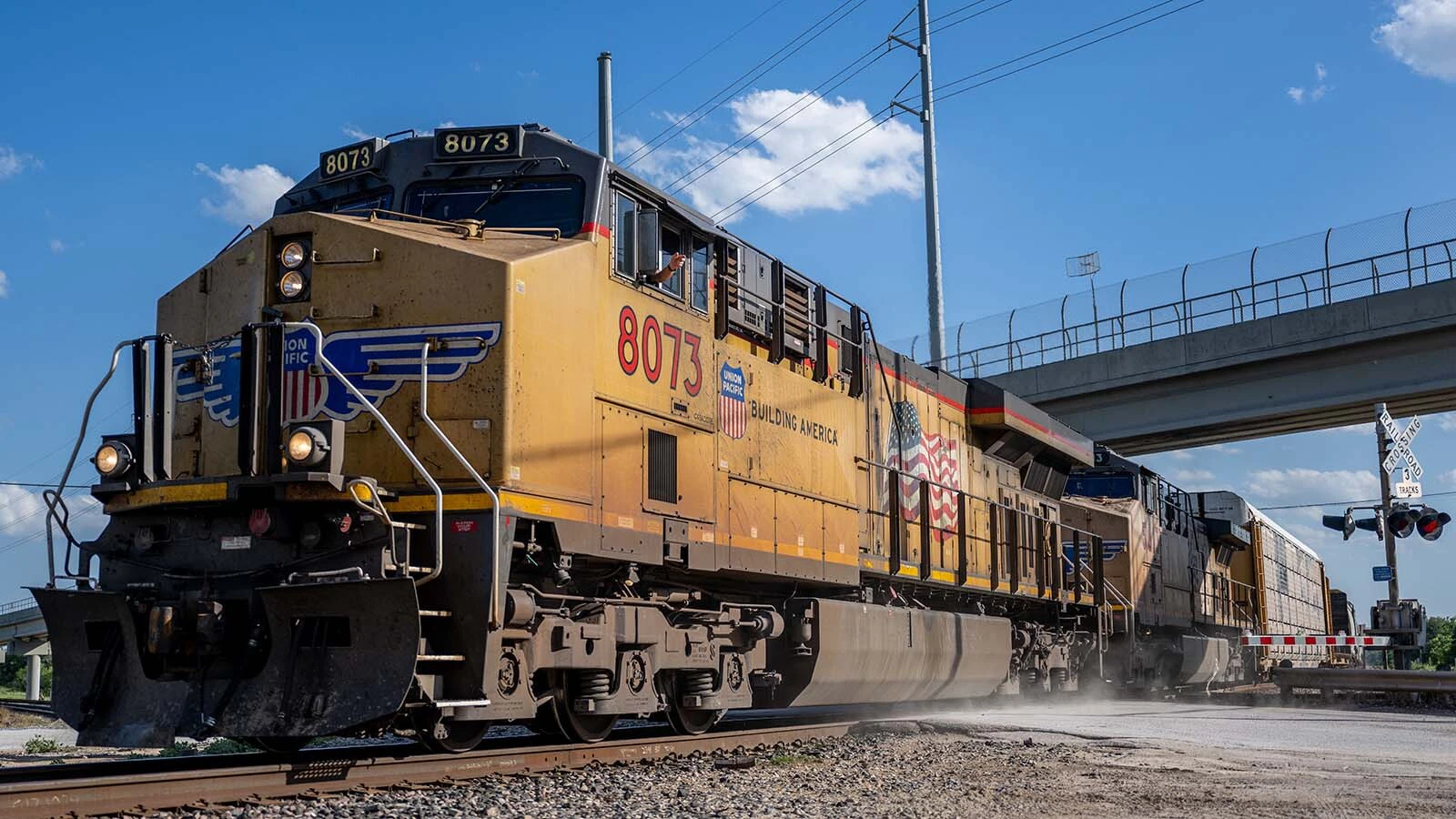
The train was 12,755 feet long and made up of 127 loaded cars and 55 empty cars, UP officials told the LCSO. It weighed about 16,000 tons and could travel at a top speed of 45-48 mph.
“I spoke with (a UP official) regarding the contents of the locomotive,” Teter wrote. “The locomotive was carrying hazardous material to include diesel fuel, liquified petroleum gas residue, ammonium nitrate residue, and hot asphalt.”
All are potentially flammable, explosive, or dangerous to health, the affidavit says.
Richards could not be charged with driving under the influence because a definition under Wyoming law exempts any vehicle on rails from being part of a DUI allegation, Laramie County Sheriff Brian Kozak told Cowboy State Daily on Tuesday.
Kozak said it’s possible a federal law enforcement agency could charge Richards with a felony.
Despite staffing issues and emerging technology, operating trains “is a two-person job, definitely,” Blake said.
Hauling a 16,000-ton load of hazardous and potentially explosive material, the conductor may have prevented a tragedy, he added.
“Without that other person there, who knows what could’ve happened if he was the only one on the train?” Blake asked.
Greg Johnson can be reached at greg@cowboystatedaily.com.