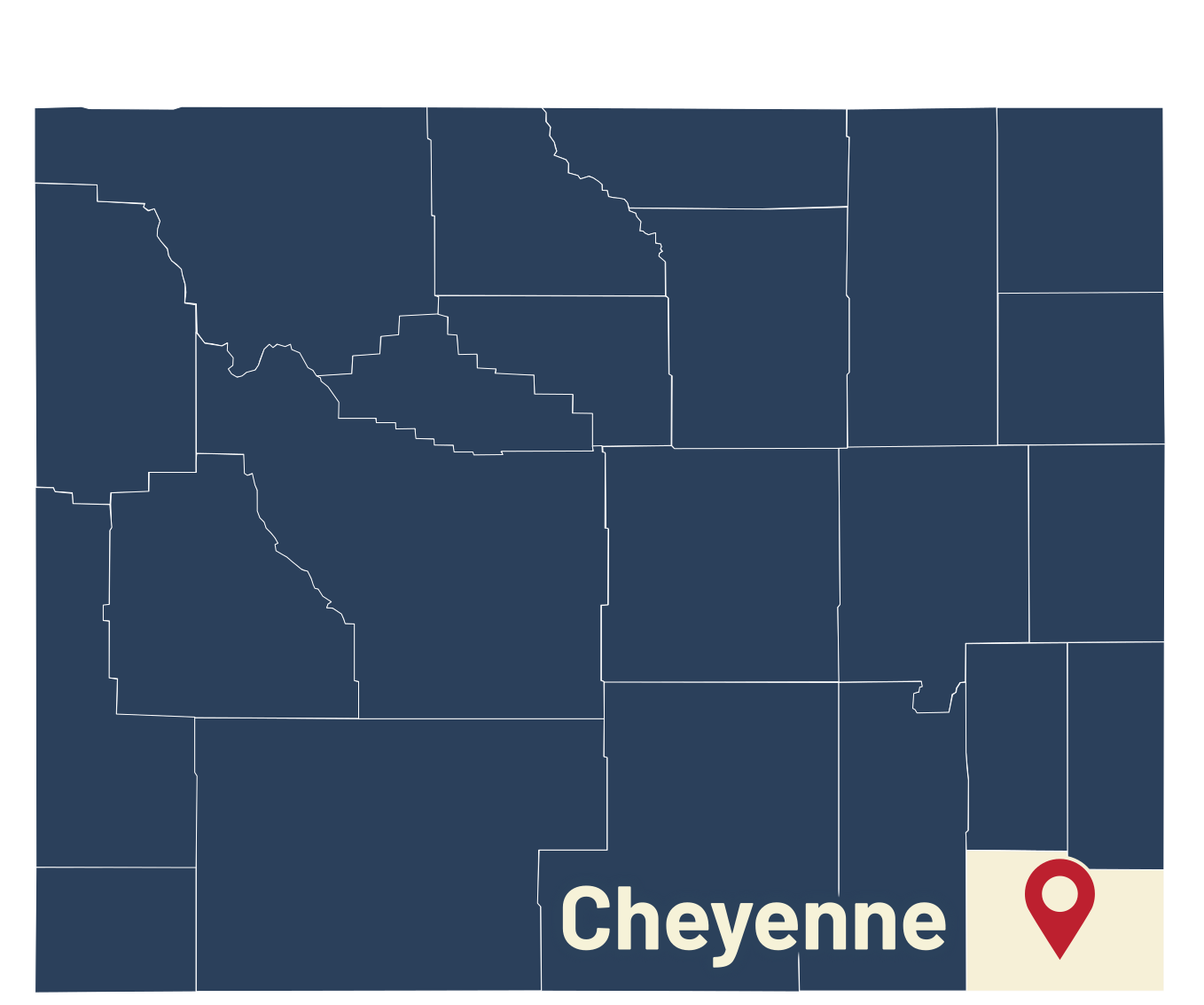
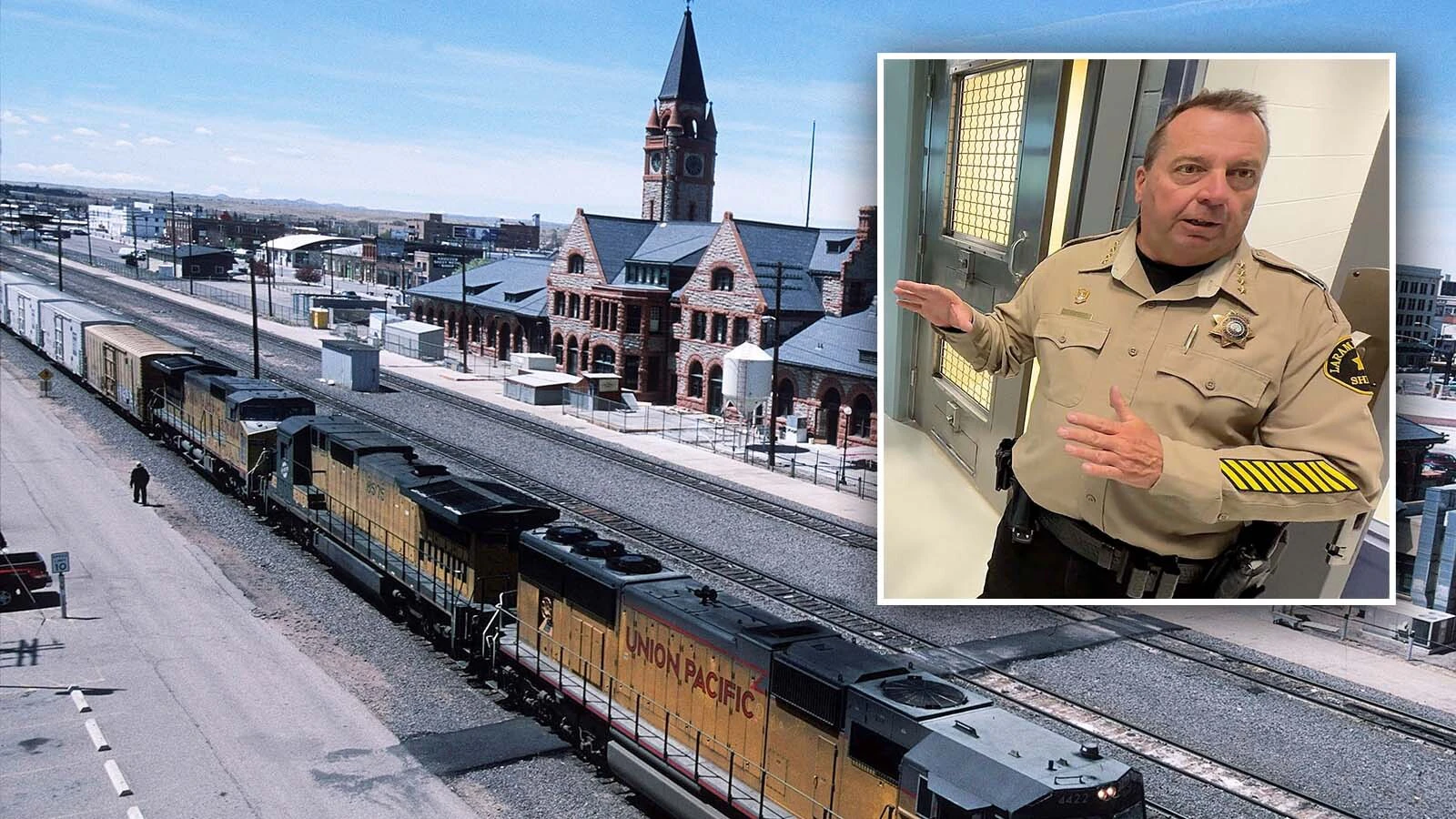
A Union Pacific train engineer remains in jail after his arrest following a terrifying eight-hour shift driving a 16,000-ton train loaded with hazardous materials from Nebraska to Cheyenne while allegedly under the influence of drugs.
Kristopher Richards, born in 1979, upset the conductor on the train with his alleged aggressive and bizarre behavior to the point that they fought, the Laramie County Sheriff’s Office reports.
Then the conductor locked himself in the locomotive for the last two hours of the train’s run from North Platte, Nebraska, to Cheyenne on Friday, according to an affidavit of probable cause by Deputy Shaun Teter.
While locked in the locomotive, the conductor called Union Pacific Railroad officials, who alerted the LCSO.
“He was extremely impaired,” Sheriff Brian Kozak told Cowboy State Daily on Tuesday about Richards.
Kozak said the conductor working with Richards noticed his coworker appeared to be under the influence of something.
“The conductor noticed the engineer was in no condition to operate the train,” he said, adding that Richards was “violent and erratic.”
The two reportedly got into a fight on the train before the conductor barricaded himself in an engine room.
The train was stopped prior to reaching the depot in Cheyenne, Kozak said, adding that Union Pacific was very cooperative in the operation.
Richards has been charged with reckless endangering, being under the influence of controlled substances, and interference with a peace officer.
He’s scheduled for his initial court appearance on Wednesday in Laramie County Circuit Court.
Richards could not be charged with driving under the influence because a definition under Wyoming law exempts any vehicle on rails from being part of a DUI allegation, Kozak said.
Kozak said it’s possible a federal law enforcement agency could charge Richards with a felony. Calls to Union Pacific were not returned prior to publication.
Fell Asleep ‘A Little Bit’
The conductor told investigators a harrowing story of Richards behaving erratically, and at times violently, while driving the train, the affidavit says.
That continued after the train stopped near Cheyenne and LCSO deputies caught up with it with the help of UP officials, Teter wrote.
When asked about his ability to control the train, Richards’ response “caused me concern,” Teter wrote.
“Richards state that he was in full control of the locomotive during the trip, adding that at some point he had fallen asleep ‘a little bit’ and possibly ‘for the whole trip,’” the affidavit says.
Richards also said he didn’t know who had stopped the train, then it was later revealed that Richards did.
“I noted that Richards had a disheveled appearance,” the affidavit continues. “Richards had urinated in his pants twice throughout the incident, appeared to be using a length of rope as an improvised belt and his eyes appeared to be very bloodshot.”
Teter wrote that further discussion with Richards showed that he’s on a number of prescription medications, including one equivalent to Ambien, a Schedule IV controlled substance.
LCSO Sgt. George Martinez, who was recently certified as a Drug Recognition Expert (DRE), was among the law enforcement officers who responded.
“This was his first (DRE) enforcement evaluation,” Kozak told Cowboy State Daily.
Martinez determined Richards was under the influence of a central nervous system stimulant, likely meth or cocaine, he said.
While Kozak said Martinez was unable to determine the exact drugs Richards was allegedly on, he said Richards showed signs of both stimulant and depressant use.
“The engineer admitted to using several other medications,” Kozak said.
At one point, Martinez demonstrated to Richards multiple times how to perform a field impairment test, the affidavit says.
“When asked if he understood the test, Richards stated, ‘I had my eyes closed,’” the affidavit says.
Feared For His Life
The conductor on UP Engine No. 6360 with Richards told deputies that his coworker showed erratic behavior throughout their eight-hour trip, which began at 6 a.m., the affidavit says.
The conductor “stated that Richards had made statements regarding having killed his cats, mentioned deceased family members, and had attempted to give him multiple random objects out of his backpack,” Teter wrote.
Richards’ bizarre and aggressive behavior made the other man “fear for his life,” the affidavit says, “and that he planned for how he would make his escape.”
The conductor also detailed that Richards also talked about atomic bombs being placed on a train “and that his family could help him make a smaller version of a bomb which would fit on the locomotive,” Teter wrote.
Finally, when Richards made a 2 p.m. stop, the conductor seized the opportunity to lock himself in an adjacent unit and call his supervisors.
The affidavit says the man stayed hidden in there for the final two hours of the trip, and at one time “Richards attempted to force the door open to reach him for approximately 10 to 15 minutes.”
Potential For Disaster
Along with the conductor fearing for his life, Richards’ alleged dangerous behavior also put tens of thousands of people at risk along the rail route across Nebraska and eastern Wyoming, the affidavit says.
The train was 12,755 feet long and made up of 127 loaded cars and 55 empty cars, UP officials told the LCSO. It weighed about 16,000 tons and could travel at a top speed of 45-48 mph.
“I spoke with (a UP official) regarding the contents of the locomotive,” Teter wrote. “The locomotive was carrying hazardous material to include diesel fuel, liquified petroleum gas residue, ammonia nitrate residue, and hot asphalt.”
All are potentially flammable, explosive, or dangerous to health, the affidavit says.
Along with the train’s cargo, Teter did some math to determine the number of people who could’ve potentially come into contact with the train allegedly driven by an impaired engineer.
In the 40 miles it traveled from the Nebraska border on its way to Cheyenne, “the locomotive appears to have passed town and areas with a total approximate population of 67,291 persons,” the affidavit says.
That includes Cheyenne, but may also exclude some smaller areas not accounted for and eight railroad crossings.
“The location where the locomotive was stopped during this incident was adjacent to a visible, populated neighborhood in Cheyenne,” according to the affidavit.
Kozak also hailed the conductor and UP officials for their efforts to get Richards off the train.
“What I want to say is, hats off to the railroad supervisor,” the sheriff said. “Hats off to the conductor who absolutely saved lives and a big tragedy from occurring in Cheyenne.
“I think he really could have really prevented a tragedy.”
Greg Johnson can be reached at greg@cowboystatedaily.com and Kate Meadows can be reached at kate@cowboystatedaily.com.