In a typical year, Horse Nation’s Indian Relay has brought upwards of 100 teams to Wyoming for its signature championship event.
This year, nothing is typical. Not only is Horse Nation’s Indian Relay experiencing a growth spurt, but it will also be celebrating its 10th anniversary, all at the same time.
Not only does that mean they expect to bring more than 100 relay teams to Wyoming this year, but it also means the relay needed to find a brand-new home for the event.
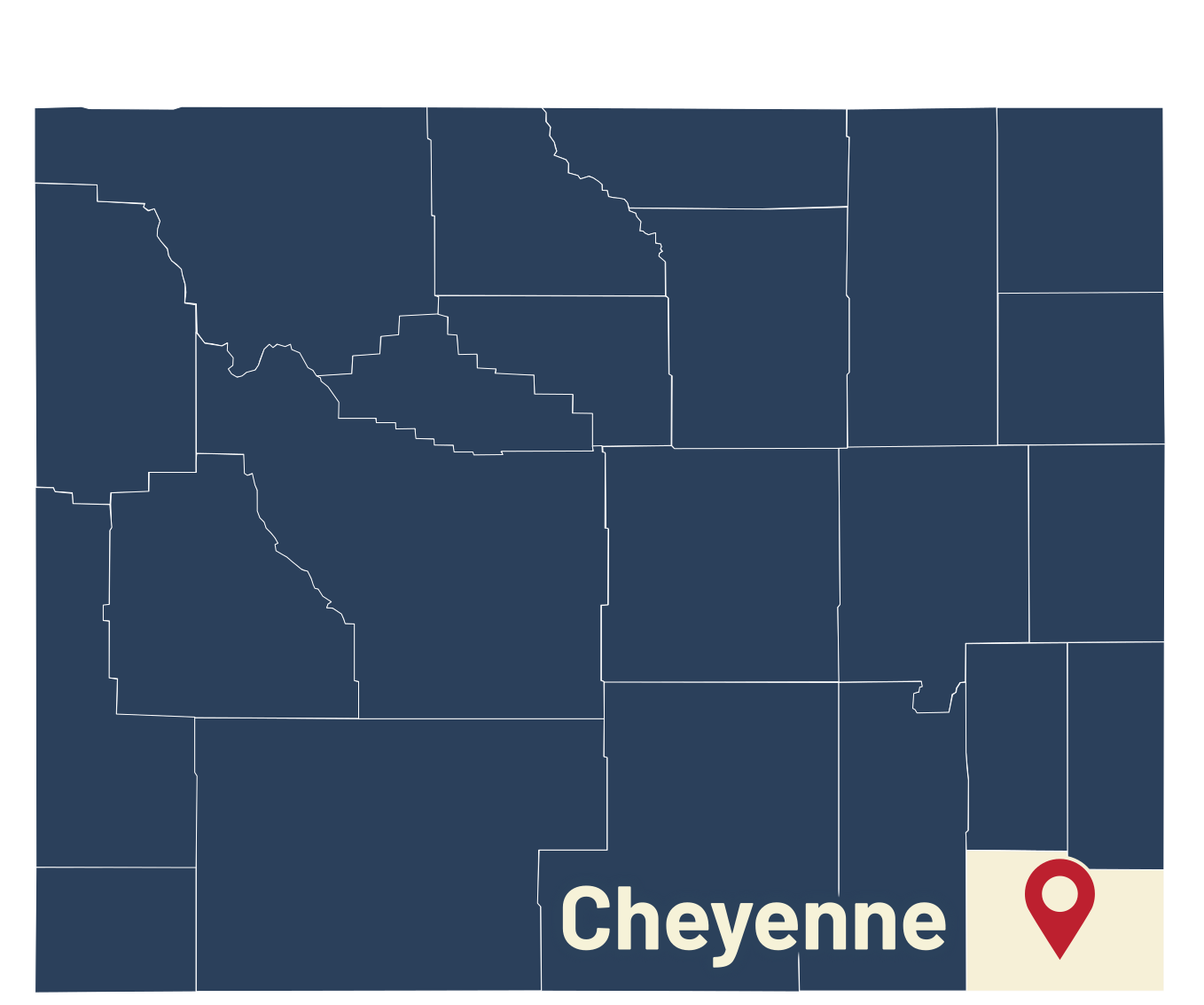
The race had been held in Casper since 2019, but this year it will be heading straight for Frontier Park, home to the iconic Cheyenne Frontier Days rodeo, the “Daddy of ‘em All.”
Jamie Howard, a board member for the Horse Nation Indian Relay Championship Council, told Cowboy State Daily the choice was such a no-brainer, organizers didn’t even look at any other location when they decided it was time to seek a larger venue.
“We had the idea that this would be a great place, and we eyeballed it for a long time,” he said. “At least the last five years or so. So, we kind of knew right where we wanted to go.”
Beyond its perfect, one-half mile track and the large grandstand for spectators, there’s also proximity to Colorado’s Front Range, I-25 and I-80.
“It’s just the perfect venue for us,” Howard said. “We can get this sport in front of a lot of people.”
Surging In Popularity
Indian Relay as a sport has been surging in popularity of late, and the Horse Nation Indian Relay has roughly doubled in size since it began, Howard said.
The reason for its popularity is the thrilling blend of danger and beauty, as well as incredible precision. It’s one of the most exciting sports to watch, Cheyenne Frontier Days CEO Tom Hirsig told Cowboy State Daily.
“Not very many events compare to Cheyenne Frontier Days rodeo with the fast pace and excitement of our rodeo,” he said. “This is one event that I will tell you is going to compare with what our rodeo is. If you can go, you will not be disappointed in the excitement of Indian Relay races.”
Hirsig added that those who would like to see what Indian Relay is all about will get a chance to see an accredited race during Cheyenne Frontier Days.
The championship, meanwhile, will be held Sept. 25-27, with daily performances beginning at 2 p.m.
Tickets for the championship races will go on sale April 1.
For a complete schedule, visit Horse Nation Indian Relay’s website.
The Race Is On
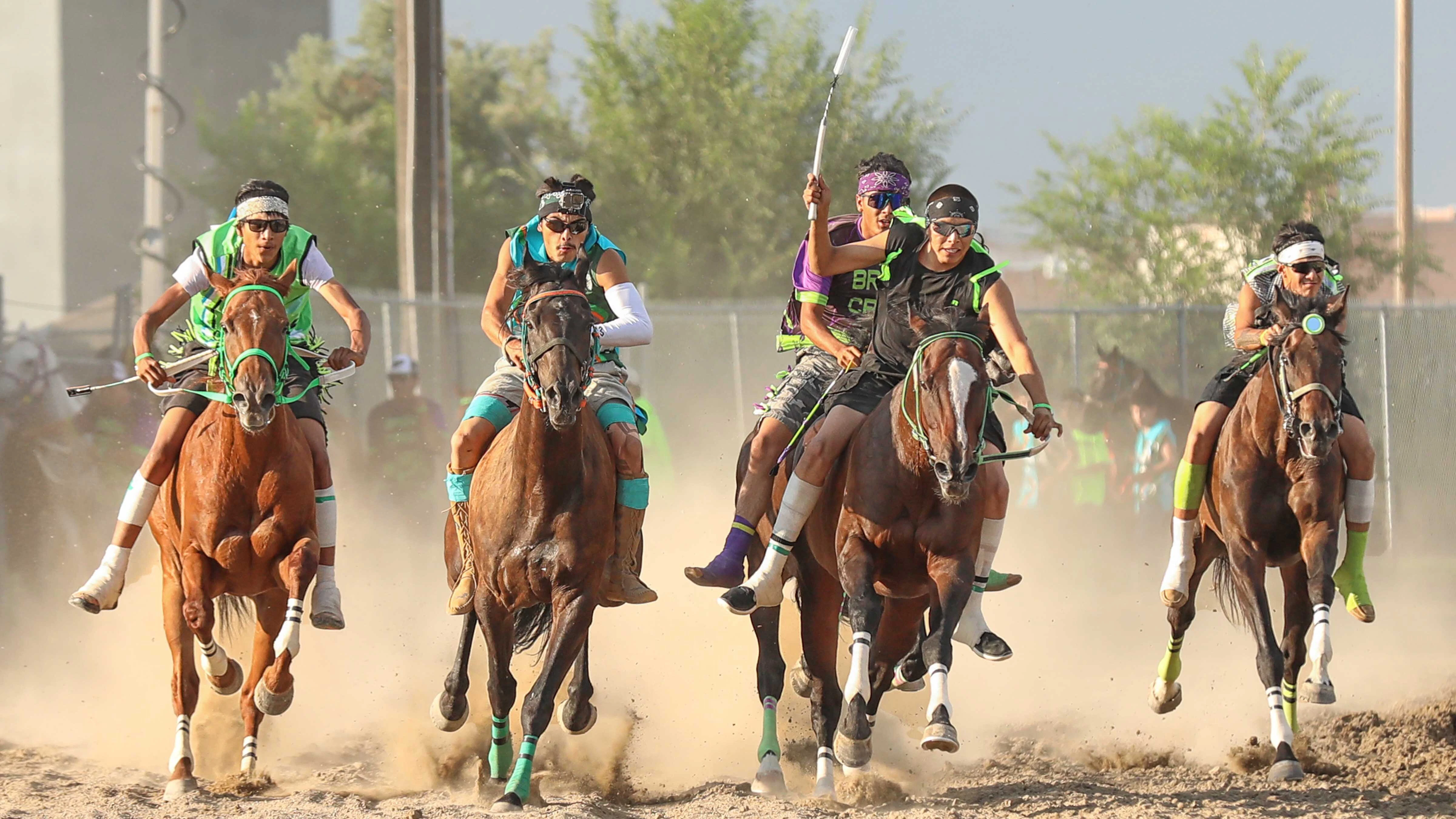
Each relay team has one rider, three horses, a pair of holders and a catcher, known as a "mugger.”
What the riders don’t have is a saddle or any other protective gear. They ride with no helmets, no boots, and no protective pads on a beast that weighs upwards of 1,200 pounds traveling at top speeds of up to 48 mph.
As the horses come into the box, they’ll begin to slow a little from their peak speed, but the rider on that horse isn’t waiting for it to stop. He’s already jumping down to the ground the instant the horse hits the box and then running and leaping onto the next horse.
“Bailing off a moving horse, taking a couple steps, and jumping on another one and taking off — when you see it orchestrated perfectly it’s very magical,” Howard said. “It’s like a classical concert.”
The moment the rider jumps off the horse, the “mugger” must catch and stop the speeding horse, or the team risks disqualification.
At the same time, the rider is already hopping onto a new horse, trusting and relying on his teammates to take care of stopping his previous ride, then taking off as fast as possible to continue the relay.
If it sounds chaotic, it can be. And it can be quite dangerous as well.
“We’re still dealing with an animal that has its own mind,” Howard said. “So things are not always perfect.”
America’s First Extreme Sport
With historical roots going back 300 to 400 years, Indian Relay is considered by many to be America’s first extreme sport.
That history can be tricky to explain, Horse Nation Indian Relay Championship President Calvin Ghost Bear told Cowboy State Daily.
“Each tribal nation has their own traditional horse games,” he said. “And they do go back hundreds of years.”
For Ghost Bear’s tribe, the Great Sioux Nation, traditional horse games channeled skills that the American Indian warriors needed.
“Some of the stories have been that we’ve had fresh horses and we exchanged and relayed fresh horses in battle,” he said. “With my tribal nation, we also had other traditional horse games.”
These included things like exchanging horses during a horse-stealing party, or a race that’s known as a warrior race, where one person holds a horse while another runs and mounts the horse to gallop off into battle.
“This is just from my Sioux perspective,” Ghost Bear added. “My history is different from the Crow or the Blackfeet. Each tribe utilized different versions of the Indian Relay for different purposes.”
Today’s Indian Relay draws on many traditions to weave together a new sport that is accessible to mainstream audiences so that America’s first extreme sport can be shared with non-native communities.
Renée Jean can be reached at renee@cowboystatedaily.com.