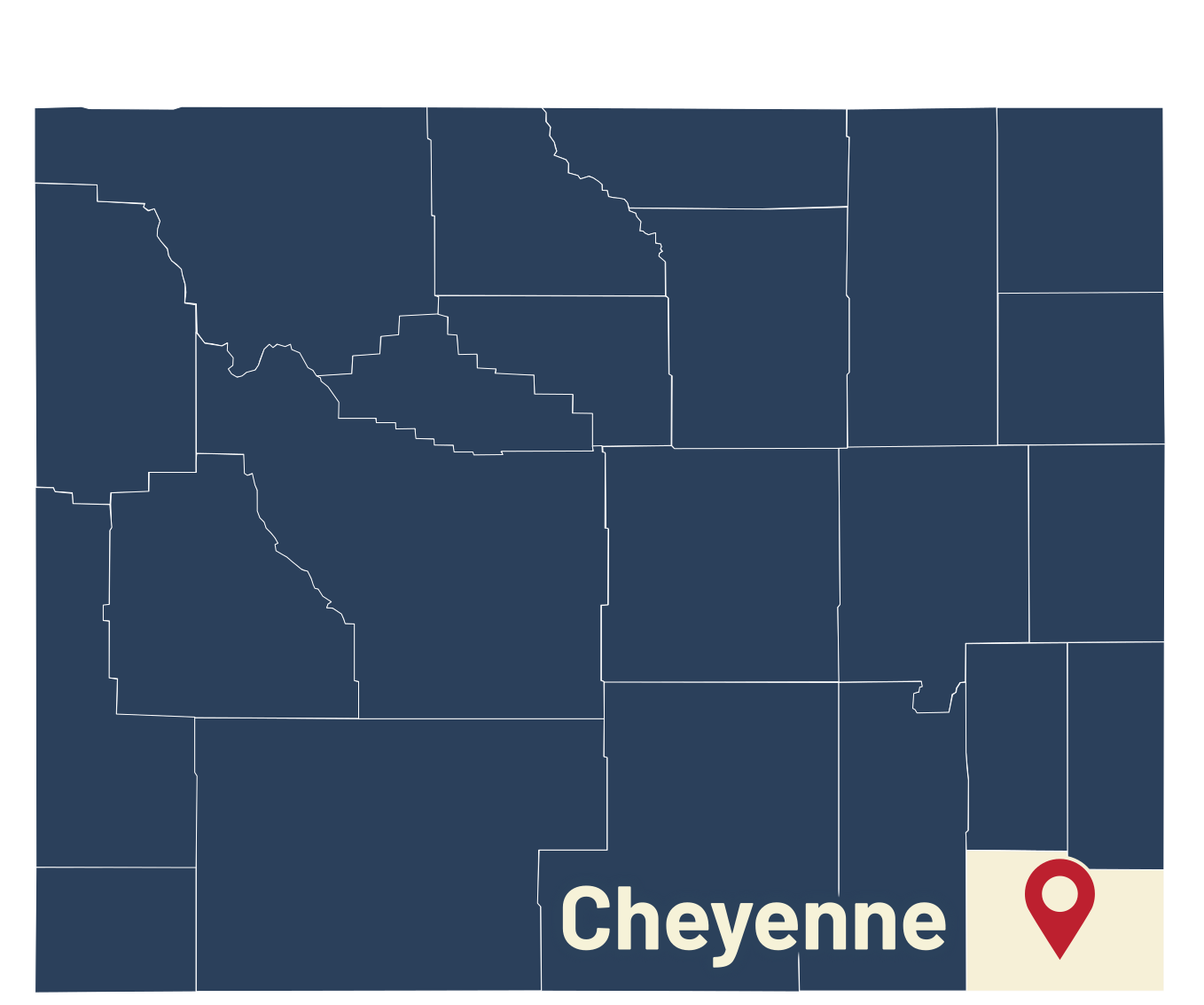
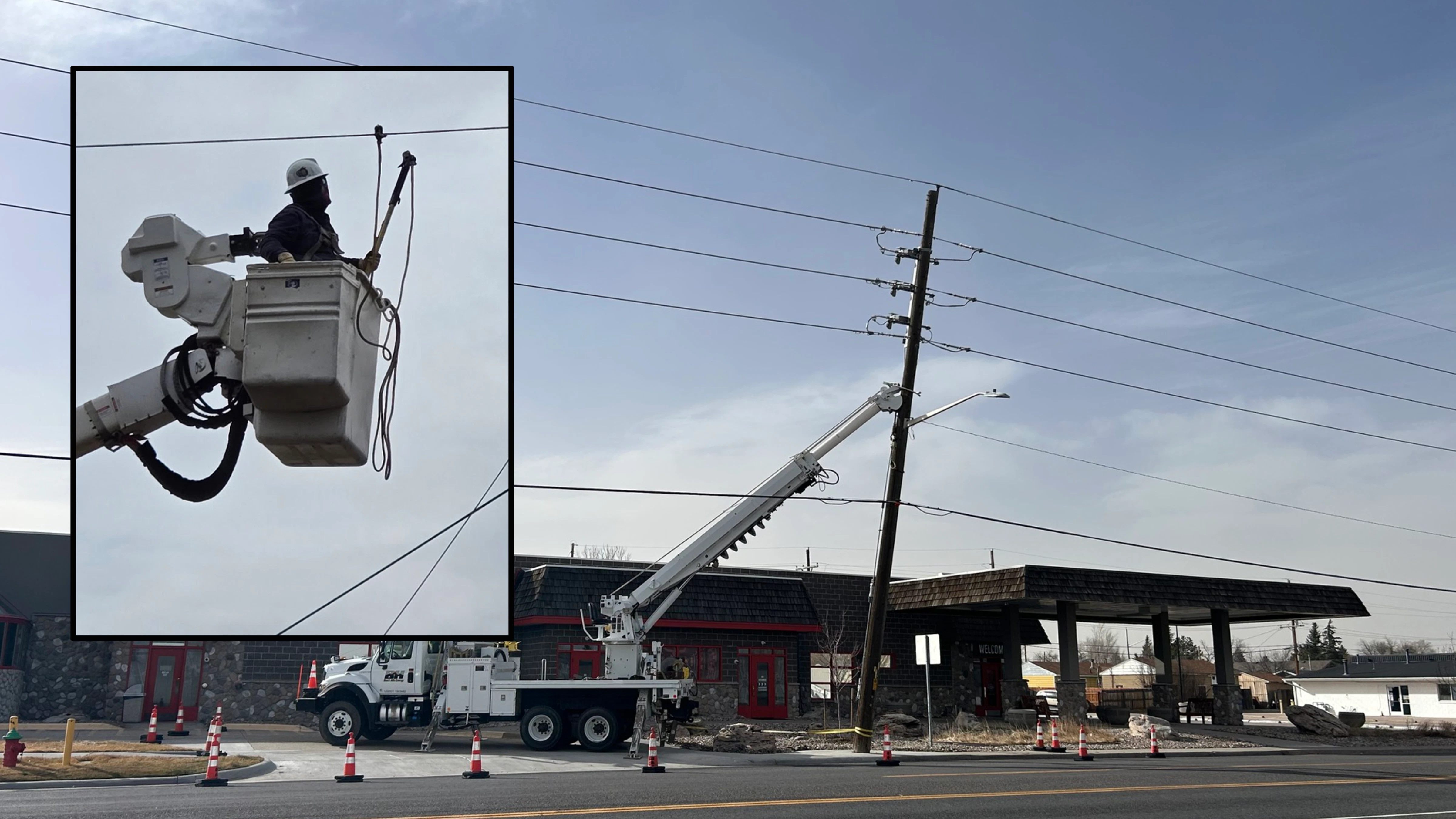
In the days after the March 12 windstorm that drove gusts to 92 mph at Cheyenne Regional Airport — the highest in 30 years of modern records — the streets of Wyoming’s capital filled with bucket trucks lifting linemen toward broken crossarms, digger derricks boring holes for new poles and chain saw crews sectioning large trees, their root systems ripped from the ground.
Black Hills Energy deployed its troublemen — specialized electric utility workers who act as first responders for power problems — and a variety of crews.
By late Friday morning, power was back for all but 460 of the 14,000 customers who went dark at the storm’s peak. Cheyenne responded with free meals, coffees and other thank yous.
Black Hills spokeswoman Laurie Farkas said the community response moved her crews.
“We were incredibly touched by more than 600 local interactions and hundreds of uplifting messages,” Farkas told Cowboy State Daily. “We see these messages and take them to heart. Additionally, we greatly appreciated the local businesses who took time to post offers of coffee and food to support our teams as they worked tirelessly. Cheyenne just has an incredible community spirit!”
The recent wind damage in Cheyenne is one of many incidents in a long history of Wyoming residents dealing with the wind. It brought specialized technology and highly trained crews into the streets.
It also joined a list of other wind events that have made headlines for as long as there have been newspapers in Wyoming.
Right Tools
Those trucks with the extendable arms and buckets for the linemen are known as cherry pickers, but linemen don’t call them that.
“We don’t use the term cherry picker,” said Michael Starner, executive director of outside line safety at the National Electrical Contractors Association. “We’ll use the term aerial lift or bucket truck.”
Those aerial lifts are just one piece of the fleet. A digger derrick is “kind of like a bucket truck, but it doesn’t have a bucket,” Starner told Cowboy State Daily. “It just has a boom. And a big drill or auger on the side.”
It digs the hole for a new pole, hoists the pole into place, and then crews tamp the dirt, plumb it and frame it with crossarms and hardware before hanging transformers and electrical equipment.
OSHA requires crews to stop handling materials aloft when wind exceeds 30 mph. Bucket truck manufacturers set their own limits around 25 mph.
“At some point it gets so windy that you have to get out of it,” Starner said. “You just can’t safely operate.”
When the bucket can’t go up, linemen turn to ground-based tools — the extendo stick, a telescoping fiberglass pole insulated against high voltage, and the shotgun stick with a retractable hook.
Linemen can hear the hook engage.
“It makes a clicking sound like a shotgun — shik, shik — like you’re loading a shotgun,” Starner said.
The first person on scene after a line goes down is typically a troubleman — a solo utility employee who responds to emergencies, makes the site safe and restores what he can with temporary repairs and switching.
“Those guys really are the rock stars of our trade,” Starner said.
Hard Hats
“I think anybody that works outside in the state experiences and knows Wyoming wind,” Tyler Lindholm told Cowboy State Daily, adding, “But when you’re a hundred foot off the ground, that’s a very different animal, and especially when you’re in a basket or you’re on hooks, that turns into a whole different scenario, which does take a lot of concentration, a lot of work, to be able to deal with.”
Lindholm, a former Wyoming state legislator and Navy veteran from Sundance, spent years as a substation electrician for Basin Electric Power Cooperative — “like being a lineman, but instead of three wires, you have a bunch more.”
He said Wyoming’s relentless wind is the hazard that defines the work — the thing every lineman in the state has to reckon with every time they climb.
Asked for a war story from his days with Basin Electric, Lindholm said, “I think probably the most common situation is sending your hard hat a hundred yards out in the distance.”
“No matter how tight you have that son of a gun cinched on, if you tilt your head just right in that wind, that hard hat is gone — well, gone with the wind,” he said.
Then comes the indignity: the ground crew chasing it while the worker up on the pole descends, because you cannot work at height bareheaded.
Lindholm turned serious about the March 12 storm: “Those Black Hills guys, they didn’t have a choice. They got to get after it because the reality is power’s out. And when power’s out during a storm, people’s lives are literally on the line.”
Storm Chasers
The scale of a disaster determines who shows up. Starner said utilities first use their own employees and in-house contractors, then activate mutual assistance networks, bartering for resources with neighboring utilities.
When that’s not enough, the storm chasers arrive — linemen and small contractors who follow extreme weather across the country, drawn by premium pay that can top $1,000 a day on 16-hour shifts.
“They’ll put an ad up on Facebook and say, ‘Hey, anybody want to work the storm, come talk to us,’” Starner said.
“Have patience,” he added, offering advice for the public about the linemen dealing with gusty winds and downed power lines. “They’re devoted to the mission. But it’s tough work and they have to be methodical about the way they do it.”
Wind Country
Of course, Wyoming’s wind woes are nothing new. Looking back, the state’s history reads like a catalog of challenges presented by moving air.
Train service into Casper ground to a halt in 1919, buried under wind-driven drifts 15 feet deep.
A hellacious gust toppled the 30-foot Christmas tree on the Cheyenne Statehouse lawn in 1956, right outside the governor’s office.
Freezing rain around Lusk in 1963 coated power lines with ice, and the wind that followed snapped poles “as though they were toothpicks,” according to the Lusk Herald.
Crews from the Niobrara Electric Association worked Saturday and Sunday night until they were exhausted.
A decade later, the Carson and Barnes Circus rolled into Douglas and had to postpone its matinee because the wind wouldn’t let the crew raise the tent.
Then in 2017, after wind toppled 17 steel transmission poles near Teton Village and blacked out 4,000 customers, Lower Valley Energy President Jim Webb told county commissioners it was the worst disaster in the utility’s 80-year history.
Nine years later, Cheyenne broke its own records. The troublemen showed up both times.
David Madison can be reached at david@cowboystatedaily.com.