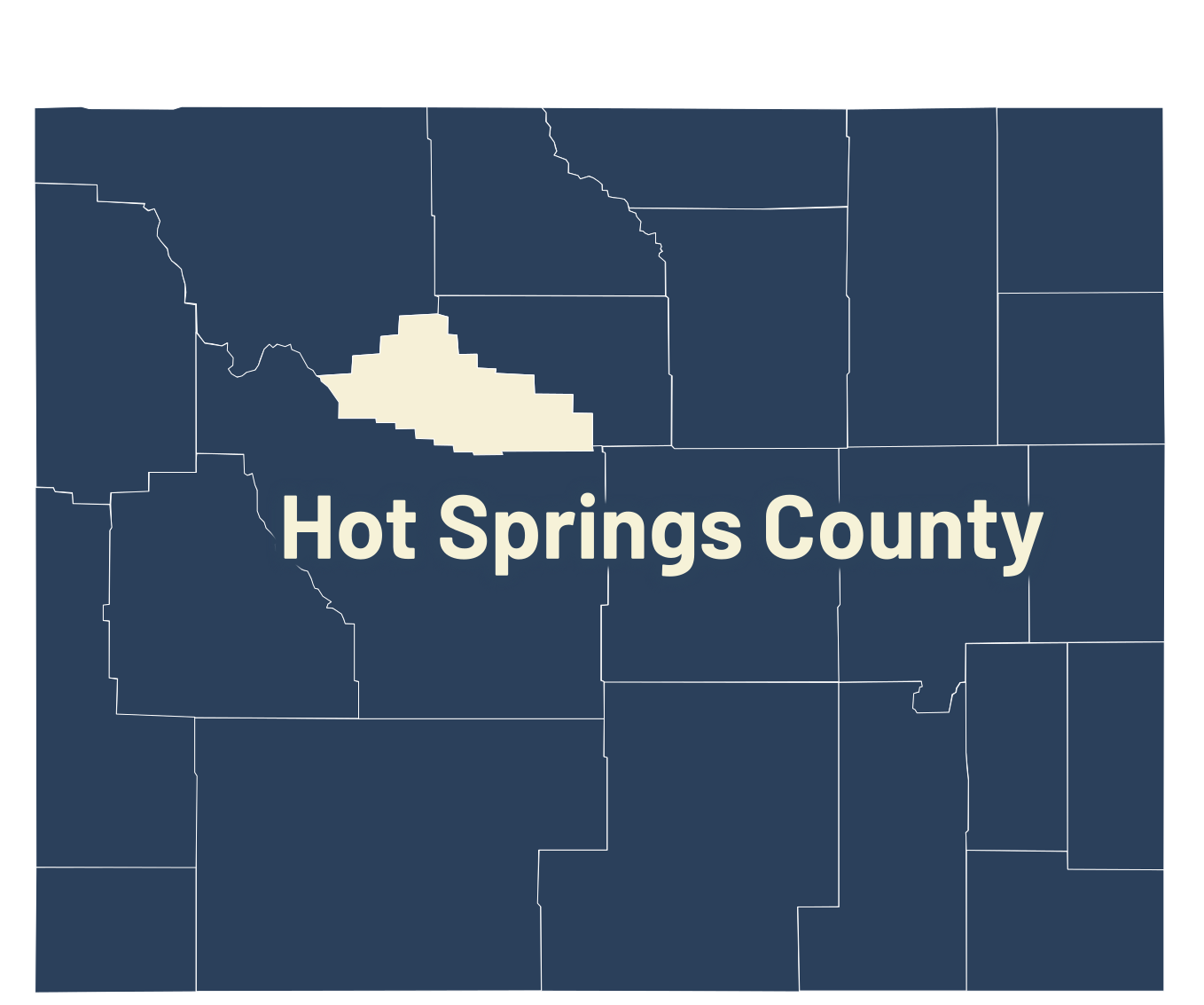
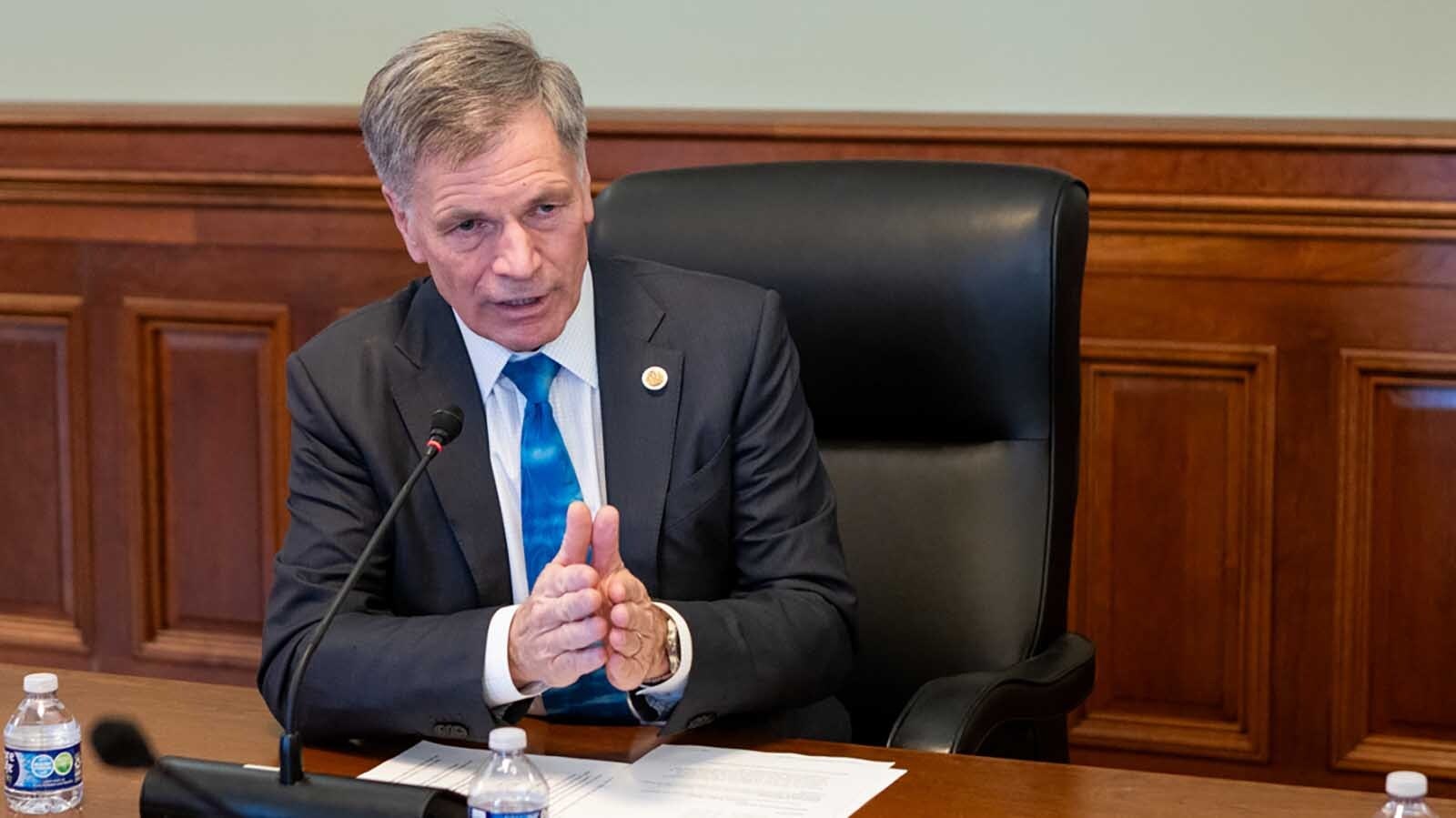
Wyoming’s governor is declining to recommend two of Hot Springs County’s three commissioners for removal from office, despite seven locals asking him to do so in October.
That’s because, while Gov. Mark Gordon expressed disagreement with the actions of Hot Springs County Commissioners Bob Aguiar and Paul Galovich, those actions don’t rise to the level of misconduct or malfeasance needed to remove elected county officials, says a decision letter Gordon issued Friday afternoon.
The dispute revolves around the five-year, intense debate over whether Hot Springs County should have allowed a local couple to secure the commercial zoning designation their Tipi campground needed to operate.
Gordon, as he has in three earlier decision letters regarding complaints calling for him to push to remove county officials from office, also emphasized his unwillingness to deny the will of the local electorate by removing people they’ve chosen.
A Little Background
Michael and Michelle Stevens sought for years to gain a county permit to host paying guests at their business the Tipi Retreat, which sits on their family’s property in rural Hot Springs County.
The county commission of 2021 denied their request, and the Stevenses challenged that denial in 2022.
District Court Judge Bill Simpson ordered the county to produce reasons for its denial, and the county commissioners of the time — Tom Ryan, Jack Baird, and Phillip Scheel — gave several reasons, in 2023.
One of those withstood legal scrutiny, Simpson ruled.
Simpson upheld the board’s denial, rendering the campground unlawful. A trial followed, and the Stevens couple was ordered to pay $40,250 within 18 months of November 2024, court documents say.
The fine was a penalty for the Tipi retreat staying open during the court case.
Michael Stevens told Cowboy State Daily in October that they chose to keep operating because the county was vague and ambiguous about its reasons for denying them the authority to operate.
Gordon noted in his decision letter, “as an aside, that the Stevens’ apparent disregard for the permissions that would have been granted in a permit was not lost on other businesses in the county.”
The Stevenses later appealed the decision.
The court case is ongoing, Galovich told Cowboy State Daily.
Then Came Elections
Galovich and Aguiar were elected in 2022 and 2024, respectively.
By January and February 2025, the new commissioners were arranging a “rehearing” for the Stevens couple, which culminated in the county settling with the Tipi retreat.
The last remaining commissioner from the prior administration, Ryan, warned them that that would be illegal – and it would be better for the Tipi Retreat’s owners to restart the permit application process from its beginning, court documents say.
The rehearing happened in February anyway. As a result, the county settled with the Tipi Retreat: the Stevenses would no longer have to pay the fine, and the tipi retreat could run a commercial operation. Both the county and the Stevenses would withdraw their claims before the Wyoming Supreme Court.
The retreat’s neighbors, Marty Oravec and Gary Frazier, asked Simpson to overturn the settlement and its underpinning maneuvers – and Simpson did, in a July 30, 2025, order. He kept the $40,250 fine in place.
The Governor’s Take
Rather than allow recall elections for county officials, Wyoming law has governor’s investigations.
County electors or county commissioners can summon the governor to investigate one or more of that county’s elected officials. If the governor finds after his investigation that the officials acted with misconduct or malfeasance – terms bearing a high legal standard in Gordon’s reading of the 1926 case addressing this – then the governor can ask the Wyoming Attorney General to remove those officials.
The AG then would, if proper, pursue removal in a civil court case.
Aguiar and Galovich didn’t show misconduct or malfeasance, but they exhibited “manifest disregard for established process and (bore an) air of personal prejudice” by settling with the Stevenses outside of the court process, the governor concluded.
He declined Friday to advance this case to the attorney general.
The people who submitted complaints against Galovich and Aguiar said the Commission’s Feb. 4, 2025, rehearing of the Stevenses’ petition was conducted in a biased manner, and that the Stevenses were given a second chance to run their resort without the county providing the required written notice to residents.
The commissioners consulted outside attorneys on the matter, the complainants also noted.
The complainants alleged a broader pattern of misconduct, pointing to Galovich’s friendship with the Stevenses, and claiming Aguiar and Galovich manipulated board appointments to stack the Land Use Planning Commission with “allies,” and interfered with other projects.
Gordon emphasized that Ryan, the county planner, and the Land Use Planning Commission all had warned Galovich and Aguiar against allowing the Tipi Retreat application to have another commission vote, rather than making the Stevenses file a new petition.
Ryan recused himself from the vote on whether to reopen the application.
“Even worse,” wrote Gordon, “the County Attorney recused herself from the proceeding, and Commissioners Galovich and Aguiar continued to rehear the Tipi Retreat application without seeking alternative legal representation for the Board.”
Gordon called Hot Springs County Attorney Jill Logan’s decision to recuse herself “complicating.”
Logan did not immediately respond to a late-day email request for comment.
Galovich
Galovich gave Gordon an interview, and Aguiar did not, says the governor’s letter.
Gordon wrote that Galovich appears to believe he could re-hear the Tipi petition since the court case had been appealed and was still open.
Galovich in his interview with the governor emphasized his belief in property rights and his belief that the earlier Hot Springs County Commission had cheated the Stevens pair a fair chance to be heard on switching their land to commercial.
He reiterated those points in a Friday interview with Cowboy State Daily.
“In the constitutional form of government we live under, you have the opportunity to be re-heard: by higher courts, by others,” he said. “They were never given that opportunity to be re-heard.”
While Gordon had said Galovich’s vote to rehear the Stevenses’ application bypassed the Land Use Planning Commission, Galovich said it wasn’t that simple.
The Land Use Planning Commission has changed the rules since the couple filed their original application. Galovich said he wanted the couple to have a fair hearing from the Commission under the old rules, since according to him, they never had that.
By example, said Galovich, the Stevens family had a study performed on whether their road could handle the traffic surge. The road’s potential has been a crux of dispute among the neighbors.
Galovich said the earlier commission didn’t give the couple a fair chance to present their evidence.
“So why would they not have the opportunity to present evidence that would have justified the (county’s) original concerns (supporting) denial?” asked Galovich.
Also, he said, the Land Use Planning Commission had approved the Stevenses’ original application, while the earlier commission had denied it.
Galovich said he disagrees with the government being involved in this area, and said the Stevens family should have been able to run their home business on their land – and if the neighbors didn’t like it, the neighbors could sue.
“My motivation was to try to bring resolve to this issue so we could go on as a county,” said Galovich. “So the county could heal, the county could overcome the divisiveness.”
Here’s how Gordon put the conflict:
“It is clear that Commissioner Galovich believes the (commission) infringed the Stevens’ private property rights by denying their application in 2021. It is also clear that he thought his primary duty as a Commissioner was to rectify this wrong and provide ‘remedy’ to the Stevens(es).”
Gordon said he respects that Galovich is a “passionate and principled man” but believes “his passions and principles clouded his judgment.”
Gordon said he’s “profoundly dismayed” by what he called Galovich and Aguiar’s “manifest disregard for established process and the air of personal prejudice displayed in bypassing the (Land Use Planning Commission) despite the continued warnings by colleagues and staff.”
Aguiar
Aguiar had declined to give Gordon an interview, which the governor met with some frustration.
Aguiar sent the governor a statement through his attorney instead, saying he was “made blind” by Logan refusing to participate in three key Commission meetings.
“Commissioner Aguiar’s unwillingness to speak with me and his decision to blame others forces me to consider this matter in a vacuum,” wrote the governor. “Commissioner Aguiar’s silence and his attempt to blame Ms. Logan for the actions that he took as a county commissioner appear to me to be an admission of wrongdoing.”
Conversely, Aguiar told Cowboy State Daily in a Friday interview that, after speaking with outside legal counsel, he understood the Stevens’ application that was pending in court to be “open” and fair matter for a re-hearing.
He voiced more consternation over Logan recusing herself from key matters.
“So we set up a public meeting… where people came in, could voice their opinion; bring in any data,” said Aguiar. “We really, honestly didn’t think we were stepping on Judge Simpson’s toes.”
The purpose of Aguiar and Galovich’s settlement vote was to bring the land use matter to a close, considering the county could pay more than $40,000 in legal costs by pursuing the Wyoming Supreme Court appeal, said Aguiar.
By forgiving the Stevenses’ fine, they hoped to avert that, he said.
“We thought (the judge) would understand that, since it was still open, we’d give them an opportunity for remedy,” said Aguiar, adding he has “no disregard” for Simpson.
Aguiar said, “I think we did the right thing – but I don’t think we did it the right way… But we received zero advice from our county attorney.”
Retaliation
Aguiar told Cowboy State Daily he believes Scheel, one of the signers of the removal complaint, filed against him because Aguiar defeated Scheel in the 2024 primary election and Scheel wants his seat back.
Scheel said that’s not true.
“Absolutely not,” said Scheel in his Friday interview with Cowboy State Daily. “The reason I was a complainant in this situation was not because I lost the election to Bob recently, but because I care for Hot Springs County and the rule of law.”
Aguiar also said Scheel was backing a petition effort to increase the Commission from three officials to five – so that Scheel could rejoin the commission.
Scheel said he’d signed the petition but didn’t feel strongly about the topic, and still has doubts about whether expanding the commission is a good idea.
Scheel voiced disappointment in the governor’s decision.
“I’m disappointed, not in the governor but that his conclusions didn’t lead him to instruct the AG to remove,” he said. “Obviously I was one of the complainants, and, not that I can speak for all of them, but obviously we felt their actions did rise to the level of malfeasance.”
Some Conclusions
Gordon wrote that the complainants portrayed Galovich and Aguiar as having improper motives and even financial interest in the outcome of the land use dispute, “but those allegations appear to be based on unproven assumptions.”
The governor said he didn’t see any apparent evidence of actual bias, financial benefit, or other conflict in his investigation.
It’s a small-town issue, wrote the governor.
“Board members are often called upon to make decisions on matters involving or affecting people they know particularly in smaller communities where individuals are more closely connected,” he wrote.
In other instances where people ask the governor to investigate a county official, that may be their only recourse. But the issue with the Hot Springs County Commission could have gone to a court via administrative appeal, he noted.
He also said Galovich and Aguiar don’t appear to perpetuate a pattern of abuse. This controversy is “just one action on a discrete issue,” the governor added.
Gordon concluded his letter with his now-usual call for people to honor the control and wishes of the local electorate, by not supplanting the voices of the many voters with the few.
Clair McFarland can be reached at clair@cowboystatedaily.com.