Gillette police investigated and found multiple instances of cheese slices left on vehicles parked outside of homes. There was no damage from the cheese.
In Gillette, cars get “cheesed.”
That means someone — or perhaps an organized team of cheese-wielding commandos — crept through a neighborhood under cover of darkness and methodically covered parked vehicles with slices of what appeared to be processed American cheese.
Gillette police have fielded multiple reports over the years, most recently in 2023 when officers found cheesed cars on Ohara, Oshannon and Henry drives in a single afternoon.
A similar incident was reported in February 2022, when a man found cheese all over his Honda on Harder Drive. Temperatures were well below zero at the time, making cleanup more difficult.
Nobody has been caught, and people are still laughing about it.
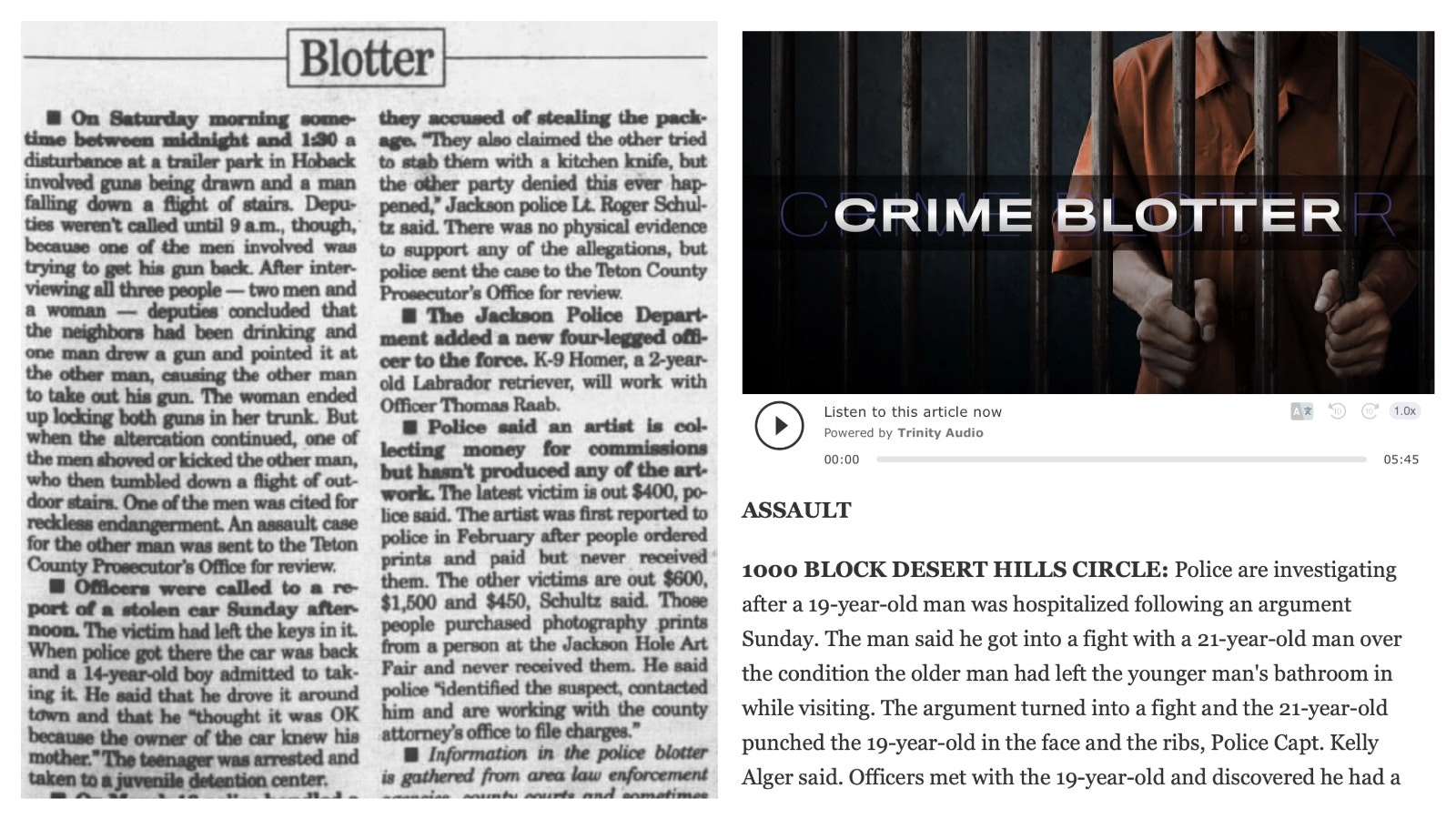
These are the stories that once made police blotters the most-read section of small-town newspapers — the “second front page,” as one Wyoming editor called it.
But with the rise of social media and the ease of online searches that turn up old dirt on private people, newspapers across the country are reconsidering the police blotter.
On March 1, the Wyoming Tribune Eagle in Cheyenne stopped publishing its crime blotter entirely, joining a growing movement that has newspaper editors asking whether the laughs are worth the potential for lasting damage.
A woman charged with forgery in Campbell County said Kevin Costner assured her it would be OK.
Blotter’s End
The Tribune Eagle, one of Wyoming’s oldest newspapers with a daily print circulation of about 4,000, announced the change in a Feb. 14 column signed by crime and safety reporter Ivy Secrest and Managing Editor Brian Martin.
“In an effort to minimize harm and produce more in-depth journalism, the Wyoming Tribune Eagle has adopted several new policies for crime and public safety coverage, including ceasing to produce the Police Blotter,” the column stated.
The paper explained that booking sheets from the Laramie County Sheriff’s Office — the blotter’s source material — are frequently incomplete and sometimes contain misspelled names, inaccurate arrest times and, in a handful of cases, wrong charges.
The Tribune Eagle declined to speak directly with Cowboy State Daily. But in an interview that appeared in Editor & Publisher magazine, Secrest said the paper had already seen the consequences of publishing unchecked booking data.
“This week we had a man call us and tell us that his booking sheet incorrectly designated his charge as a felony and our publishing of that, prior to this policy, caused him to lose his job,” Secrest said. “It felt like a good reminder of why we did this.”
The Tribune Eagle's parent company, Adams MultiMedia, published a formal policy document laying out the reasoning.
The policy states that blotters “are also not followed up with a compiled list of arraignments, trial results or sentencings, and thus do not fairly indicate whether or not the subject was convicted of the crime they were arrested for.”
“Publishing that information before an individual has undergone the legal process can cause undue harm, leading to lifelong consequences, such as impacting employment or social status,” the Adams MultiMedia policy states.
The document also notes that the Tribune Eagle had previously offered to remove people from the blotter if they provided documentation that charges were dismissed, “but this does not stop the initial impact of publishing the arrest information.”
Previously published blotters will remain on the website, though the paper will remove links to them from its home page.
The decision came after the Tribune Eagle’s staff participated in a roughly nine-month course with the Poynter Institute called “Transforming Crime Coverage,” which encouraged newsrooms to shift from sensationalized crime reporting to public safety journalism.
Few readers have complained, according to the paper.
“Now that it’s gone it doesn’t seem to be missed,” noted Secrest.
And if someone’s car gets cheesed?
The “E&P” article pointed out, “Reporters can always write that up as a short story. You don’t need a police blotter to report on that.”
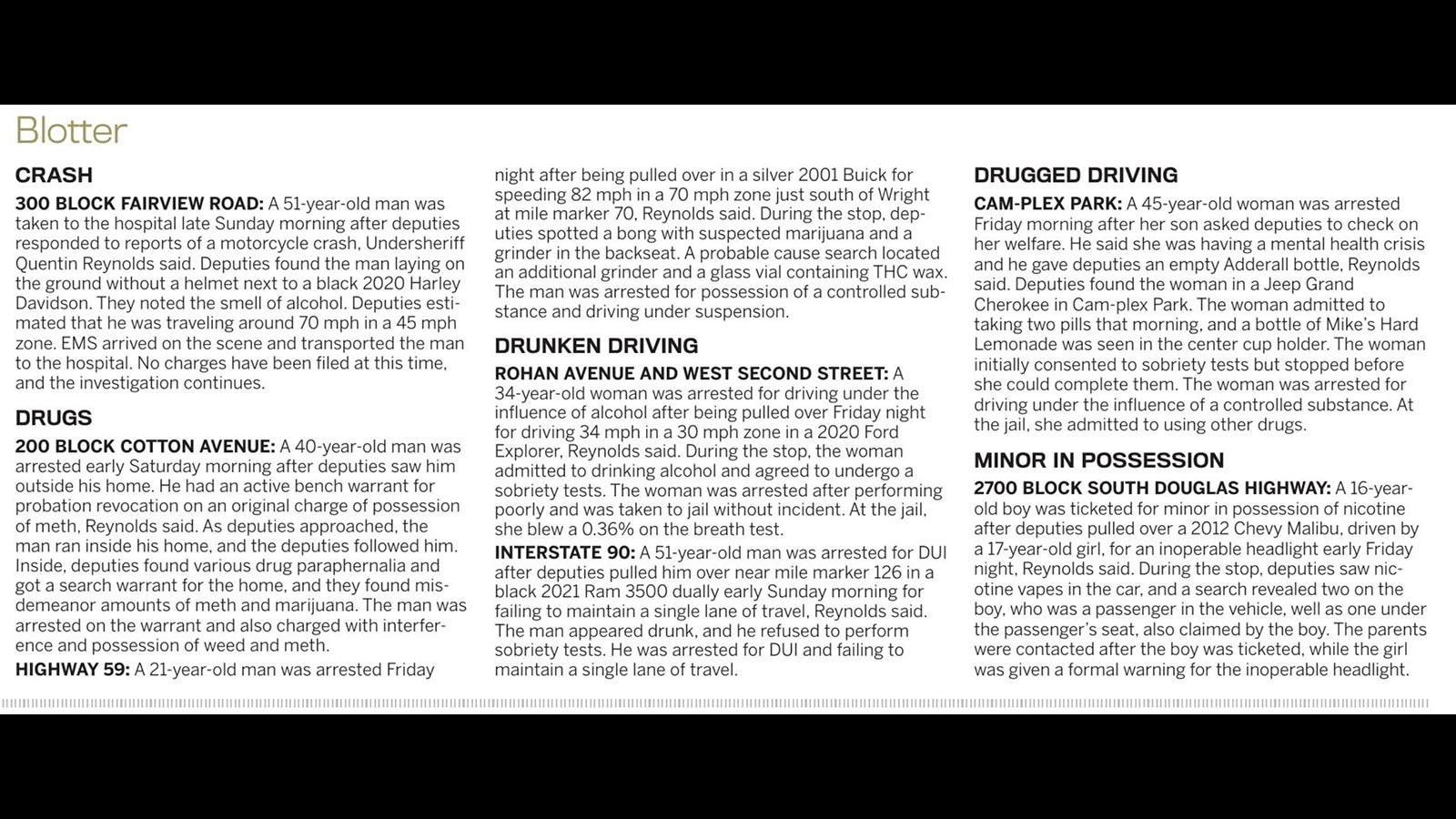
A man in the 700 block of Mountain View complained because his girlfriend’s husband keeps stopping by.
Lost Juice
The Tribune Eagle isn’t alone.
Its sister paper, the Bozeman Daily Chronicle in Montana — both are owned by Adams MultiMedia — quietly stopped publishing police reports in recent months as well.
“The Police Reports just haven’t had the juice they once did,” Chronicle Editor-in-Chief Jeff Welsch told Cowboy State Daily in an email.
Welsch said the Chronicle’s decision was driven partly by staffing losses and partly by a reduction in source material from the Gallatin County Sheriff’s Office, which was dealing with its own lack of staffing.
“Where once their daily log might have 100 or so entries, it was reduced to less than 10,” Welsch said.
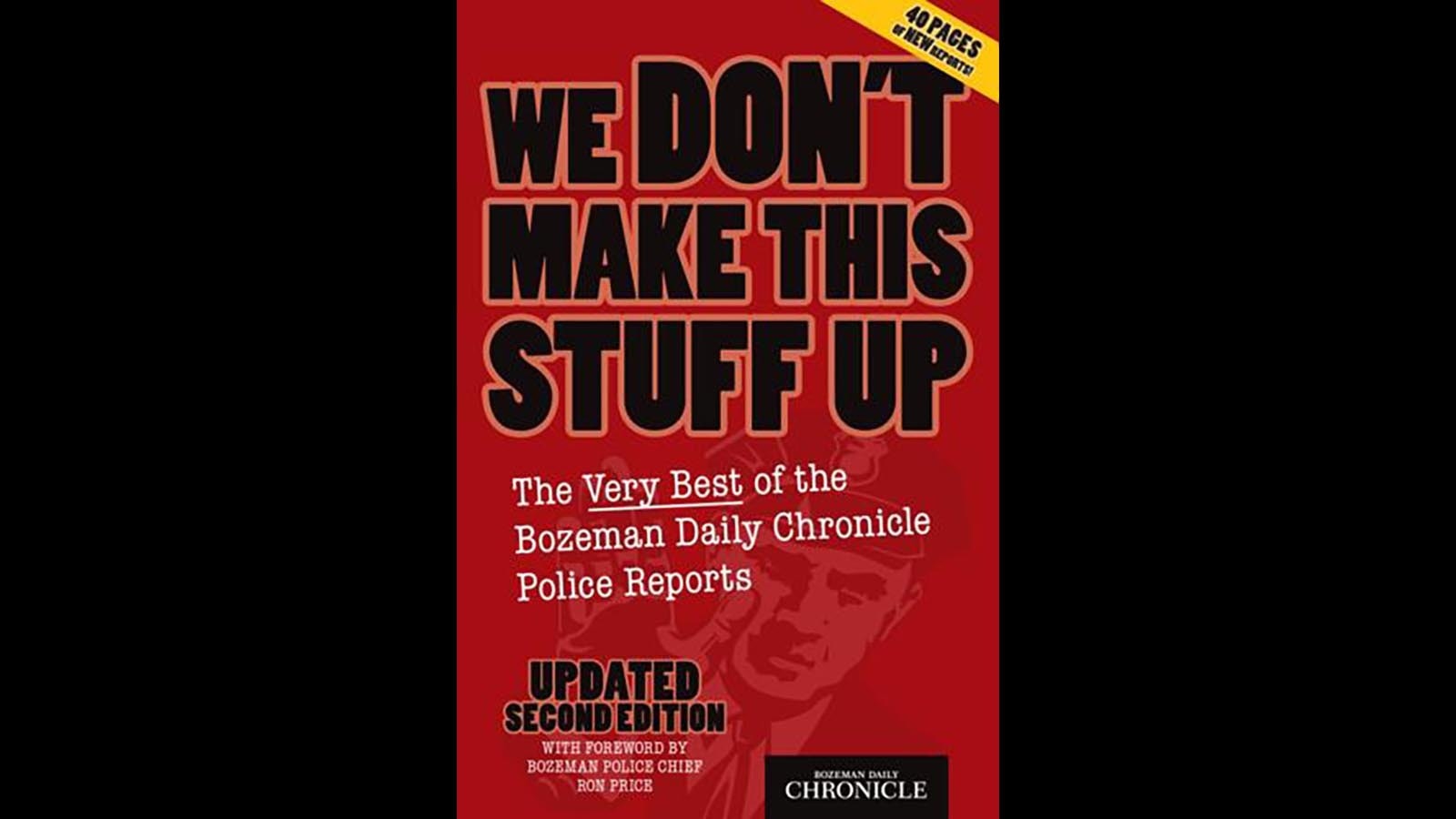
The Chronicle’s blotter was once so popular that the paper published a book titled “We Don’t Make This Stuff Up,” a compilation of the blotter’s greatest hits dating back to the late 1970s when the Chronicle first began publishing daily police reports.
The book, now in its second edition with 40 pages of new content, is advertised with entries like these:
“A group of women flagged down an officer at 1:55 a.m. because a newlywed in the group had to cross ‘flirt with a cop’ off of her bucket list. She was warned.”
“Several people were arguing over horses being tied up to a bike rack outside a bar on Main Street.”
“A man wanted to speak to an officer regarding laws about marrying cousins and family members. He said he is having trouble meeting women.”
The Chronicle even produced a desktop, flip-up calendar in 2018 featuring favorite entries. A few copies of the book still gather dust at the Chronicle’s offices.
“It feels as though these have run their course,” Welsch said. “Interestingly, since we stopped publishing Police Reports we’ve had a tiny handful of complaints — a half-dozen at most. Readership was tepid.”
The blotter also created an editorial tightrope for the Chronicle’s staff.
“One other challenge we addressed in an editor’s note was that half the readership was upset if these weren’t cute enough and the other half was upset that we were too cute about something so serious. (Bozeman Police and the Sheriff’s Office were in the latter camp — more understanding than upset),” wrote Welsch.
Many of the Chronicle’s most memorable entries involved wildlife, Welsch recalled: “A man thought a bobcat was under his Magenta Road porch. Also, his cat was missing, which he thought could be related.”
A man showed up to Papa Murphy’s in Gillette looking for a fight, threw cheese, then left.
Second Page
Given the steady stream of reports about ridiculous tourist behavior and serious crimes that interest its readers, the Cody Enterprise has no plans to ditch its blotter.
Victoria O’Brien, the Enterprise’s editor, said she understands the Tribune Eagle’s reasoning but isn’t ready to follow suit.
“We don’t currently have any intention of doing away with the blotter,” O’Brien told Cowboy State Daily.
O’Brien’s newsroom is tiny — just her and two writers, one of whom only covers sports. She said the kind of sensitive, in-depth courts and justice reporting that would replace a blotter requires manpower she doesn’t have.
“Having a designated courts, justice and government reporter is a huge ask for us,” O’Brien said. “I would love to have that, but just right now, physically, the manpower that it would require for me to do sensitive in-depth reporting on that — I don’t have that in my newsroom right now.”
The Enterprise still publishes the full names of those arrested.
O’Brien acknowledged that the blotter’s heyday may have passed, attributing some of the decline to social media.
“It’s a whole lot easier to find out if somebody’s been naughty when you have Cody Classifieds or Instagram or anything else where things kind of catch fire and go around really quickly — naming and shaming,” O’Brien said, referring to a popular Facebook group where the Cody community buys, sells and gossips about everything from state championships to neighborhood disputes.
Some of those platforms now allow anonymous posting, O’Brien noted, which can be weaponized in ways a straightforward blotter never was.
O’Brien said she’s heard from readers that the blotter isn’t as entertaining as it once was.
“I recently had a reader say something to me to the effect of, ‘Well, they used to be funny,’” O’Brien said. “And I said, ‘Well, if we get the blotter and the blotter’s not funny, we can’t make it funny. I’m sorry to disappoint you, but I only write what I get.’”
She recalled an early experience in her career when she tried slipping a “Who Let the Dogs Out” song reference into a blotter entry about a loose-dog call. Her editor at the time wasn’t amused.
A paramedic once asked O’Brien if she could make the blotter funnier, because between stressful calls, the EMTs turned to the blotter for laughs.
O’Brien said she understands the limits of humor when an account of someone’s low point winds up in print.
“Everybody loves a little bit of water cooler gossip,” O’Brien said. “But depending on what the situation is, it might be somebody’s worst day. I don’t want to make a joke about that.”
A former editor once told her the blotter was “the second front page.”
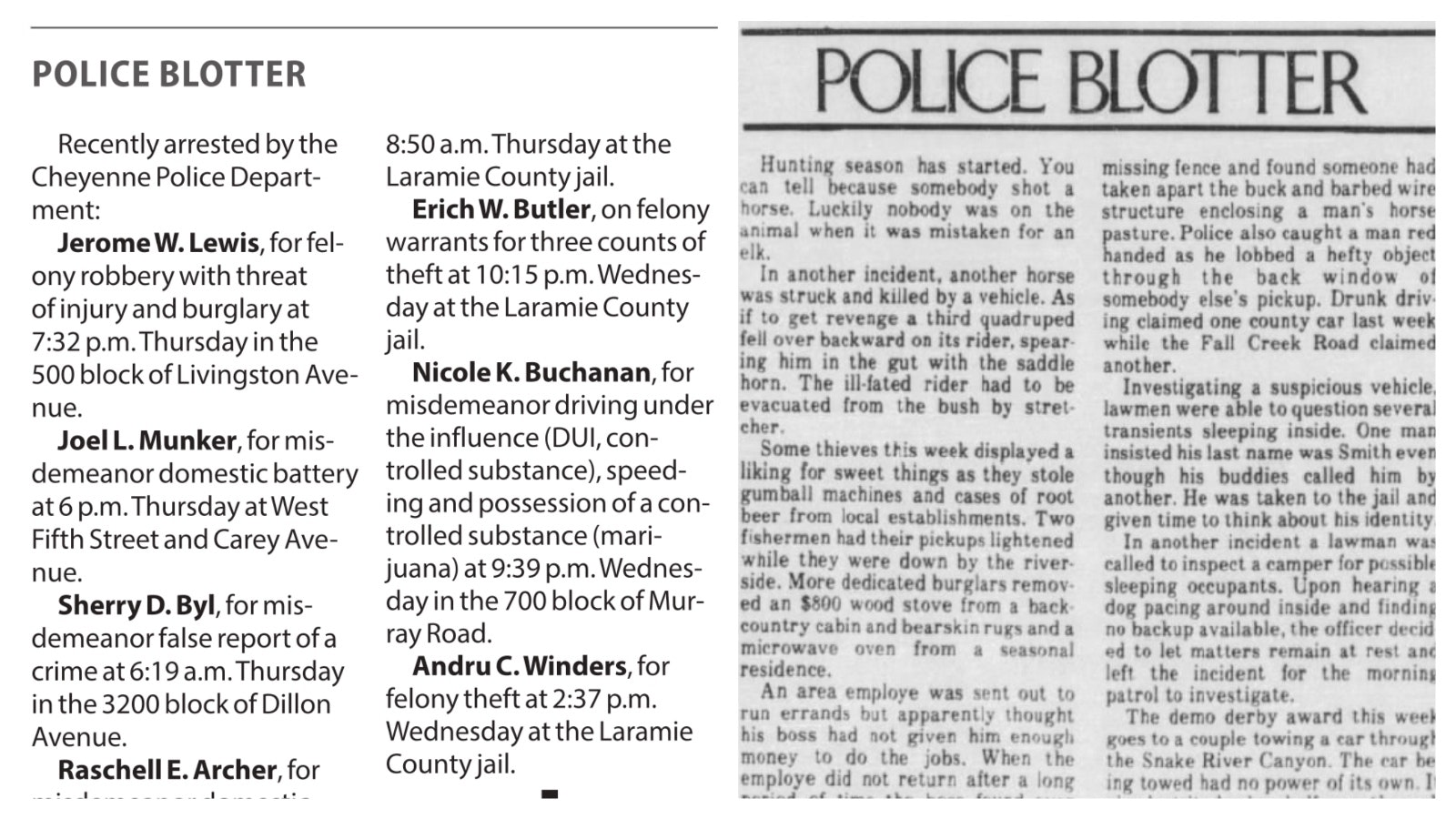
That likely rings true for some readers, especially when last summer, Cody’s mayor appeared in the blotter like this: “Lee Ann Reiter, DUI: 1st offense within 10 years.”
“I’ve heard teachers say that after they read the front-page stories, they flip to the blotter because they want to see if any of their kids who might be from troubled homes — if one of their parents got arrested,” O’Brien said.
Her favorite recent entry? A dispatcher who broke protocol to use all caps.
“The reporting party said that there are — all caps — A LOT of horses on the road,” O’Brien said. “They very rarely do that. Usually our dispatch is very straight, very dry, very clinical. For them to use all caps for emphasis, I just couldn’t help but wonder what that conversation was like.”
A man reported that his neighbor’s cat had turned a stereo on “really loud” while the neighbor was out of town.
Clean Slate
O’Brien said the conversation about blotters is part of a broader reckoning in the industry about the lasting digital footprint of crime coverage — what some call “the right to be forgotten.”
A January 2025 article in The Guardian documented a growing wave of American newspapers that are deleting or de-indexing old crime stories from their online archives, giving subjects a fresh start years after they’ve served their time.
The movement was pioneered in 2018 by Chris Quinn, editor of Cleveland.comand the Plain Dealer. As The Guardian reported, Quinn had grown tired of fielding calls from people whose minor past offenses had become the first result in any Google search of their names.
The concept has since spread to the Boston Globe, the Atlanta Journal-Constitution and The Oregonian.
O’Brien said the Cody Enterprise isn’t ready to tackle delisting yet but called it “a really interesting conversation that’s happening in the industry right now.”
“I’m open to changing as our newsroom grows,” O’Brien said.
She framed the tension simply: “It’s a matter of discretion, newsworthiness — what incidents are minor infractions? What incidents should live on in the public memory and the public consciousness? And how you define those.”
The Adams MultiMedia policy echoes this concern, stating that the Tribune Eagle is “committed to reporting that encourages a fair and just system for all, starting with our own role in it.”
As a recent Cody Enterprise blotter reports: A silver Volvo sedan was driving erratically on Highway 120 North near Cody — “all over the road, drove off the road twice while on 911, southbound towards Cody, varying speeds, driving into oncoming traffic.”
The driver pulled over and it turned out they were “not impaired, just elderly.”
David Madison can be reached at david@cowboystatedaily.com.