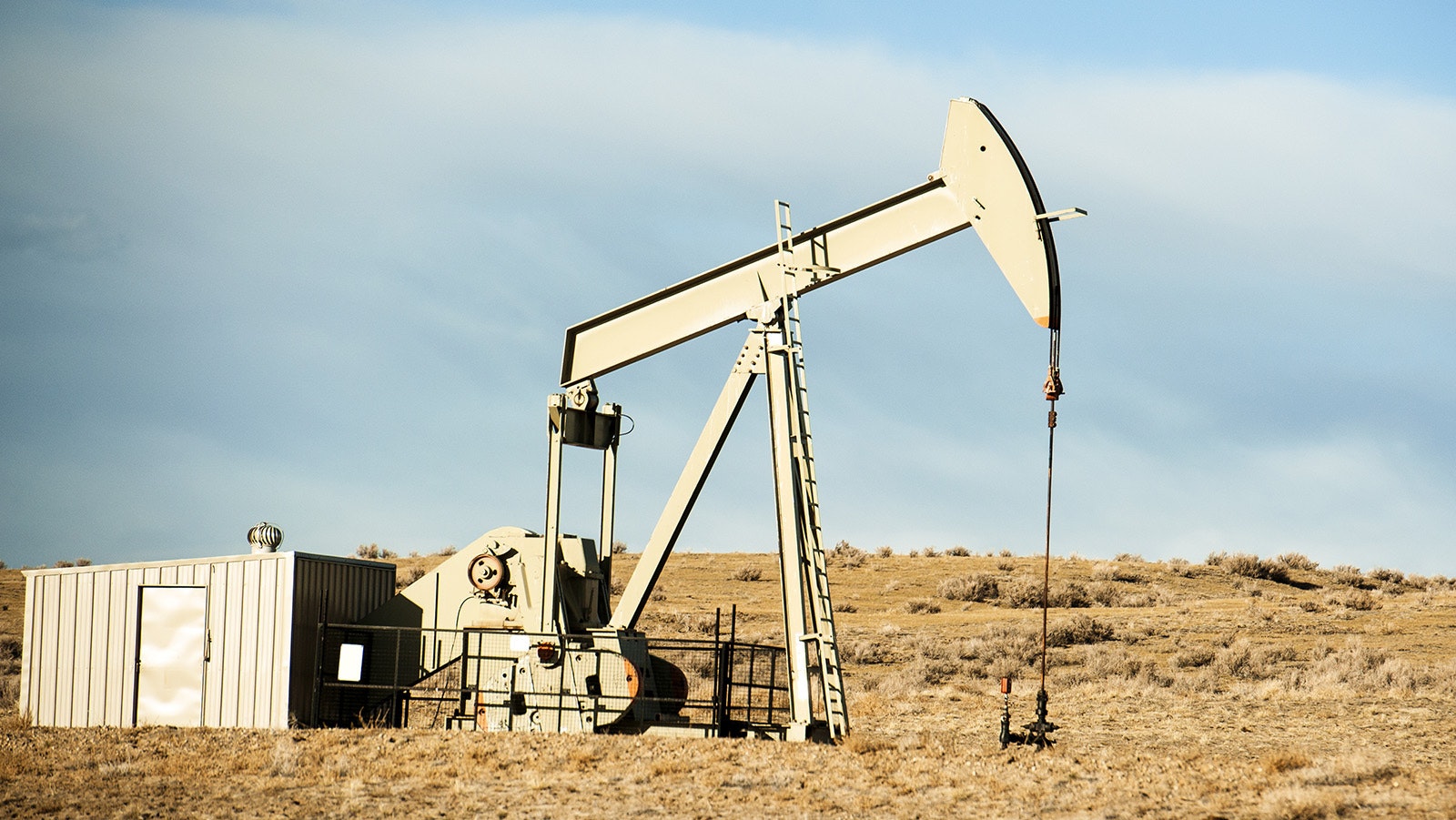
Along the North Platte River between Glenrock and Douglas, the cottonwoods marking the bank give way to dry grass hills that roll north toward the Powder River Basin, where burrowing owls nest in abandoned prairie dog towns and ferruginous hawks — nearly the size of golden eagles — hunt the open ground.
Maria Katherman has watched this landscape for 40 years from her place along the river. She keeps horses and chickens and has raised calves and lambs over the years, what she describes as “kind of subsistence.”
Her husband is an avid birdwatcher who used to do a spring bird count in the hills above the property. Her family members are, she says, “all kind of biologists.”
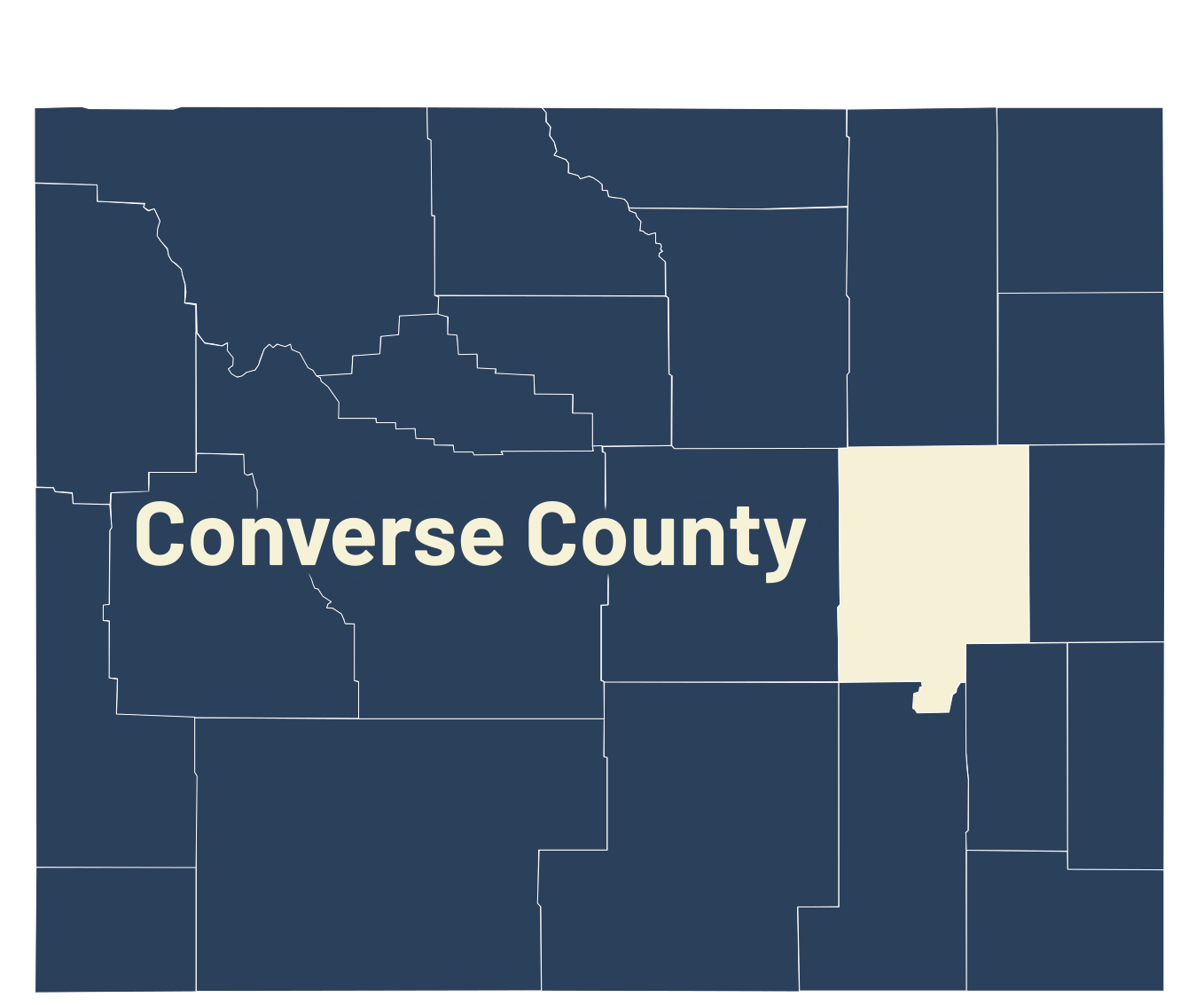
Katherman watched closely as a federal judge recently threw out the environmental review for the largest oil and gas project in Wyoming — what’s known as the Converse County Oil and Gas Project.
Katherman, who sits on the board of the Powder River Basin Resource Council — one of the groups that brought the lawsuit — said she hasn’t noticed much difference on the ground.
The BLM confirmed it is still issuing drilling permits in the project area under a separate planning document. The rigs keep working. The wildlife keeps losing, or at least that’s how Katherman sees it.
“The BLM said, ‘We abandoned the project,’” Katherman told Cowboy State Daily. “However, they continued to do one-by-one leases in the same area.”
In Casper, Steve Degenfelder with Kirkwood Oil and Gas, has an entirely different account of the same scenario.
Where Katherman claims the BLM won’t stop rubber-stamping oil and gas permits, Degenfelder sees an industry whipsawed by litigation and policy reversals that make it nearly impossible to plan a drilling program.
“You’re seeing this seesaw business going on that is very destructive for companies only really wanting a predictable business environment to operate in,” Degenfelder said.
The Converse County Oil and Gas Project authorized up to 5,000 wells across approximately 1.5 million acres — an area roughly the size of Delaware. It was expected to generate 8,000 jobs and between $18 billion and $28 billion in federal revenues.
In late February, the comprehensive environmental review that authorized it was vacated by a federal judge, and the question now hanging over the project is whether the government will have to start over from scratch — and what happens in the meantime.
Both sides would agree on one thing: the meantime is where everybody lives.
Across the board, those bound up in the contentious Converse County project point to a better way of doing things when it comes to revving up Wyoming’s economic engine while also protecting landscapes and wildlife.
As Katherman put it, the BLM is, “Still doing this landscape-sized development without a landscape-sized environmental impact statement.”
On The Range
Growing up in Casper, Katherman’s father was in the oil business.
“We’re not against the development,” she said. “We think it should be paced. That gives the ranchers — it gives the communities time to adjust to the new norms.”
“It’s a big, wide, empty,” Katherman said, reaching for a description of the Powder River Basin that would explain why a person might care about it. “Those are the things that make me glad I live in Wyoming. And it’s hard to see these places that are important for other things besides humans just getting industrialized.”
As development has proceeded, she said, “The BLM has given an exception to every single time they’ve found either burrowing owls or ferruginous hawks or leks. They’re just rubber-stamping exceptions to what they said they would take care of.”
Oil and gas producers hear this and point to examples of coexistence between wildlife and wildcatting, with drilling infrastructure sometimes providing winter shelter for antelope.
At the same time, an emphasis on natural resource development remains the state’s economic shield against financial hard times. Degenfelder said the Converse County project is “the development that is most likely to occur” and confirmed it’s the biggest of them all right now.
He then pointed to the Wyoming Taxpayers Association’s list of the state’s top taxpayers: The top 11 are all mineral producers.
“The top non-mineral-produced taxpayer is the railroad and they come in about 12th or 13th overall,” Degenfelder said. “That’s how important it is to the state of Wyoming.”
It’s also why a Feb. 27 ruling by the U.S. District Court in Washington, D.C., drew a lot of attention from Wyoming.
Judge Tanya Chutkan vacated the Converse County project’s Environmental Impact Statement and Record of Decision for a second time, finding that the Bureau of Land Management violated the National Environmental Policy Act.
The project was approved in December 2020 during the final weeks of the first Trump administration, authorizing multiple wells on up to 1,500 well pads.
In September 2022, the Powder River Basin Resource Council and Western Watersheds Project filed suit. Wyoming intervened, along with Continental Resources, Devon Energy, Anschutz Exploration Corporation and the Petroleum Association of Wyoming.
The first significant blow came in September 2024, when Chutkan found that the BLM had used an erroneous “specific storage value” in its groundwater modeling — a technical variable that measures an aquifer’s capacity to release water under pressure.
The figure substantially underestimated potential groundwater drawdown.
Chutkan temporarily halted permit approvals based on the deficient EIS.
Then in June 2025, the BLM published a supplemental Environmental Assessment and announced it had found no new significant impacts to groundwater.
The agency then began approving new permits through separate environmental reviews — two new Environmental Assessments covering 270 wells, plus 20 Categorical Exclusions covering another 60 permits, all issued between August and October 2025.
Chutkan’s February 2026 opinion identified a second, independent NEPA deficiency: the BLM’s failure to adequately analyze reasonable alternatives.
The BLM had eliminated a “paced development” alternative — one that would have limited the number of wells drilled per year — on the grounds that it was inconsistent with the project’s objectives and that the agency lacked authority to restrict the pace of development on existing leases. Chutkan rejected both rationales.
The court also called out the BLM for how it handled greenhouse gas mitigation.
“With an informed look at the alternatives involving a slower pace of development and greenhouse gas reduction measures, BLM could reasonably change course,” Chutkan wrote. She vacated the EIS and Record of Decision and remanded the project to the agency.
Chutkan denied the conservation groups’ request to file a second amended complaint challenging the 255 new permits the BLM had approved since August 2025. Those claims were “factually and legally distinct,” she wrote, and would need to be argued as a separate lawsuit.
The Petroleum Association of Wyoming called the recent ruling “flawed,” arguing it ignored the U.S. Supreme Court’s unanimous decision last May in Seven County Infrastructure Coalition v. Eagle County, Colorado, which narrowed the scope of NEPA reviews.
“The ruling is a blow to the creative work of balancing development and conservation in Wyoming that will limit future collaborations if left standing,” the association said in a March 2 statement. “It is definitive proof that the federal mineral management system is broken.”
Gov. Mark Gordon has been vocal about the need for a friendlier federal approach to energy development.
At the North American Prospect Expo in Houston in February 2025, Gordon spoke alongside Continental Resources founder Harold Hamm and signaled optimism about the second Trump administration’s energy policies.
“The days of Biden — and Obama — handcuffs on fossil fuels are over,” Gordon said at the event.
Permits Flowing
Despite Chutkan’s ruling, drilling permits are still getting approved in the Powder River Basin — and one small operator’s experience illustrates how.
Out of Steamboat Springs, Colorado, Howard Cooper runs Three Crown Petroleum and said his company recently obtained federal permits in 30 days. An APD — Application for Permit to Drill — is the government’s formal authorization to drill a well.
“The BLM has been very cooperative with us on getting permits,” Cooper said.
Three Crown is planning to drill four wells in the second quarter of 2026 — two in Johnson County and two in Campbell County. Under Biden, the company got permits in Campbell County in 90 days. Under Trump, the Johnson County permits came through in 30.
“I wouldn’t say faster,” Cooper said. “I would just say we were able to get permits because each situation is different.”
The permits aren’t coming through the now-vacated Converse County EIS. They’re being processed through the Casper Resource Management Plan — a separate BLM planning document that survived Chutkan’s ruling. A BLM spokesperson in Wyoming confirmed the agency is moving ahead with issuing “APD per the existing RMP.”
Degenfelder explained the distinction.
“The judge specifically said that the Casper BLM office could still process APDs under their resource management plan,” Degenfelder said. “You’ve got a Converse County EIS that has been vacated and can no longer be used until they start over again and redo it. But operators can get APDs approved through and under the Casper resource management plan.”
The open question is whether conservation groups will challenge the RMP mechanism in court, too.
“But until that time, it appears that APDs processed under the Casper resource management plan can be approved,” Degenfelder said.
Had the EIS been upheld, large-scale development would have proceeded under a single comprehensive authorization for 5,000 wells. Instead, Degenfelder said, it’s now piecemeal — permit by permit, a slower pace of development arrived at by court order rather than by design.
Wyoming’s Revenue
What no one on any side of this debate disputes is how much money is at stake.
According to the Wyoming Taxpayers Association’s 2025 Tax Summary, oil and natural gas together generated $557.7 million in severance tax revenue in fiscal year 2025 — about 77% of the total $720 million in all severance tax collections.
Oil alone produced $417.5 million on a taxable value of nearly $7 billion.
Weighing ecological value against economic return extends well beyond the Converse County project. In fact, the case is just one battle in what has become an escalating legal war over energy development on Western public lands.
On March 2 — three days after Chutkan’s ruling — a coalition of seven environmental organizations filed a separate 75-page complaint in U.S. District Court in Montana challenging the BLM’s 2025 management plans for greater sage-grouse habitat across nine Western states.
The plaintiffs include Western Watersheds Project, which also sued over the Converse County project, along with the Center for Biological Diversity, the Sierra Club and WildEarth Guardians, represented by the Missoula and Boise offices of Advocates for the West.
Where the Converse County case targets a single oil and gas project in the Powder River Basin, the sage-grouse lawsuit goes after the broader federal framework — the planning documents that govern how development, grazing and mining proceed on 71 million acres of BLM-managed land across the sagebrush West.
The complaint describes an ecosystem in freefall.
Since 1965, sage-grouse populations have dropped roughly 80 percent, with half that loss occurring in the last two decades.
A 2025 study from the U.S. Geological Survey found populations still declining at 3 percent per year and predicted that two-thirds of all sage-grouse leks — the traditional breeding grounds where males perform their elaborate strutting display each spring — are likely to disappear. In North Dakota, the sage-grouse population now appears effectively extinct, according to the lawsuit.
The sagebrush steppe itself is vanishing at 1.3 million acres per year. The complaint calls the sage-grouse an “umbrella species” whose survival shelters more than 350 other species dependent on the same habitat — mule deer, pronghorn, pygmy rabbits, sage sparrows. Protecting the bird, in other words, is a proxy for protecting the landscape.
For producers, the cumulative weight of litigation creates an operating environment where a court ruling can reshape a business plan overnight.
“I would hope that people realize how these environmental groups, the Powder River Basin Resource Council and Western Watersheds, do so much to harm Wyoming’s economy,” argued Degenfelder, insisting lawsuits add to a less than ideal business climate for industries at the heart of Wyoming’s financial support system.
Conservation groups push back with a stream of statistics valuing conservation as an economic driver. On March 5, the Outdoor Recreation Roundtable reported that, “Outdoor recreation on federal lands alone generates $350 million per day for the (U.S.) economy.”
Dueling statistics and statements like this reveal a shaky divide separating conservationists and oil and gas developers. At the same time, the opposing sides say they share a desire to establish something more stable.
For Katherman, a wildlife-friendly plan for oil and gas development. For Degenfelder, a break from the seesaw.
“You’re seeing this seesaw business going on that is very destructive for companies only really wanting a predictable business environment to operate in,” he said. “Oil and gas operators in Wyoming have gotten used to ‘nothing is forever.’ It changes. Anything that could bring a steady, predictable environment to the industry would be supported by us.”
David Madison can be reached at david@cowboystatedaily.com.