A Wyoming judge has joined the more than 300 federal judges in opposing the Trump administration’s policy of detaining nearly everyone brought to immigration proceedings.
A recent Wyoming-based federal case highlighting the legal issue started Feb. 4, when New Jersey-based noncitizen and truck driver Vazha Gelashvili asked the U.S. District Court of Wyoming to require immigration authorities to give him a bond hearing.
Gelashvili had been operating previously on an unsecured bond, had obtained a work permit, and was driving a commercial truck on about Feb. 1, court documents say.
He stopped at a Green River truck stop to shower.
He soon noticed his vehicle’s mirror was broken, says his petition to the court.
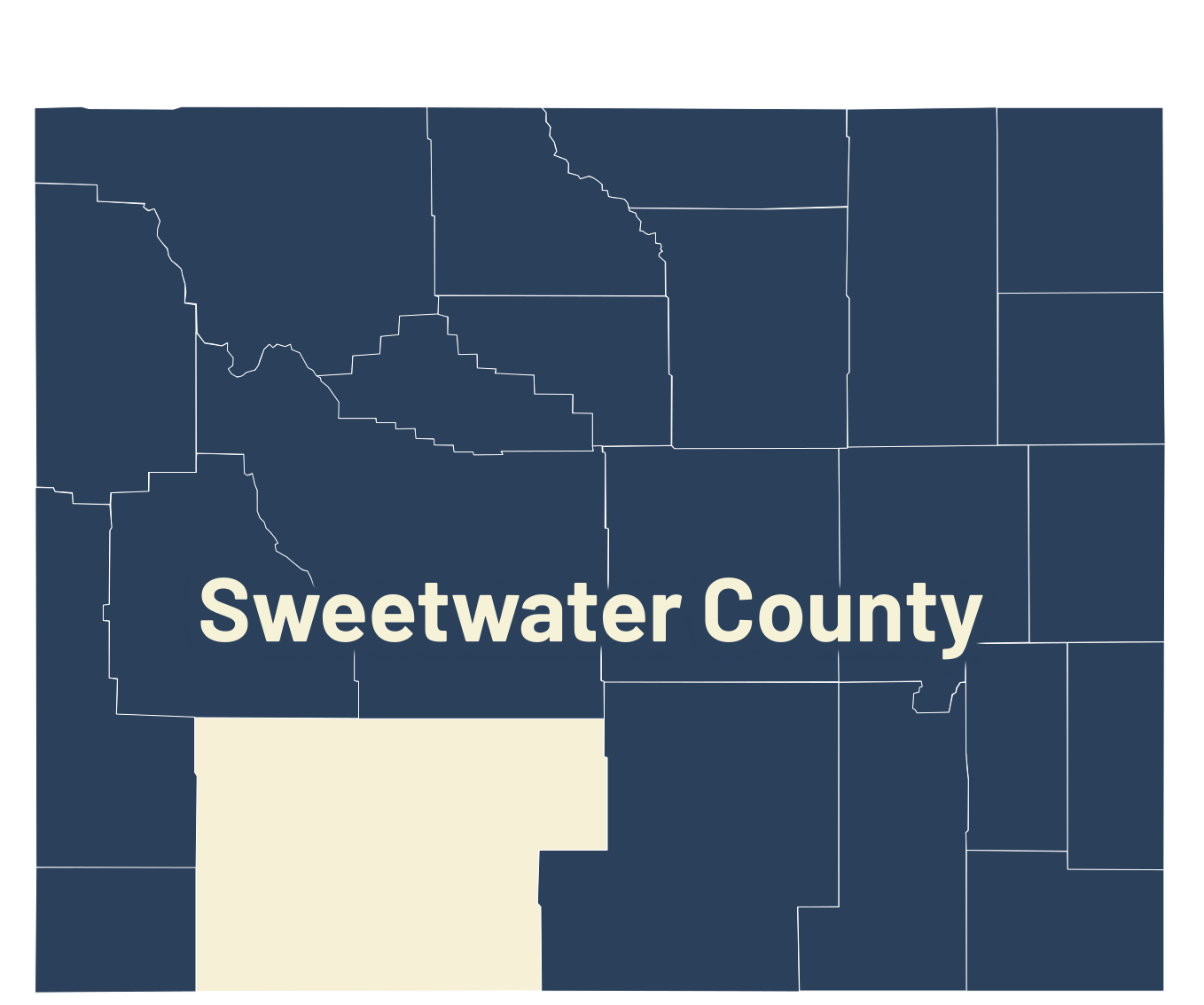
The truck stop attendant called the Sweetwater County Sheriff’s Office, telling Gelashvili a sheriff’s deputy needed to check security video to investigate the damage to the mirror, reportedly.
A deputy arrived and took Gelashvili into custody under a new Wyoming law invalidating out-of-state driver’s licenses that are issued to “unauthorized aliens” but not supported by proof of lawful presence in the United States.
The Sweetwater County Sheriff’s Office continued to investigate the property damage to the mirror as well, the agency told Cowboy State Daily last month.
Gelashvili was soon transferred into U.S. Immigration and Customs Enforcement custody and taken to the federal facility in Colorado.
That was about seven months after the U.S. Department of Homeland Security — which is ICE’s umbrella agency – declared that noncitizens already living in the country aren’t eligible for a bond during immigration proceedings. It invoked a part of federal law traditionally used to detain immigrants of a different category: those encountered at or near the border upon entering the country.
DHS’s interpretation runs contrary to decades of granting people who are already established in the country the chance to make bond during immigration proceedings, U.S. District Court Judge Scott Skavdahl wrote in a Feb. 26 order in Gelashvili’s case.
“The Court understands DHS, supported by the Board of Immigration Appeals, has recently changed its decades-long approach,” wrote Skavdahl. But neither that new interpretation nor a Fifth Circuit Court of Appeals ruling backing it “persuaded this Court that the prior understanding and application of the statutory scheme was erroneous or broken.”
Skavdahl acknowledged, rather, the hundreds of other judges’ rulings, saying the new interpretation is not correct.
He indicated that even if a higher court ultimately sides with DHS, his is a safer gamble for now. That’s because, even once ordered to hold bond hearings for noncitizens like Gelashvili, immigration authorities still can hinge the noncitizen’s release upon whether he is a flight risk or a danger to the community.
Skavdahl quoted from a case from the U.S. District Court for Utah:
“If this court has gotten the law wrong, its error will have resulted in a handful of immigrants being allowed to remain free from detention on a bond… after determination that they do not pose a flight risk or a danger to the community,” says the quote Skavdahl used. “If, however, other courts eventually determine that it is DHS who has gotten the law wrong, then the agency will have unlawfully detained tens of thousands, if not hundreds of thousands, of people.”
Skavdahl retained jurisdiction over the matter long enough to ensure immigration authorities granted Gelashvili a bond hearing. Once he learned they had, he concluded the case with a Monday order.
Second Rodeo
This was not Skavdahl’s first time adhering to the older reading of federal immigration law.
He ruled in November that an illegal immigrant who says he’s been living in the U.S. for 20 years does not fall under the detention mandate the federal government historically applied to people just arriving in the nation.
That man, a Mexican national named Octavio Serrato, was arrested while ICE officers were conducting a separate criminal investigation at a racetrack in Wilder, Idaho, then taken to the Uinta County Detention Center, court documents say.
He was originally detained without a bond hearing, which he argued was unlawful.
Just as he’d later echo in Gelashvili’s case, Skavdahl ordered federal immigration authorities to grant Serrato a bond hearing – but noted that Serrato still had to demonstrate he wasn’t a danger or a flight risk to win his release from custody.
Out Of Custody
Gelashvili is now out of custody, while his immigration case is ongoing, his attorney Adam Boyd of Palladino, Isbell & Casazza LLC, confirmed Tuesday to Cowboy State Daily.
“We had a bond hearing (after Skavdahl’s order),” said Boyd. “We were successful and so now, he can tend to his family and go through the regular immigration court processes he’d been a part of since he came here and sought his application.”
Boyd discussed the massive court response to DHS’s new reading of the law, calling it “a pretty big nationwide issue.”
In Boyd’s view, “it would be a better use of resources to truly go after those who are a danger.”
“Someone who has a valid driver’s license and who has no criminal history does not meet that category,” he added.
‘ICE Complies With All Court Orders’
An ICE spokesman countered in a Tuesday statement, saying enforcing immigration law “is not optional and is essential to protecting America’s national security, public safety, and economic strength.”
“Operations are conducted lawfully within the authority granted to immigration officers under Title 8,” the statement continues.
“While every removal of an illegal alien helps restore order and reinforce the rule of law,” the statement concludes, “ICE complies with all court orders.”
The Sweetwater County Sheriff’s Office, which had custody of Gelashvili briefly before his transfer, declined Tuesday to comment on the case’s conclusion.
The office’s spokesman Jason Mower had emphasized last month that, once it gave up custody of Gelashvili, it was no longer a relevant party in the action by which Gelashvili challenged his detention.
His Petition
Through his attorneys, Devon Petersen, of Fleener Petersen LLC, and Boyd, Gelashvili had argued that a DHS policy adopted July 8 wrongly ordered immigration authorities to keep him detained.
Gelashvili entered the United States without inspection at the southern border, says a redacted copy of his petition, obtained by Cowboy State Daily.
The date of his entry is redacted.
Government officials apprehended him after he entered, and he was then ordered to be released on his own recognizance – a less rigorous bond arrangement for people who are deemed not to be a danger to the community, the petition says.
He was told to appear in immigration court for removal proceedings for entering without inspection, but he soon filed a motion with the immigration court, the nature of which is redacted from the petition.
He’s eligible for work authorization, the petition says.
“As a noncriminal outside of any DHS priorities for removal, his next scheduled Master Calendar Hearing before (an immigration judge) was scheduled for… 2028,” the document adds.
The Board of Immigration Appeals on Sept. 5 issued a decision saying immigration judges don’t have authority to consider bond requests from people who entered the U.S. without admission, court documents say.
The Board determined those people should be detained.
Gelashvili’s petition argues that people like him, who entered without admission, are under a different section of law, 8 U.S.C. 1226(a), which says the federal government “may” release an alien on a bond or conditional parole.
Clair McFarland can be reached at clair@cowboystatedaily.com.