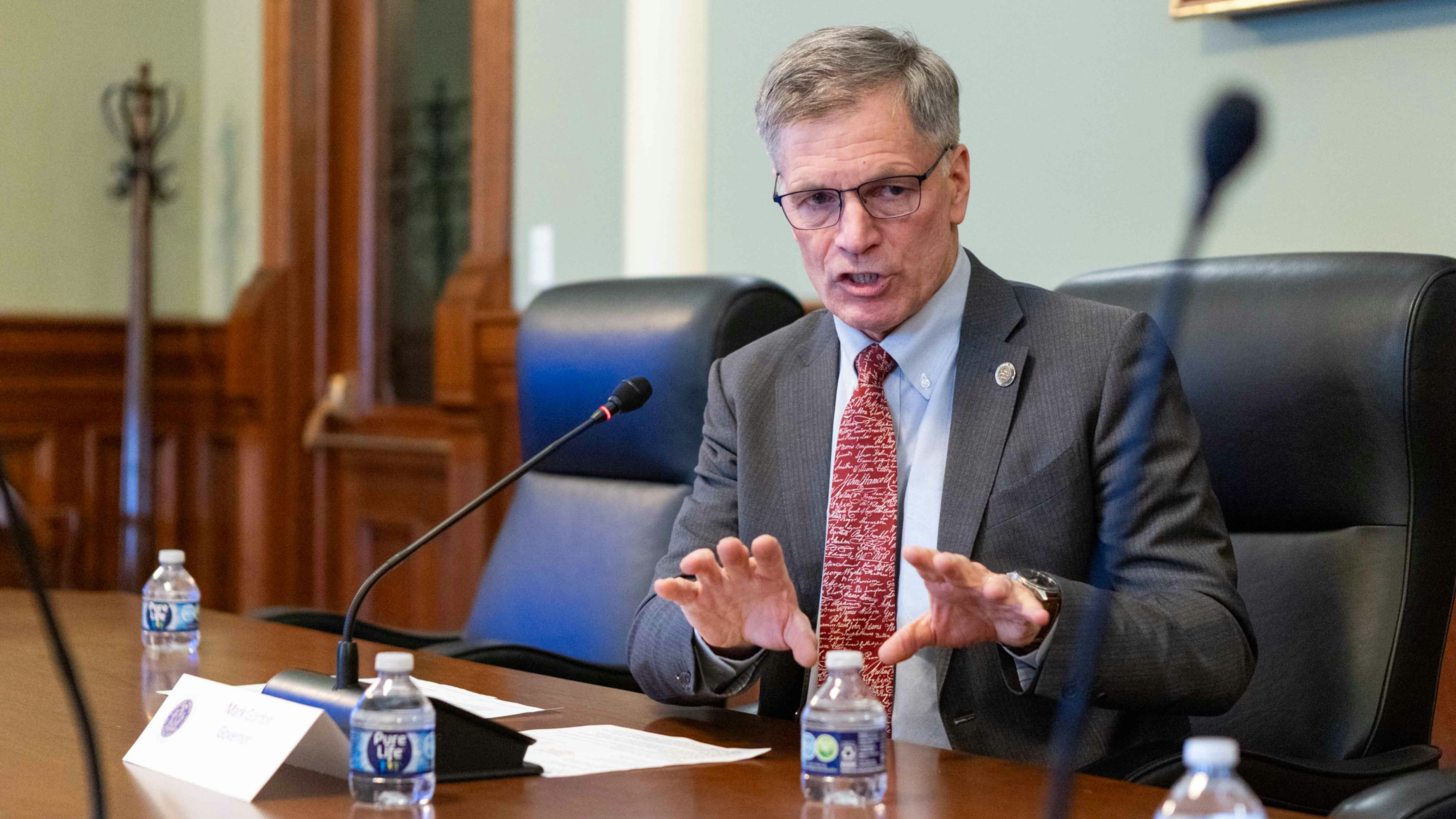
Gov. Mark Gordon on Tuesday vetoed a bill geared toward penalizing Wyoming police agencies that help with federal gun enforcement initiatives or hire former federal agents involved in such operations.
President Donald Trump’s administration supports this veto, Gordon wrote in a Tuesday statement.
Senate File 101, which would impose $50,000 civil penalties on Wyoming police agencies that help with federal gun-crime enforcement operations against "law-abiding" citizens, or hire former federal agents who’ve conducted those operations, garnered massive controversy during this year’s legislative session – as all 23 Wyoming sheriffs opposed it.
“Those concerns were echoed by the Trump Administration federal law enforcement officials,” wrote Gordon’s office in a Tuesday statement on his veto. Trump’s administration warned the bill “could weaken critical cooperation between Wyoming law enforcement and federal agencies combating violent crime, firearms trafficking, and cartel activity.”
U.S. Immigration and Customs Enforcement (ICE) acting director Todd Lyons cautioned Gordon that the bill, while framed as a Second Amendment protection measure, could undermine law enforcement.
The bill would have coupled with misdemeanor penalties for individual officers who participate in federal gun operations.
“The legislation undermines law enforcement by threatening Wyoming police officers with criminal charges, civil lawsuits, and steep financial penalties for their employers simply for cooperating with federal law enforcement on firearm investigations, even when those investigations target violent offenders, traffickers, or organized criminal networks,” Lyons wrote.
The ICE letter asserted that restricting cooperation between federal and local law enforcement could make it harder to dismantle criminal networks responsible for firearms trafficking and cross-border smuggling.
“Many of the most serious gun crimes today—international firearms trafficking, cross-border smuggling, terrorist cartel-linked straw purchasing, airport security violations, and financial crimes tied to arms trafficking—are primarily federal offenses. In many of these cases, Wyoming law has no parallel statute at all,” wrote Lyons. “Without federal cooperation, these serious crimes may never be prosecuted.”
Governor Gordon noted in his veto letter that the concerns raised by federal law enforcement reinforce warnings raised throughout the legislative session by Wyoming’s own law enforcement leaders.
“Please note that every single one of Wyoming’s twenty-three duly elected sheriffs, numerous community police chiefs, and state law enforcement officials spoke out to list their concerns throughout the legislative session to no avail,” Governor Gordon wrote in his veto message.
The governor emphasized that Wyoming strongly supports the Second Amendment but said the legislation could create serious unintended consequences for law enforcement and public safety.
“This legislation is an ambulance chasing activist litigator’s meal ticket wrapped in a politically sacred wrapper of ‘Second Amendment Protection,’” Gordon said. “Illegal immigration, drug smuggling, human trafficking – major enforcement initiatives of President Trump’s – will all be hindered as a consequence of this bill.”
Gordon reiterated that Wyoming law already protects against federal overreach under the U.S. Supreme Court’s anti-commandeering doctrine established in Printz v. United States.
“If an order is given on the federal level to seize law-abiding Wyoming citizens’ firearms, state and local law enforcement cannot be forced to administer or enforce any of their regulations,” he wrote.
Both chambers of the Legislature convene Wednesday and, if first the Senate, then the House of Representatives return a two-thirds majority in the bill’s favor, they’ll override Gordon’s veto.
The bill would impose a civil penalty of $50,000 on Wyoming agencies that advanced enforcements "solely" of federal gun laws. It contains carveouts so it wouldn't protect illegal aliens. It says it protects "law abiding" citizens from gun law overreach.
It also could apply a misdemeanor to individual Wyoming officers who advance federal gun law enforcement.
"Nothing in this section" shall be used to block lawful gun seizures under Wyoming law, expose individual officers to civil liability, or prevent agencies from hiring former military members, the bill says.
It contains carveouts for cross-state pursuit situations and drug cases.
The Whole Point, To This Senator
In an impassioned speech Sen. Cale Case, R-Lander, delivered Feb. 19 in the bill’s favor, rebuffing the federal government was the whole point.
“I think this bill is… an insurance policy against the hypothetical situation, that perhaps federal agents arrive in our cities and seek to harm our constitutional rights,” said Case. “I mean, I could sit here and I can imagine – in a maybe dystopian future, Mr. President – where there might be federal police on the streets. Maybe wearing masks. Maybe looking to harm peaceful protestors. Maybe even to harm people that are legally carrying firearms.”
Case’s comments came days after a controversy in which DHS officers killed Alex Pretti, a protestor in Minneapolis who appeared in widely circulated video recordings to intervene when an officer pushed a woman to the ground.
Pretti had been armed. He did not appear to be wielding his gun before entering the fray. Officers held him down and hit him once he engaged them. It is unclear what happened inside that altercation, just before the first shot sounded. At least 10 shots followed. Pretti was killed.
The incident is under investigation.
“So I think this is really an important bill and I intend to support it,” said Case. “That is one dystopian future for America that I never want to see.”
The Sheriff Who Resisted The Feds
Sweetwater County Sheriff John Grossnickle joined his counterparts across the state in opposing the bill, saying it overlooks the nuance of law enforcement interactions between federal and state agencies.
Lawmakers who opposed the bill pointed to Grossnickle's past gestures to defend his county from larger governments' encroachments. He refused to enforce state mask mandates during COVID. He announced during the Biden administration that he’d refuse to implement an early and broad-reaching version of a land use plan the U.S. Bureau of Land Management proposed.
To Grossnickle, the Second Amendment Protection Act doesn’t help him oppose a future tyrannical government, it impedes him.
“This (bill), in my eyes, allows the federal government to come into the state of Wyoming — in particular the ATF (Bureau of Alcohol, Tobacco and Firearms) — and do whatever they want without any oversight or any local control,” said Grossnickle in a Friday interview with Cowboy State Daily.
He said that’s because his office has spent years forging good working relationships with federal entities, so that they consult it before undertaking operations in Sweetwater County.
“There’s been several times I’ve been like, ‘That’s not going to fly in my community. Let’s think of a different way of doing this.’ Or, ‘that’s not going to fly in Wyoming,’” said Grossnickle. “And historically, they listen to us.”
In his view, SAPA severs that tie so that local agencies are too afraid of its $50,000 civil penalty provision to work with federal agents to build that communication.
Like Gordon, Grossnickle cast the effort as a counterproductive mission by “the gun lobby.”
The Gun Lobby
Gun Owners of America countered Gordon in a Tuesday statement. GOA Senior Vice President Erich Pratt called the veto "a disappointing surrender to federal interests over the constitutional rights of the people of Wyoming," and said Gordon "has chosen to prioritize the demands of federal agencies over the clear will of the Legislature and the protections of the Second Amendment.”
GOA's statement asserts that Gordon's veto message relies on sensationalist claims about illegal immigration, drug smuggling and cartel activity, while the bill has a "targeted scope," protects "law abiding" gun owners and doesn't shield crimes of violence, smuggling or financial violations.
"By conflating organized crime and terrorism with the activities of law-abiding Wyoming citizens, the Governor and federal agencies are engaging in fearmongering rather than an honest reading of the law," the statement says. "Federal agencies like ICE already possess the resources to pursue international smuggling and cartel networks without conscripting Wyoming’s local police to enforce federal-only gun regulations against their own neighbors."
Printz v. United States, which Gordon referenced, says federal authorities cannot force state officials to administer federal programs.
"It does nothing to prevent local officials from voluntarily assisting in federal gun grabs," says the statement, adding that Senate File 101 was designed to provide that missing safeguard.
While Gordon characterized the bill’s accountability measures as a "meal ticket" for litigators, GOA asserts that its provisions "ensure that state and local officials pause to consider the constitutionality of their actions before stripping a citizen of their rights. If an officer is operating within the bounds of Wyoming law and the Constitution, they have nothing to fear."
Clair McFarland can be reached at clair@cowboystatedaily.com.