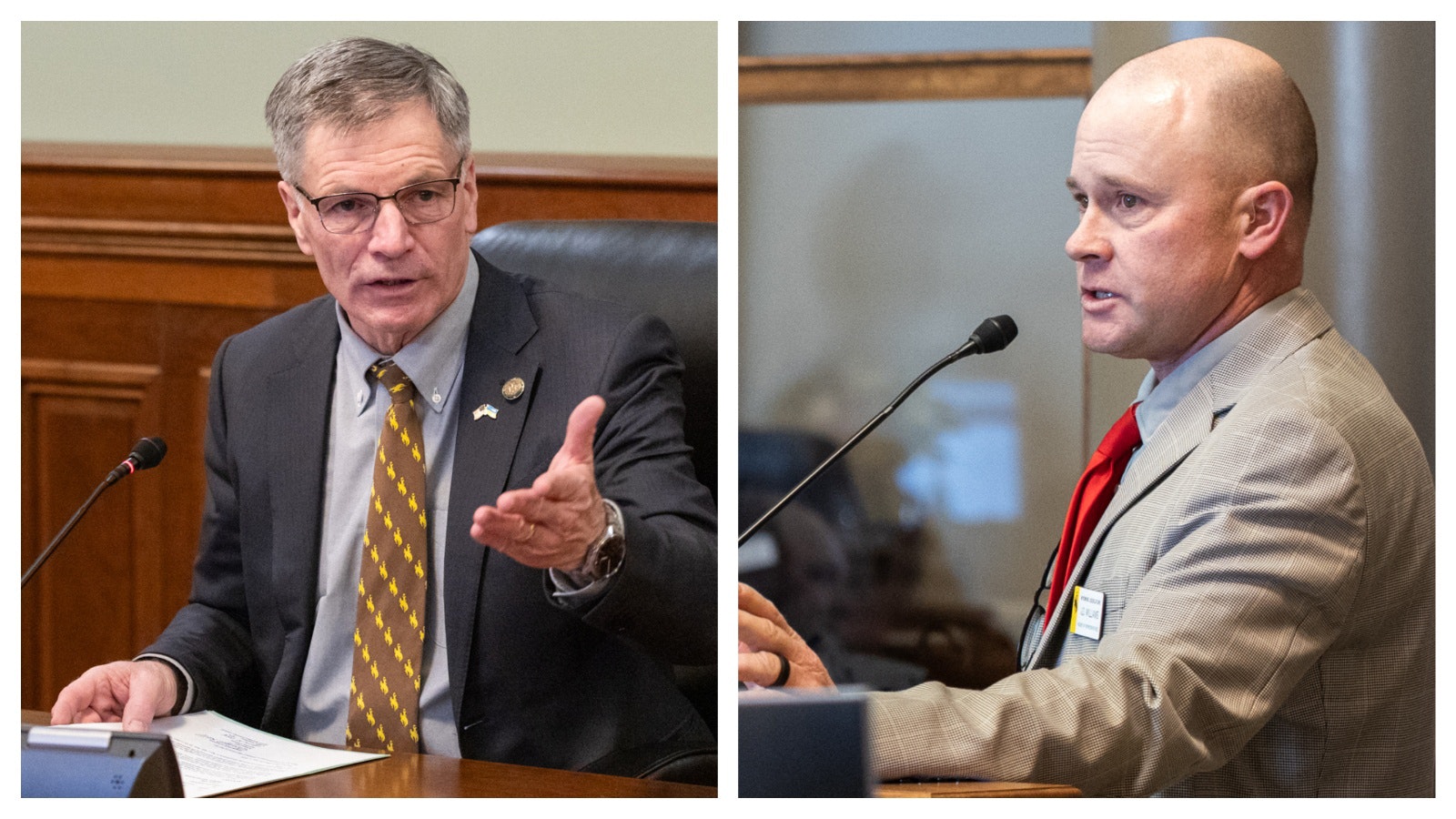
Wyoming’s governor on Tuesday vetoed a bill that would have banned many state governmental entities, including school districts, from deducting union and political organization dues from public workers’ paychecks.
Sponsored by Rep. JD Williams, R-Lusk, House Bill 178 seeks to block Wyoming public entities, excluding public safety agencies, from collecting dues for labor groups, political action committees and organizations, political candidates and committees.
It still would have allowed people to pay dues to those groups on their own.
Gov. Mark Gordon released multiple criticisms of the bill in a Tuesday statement and said he’s frustrated with “the increasing trend of out-of-state interests influencing legislation.”
“With alarming regularity, these think-tanks-for-hire use our legislative process to enact solutions to problems we do not have,” Gordon said. “Chalking up a win in Wyoming to augment their scoresheet across the nation does very little for our state, but it allows them to continue to raise funds for the fat cats who support these efforts.”
He derided the bill’s different approaches to different agencies, prohibition on certain public employees “voluntarily deducting labor organization dues from their paychecks,” and the potential for public employees who deduct union dues to face misdemeanor charges.
‘Fat Cat’
Two of the bill’s key proponents were the anti-union group the Freedom Foundation, and libertarian-leaning group Americans for Prosperity.
The Freedom Foundation is based in Washington state.
Americans for Prosperity is based in Virginia. Its Wyoming director Tyler Lindholm, however, is a former lawmaker and cowboy from Sundance, Wyoming.
“I guess somebody needs to let the governor know that Sundance, to my knowledge, is still in the state of Wyoming, and I’m not a fat cat,” said Lindholm in a Tuesday phone interview.
He said the bill’s mission is simple: “unions should collect their own dues. That’s it.”
Lindholm said taxpayers should not be “somehow paying for bank transfer fees and stuff like that for public unions.”
The Wyoming Education Association and other detractors of the bill cast it as an effort at “union busting.”
Lindholm acknowledged that argument, calling it a “fascinating take.”
“Because if making them collect their own dues would bust a union, I don’t think they have much of a union in the first place,” he said. “But that’s not the intent. The intent is whether it’s appropriate that the state of Wyoming subsidizes those entities by collecting their dues for them.”
Lindholm concluded: “If anybody wants to come up and share a cup of coffee with a fat cat that’s ‘out of state’ in Sundance, I’m always open for coffee, including (with) the governor.”
Override Prospects Uncertain
It’s uncertain whether the Legislature will override Gordon’s veto.
Both chambers are slated to meet Wednesday for veto overrides.
House Bill 178 enjoyed a two-thirds majority passage when it left the Senate on a 21-10 vote March 5.
The House passed it with less than two-thirds favor on a 36-22 vote Feb. 23. Four lawmakers were marked excused from that vote. However, even had they been present and voted in the bill’s favor, it still would have ended with a 40-22 vote: fewer than two thirds approval in the 62-member House.
In its original form the bill also would have required unions containing public employees to publish a report showing how many public employees it represents, how much revenue it receives by category, and how much it spent on supporting political candidates and other political and litigation maneuvers.
The Senate removed that component.
The final version shields firefighters and public safety agencies from the bill’s ban on collecting dues.
Its opponents have said it makes more, not less work for payroll secretaries who will have to parse union dues out from other paycheck deductions; and they call it government overreach.
Its proponents have said it removes the government from deductions workers can easily arrange on their own, and may prevent workplace coercion toward supporting a union.
Back To The Sponsor
Williams did not bristle like Lindholm did at Gordon's statements.
“I’m disappointed and I don’t necessarily agree with the governor on all of his statements, but he certainly raises some valid points that I can appreciate,” Williams told Cowboy State Daily in a Tuesday phone interview. “And he always is thoughtful and thorough when he exercises his right and responsibility of veto.”
More From Gordon
Gordon explained his veto further in a Tuesday letter to House Speaker Chip Neiman, R-Hulett.
He called House Bill 178 an example of cynicism fueled by out-of-state interests misaligned with real Wyoming issues.
“While I understand the inappropriateness of using public resources to support the political activity of private organizations, this bill is not a solution to that problem,” wrote Gordon. “Rather it is a thinly veiled attempt to frustrate the choices an employee can make with their own earned money.”
Gordon added: “having paid someone for their work, the state has very little to say with how that individual chooses to use his own money.”
Wyoming is a right-to-work state, he noted.
Firefighters are allowed to unionize under state law. Other public entities are not.
Public employees can opt in to a variety of paycheck deductions including those for charities and other organizations, Gordon noted. The cost to public employers is “negligible,” he added.
Sen. Eric Barlow, R-Gillette, had proposed an amendment letting public employers deduct these dues, if the employees pay the costs of that action.
The Senate rejected that amendment.
In Gordon’s reasoning, “if the administrative costs of this practice were the true concern of the legislature, the amendment offered to charge for the convenience would have been adopted.”
The governor called it “arbitrary” for the bill to prohibit deductions for unions and political groups but not other groups engaged in advocacy.
Lawmakers opposed to the bill noted during its debate hearings that insurance companies often engage in political advocacy.
“This raises questions about the potential retaliatory nature behind this initiative, rather than an honest response to the concerns brought forth by our constituents,” wrote Gordon.
Gordon’s letter does not mention the Wyoming Education Association, which was a key detractor of the bill during the session.
The group’s longstanding clashes with state authorities have been frequent and public.
The Wyoming Education Association has sued the state of Wyoming multiple times over its education funding programs. It successfully won a court-ordered pause last year on a school choice program the Legislature passed and funded.
Last February the WEA won a court order concluding that the Legislature does not adequately or correctly fund education. That order is paused during a Wyoming Supreme Court appeal on the matter, but it surfaced repeatedly as a concern while lawmakers crafted the state’s education spending plan this year.
Retirees
Lastly, Gordon said he’s concerned for state retirees.
Some Wyoming Retirement System beneficiaries continue to receive health benefits through automatic payments from their retirement benefits that are conditioned on their participation in a labor organization, he wrote.
“How the state should intervene in that decision to direct compensation toward certain benefits offered by labor organizations and not the state retirement system was not adequately considered in the legislative process,” wrote the governor, calling that an “unintended consequence of rash policymaking fueled by political retribution. This is not the Wyoming way.”
The Other Group
Max Nelsen, director of research and government affairs at the Freedom Foundation, called Gordon's veto "disappointing," in a Tuesday statement to Cowboy State Daily, and said he relied on "misconceptions."
"Ending the use of taxpayer-funded payroll systems and personnel to fundraise for certain, government-endorsed political special interests is broadly supported both by good-government advocates in Wyoming and national organizations with supporters in Wyoming, such as the Freedom Foundation," wrote Nelsen.
He said "everyone agrees that public employees can do what they like with their own money" and removing government from the business of collecting union dues doesn't prevent that.
Nelsen called Gordon's desire to treat public employees equally "admirable, but misplaced," noting firefighters have been carved out of Wyoming's right-to-work status for decades. The bill's architects exempted first responders to preserve that longstanding practice, he wrote.
"If it looks like HB 178 singled out labor organizations in any way, it’s because these organizations enjoy unique privileges not extended to other kinds of organizations," he wrote. "For instance, the Wyoming Education Association and Wyoming Public Employees Associations’ political action committees are the only known political funds school districts collect contributions for, while the WPEA-PAC is the only known political fund for which the Department of Administration collects contributions. Removing these unions’ special government support isn’t singling them out; it’s restoring a level playing field."
Nelsen concluded, saying the Freedom Foundation "has learned that the primary reason unions want dues collection to occur via payroll deduction is because it makes it easier for them to sign up employees who otherwise wouldn’t join."
That's a theory Sen. Charlie Scott, R-Casper, also argued in support of the bill this session.
Nelsen quoted from an Indiana teachers' union president who said, “When [dues] money was coming out of their paycheck, many people didn’t notice it. When it comes out of your bank account, you do.”
Jeff Daugherty, a Cheyenne-based political consultant who also represented the Freedom Foundation this session, told Cowboy State Daily he "surprised by the Governor’s tone regarding the recent veto, as he is typically more measured. His veto messages usually read a bit like a Federalist Paper - thoughtful."
He said he hopes the Legislature will override the veto "and defend what should be a bright line: government should not subsidize political activity."
"I am proud to be part of a coalition of moms, dads, neighbors, church members and conservative advocacy groups who fought to separate political activity from government operations. Our work on this issue isn't done," said Daugherty, adding, "Today, big labor prevailed over Wyoming values."
Clair McFarland can be reached at clair@cowboystatedaily.com.