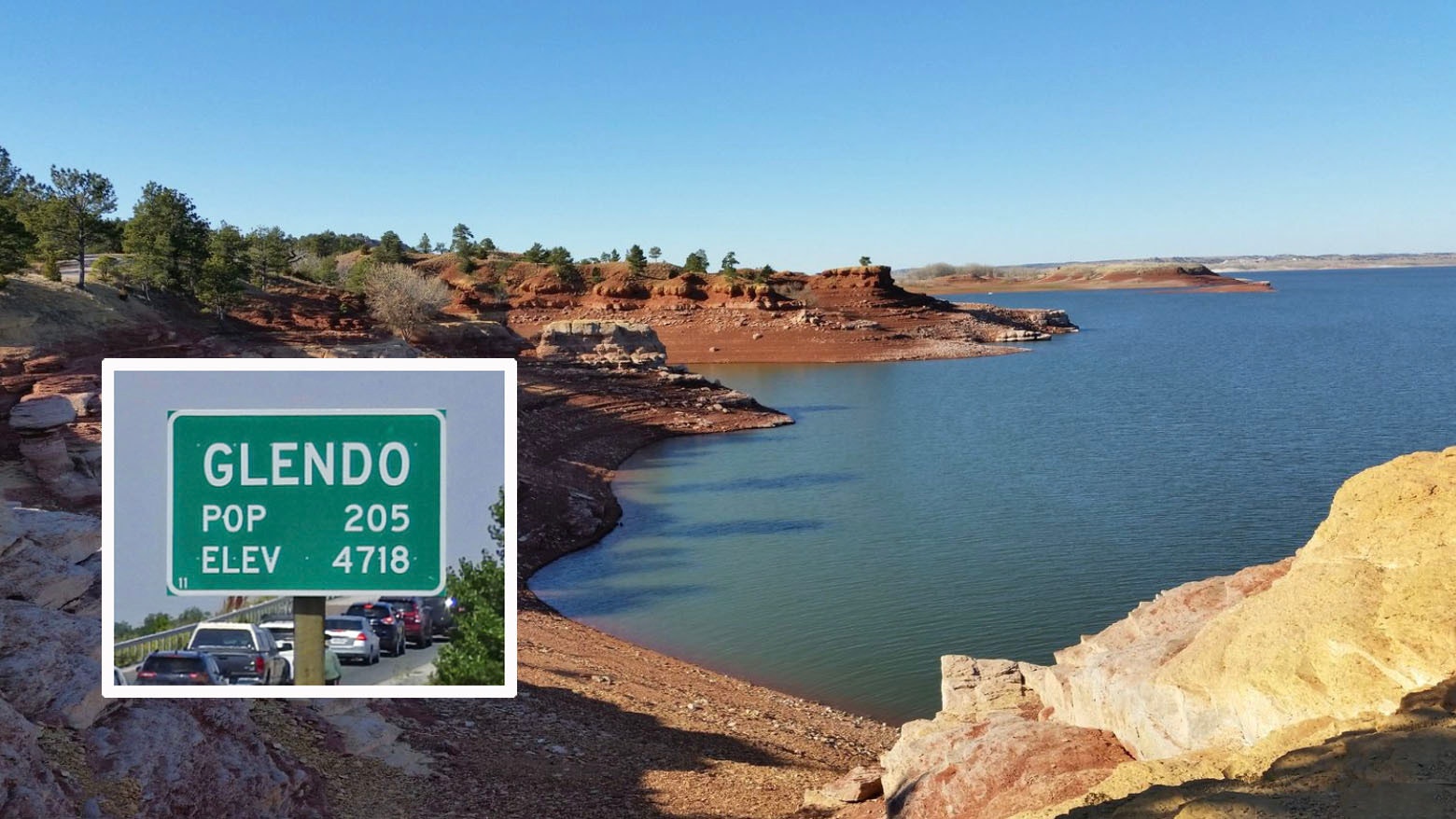
The new home sits on the north end of Glendo Reservoir — a two-story stick-built retreat with a great loft and open floor plan designed for entertaining and family gatherings.
From its windows, you can gaze across the water at the cliffs on the far shore, beneath enormous Wyoming skies. The nearest trees are more than 100 yards away — 400 to 500 yards in some directions — with open prairie all around.
But it’s also remote enough to raise concerns about a fast-moving wildfire and the local fire department’s ability to respond.
“Anybody that’s outside of that five-mile buffer from a fire station is getting a struggle with insurance, and insurance costs have risen dramatically,” said Sen. Taft Love, R-Cheyenne, who built the custom home for a client through his construction company. “And so that very much is going to create an issue for a lot of people in Wyoming.”
The house sits about 5.5 miles from the nearest fire station — just outside the buffer that many insurers use to determine coverage eligibility. One quote came back at $40,000 a year. Love tried to extend his existing construction insurance policy on the property, and his carrier refused citing the property’s fire designation.
Heading into the spring and summer building and vacation seasons, if you’re thinking about buying or building a log cabin, a lake house, or some other type of rural property in Wyoming — get ready for a ballooning insurance bill.
Not So Remote
The Glendo project wasn’t Love’s only insurance headache. His own aviation property east of Cheyenne — at Skyview Airpark, with an airplane hangar, office and apartment building — sits four miles from the Hillsdale Volunteer Fire Department, comfortably within the five-mile buffer.
It still wasn’t enough to hold the line on cost.
“My insurance tripled from one year to the next just because they had changed the fire rating,” Love told Cowboy State Daily. “It’s something that had been insured before. It was with that company already. It shouldn’t have been a big deal.”
From one corner of the state to the other, property insurance rates continue to rise.
Leah Vermeire, a producer at Tegeler & Associates in Dubois, insures commercial and personal properties for some of Wyoming’s most scenic alpine properties.
“The availability is still there. It is just expensive,” said Vermeire
Premiums have risen roughly 200% to 300% over the past decade, Vermeire estimates.
Log cabins add an extra layer of difficulty on top of fire risk. When a log cabin catches fire, it’s curtains.
“With a log cabin, a partial loss is essentially an entire loss,” Vermeire said. “You can’t just replace one piece of drywall or one corner of the house or one part of the exterior.”
A neighbor of Vermeire’s on Union Pass found out exactly how crushing the premiums can be. The neighbor was non-renewed by an existing carrier, came to Vermeire for quotes, received options — and then chose to go without coverage rather than pay the premium.
The property, a secondary log cabin home, is worth around $900,000. The annual premium came in at over $10,000.
Wyoming is not an island when it comes to fire risk pricing. Catastrophic fires in California, hurricanes along the Gulf Coast, and floods across the country all feed into the national insurance pool that Wyoming property owners draw from.
“The frequency and severity of natural disasters nationwide is also impacting the insurance market here,” Vermeire said.
Climate Factor
The insurance affordability squeeze hitting Wyoming is part of a trend that national regulators have been tracking for years. The 2024 “National Climate Resilience Strategy for Insurance,” issued by the National Association of Insurance Commissioners, warned that the growing number and scope of severe disasters have raised questions “about the sustainability of insurance availability and the challenges for consumers seeking insurance to be able to find and maintain it.”
An NAIC member, Wyoming Insurance Commissioner Jeff Rude participates in the group’s ongoing discussions about affordability and availability across the country. The NAIC strategy calls for a first-ever national data collection on insurance availability and affordability, and for prioritizing pre-disaster mitigation — the kind of forest health work that Wyoming’s legislature has been debating this session.
At the Wyoming Department of Insurance, Deputy Commissioner Tana Howard said the forces driving insurance costs higher are numerous and layered — and that no single rule applies to all properties.
“Insurance is not one size fits all,” Howard said. “The cost of a home depends on when it was built, how it was built, what codes, where it’s at — obviously a home in town has a little less risk if it’s sitting right next to a fire station, as opposed to something 30 miles out of town that is a long ways from a fire station or any type of water hydrant.”
Insurers are also factoring in the rising cost of labor and materials when calculating what it would cost to rebuild a property after a loss — a reality that has only sharpened since the COVID-era inflation spike.
Legislative Talks
The insurance burden on rural property owners got a public moment on Feb. 24 before the Senate Agriculture, State and Public Lands and Water Resources Committee, during testimony on House Bill 78 — a $3 million forest health grant program that passed the panel 5-0.
“Between Glendo and Douglas, we’ve got a property that we had been building and working on — lodge and cabins — and they are almost impossible to get insurance right now because of the fire designations throughout the entire West,” Sen. Love told the committee on Feb. 24. “It’s changed everybody’s abilities.”
Testifying on behalf of the Wyoming County Commissioners Association, Natrona County Commissioner Dave North connected the state’s unmanaged forest and grassland fuels directly to rising insurance rates.
“It’s across the state,” North said. “It’s going to be worse and worse. If you can’t go in there and suppress those fires, they’re looking for excuses — especially after everything that happened in California — to cancel our insurance.”
In a follow-up interview with Cowboy State Daily, Love said he was happy to see House Bill 78 — the Forest Health Grant Program — pass during the recent session. It supports fuel reduction and wildfire mitigation work.
“As the insurance companies look at these things, we need to have conversations with them if we’re going to start being more responsible and the federal government’s going to be more responsible with managing our fuel loads and making sure that we have appropriate fire breaks and making sure that we’re doing the things necessary to prevent loss,” said Love. “That should come with some savings on the insurance side as we become proactive in that management.”
Love also acknowledged the problem reaches beyond cabins and getaway homes into Wyoming families’ health coverage as well — and that a small group of lawmakers is already building the case for action.
“Myself and a few other legislators have started the conversation on this,” Love said. “We’ve put some interim ideas in to look at what we do, not only just for insuring structures in the rural remoteness of Wyoming, but also for health insurance. We’re going to have to do some things to answer some questions in Wyoming about insurance — and hopefully be able to draft some legislation to start helping.”
David Madison can be reached at david@cowboystatedaily.com.