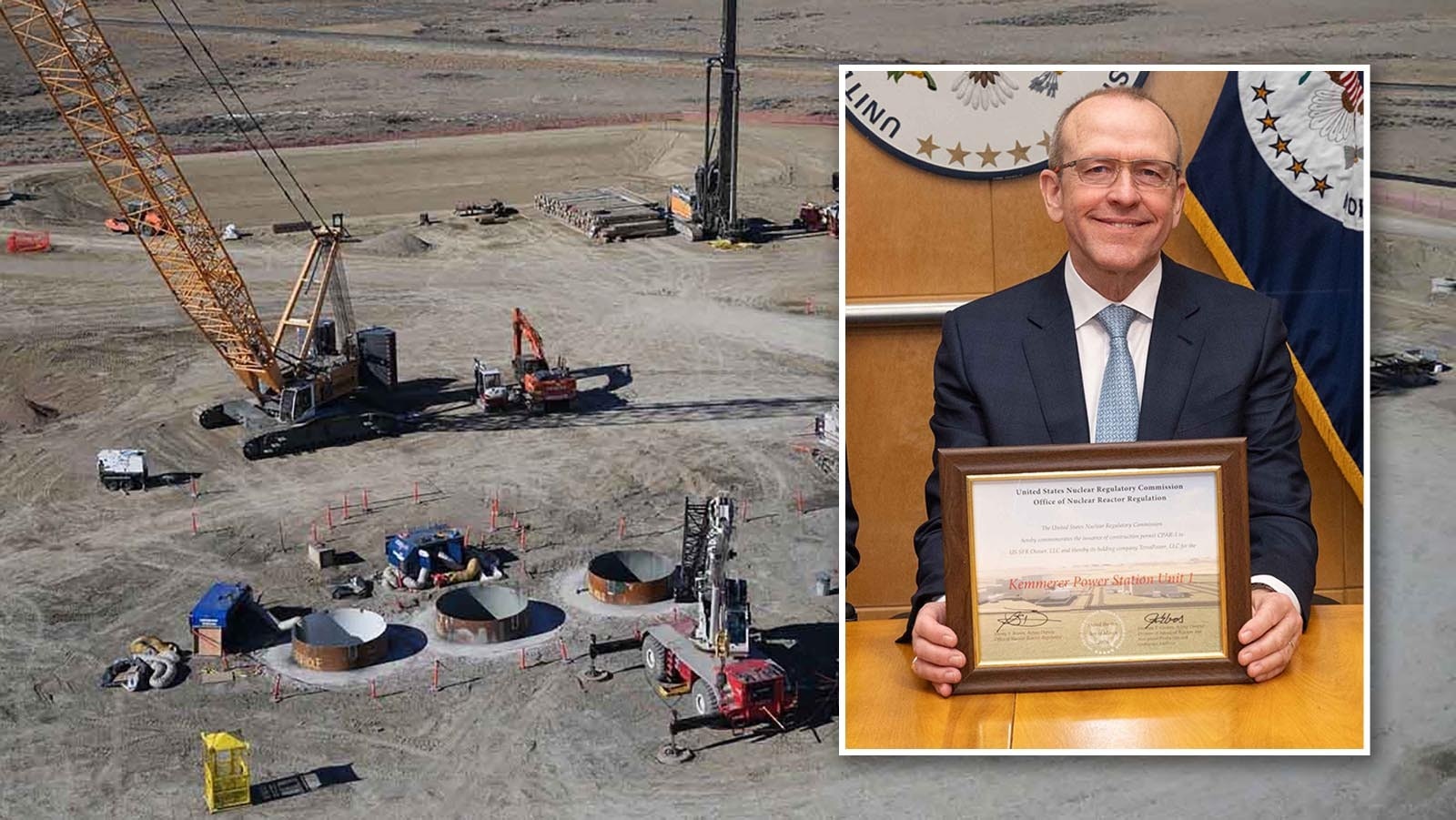
Five years of engineering, a million staff hours of preparation and 18 months of federal safety reviews culminated Monday in a formal ceremony at Nuclear Regulatory Commission headquarters, where officials signed and handed TerraPower its construction permit for the Kemmerer Unit 1 Natrium reactor.
The ceremony, held just outside Washington, D.C., in Rockville, Maryland, expanded on last week’s permit announcement with new details about what made the safety review historic, what TerraPower will need to do to obtain an operating license, and why the Kemmerer plant is being positioned as a showcase for American nuclear technology around the world.
“Today is not just a regulatory milestone, but a moment of genuine national significance,” said TerraPower CEO Chris Levesque. “It demonstrates that advanced nuclear technology is moving from concepts to commercialization.”
Jeremy Bowen, acting deputy director for New Reactors in the NRC’s Office of Nuclear Reactor Regulation, opened the ceremony by detailing just how unprecedented the review process was.
“Today’s ceremony represents a historic step forward for advancing nuclear energy in the United States,” he said. “And it reflects the NRC’s commitment to delivering timely, predictable decisions that are grounded in rigorous and independent safety reviews.”
The Natrium reactor is the seventh advanced reactor design review completed by the NRC in recent years, Bowen said, and everyone has come in on or ahead of schedule and on or under budget.
It is the first Generation 4 commercial power reactor approved for construction in the U.S., the first commercial non-light-water reactor in over 40 years, the first advanced sodium fast reactor, the first use of functional containment by a commercial power reactor, and the first use of a fully risk-informed, performance-based licensing approach for a commercial reactor.
The NRC’s environmental review — the fastest of its kind in the agency’s history — was completed in 16 months, eight months ahead of schedule and 25% under budget. The safety review was completed in 18 months, nine months ahead of schedule and 11% under budget, according to the NRC.
Bowen detailed the three core questions NRC staff focused on throughout the safety review. They tested for whether the reactor can be controlled whether heat can be removed, and whether radioactive material can be contained. The biggest challenge, he said, was simply that the technology was new to regulators.
“The staff at the NRC had to go through some training and understand that technology, learn about the details and understand what questions we needed to ask,” Bowen said.
He credited TerraPower’s cooperation as essential to working through the novel design, saying the NRC “could not have been successful without a similarly dedicated and cooperative applicant.”
Levesque said the preparation was extraordinary in scale. TerraPower submitted six white papers and completed 15 topical reports, which were eventually incorporated by reference into the construction permit application, in addition to spending more than one million staff hours preparing the application itself.
“Together, we’ve set a high bar for the applications that will come after us,” he said.
Global Showcase
Levesque made clear that the Kemmerer plant is designed to be more than a power source for Wyoming and Utah. Receiving approval from what he called “the gold standard regulator” is a prerequisite for offering the Natrium technology to other parts of the world.
“We’ve always said that we want to take TerraPower to nations that need nuclear energy to power their growing economies and to do it safely,” Levesque said. “Receiving the NRC’s approval is essential as we take Natrium to international markets.”
He added that the permit “sends a signal around the world that the United States remains committed to advancing safe, secure, and reliable nuclear power,” and that the independent, science-based nature of the American regulatory process is precisely why U.S. nuclear technology commands international respect.
“That independent science-based oversight is one of the reasons the American nuclear industry continues to be respected around the world,” Levesque said. “And that matters.”
Iran Impact
Asked whether the current U.S. conflict with Iran poses any risk to TerraPower’s supply chain, Levesque said the company sees no direct impact but is monitoring the situation.
“TerraPower has been around for 18 years,” he said. “We’ve been through multiple administrations, multiple geopolitical events, including the Russia-Ukraine war, which required us to adjust along the way.”
Levesque noted that rising global energy prices driven by the conflict underscore nuclear energy’s value.
“When you load nuclear energy into a reactor, you just provided two years of electricity to the community where you’re building it,” he said. “These geopolitical events remind us of the importance of nuclear energy.”
Ratepayer Pledge
Levesque offered a direct reassurance to Wyoming and Utah residents concerned about bearing the financial burden of a first-of-a-kind nuclear project.
“We’re keeping our pledge that ratepayers in Wyoming and Utah will see zero of that first-of-a-kind investment,” he said.
The billions in development costs are being shared by TerraPower’s investors and the U.S. Department of Energy through the Advanced Reactor Demonstration Program.
“The people of Wyoming, who are hosting this project, will pay the market price of electricity from the Natrium reactor. We will not be burdening ratepayers with the significant first-of-a-kind investment needed in a new nuclear project,” he said.
Next Steps
Bowen noted that Monday’s permit is not the finish line. Before the plant can operate, TerraPower must submit a separate operating license application that will trigger another full NRC review — this time with far more detail about how the reactor will actually function day to day.
“We’re asking for a lot more information about how those structures, systems, and components will actually be implemented, how they will interact with each other, and what actions operators will take if there is an abnormal condition,” Bowen said. Security and emergency planning will also be scrutinized at that stage.
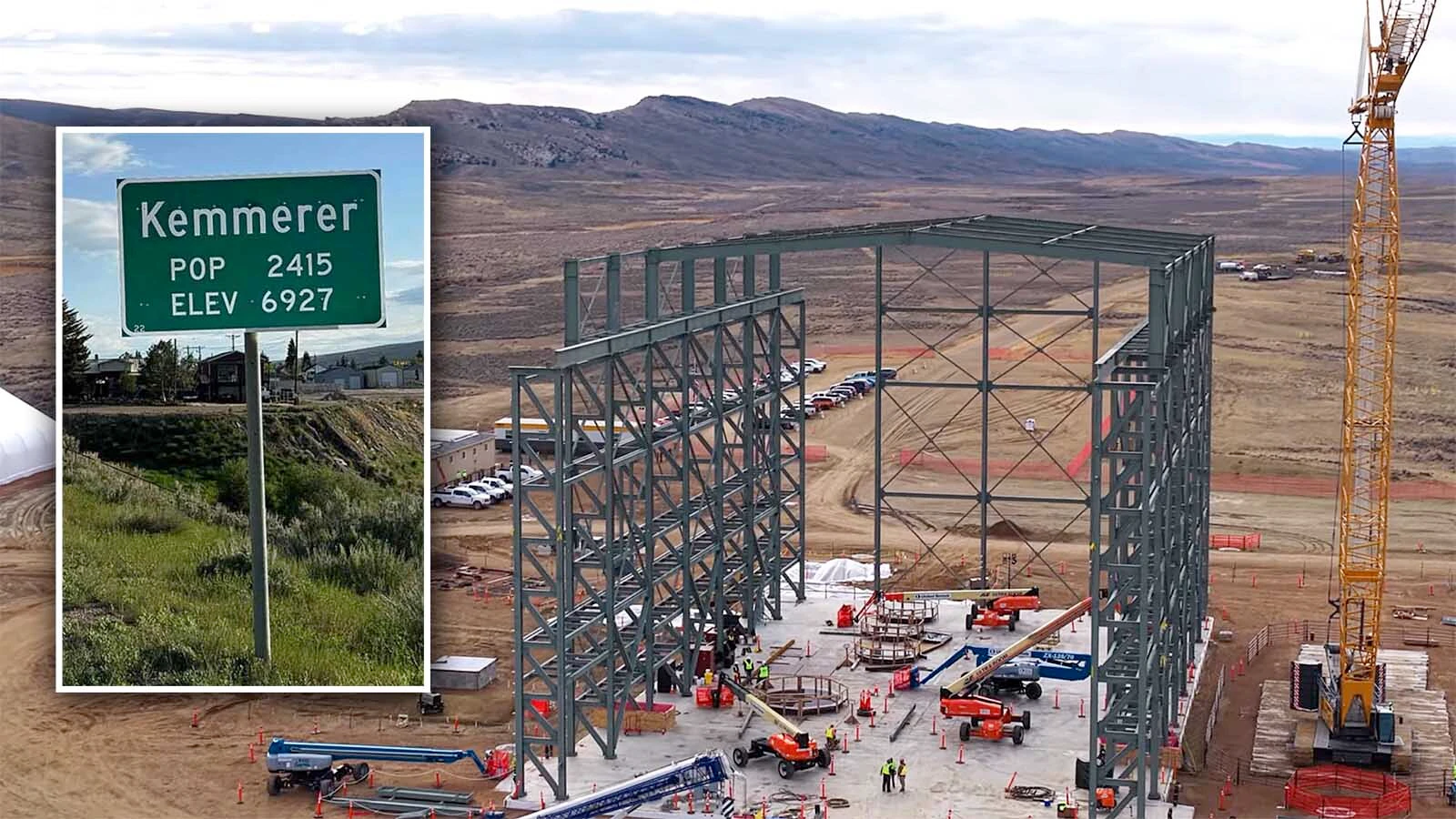
TerraPower’s Levesque said actual power plant construction — distinct from the already-rising 167-foot Test and Fill Facility — will begin in the coming weeks inside the power plant perimeter, covering both the nuclear island and the energy island.
The Test and Fill Facility, Levesque explained to Wyoming media attending remotely, is not a nuclear reactor. It will be used to fill the reactor with sodium and test new components when they arrive. With that structure nearing enclosure, earthworks will soon begin visibly inside the power plant footprint. “The next time you drive by, you’ll see significant earthworks starting inside the power plant footprint,” Levesque said.
“Points On Board”
Dr. Rian Bahran, deputy assistant secretary for nuclear reactors in the Department of Energy’s Office of Nuclear Energy, said the ceremony marked a turning point for a nuclear industry that has long talked about a renaissance without delivering one.
“For years I’ve been saying we’re at a tipping point, and it feels like we’re finally tipping,” Bahran said. With executive orders last May setting a target of 400 gigawatts of nuclear power by 2050 — quadrupling current capacity — he said milestones like Monday’s permit are essential to unlocking capital and public confidence.
Bahran said the goal of reaching even 50 gigawatts by 2035 requires gigawatt-scale reactors, uprates, restarts, and both Generation 3+ and Generation 4 designs. For that to happen, companies need to clear technical and regulatory milestones at a pace that keeps investors and utilities engaged.
“Congratulations to the NRC for being able to help unlock this potential by allowing innovation to not be strangled by government bureaucracy,” Bahran said, adding that DOE was equally committed to not being a bureaucratic bottleneck. “Still, with the high standards of safety and security, being able to go through technical and regulatory milestones — that is what is needed.”
“I like to tell my team, we have to get points on the board,” Bahran said. “This is points on the board.”
NRC Chairman Ho Nieh, who visited the Kemmerer construction site, said the ceremony signals a new direction for the agency.
“The NRC will not be an impediment to nuclear innovation in America,” Nieh said. “A new NRC has emerged, one that enables and accelerates the safe and secure use of nuclear technologies.”
UW Connection
The Rockville ceremony came just five days after the University of Wyoming offered its own window into the science underpinning the nuclear development now unfolding in the state. On March 4 — the same day the NRC announced its construction permit vote — the UW School of Energy Resources hosted Dr. David Andersson of Los Alamos National Laboratory as part of its Distinguished Speaker Series.
Andersson is the national technical director of the Nuclear Energy Advanced Modeling and Simulation program, known as NEAMS, a Department of Energy Office of Nuclear Energy initiative developing the computational tools needed to design, license, and operate the next generation of reactors.
Andersson, who received his doctorate in materials science and engineering from the Royal Institute of Technology in Stockholm and joined Los Alamos in 2007, was awarded the American Nuclear Society Mishima Award in 2023 for advancing understanding of nuclear fuel performance.
In his UW presentation, he described how predictive modeling and simulation tools enable innovation across the full lifecycle of a reactor — development, licensing, deployment and operation.
Andersson made a point of noting that the liquid metal-cooled fast reactor TerraPower is building near Kemmerer represents one of the reactor types his program actively studies.
Fast reactors, he explained, have a safety characteristic built into their physics: When temperatures rise, the mechanical deformation of reactor materials naturally decreases neutron reactivity, effectively causing the reactor to throttle itself down.
“If you have more accurate tools, you can understand it better, define the safety requirements better, and design a better system,” Andersson said of fast reactor modeling.
He also spoke to the challenge that will confront TerraPower and the NRC as they work toward an operating license: fuel qualification. Testing nuclear fuel is expensive and slow — irradiation campaigns can take years, and the resulting material may be too radioactive to handle for years more. Advanced modeling tools, Andersson said, can help compress that timeline without compromising safety.
“With modern tools and simulation, how can we get from the starting point to the finish point in terms of regulation quicker — while maintaining the same safety as we expect today?” Andersson said. “The answer is using the best tools you have available, putting them together, and analyzing your information in an efficient way.”
David Madison can be reached at david@cowboystatedaily.com.